
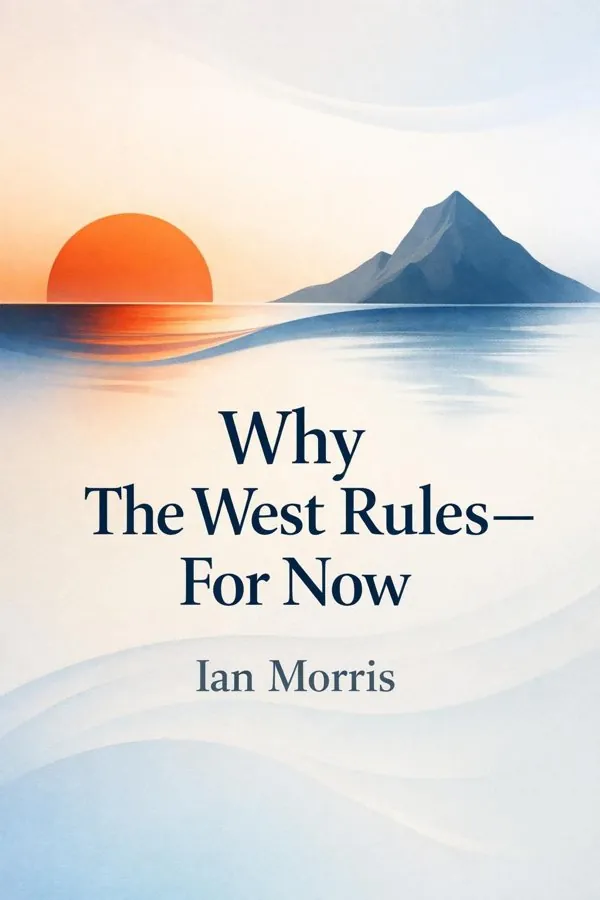
Why The West Rules—For Now: The Patterns of History, and What They Reveal About the Future: Summary & Key Insights
by Ian Morris
 10 min10 chaptersAudio available
What Is Why The West Rules—For Now: The Patterns of History, and What They Reveal About the Future About?
Why The West Rules—For Now: The Patterns of History, and What They Reveal About the Future by Ian Morris is a world_history book spanning 10 pages. This book explores 50,000 years of human history to explain why Western civilization has dominated the modern world. Ian Morris argues that geography and human responses to environmental challenges, rather than race or culture, have shaped global power dynamics. Drawing on archaeology, history, and social science, Morris identifies recurring patterns that reveal how societies rise and fall—and what these patterns suggest about the future balance of power between East and West.
This FizzRead summary covers all 10 key chapters of Why The West Rules—For Now: The Patterns of History, and What They Reveal About the Future in approximately 10 minutes, distilling the most important ideas, arguments, and takeaways from Ian Morris's work. Also available as an audio summary and Key Quotes Podcast.
Why The West Rules—For Now: The Patterns of History, and What They Reveal About the Future
This book explores 50,000 years of human history to explain why Western civilization has dominated the modern world. Ian Morris argues that geography and human responses to environmental challenges, rather than race or culture, have shaped global power dynamics. Drawing on archaeology, history, and social science, Morris identifies recurring patterns that reveal how societies rise and fall—and what these patterns suggest about the future balance of power between East and West.
Who Should Read Why The West Rules—For Now: The Patterns of History, and What They Reveal About the Future?
This book is perfect for anyone interested in world_history and looking to gain actionable insights in a short read. Whether you're a student, professional, or lifelong learner, the key ideas from Why The West Rules—For Now: The Patterns of History, and What They Reveal About the Future by Ian Morris will help you think differently.
- ✓Readers who enjoy world_history and want practical takeaways
- ✓Professionals looking to apply new ideas to their work and life
- ✓Anyone who wants the core insights of Why The West Rules—For Now: The Patterns of History, and What They Reveal About the Future in just 10 minutes
Want the full summary?
Get instant access to this book summary and 100K+ more with Fizz Moment.
Get Free SummaryAvailable on App Store • Free to download
Key Chapters
To understand why the West rules—at least for now—we must begin in the deep past, when no West or East existed in any recognizable form. Around 50,000 BCE, humans everywhere lived in what I call the Biological Old Regime: an era defined by the limitations of environment and biology. People depended entirely on the energy nature provided in real time—the sunlight captured by plants, the animals they hunted, the water they drank. Geography, climate, and ecology dictated everything.
Our ancestors survived not by conquering their surroundings but by adapting to them. Different environments produced different kinds of societies: small, mobile bands in arid regions, more sedentary groups in fertile areas where wild grains or game were abundant. These societies were socially simple because they were constrained by the amount of energy they could extract from nature’s bounty. There was little room for hierarchy or complex institutions when everyone’s daily task was survival.
This chapter examines how ingenuity nonetheless began to erode those limits. Ice ages and climatic fluctuations forced migrations; human communities innovated tools, language, symbolic systems. Yet these changes were local and incremental. In biological terms, humans everywhere faced the same predicament: nature imposed a ceiling on social development. Only when people discovered ways to control energy sources beyond immediate ecosystems could this ceiling lift. Thus, we prepare for the first major turning point in world history—the agricultural revolution—that would crack open entirely new pathways of development.
About 14,000 years ago, the global climate stabilized after the end of the last Ice Age. This stability presented opportunities: certain regions, notably the Near East and East Asia, offered rich environments where people could experiment with agriculture. Geography again played the starring role. In the Fertile Crescent, wildly growing cereals were easily domesticated, while in the valleys of the Yellow and Yangtze Rivers, rice cultivation began to redefine human relations with nature.
As humans learned to store energy in grain and wield it at will, societies transformed. Populations exploded, towns formed, and new hierarchies crystallized. But even this revolution was uneven. Farming spread only where geography allowed; thus, centers of innovation emerged independently in both East and West. I call this the first great divergence. It produced multiple world regions whose developmental trajectories began to separate, shaped by different landscapes, resource distributions, and climatic pressures.
Yet the underlying principle remained the same: geography set the stage, while humans’ adaptive ingenuity dictated the play. Agricultural success led to surplus wealth but also new vulnerabilities, from disease to political tyranny. Still, agriculture represented humankind’s first victory over the constraints of the Biological Old Regime. It established the basic equation that would govern all future civilizations: power grows where societies can harness more energy than their competitors, and where organizational complexity allows that energy to be sustained and directed.
+ 8 more chapters — available in the FizzRead app
All Chapters in Why The West Rules—For Now: The Patterns of History, and What They Reveal About the Future
About the Author
Ian Morris is a British historian, archaeologist, and professor at Stanford University. His research focuses on long-term social development and the interplay between geography and human behavior. He is known for synthesizing insights from multiple disciplines to understand historical patterns and global change.
Get This Summary in Your Preferred Format
Read or listen to the Why The West Rules—For Now: The Patterns of History, and What They Reveal About the Future summary by Ian Morris anytime, anywhere. FizzRead offers multiple formats so you can learn on your terms — all free.
Available formats: App · Audio · PDF · EPUB — All included free with FizzRead
Download Why The West Rules—For Now: The Patterns of History, and What They Reveal About the Future PDF and EPUB Summary
Key Quotes from Why The West Rules—For Now: The Patterns of History, and What They Reveal About the Future
“To understand why the West rules—at least for now—we must begin in the deep past, when no West or East existed in any recognizable form.”
“About 14,000 years ago, the global climate stabilized after the end of the last Ice Age.”
Frequently Asked Questions about Why The West Rules—For Now: The Patterns of History, and What They Reveal About the Future
Why The West Rules—For Now: The Patterns of History, and What They Reveal About the Future by Ian Morris is a world_history book that explores key ideas across 10 chapters. This book explores 50,000 years of human history to explain why Western civilization has dominated the modern world. Ian Morris argues that geography and human responses to environmental challenges, rather than race or culture, have shaped global power dynamics. Drawing on archaeology, history, and social science, Morris identifies recurring patterns that reveal how societies rise and fall—and what these patterns suggest about the future balance of power between East and West.
More by Ian Morris
You Might Also Like
The Age of Capital
Eric Hobsbawm
10 min
The Gulag Archipelago
Aleksandr Solzhenitsyn
10 min
Jerusalem: The Biography
Simon Sebag Montefiore
10 min
The Anglo-Saxons
James Campbell
10 min
The Boer War
Thomas Pakenham
10 min
The Industrial Revolutionaries: The Making of the Modern World 1776–1914
Gavin Weightman
10 minBrowse by Category
Ready to read Why The West Rules—For Now: The Patterns of History, and What They Reveal About the Future?
Get the full summary and 100K+ more books with Fizz Moment.