
Ian Morris Books
Ian Morris is a British historian, archaeologist, and professor at Stanford University. His research focuses on long-term social development, the evolution of human societies, and the comparative history of East and West.
Known for: Foragers, Farmers, and Fossil Fuels: How Human Values Evolve, The Measure of Civilization: How Social Development Decides the Fate of Nations, Why The West Rules—For Now: The Patterns of History, and What They Reveal About the Future
Books by Ian Morris
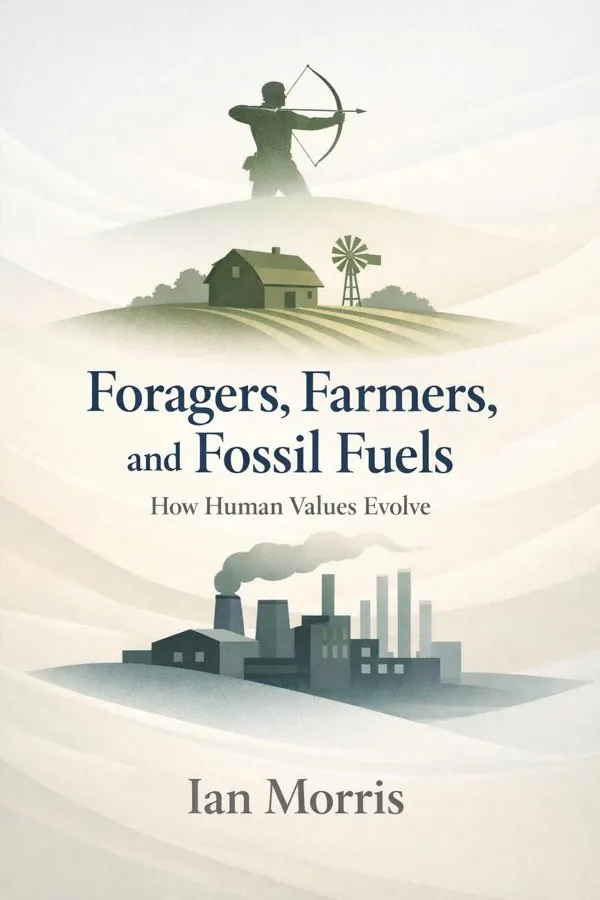
Foragers, Farmers, and Fossil Fuels: How Human Values Evolve
In this book, historian and archaeologist Ian Morris explores how different modes of subsistence—hunting and gathering, farming, and fossil fuel–based industrial economies—shape human values and socia...
The Measure of Civilization: How Social Development Decides the Fate of Nations
In this groundbreaking work, historian and archaeologist Ian Morris quantifies the social development of civilizations across East and West over the past 15,000 years. Using data-driven analysis, he m...
Why The West Rules—For Now: The Patterns of History, and What They Reveal About the Future
This book explores 50,000 years of human history to explain why Western civilization has dominated the modern world. Ian Morris argues that geography and human responses to environmental challenges, r...
Key Insights from Ian Morris
Theoretical Foundation: Energy, Complexity, and Morality
The backbone of this book is a simple, empirical insight: the amount of energy a society captures per person shapes everything about how that society works. When I speak of 'energy capture,' I’m referring to the total amount of energy used to sustain each individual—whether from food, animals, plant...
From Foragers, Farmers, and Fossil Fuels: How Human Values Evolve
Forager Societies: Equality in Motion
Let me take you back into the world of foragers—the beginning of our moral story. Imagine living in a band of twenty to fifty people, sustained by hunting, gathering, and fishing. Every meal depends on shared labor and shared risk. In such a setting, nothing destroys harmony faster than inequality. ...
From Foragers, Farmers, and Fossil Fuels: How Human Values Evolve
Defining Social Development
Social development, as I use the term, is not simply economic growth or cultural sophistication. It is a measure of how well societies accomplish collective objectives—how they extract energy, organize communities, defend themselves, and transmit ideas. Economic growth captures wealth, but it doesn’...
From The Measure of Civilization: How Social Development Decides the Fate of Nations
Energy Capture
Energy is the foundation of every social achievement. The measure of how much energy a society can harness—from the calories in food to the power of coal and oil—indicates how far it can sustain growth and specialization. In the earliest foraging communities, human beings depended entirely on the na...
From The Measure of Civilization: How Social Development Decides the Fate of Nations
The Biological Old Regime
To understand why the West rules—at least for now—we must begin in the deep past, when no West or East existed in any recognizable form. Around 50,000 BCE, humans everywhere lived in what I call the Biological Old Regime: an era defined by the limitations of environment and biology. People depended ...
From Why The West Rules—For Now: The Patterns of History, and What They Reveal About the Future
The First Great Divergence
About 14,000 years ago, the global climate stabilized after the end of the last Ice Age. This stability presented opportunities: certain regions, notably the Near East and East Asia, offered rich environments where people could experiment with agriculture. Geography again played the starring role. I...
From Why The West Rules—For Now: The Patterns of History, and What They Reveal About the Future
About Ian Morris
Ian Morris is a British historian, archaeologist, and professor at Stanford University. His research focuses on long-term social development, the evolution of human societies, and the comparative history of East and West. He is the author of several influential books, including 'Why the West Rules—F...
Read more
Ian Morris is a British historian, archaeologist, and professor at Stanford University. His research focuses on long-term social development, the evolution of human societies, and the comparative history of East and West. He is the author of several influential books, including 'Why the West Rules—F...
Ian Morris is a British historian, archaeologist, and professor at Stanford University. His research focuses on long-term social development, the evolution of human societies, and the comparative history of East and West. He is the author of several influential books, including 'Why the West Rules—For Now' and 'War! What Is It Good For?'.


Frequently Asked Questions
Ian Morris is a British historian, archaeologist, and professor at Stanford University. His research focuses on long-term social development, the evolution of human societies, and the comparative history of East and West.
Read Ian Morris's books in 15 minutes
Get AI-powered summaries with key insights from 3 books by Ian Morris.