
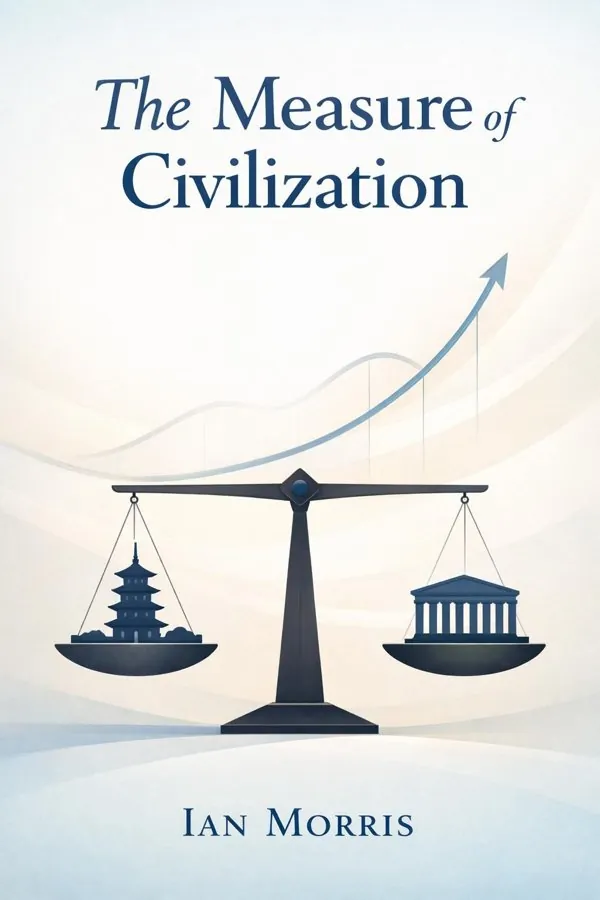
The Measure of Civilization: How Social Development Decides the Fate of Nations: Summary & Key Insights
by Ian Morris
 10 min7 chaptersAudio available
What Is The Measure of Civilization: How Social Development Decides the Fate of Nations About?
The Measure of Civilization: How Social Development Decides the Fate of Nations by Ian Morris is a civilization book spanning 7 pages. In this groundbreaking work, historian and archaeologist Ian Morris quantifies the social development of civilizations across East and West over the past 15,000 years. Using data-driven analysis, he measures energy capture, organization, war-making capacity, and information technology to explain why the West dominated global power for centuries—and why that dominance may be shifting. The book serves as a companion to his earlier work, 'Why the West Rules—For Now,' offering a detailed empirical foundation for understanding the rise and fall of great powers throughout history.
This FizzRead summary covers all 7 key chapters of The Measure of Civilization: How Social Development Decides the Fate of Nations in approximately 10 minutes, distilling the most important ideas, arguments, and takeaways from Ian Morris's work. Also available as an audio summary and Key Quotes Podcast.
The Measure of Civilization: How Social Development Decides the Fate of Nations
In this groundbreaking work, historian and archaeologist Ian Morris quantifies the social development of civilizations across East and West over the past 15,000 years. Using data-driven analysis, he measures energy capture, organization, war-making capacity, and information technology to explain why the West dominated global power for centuries—and why that dominance may be shifting. The book serves as a companion to his earlier work, 'Why the West Rules—For Now,' offering a detailed empirical foundation for understanding the rise and fall of great powers throughout history.
Who Should Read The Measure of Civilization: How Social Development Decides the Fate of Nations?
This book is perfect for anyone interested in civilization and looking to gain actionable insights in a short read. Whether you're a student, professional, or lifelong learner, the key ideas from The Measure of Civilization: How Social Development Decides the Fate of Nations by Ian Morris will help you think differently.
- ✓Readers who enjoy civilization and want practical takeaways
- ✓Professionals looking to apply new ideas to their work and life
- ✓Anyone who wants the core insights of The Measure of Civilization: How Social Development Decides the Fate of Nations in just 10 minutes
Want the full summary?
Get instant access to this book summary and 100K+ more with Fizz Moment.
Get Free SummaryAvailable on App Store • Free to download
Key Chapters
Energy is the foundation of every social achievement. The measure of how much energy a society can harness—from the calories in food to the power of coal and oil—indicates how far it can sustain growth and specialization. In the earliest foraging communities, human beings depended entirely on the natural bounty around them; energy capture was limited by what people could gather or hunt. The shift to agriculture multiplied energy use, as plants and domesticated animals turned sunlight into food more efficiently under human control.
As societies moved from farming to industrialization, energy capture surged. The Industrial Revolution marked an extraordinary leap, allowing humans to command non-biological sources of power. When coal, and later electricity and oil, entered the picture, a society’s productive capacity—and therefore its developmental potential—expanded exponentially.
Throughout this book, I quantify energy capture by calculating calories per person per day. This simple figure becomes a powerful yardstick of how well societies produce and distribute sustenance and power. It reflects not just economic productivity but the deep relationship between people, technology, and their environment. Tracking this through history reveals where and when major transitions occurred, and how they changed the balance between East and West. For centuries, the gap widened as Western societies industrialized first. But the recent surge of energy use in the East signals a new chapter of convergence.
+ 5 more chapters — available in the FizzRead app
All Chapters in The Measure of Civilization: How Social Development Decides the Fate of Nations
About the Author
Ian Morris is a British historian, archaeologist, and professor at Stanford University. His research focuses on long-term social development, the evolution of human societies, and the comparative history of East and West. He is the author of several influential books, including 'Why the West Rules—For Now' and 'War! What Is It Good For?'.
Get This Summary in Your Preferred Format
Read or listen to the The Measure of Civilization: How Social Development Decides the Fate of Nations summary by Ian Morris anytime, anywhere. FizzRead offers multiple formats so you can learn on your terms — all free.
Available formats: App · Audio · PDF · EPUB — All included free with FizzRead
Download The Measure of Civilization: How Social Development Decides the Fate of Nations PDF and EPUB Summary
Key Quotes from The Measure of Civilization: How Social Development Decides the Fate of Nations
“Social development, as I use the term, is not simply economic growth or cultural sophistication.”
“Energy is the foundation of every social achievement.”
Frequently Asked Questions about The Measure of Civilization: How Social Development Decides the Fate of Nations
The Measure of Civilization: How Social Development Decides the Fate of Nations by Ian Morris is a civilization book that explores key ideas across 7 chapters. In this groundbreaking work, historian and archaeologist Ian Morris quantifies the social development of civilizations across East and West over the past 15,000 years. Using data-driven analysis, he measures energy capture, organization, war-making capacity, and information technology to explain why the West dominated global power for centuries—and why that dominance may be shifting. The book serves as a companion to his earlier work, 'Why the West Rules—For Now,' offering a detailed empirical foundation for understanding the rise and fall of great powers throughout history.
More by Ian Morris
You Might Also Like
The Structure of Scientific Revolutions
Thomas S. Kuhn
10 min
Genius
Harold Bloom
10 min
A Cultural History of the Medieval Age
Various Editors
10 min
A History of God: The 4,000-Year Quest of Judaism, Christianity and Islam
Karen Armstrong
10 min
A History of the World in 10½ Chapters
Julian Barnes
10 min
A Short History of Progress
Ronald Wright
10 minBrowse by Category
Ready to read The Measure of Civilization: How Social Development Decides the Fate of Nations?
Get the full summary and 100K+ more books with Fizz Moment.