
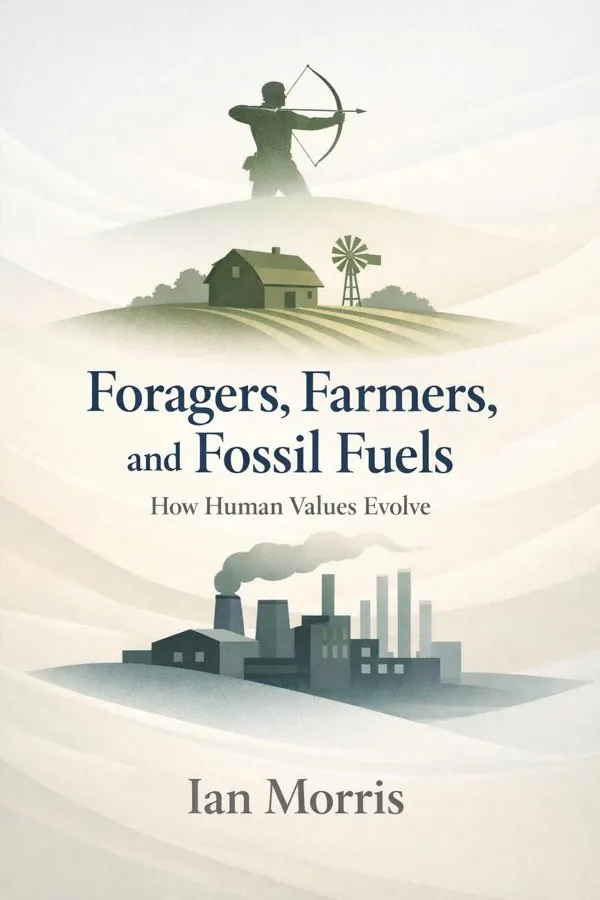
Foragers, Farmers, and Fossil Fuels: How Human Values Evolve: Summary & Key Insights
by Ian Morris
 10 min9 chaptersAudio available
What Is Foragers, Farmers, and Fossil Fuels: How Human Values Evolve About?
Foragers, Farmers, and Fossil Fuels: How Human Values Evolve by Ian Morris is a civilization book spanning 9 pages. In this book, historian and archaeologist Ian Morris explores how different modes of subsistence—hunting and gathering, farming, and fossil fuel–based industrial economies—shape human values and social structures. Drawing on data from anthropology, history, and economics, Morris argues that moral systems evolve in response to energy capture and social organization, offering a unified theory of cultural development and ethical change.
This FizzRead summary covers all 9 key chapters of Foragers, Farmers, and Fossil Fuels: How Human Values Evolve in approximately 10 minutes, distilling the most important ideas, arguments, and takeaways from Ian Morris's work. Also available as an audio summary and Key Quotes Podcast.
Foragers, Farmers, and Fossil Fuels: How Human Values Evolve
In this book, historian and archaeologist Ian Morris explores how different modes of subsistence—hunting and gathering, farming, and fossil fuel–based industrial economies—shape human values and social structures. Drawing on data from anthropology, history, and economics, Morris argues that moral systems evolve in response to energy capture and social organization, offering a unified theory of cultural development and ethical change.
Who Should Read Foragers, Farmers, and Fossil Fuels: How Human Values Evolve?
This book is perfect for anyone interested in civilization and looking to gain actionable insights in a short read. Whether you're a student, professional, or lifelong learner, the key ideas from Foragers, Farmers, and Fossil Fuels: How Human Values Evolve by Ian Morris will help you think differently.
- ✓Readers who enjoy civilization and want practical takeaways
- ✓Professionals looking to apply new ideas to their work and life
- ✓Anyone who wants the core insights of Foragers, Farmers, and Fossil Fuels: How Human Values Evolve in just 10 minutes
Want the full summary?
Get instant access to this book summary and 100K+ more with Fizz Moment.
Get Free SummaryAvailable on App Store • Free to download
Key Chapters
The backbone of this book is a simple, empirical insight: the amount of energy a society captures per person shapes everything about how that society works. When I speak of 'energy capture,' I’m referring to the total amount of energy used to sustain each individual—whether from food, animals, plants, or fuel. This isn’t an abstract number; it’s the physical measure of a society’s capacity to sustain complexity.
As energy capture rises, populations grow, economies diversify, and new forms of hierarchy emerge. With these transformations come new moral expectations: the norms that allow these more complex systems to function. The small-scale world of foragers required values that promoted fairness, reciprocity, and flexible leadership. The vast empires of farmers required obedience, hierarchy, and structured social order. The fossil-fuel revolution, with its mechanical abundance and rapid communication, generated a world where equality and rights became functional necessities.
At first glance, it might seem strange to suggest that ethics can be explained through energy. But the evidence across history and anthropology repeatedly reveals this connection. Societies do not invent moral codes in a vacuum; they craft them to manage the social stresses inherent in their modes of survival. Foragers, with little surplus and constant mobility, could not afford formal hierarchies—their moral systems discouraged dominance. Farmers, tied to land and harvest cycles, found stability in authority and religion. Modern industrial societies, working through machines rather than muscles, demand flexible labor and intellectual freedom, hence their moral emphasis on equality and rights.
I draw upon data from sources like the Human Relations Area Files and historical surveys of social energy use to demonstrate how these transitions occurred. The figures are striking: the typical forager captures about 5,000 kilocalories per day per person, the typical farmer around 30,000, and the modern industrial citizen exceeds 200,000. These leaps are not merely technological—they map directly onto changes in ideology and social organization.
Understanding this framework lets us compare the moral systems of ancient and modern peoples without falling into ethnocentrism or moral relativism. We can see each code as a rational adaptation to material conditions. And while moral reasoning always matters, its practical success depends on how well it aligns with the energy regime of its time. That is the foundation upon which the rest of the book builds.
Let me take you back into the world of foragers—the beginning of our moral story. Imagine living in a band of twenty to fifty people, sustained by hunting, gathering, and fishing. Every meal depends on shared labor and shared risk. In such a setting, nothing destroys harmony faster than inequality. Foragers learned through experience that survival depended on maintaining balance among all.
Their moral world was organized not around laws or rulers, but around norms of reciprocity and fairness. Leaders were temporary and modest, chosen for skill rather than recognized authority. If a hunter grew too boastful, others mocked him into humility. Resources were distributed through direct sharing; hoarding or greed was condemned not just as morally wrong, but as socially dangerous.
The values that defined forager life—equality, personal autonomy, and communal responsibility—reflected the logic of their ecological conditions. Energy capture was low, mobility was high, and labor was collective. The cost of maintaining hierarchy was too great to be sustained. Thus, moral systems emerged that affirmed the dignity and independence of each person while keeping social cohesion.
Anthropological evidence from societies like the !Kung of the Kalahari or the Hadza of Tanzania reveals how these values manifest. Anthropologists describe practices like 'insulting the meat,' where a successful hunter’s kill is deliberately downplayed to prevent arrogance. These customs encode a deep commitment to leveling power, reinforcing that cooperation, not domination, ensures survival.
For all its simplicity, this morality has profound lessons. It reminds us that liberty and equality were not inventions of modern democracies—they are ancient human instincts that once kept us alive. But those instincts existed under energy conditions that could only support small groups and simple technologies. As human populations grew and the quest for surplus began, these egalitarian foundations would prove too fragile. The next stage of our journey ushers in farming, hierarchy, and the birth of inequality.
+ 7 more chapters — available in the FizzRead app
All Chapters in Foragers, Farmers, and Fossil Fuels: How Human Values Evolve
About the Author
Ian Morris is a British historian, archaeologist, and professor at Stanford University. His research focuses on long-term social development, ancient history, and the evolution of human societies. He is known for his interdisciplinary approach combining archaeology, history, and social science.
Get This Summary in Your Preferred Format
Read or listen to the Foragers, Farmers, and Fossil Fuels: How Human Values Evolve summary by Ian Morris anytime, anywhere. FizzRead offers multiple formats so you can learn on your terms — all free.
Available formats: App · Audio · PDF · EPUB — All included free with FizzRead
Download Foragers, Farmers, and Fossil Fuels: How Human Values Evolve PDF and EPUB Summary
Key Quotes from Foragers, Farmers, and Fossil Fuels: How Human Values Evolve
“The backbone of this book is a simple, empirical insight: the amount of energy a society captures per person shapes everything about how that society works.”
“Let me take you back into the world of foragers—the beginning of our moral story.”
Frequently Asked Questions about Foragers, Farmers, and Fossil Fuels: How Human Values Evolve
Foragers, Farmers, and Fossil Fuels: How Human Values Evolve by Ian Morris is a civilization book that explores key ideas across 9 chapters. In this book, historian and archaeologist Ian Morris explores how different modes of subsistence—hunting and gathering, farming, and fossil fuel–based industrial economies—shape human values and social structures. Drawing on data from anthropology, history, and economics, Morris argues that moral systems evolve in response to energy capture and social organization, offering a unified theory of cultural development and ethical change.
More by Ian Morris
You Might Also Like

The Structure of Scientific Revolutions
Thomas S. Kuhn
10 min
Genius
Harold Bloom
10 min
A Cultural History of the Medieval Age
Various Editors
10 min
A History of God: The 4,000-Year Quest of Judaism, Christianity and Islam
Karen Armstrong
10 min
A History of the World in 10½ Chapters
Julian Barnes
10 min
A Short History of Progress
Ronald Wright
10 minBrowse by Category
Ready to read Foragers, Farmers, and Fossil Fuels: How Human Values Evolve?
Get the full summary and 100K+ more books with Fizz Moment.