
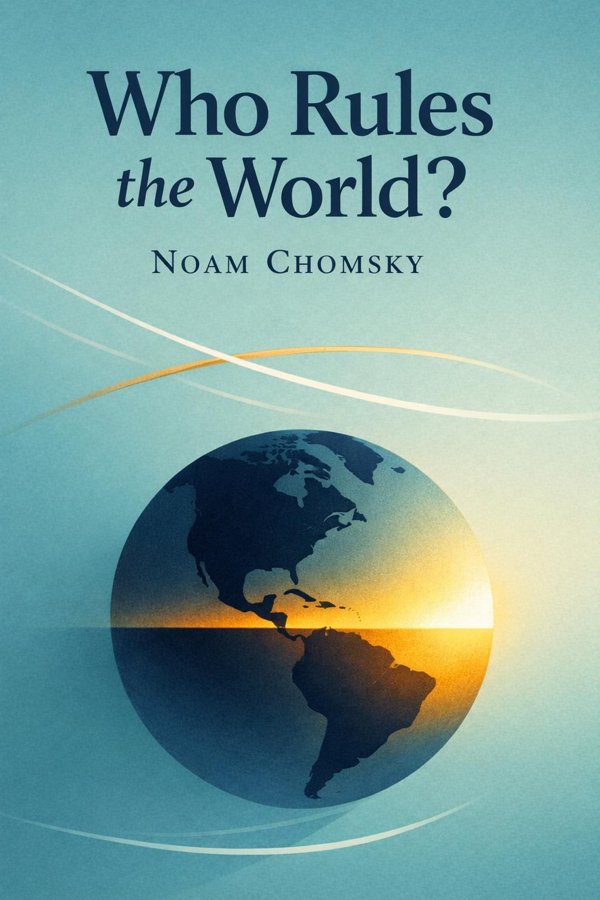
Who Rules the World?: Summary & Key Insights
by Noam Chomsky
 10 min11 chaptersAudio available
What Is Who Rules the World? About?
Who Rules the World? by Noam Chomsky is a politics book spanning 11 pages. In this work, Noam Chomsky examines the shifting balance of global power and the enduring influence of the United States in world affairs. He explores how U.S. foreign policy, military interventions, and economic dominance shape international relations, often at odds with democratic ideals and human rights. The book offers a critical analysis of global governance, inequality, and the moral responsibilities of powerful nations.
This FizzRead summary covers all 11 key chapters of Who Rules the World? in approximately 10 minutes, distilling the most important ideas, arguments, and takeaways from Noam Chomsky's work. Also available as an audio summary and Key Quotes Podcast.
Who Rules the World?
In this work, Noam Chomsky examines the shifting balance of global power and the enduring influence of the United States in world affairs. He explores how U.S. foreign policy, military interventions, and economic dominance shape international relations, often at odds with democratic ideals and human rights. The book offers a critical analysis of global governance, inequality, and the moral responsibilities of powerful nations.
Who Should Read Who Rules the World??
This book is perfect for anyone interested in politics and looking to gain actionable insights in a short read. Whether you're a student, professional, or lifelong learner, the key ideas from Who Rules the World? by Noam Chomsky will help you think differently.
- ✓Readers who enjoy politics and want practical takeaways
- ✓Professionals looking to apply new ideas to their work and life
- ✓Anyone who wants the core insights of Who Rules the World? in just 10 minutes
Want the full summary?
Get instant access to this book summary and 100K+ more with Fizz Moment.
Get Free SummaryAvailable on App Store • Free to download
Key Chapters
In the immediate aftermath of World War II, the United States stood as the unchallenged global power. Europe and Japan lay in ruins, and much of the Global South was still under colonial domination. From this landscape of destruction, American policymakers saw both an opportunity and an obligation: the opportunity to shape a new world order that would secure their economic and strategic dominance, and the obligation to present this domination as the advancement of freedom and prosperity.
Documents from the era, particularly those of the National Security Council, reveal a candid understanding of what was at stake. The United States sought to maintain control over what officials called the ‘Grand Area’, encompassing as much of the globe as necessary to ensure access to markets, resources, and investment opportunities. Behind the language of leadership and reconstruction, the guiding principle was clear—global economic integration under American terms. Institutions such as the International Monetary Fund and the World Bank were established not merely as instruments of global development but as mechanisms to discipline global finance within a framework conducive to American capital.
This period also saw the creation of the North Atlantic Treaty Organization and the global expansion of U.S. military bases. The purpose was not only defense against a potential adversary, but also the projection of American influence across continents. Chomsky draws attention to how early Cold War doctrines, including the Truman Doctrine and the Marshall Plan, were driven by strategic calculations that extended far beyond humanitarian rhetoric. In essence, the United States institutionalized its wartime dominance into an enduring architecture of empire.
Throughout the Cold War, the United States framed its interventions as a defense of freedom against totalitarianism. But a sober review of history reveals a more complex and often disturbing picture. The record of U.S. foreign policy during these decades is one of consistent support for authoritarian regimes, so long as they aligned with Washington’s perceived interests.
From the overthrow of Iran’s democratically elected leader Mohammad Mossadegh in 1953 to the long alliance with Suharto’s Indonesia, and from the coup in Guatemala to direct military involvement in Vietnam, the pattern was unmistakable. Liberation movements that challenged Western control of resources were labeled ‘communist threats’, regardless of their actual character. The Cold War, for Chomsky, was not so much a clash of ideologies as it was a struggle over the limits of independence in a world dominated by the hegemonic power of the United States.
The rhetoric of freedom functioned as ideological cover. Within the United States, media and education systems nurtured the perception that American actions were guided by benevolence. Abroad, populations that resisted U.S.-backed dictators paid a staggering price. Chomsky interprets these events not as anomalies but as logical outcomes of imperial reasoning: maintaining control in the name of security, undermining dissent in the name of stability, and shaping world opinion through a masterfully crafted moral narrative.
+ 9 more chapters — available in the FizzRead app
All Chapters in Who Rules the World?
About the Author
Noam Chomsky is an American linguist, philosopher, cognitive scientist, historian, and social critic. He is Institute Professor Emeritus at the Massachusetts Institute of Technology (MIT) and one of the most influential intellectuals of the 20th and 21st centuries, known for his groundbreaking work in linguistics and his critiques of political power and media.
Get This Summary in Your Preferred Format
Read or listen to the Who Rules the World? summary by Noam Chomsky anytime, anywhere. FizzRead offers multiple formats so you can learn on your terms — all free.
Available formats: App · Audio · PDF · EPUB — All included free with FizzRead
Download Who Rules the World? PDF and EPUB Summary
Key Quotes from Who Rules the World?
“In the immediate aftermath of World War II, the United States stood as the unchallenged global power.”
“Throughout the Cold War, the United States framed its interventions as a defense of freedom against totalitarianism.”
Frequently Asked Questions about Who Rules the World?
Who Rules the World? by Noam Chomsky is a politics book that explores key ideas across 11 chapters. In this work, Noam Chomsky examines the shifting balance of global power and the enduring influence of the United States in world affairs. He explores how U.S. foreign policy, military interventions, and economic dominance shape international relations, often at odds with democratic ideals and human rights. The book offers a critical analysis of global governance, inequality, and the moral responsibilities of powerful nations.
More by Noam Chomsky
Manufacturing Consent: The Political Economy of the Mass Media
Edward S. Herman, Noam Chomsky
10 min
Understanding Power: The Indispensable Chomsky
Noam Chomsky
10 min
Profit Over People: Neoliberalism and Global Order
Noam Chomsky
10 min
Failed States: The Abuse of Power and the Assault on Democracy
Noam Chomsky
10 minYou Might Also Like
Antifa: The Anti-Fascist Handbook
Mark Bray
10 min
Attack from Within: How Disinformation Is Sabotaging America
Barbara McQuade
10 min
Coercion, Capital, and European States, AD 990–1992
Charles Tilly
10 min
Digital Democracy: Concepts, Methodologies, Tools, and Applications
Various Authors
10 min
Fascism
Stanley G. Payne
10 min
Fire And Fury: Inside The Trump White House
Michael Wolff
10 minBrowse by Category
Ready to read Who Rules the World??
Get the full summary and 100K+ more books with Fizz Moment.