
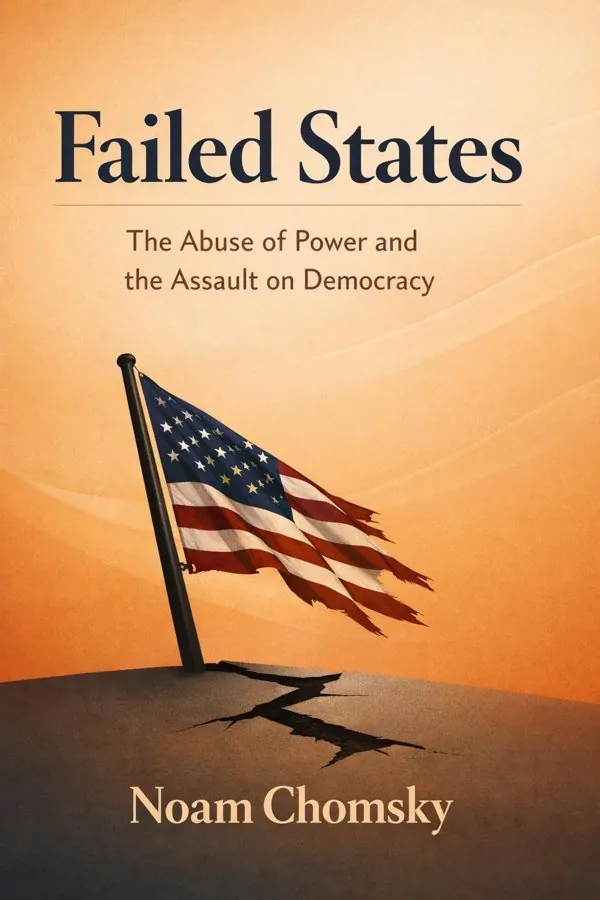
Failed States: The Abuse of Power and the Assault on Democracy: Summary & Key Insights
by Noam Chomsky
 10 min12 chaptersAudio available
What Is Failed States: The Abuse of Power and the Assault on Democracy About?
Failed States: The Abuse of Power and the Assault on Democracy by Noam Chomsky is a politics book spanning 12 pages. In 'Failed States: The Abuse of Power and the Assault on Democracy', Noam Chomsky examines how the United States, often self-proclaimed as a model of democracy, exhibits characteristics of a 'failed state'—a nation that cannot protect its citizens, upholds law selectively, and disregards international norms. Chomsky critiques U.S. foreign and domestic policies, arguing that they undermine democratic principles both at home and abroad.
This FizzRead summary covers all 12 key chapters of Failed States: The Abuse of Power and the Assault on Democracy in approximately 10 minutes, distilling the most important ideas, arguments, and takeaways from Noam Chomsky's work. Also available as an audio summary and Key Quotes Podcast.
Failed States: The Abuse of Power and the Assault on Democracy
In 'Failed States: The Abuse of Power and the Assault on Democracy', Noam Chomsky examines how the United States, often self-proclaimed as a model of democracy, exhibits characteristics of a 'failed state'—a nation that cannot protect its citizens, upholds law selectively, and disregards international norms. Chomsky critiques U.S. foreign and domestic policies, arguing that they undermine democratic principles both at home and abroad.
Who Should Read Failed States: The Abuse of Power and the Assault on Democracy?
This book is perfect for anyone interested in politics and looking to gain actionable insights in a short read. Whether you're a student, professional, or lifelong learner, the key ideas from Failed States: The Abuse of Power and the Assault on Democracy by Noam Chomsky will help you think differently.
- ✓Readers who enjoy politics and want practical takeaways
- ✓Professionals looking to apply new ideas to their work and life
- ✓Anyone who wants the core insights of Failed States: The Abuse of Power and the Assault on Democracy in just 10 minutes
Want the full summary?
Get instant access to this book summary and 100K+ more with Fizz Moment.
Get Free SummaryAvailable on App Store • Free to download
Key Chapters
Before diagnosing failure, we must understand what constitutes a state’s success. A functioning state, by any reasonable standard, protects its citizens, adheres to law—both domestic and international—and acts as a responsible member of the global community. A failed state, conversely, fulfills none of these duties. When I apply this definition to the United States, I am not speaking metaphorically but in concrete terms.
Consider first the principle of protection. Despite immense wealth, millions of Americans lack access to healthcare, education, or security. The government’s priorities—military expansion, surveillance, corporate favor—do not translate into protection for the public. Second, the rule of law. From torture and rendition to illegal invasions, America’s actions betray its legal commitments. International norms become conditional tools used against others, never themselves. Third, global responsibility. By pursuing unilateral interests over collective safety, the United States consistently undermines international institutions it helped build.
These are not isolated deviations but systemic features. A failed state does not collapse overnight; it decays through normalized hypocrisy. My intent is not to vilify, but to expose the dissonance between proclaimed ideals and political reality, and to remind citizens that democracy dies not through coups, but through indifference.
Since World War II, the United States has positioned itself as the global hegemon—the self-appointed guardian of freedom. Yet the record of interventions tells another story. From Guatemala and Vietnam to Chile and Iraq, American policy has repeatedly subverted democracies in the name of stability, or defended dictatorships under the guise of anti-communism and later anti-terrorism.
This pattern is not accidental. It reflects a structural commitment to dominance rather than democracy. The Cold War, ostensibly fought for freedom, left a legacy of covert operations and proxy wars that devastated entire societies. After its end, the justification simply shifted—from preventing communism to promoting democracy. But whether one looks at U.S. actions in the Middle East or Latin America, the result is the same: instability, resentment, and suffering within nations subjected to intervention.
These historical episodes reveal how power, even dressed in noble language, operates according to its own logic—one that rarely aligns with justice. The lesson is that moral rhetoric without accountability becomes a tool of control. Recognizing this history allows us to confront the continuity of empire beneath the banners of liberation.
+ 10 more chapters — available in the FizzRead app
All Chapters in Failed States: The Abuse of Power and the Assault on Democracy
About the Author
Noam Chomsky is an American linguist, philosopher, cognitive scientist, historian, and social critic. He is Institute Professor Emeritus at the Massachusetts Institute of Technology (MIT) and one of the most influential public intellectuals of the 20th and 21st centuries, known for his work in linguistics and his critiques of political power and media.
Get This Summary in Your Preferred Format
Read or listen to the Failed States: The Abuse of Power and the Assault on Democracy summary by Noam Chomsky anytime, anywhere. FizzRead offers multiple formats so you can learn on your terms — all free.
Available formats: App · Audio · PDF · EPUB — All included free with FizzRead
Download Failed States: The Abuse of Power and the Assault on Democracy PDF and EPUB Summary
Key Quotes from Failed States: The Abuse of Power and the Assault on Democracy
“Before diagnosing failure, we must understand what constitutes a state’s success.”
“Since World War II, the United States has positioned itself as the global hegemon—the self-appointed guardian of freedom.”
Frequently Asked Questions about Failed States: The Abuse of Power and the Assault on Democracy
Failed States: The Abuse of Power and the Assault on Democracy by Noam Chomsky is a politics book that explores key ideas across 12 chapters. In 'Failed States: The Abuse of Power and the Assault on Democracy', Noam Chomsky examines how the United States, often self-proclaimed as a model of democracy, exhibits characteristics of a 'failed state'—a nation that cannot protect its citizens, upholds law selectively, and disregards international norms. Chomsky critiques U.S. foreign and domestic policies, arguing that they undermine democratic principles both at home and abroad.
More by Noam Chomsky
Manufacturing Consent: The Political Economy of the Mass Media
Edward S. Herman, Noam Chomsky
10 min
Understanding Power: The Indispensable Chomsky
Noam Chomsky
10 min
Profit Over People: Neoliberalism and Global Order
Noam Chomsky
10 min
Who Rules the World?
Noam Chomsky
10 minYou Might Also Like
Antifa: The Anti-Fascist Handbook
Mark Bray
10 min
Attack from Within: How Disinformation Is Sabotaging America
Barbara McQuade
10 min
Coercion, Capital, and European States, AD 990–1992
Charles Tilly
10 min
Digital Democracy: Concepts, Methodologies, Tools, and Applications
Various Authors
10 min
Fascism
Stanley G. Payne
10 min
Fire And Fury: Inside The Trump White House
Michael Wolff
10 minBrowse by Category
Ready to read Failed States: The Abuse of Power and the Assault on Democracy?
Get the full summary and 100K+ more books with Fizz Moment.