
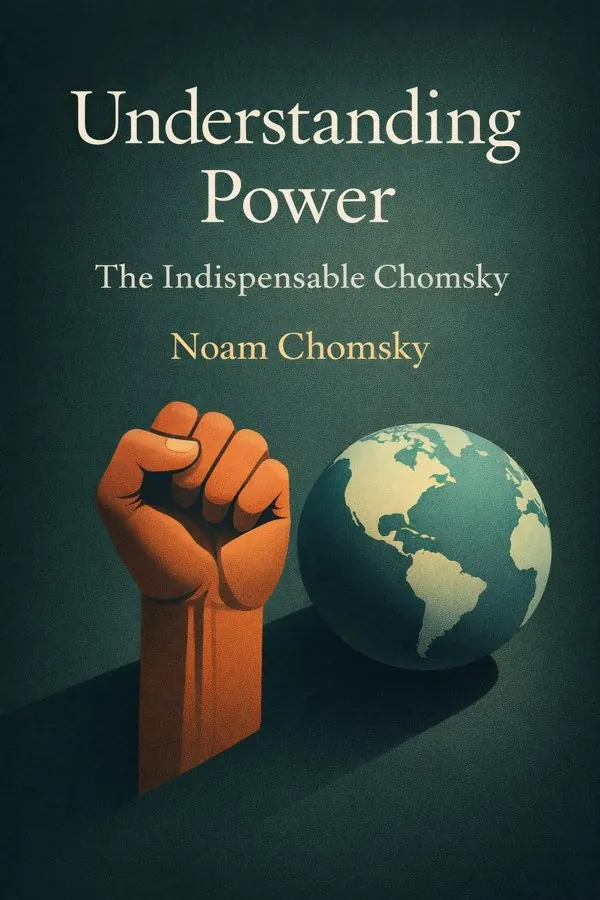
Understanding Power: The Indispensable Chomsky: Summary & Key Insights
by Noam Chomsky
 10 min11 chaptersAudio available
What Is Understanding Power: The Indispensable Chomsky About?
Understanding Power: The Indispensable Chomsky by Noam Chomsky is a politics book spanning 11 pages. Understanding Power: The Indispensable Chomsky es una colección de transcripciones inéditas de seminarios, charlas y sesiones de preguntas y respuestas de Noam Chomsky. Editado por Peter R. Mitchell y John Schoeffel, el libro ofrece una visión integral del pensamiento de Chomsky sobre política, medios de comunicación, economía global, educación, medio ambiente y poder militar. A través de un diálogo accesible y profundo, Chomsky analiza las estructuras de poder que moldean la sociedad contemporánea y propone formas de resistencia y cambio social.
This FizzRead summary covers all 11 key chapters of Understanding Power: The Indispensable Chomsky in approximately 10 minutes, distilling the most important ideas, arguments, and takeaways from Noam Chomsky's work. Also available as an audio summary and Key Quotes Podcast.
Understanding Power: The Indispensable Chomsky
Understanding Power: The Indispensable Chomsky es una colección de transcripciones inéditas de seminarios, charlas y sesiones de preguntas y respuestas de Noam Chomsky. Editado por Peter R. Mitchell y John Schoeffel, el libro ofrece una visión integral del pensamiento de Chomsky sobre política, medios de comunicación, economía global, educación, medio ambiente y poder militar. A través de un diálogo accesible y profundo, Chomsky analiza las estructuras de poder que moldean la sociedad contemporánea y propone formas de resistencia y cambio social.
Who Should Read Understanding Power: The Indispensable Chomsky?
This book is perfect for anyone interested in politics and looking to gain actionable insights in a short read. Whether you're a student, professional, or lifelong learner, the key ideas from Understanding Power: The Indispensable Chomsky by Noam Chomsky will help you think differently.
- ✓Readers who enjoy politics and want practical takeaways
- ✓Professionals looking to apply new ideas to their work and life
- ✓Anyone who wants the core insights of Understanding Power: The Indispensable Chomsky in just 10 minutes
Want the full summary?
Get instant access to this book summary and 100K+ more with Fizz Moment.
Get Free SummaryAvailable on App Store • Free to download
Key Chapters
Power, as I see it, is not a mysterious force exercised by hidden hands. It’s institutional, structured, and entirely visible once you know where to look. In contemporary societies—particularly those calling themselves 'democracies'—power resides largely in the interlocking networks of corporate and state institutions. These entities are bound together by shared interests, not conspiracies, but by a common logic: the preservation of privilege and control over productive resources. The rhetoric of freedom serves as a convenient mask for systems that function to concentrate decision-making in the hands of a tiny elite.
The economic system, especially postwar capitalism, is built to maximize profit, not public welfare. Governments, while nominally representing the people, act primarily as the executive committees of those who own and control economic wealth. This does not require nefarious plotting; it’s the predictable outcome of institutional design. The educational system trains individuals to conform, the media shapes acceptable opinion, and the political system provides the illusion of choice within narrow boundaries.
Throughout the book, I emphasize that genuine democracy would require dismantling these boundaries—expanding control over social resources to those who actually produce them and are affected by them. But the first step is to recognize the pattern: an ideological structure that teaches people to consent to their own marginalization through talk of efficiency, security, and freedom. Once you see how these logics operate, it becomes impossible to confuse the rhetoric of democracy with its practice.
The media, as I have argued in many contexts, is one of the principal instruments through which power maintains itself. Along with Edward Herman, I’ve described this arrangement as the 'propaganda model'—a system not of censorship, but of structural filtering. Journalists do not typically lie; rather, they internalize the assumptions of their institutions and the social class that supports them. These filters—ownership, advertising, sourcing, flak, and ideology—determine what counts as news and how it’s framed. The result is a system in which dissenting voices are marginalized, often not by explicit suppression but by omission, ridicule, or framing that makes their arguments appear irrational or unpatriotic.
This is why media appears free but functions as a powerful instrument of social control. When corporate interests fund and own major outlets, coverage naturally aligns with corporate priorities. Take foreign policy: transgressions committed by official enemies are highlighted, while comparable acts by our own government are downplayed or rationalized. This selective attention teaches the public what to care about and what to ignore. It molds perception until the boundaries of permissible thought coincide with the interests of the powerful.
Understanding this structure isn’t simply an academic exercise. It’s a call to cultivate media literacy as a political act—to learn to ask, 'Whose interests are served by this story?' and 'What realities are omitted?' Awareness is the first step toward freeing thought from manipulation, a prerequisite for genuine democratic participation.
+ 9 more chapters — available in the FizzRead app
All Chapters in Understanding Power: The Indispensable Chomsky
About the Author
Noam Chomsky es un lingüista, filósofo, científico cognitivo, historiador y activista político estadounidense. Profesor emérito del Instituto Tecnológico de Massachusetts (MIT), es considerado uno de los intelectuales más influyentes del siglo XX. Su trabajo abarca desde la teoría lingüística hasta la crítica de los medios y la política exterior de Estados Unidos.
Get This Summary in Your Preferred Format
Read or listen to the Understanding Power: The Indispensable Chomsky summary by Noam Chomsky anytime, anywhere. FizzRead offers multiple formats so you can learn on your terms — all free.
Available formats: App · Audio · PDF · EPUB — All included free with FizzRead
Download Understanding Power: The Indispensable Chomsky PDF and EPUB Summary
Key Quotes from Understanding Power: The Indispensable Chomsky
“Power, as I see it, is not a mysterious force exercised by hidden hands.”
“The media, as I have argued in many contexts, is one of the principal instruments through which power maintains itself.”
Frequently Asked Questions about Understanding Power: The Indispensable Chomsky
Understanding Power: The Indispensable Chomsky by Noam Chomsky is a politics book that explores key ideas across 11 chapters. Understanding Power: The Indispensable Chomsky es una colección de transcripciones inéditas de seminarios, charlas y sesiones de preguntas y respuestas de Noam Chomsky. Editado por Peter R. Mitchell y John Schoeffel, el libro ofrece una visión integral del pensamiento de Chomsky sobre política, medios de comunicación, economía global, educación, medio ambiente y poder militar. A través de un diálogo accesible y profundo, Chomsky analiza las estructuras de poder que moldean la sociedad contemporánea y propone formas de resistencia y cambio social.
More by Noam Chomsky
Manufacturing Consent: The Political Economy of the Mass Media
Edward S. Herman, Noam Chomsky
10 min
Profit Over People: Neoliberalism and Global Order
Noam Chomsky
10 min
Failed States: The Abuse of Power and the Assault on Democracy
Noam Chomsky
10 min
Who Rules the World?
Noam Chomsky
10 minYou Might Also Like
Antifa: The Anti-Fascist Handbook
Mark Bray
10 min
Attack from Within: How Disinformation Is Sabotaging America
Barbara McQuade
10 min
Coercion, Capital, and European States, AD 990–1992
Charles Tilly
10 min
Digital Democracy: Concepts, Methodologies, Tools, and Applications
Various Authors
10 min
Fascism
Stanley G. Payne
10 min
Fire And Fury: Inside The Trump White House
Michael Wolff
10 minBrowse by Category
Ready to read Understanding Power: The Indispensable Chomsky?
Get the full summary and 100K+ more books with Fizz Moment.