
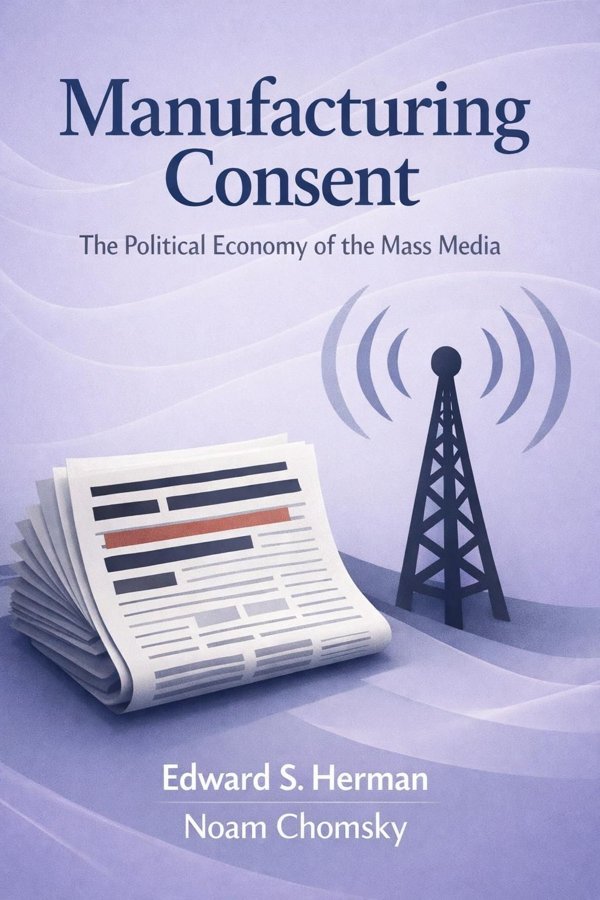
Manufacturing Consent: The Political Economy of the Mass Media: Summary & Key Insights
by Edward S. Herman, Noam Chomsky
 10 min12 chaptersAudio available
What Is Manufacturing Consent: The Political Economy of the Mass Media About?
Manufacturing Consent: The Political Economy of the Mass Media by Edward S. Herman, Noam Chomsky is a politics book spanning 12 pages. Manufacturing Consent: The Political Economy of the Mass Media es un análisis crítico del papel de los medios de comunicación en las democracias modernas. Herman y Chomsky presentan el 'modelo de propaganda', que sostiene que los medios de comunicación sirven a los intereses de las élites económicas y políticas, filtrando la información y moldeando la opinión pública para mantener el statu quo. A través de estudios de caso, los autores muestran cómo las noticias se estructuran para favorecer las agendas de poder y cómo la disidencia se margina sistemáticamente.
This FizzRead summary covers all 12 key chapters of Manufacturing Consent: The Political Economy of the Mass Media in approximately 10 minutes, distilling the most important ideas, arguments, and takeaways from Edward S. Herman, Noam Chomsky's work. Also available as an audio summary and Key Quotes Podcast.
Manufacturing Consent: The Political Economy of the Mass Media
Manufacturing Consent: The Political Economy of the Mass Media es un análisis crítico del papel de los medios de comunicación en las democracias modernas. Herman y Chomsky presentan el 'modelo de propaganda', que sostiene que los medios de comunicación sirven a los intereses de las élites económicas y políticas, filtrando la información y moldeando la opinión pública para mantener el statu quo. A través de estudios de caso, los autores muestran cómo las noticias se estructuran para favorecer las agendas de poder y cómo la disidencia se margina sistemáticamente.
Who Should Read Manufacturing Consent: The Political Economy of the Mass Media?
This book is perfect for anyone interested in politics and looking to gain actionable insights in a short read. Whether you're a student, professional, or lifelong learner, the key ideas from Manufacturing Consent: The Political Economy of the Mass Media by Edward S. Herman, Noam Chomsky will help you think differently.
- ✓Readers who enjoy politics and want practical takeaways
- ✓Professionals looking to apply new ideas to their work and life
- ✓Anyone who wants the core insights of Manufacturing Consent: The Political Economy of the Mass Media in just 10 minutes
Want the full summary?
Get instant access to this book summary and 100K+ more with Fizz Moment.
Get Free SummaryAvailable on App Store • Free to download
Key Chapters
The propaganda model, developed by Edward S. Herman and myself, is the conceptual core of this book. It offers a structural understanding of how mass media function within capitalist democracies—not as neutral disseminators of information but as institutions integrated into power systems of ownership, profit, and ideological control. The model identifies five filters through which news passes before reaching the public: ownership, advertising, sourcing, flak, and ideology.
Ownership refers to the corporate control of media outlets. In practice, this means major newspapers, television networks, and publishing houses are owned by conglomerates deeply tied to other industrial and financial interests. Their primary obligation is to shareholders, not to truth. This ownership filter ensures that editorial policies do not undermine the profit structure upon which they depend.
The second filter, advertising, transforms audiences into commodities. Media outlets sell your attention, not just stories. When advertisers fund most of the media, content that might offend or challenge their interests becomes inherently risky. Thus, journalism bends toward 'harmless' material—sensational, consumer-friendly, but politically safe.
Third, sourcing reflects the symbiotic relationship between media and institutional power. Reporters rely on official sources—government press offices, corporate communications, and 'experts' often drawn from elite circles—because these sources are accessible, authoritative, and continuous. The result is a subtle privileging of establishment voices and a marginalization of dissenting ones.
The fourth filter, flak, arises when powerful actors deploy criticism, complaints, or organized campaigns to discipline the media. Think tanks, lobbying groups, and even government offices create flak when journalists step outside approved narratives. The threat of flak exerts a preventive pressure, narrowing coverage long before overt censorship occurs.
Finally, ideology—once driven by anti-communism, now often rebranded as the defense of market freedom or the war on terror—provides the moral framework that justifies the other filters. Ideology defines the boundary of what counts as rational debate. It identifies enemies, foments fear, and turns complex geopolitical realities into simple moral dichotomies.
Together, these filters form an interlocking system that produces 'manufactured consent.' Through them, the media fulfill a dual function: they instruct the public in acceptable viewpoints and legitimize elite agendas while maintaining the appearance of pluralism. In reading this, I ask you not to interpret the model as a conspiracy but as a structural necessity derived from economic and institutional constraints. The model does not claim journalists are dishonest; rather, it explains how honest journalists operate within boundaries they rarely perceive.
Once you understand these filters, you can begin to decode media behavior across issues—from foreign policy crises to domestic political coverage. You will see patterns not of deliberate deceit but of structural selection, where some facts are amplified and others atomized, some voices heard and others erased.
Ownership concentration determines the worldview the media propagate. In the United States, most major outlets are owned by a handful of corporations whose interests extend far beyond news itself—into manufacturing, telecommunications, weapons production, and finance. When editorial policy potentially conflicts with those broader corporate concerns, internal discipline ensures conformity.
From our analysis, ownership acts as a silent regulator. Editors and journalists understand the implicit limits of acceptable inquiry. You will notice few media organizations scrutinizing military contractors when they are owned by conglomerates tied to defense industries, or challenging pharmaceutical giants when their advertisers belong to those same firms. This coherence of interest establishes a predictable news frame—one that minimizes structural critique and maximizes narrative stability.
Profit orientation adds another layer. Because media are commercial enterprises, their primary goal is audience retention and revenue generation. Investigative reporting, which is expensive and potentially alienating, competes poorly with entertainment-driven content that ensures profitability. The rise of corporate media entertainment in the late twentieth century cemented this orientation, transforming news from a public service to a consumer product.
The irony is profound: as media profits grow, public enlightenment shrinks. Ownership and profit imperatives rationalize a narrow discourse—one that celebrates market efficiency while avoiding critiques of systemic inequality. This is how the media, though formally free, become functionally predictable. They reproduce the interests of their owners not through mandates but through economic self-regulation.
+ 10 more chapters — available in the FizzRead app
All Chapters in Manufacturing Consent: The Political Economy of the Mass Media
About the Authors
Edward S. Herman fue un economista y analista de medios estadounidense, profesor en la Wharton School de la Universidad de Pensilvania. Noam Chomsky es un lingüista, filósofo y activista político estadounidense, profesor emérito del MIT, conocido por su trabajo en lingüística y crítica de los medios y la política exterior estadounidense.
Get This Summary in Your Preferred Format
Read or listen to the Manufacturing Consent: The Political Economy of the Mass Media summary by Edward S. Herman, Noam Chomsky anytime, anywhere. FizzRead offers multiple formats so you can learn on your terms — all free.
Available formats: App · Audio · PDF · EPUB — All included free with FizzRead
Download Manufacturing Consent: The Political Economy of the Mass Media PDF and EPUB Summary
Key Quotes from Manufacturing Consent: The Political Economy of the Mass Media
“The propaganda model, developed by Edward S.”
“Ownership concentration determines the worldview the media propagate.”
Frequently Asked Questions about Manufacturing Consent: The Political Economy of the Mass Media
Manufacturing Consent: The Political Economy of the Mass Media by Edward S. Herman, Noam Chomsky is a politics book that explores key ideas across 12 chapters. Manufacturing Consent: The Political Economy of the Mass Media es un análisis crítico del papel de los medios de comunicación en las democracias modernas. Herman y Chomsky presentan el 'modelo de propaganda', que sostiene que los medios de comunicación sirven a los intereses de las élites económicas y políticas, filtrando la información y moldeando la opinión pública para mantener el statu quo. A través de estudios de caso, los autores muestran cómo las noticias se estructuran para favorecer las agendas de poder y cómo la disidencia se margina sistemáticamente.
You Might Also Like

Antifa: The Anti-Fascist Handbook
Mark Bray
10 min
Attack from Within: How Disinformation Is Sabotaging America
Barbara McQuade
10 min
Coercion, Capital, and European States, AD 990–1992
Charles Tilly
10 min
Digital Democracy: Concepts, Methodologies, Tools, and Applications
Various Authors
10 min
Fascism
Stanley G. Payne
10 min
Fire And Fury: Inside The Trump White House
Michael Wolff
10 minBrowse by Category
Ready to read Manufacturing Consent: The Political Economy of the Mass Media?
Get the full summary and 100K+ more books with Fizz Moment.