
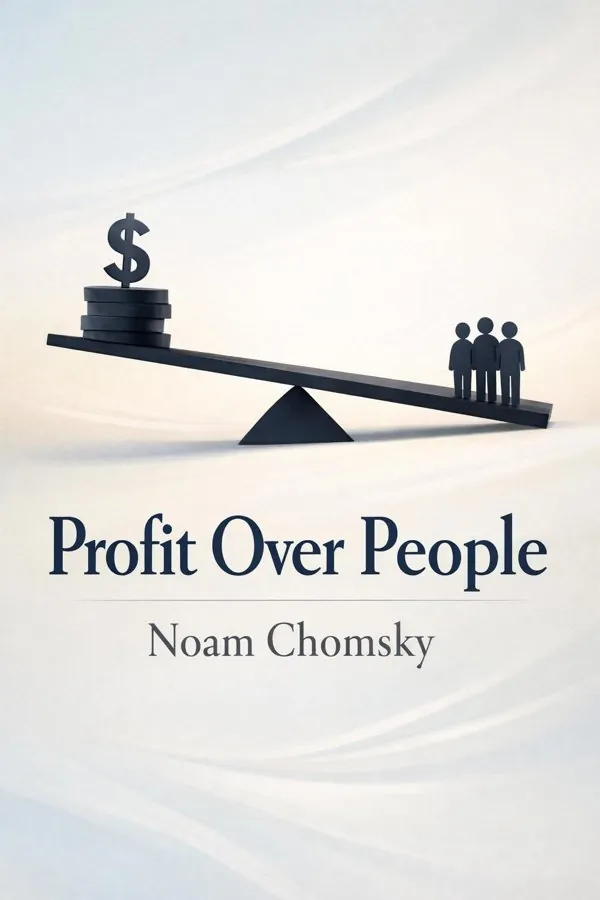
Profit Over People: Neoliberalism and Global Order: Summary & Key Insights
by Noam Chomsky
 10 min10 chaptersAudio available
What Is Profit Over People: Neoliberalism and Global Order About?
Profit Over People: Neoliberalism and Global Order by Noam Chomsky is a politics book spanning 10 pages. In this influential work, Noam Chomsky offers a powerful critique of neoliberalism, exposing how global economic policies prioritize corporate profit over human welfare. Through incisive essays, he traces the historical development of neoliberal ideology, its impact on democracy, and the resulting social and economic inequalities. Chomsky argues that the concentration of wealth and power undermines genuine democratic participation and perpetuates global injustice.
This FizzRead summary covers all 10 key chapters of Profit Over People: Neoliberalism and Global Order in approximately 10 minutes, distilling the most important ideas, arguments, and takeaways from Noam Chomsky's work. Also available as an audio summary and Key Quotes Podcast.
Profit Over People: Neoliberalism and Global Order
In this influential work, Noam Chomsky offers a powerful critique of neoliberalism, exposing how global economic policies prioritize corporate profit over human welfare. Through incisive essays, he traces the historical development of neoliberal ideology, its impact on democracy, and the resulting social and economic inequalities. Chomsky argues that the concentration of wealth and power undermines genuine democratic participation and perpetuates global injustice.
Who Should Read Profit Over People: Neoliberalism and Global Order?
This book is perfect for anyone interested in politics and looking to gain actionable insights in a short read. Whether you're a student, professional, or lifelong learner, the key ideas from Profit Over People: Neoliberalism and Global Order by Noam Chomsky will help you think differently.
- ✓Readers who enjoy politics and want practical takeaways
- ✓Professionals looking to apply new ideas to their work and life
- ✓Anyone who wants the core insights of Profit Over People: Neoliberalism and Global Order in just 10 minutes
Want the full summary?
Get instant access to this book summary and 100K+ more with Fizz Moment.
Get Free SummaryAvailable on App Store • Free to download
Key Chapters
After the devastation of World War II, the global economy was reordered under what is often called the Bretton Woods system—a framework designed to balance national sovereignty with international cooperation. For several decades, general economic policy was guided by Keynesian principles: governments played an active role in regulating markets, ensuring social security, and promoting full employment. Wealthy nations accepted the idea that stability and shared prosperity required constraints on corporate power.
But beginning in the 1970s, this consensus began to unravel. The oil shocks, economic stagnation, and rising inflation provided an opening for a different doctrine—a counterrevolution in economic thought that claimed markets should govern every sphere of life. Its proponents called it 'liberalization'; I call it a restoration of class power. Neoliberalism was not born from spontaneous intellectual discovery. It was a calculated response by economic elites to reclaim control over wealth and policy. Institutions like the International Monetary Fund and the World Bank, initially designed to promote reconstruction and development, were repurposed to impose austerity and privatization on the Global South, and eventually on working populations in advanced economies.
This shift was symbolized by the rise of leaders like Ronald Reagan and Margaret Thatcher, who spoke the language of freedom but implemented policies that transferred power upward—deregulating finance, crushing unions, and selling off public assets. Under this new order, the state was not weakened but retooled: it became an agent serving private interests rather than the public good. By the 1990s, neoliberalism had become the dominant orthodoxy, enforced through international agreements, corporate globalization, and a new moral vocabulary that made greed appear virtuous and inequality inevitable.
Neoliberalism presents itself as a philosophy of freedom—the idea that individuals should be liberated from the interference of the state. Yet in practice, it defines freedom in a way that is profoundly one-dimensional: the freedom of property, the freedom of corporations, the freedom to invest and extract without social responsibility. What disappears in this discourse is the freedom that actually matters to most people—the freedom from poverty, exploitation, and domination.
Behind its rhetoric lies a subtle but powerful form of ideological control. The doctrine cloaks power relations behind economic jargon: the 'market' becomes a natural law, while political decisions that shape it are hidden from view. By defining market outcomes as expressions of freedom, neoliberal ideology discourages collective action and delegitimizes any form of public intervention. Education becomes a commodity, healthcare a privilege, labor a flexible cost. This reframing of values reshapes society itself, creating a moral universe where inequality is not only tolerated but justified as the reward for merit.
In *Profit Over People*, I argue that this is not accidental. Neoliberal thought is a continuation of centuries of elite strategies to suppress democracy. From Adam Smith’s time to the Cold War era, economic theory has often been mobilized to protect class privilege under the guise of natural order. The modern neoliberal project has perfected this tradition through the use of media, academia, and bureaucratic systems that frame corporate control as the essence of progress. The result is a society where genuine democracy—rule by the people in their collective interest—is systematically undermined.
+ 8 more chapters — available in the FizzRead app
All Chapters in Profit Over People: Neoliberalism and Global Order
About the Author
Noam Chomsky is an American linguist, philosopher, cognitive scientist, historian, and social critic. Widely regarded as one of the most influential intellectuals of the 20th and 21st centuries, he is known for his groundbreaking work in linguistics as well as his critical analyses of politics, media, and economics.
Get This Summary in Your Preferred Format
Read or listen to the Profit Over People: Neoliberalism and Global Order summary by Noam Chomsky anytime, anywhere. FizzRead offers multiple formats so you can learn on your terms — all free.
Available formats: App · Audio · PDF · EPUB — All included free with FizzRead
Download Profit Over People: Neoliberalism and Global Order PDF and EPUB Summary
Key Quotes from Profit Over People: Neoliberalism and Global Order
“For several decades, general economic policy was guided by Keynesian principles: governments played an active role in regulating markets, ensuring social security, and promoting full employment.”
“Neoliberalism presents itself as a philosophy of freedom—the idea that individuals should be liberated from the interference of the state.”
Frequently Asked Questions about Profit Over People: Neoliberalism and Global Order
Profit Over People: Neoliberalism and Global Order by Noam Chomsky is a politics book that explores key ideas across 10 chapters. In this influential work, Noam Chomsky offers a powerful critique of neoliberalism, exposing how global economic policies prioritize corporate profit over human welfare. Through incisive essays, he traces the historical development of neoliberal ideology, its impact on democracy, and the resulting social and economic inequalities. Chomsky argues that the concentration of wealth and power undermines genuine democratic participation and perpetuates global injustice.
More by Noam Chomsky
Manufacturing Consent: The Political Economy of the Mass Media
Edward S. Herman, Noam Chomsky
10 min
Understanding Power: The Indispensable Chomsky
Noam Chomsky
10 min
Failed States: The Abuse of Power and the Assault on Democracy
Noam Chomsky
10 min
Who Rules the World?
Noam Chomsky
10 minYou Might Also Like

Antifa: The Anti-Fascist Handbook
Mark Bray
10 min
Attack from Within: How Disinformation Is Sabotaging America
Barbara McQuade
10 min
Coercion, Capital, and European States, AD 990–1992
Charles Tilly
10 min
Digital Democracy: Concepts, Methodologies, Tools, and Applications
Various Authors
10 min
Fascism
Stanley G. Payne
10 min
Fire And Fury: Inside The Trump White House
Michael Wolff
10 minBrowse by Category
Ready to read Profit Over People: Neoliberalism and Global Order?
Get the full summary and 100K+ more books with Fizz Moment.