
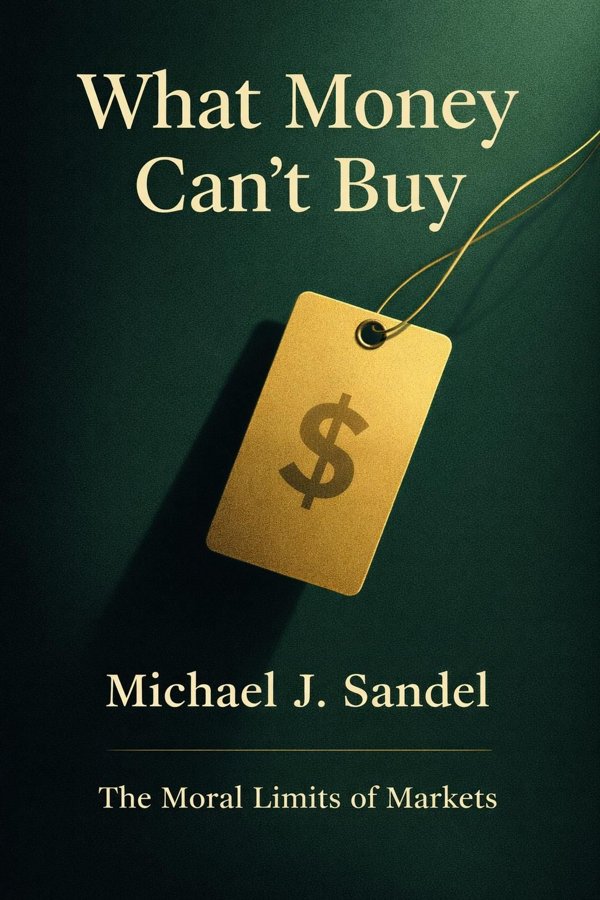
What Money Can't Buy: The Moral Limits of Markets: Summary & Key Insights
 10 min11 chaptersAudio available
What Is What Money Can't Buy: The Moral Limits of Markets About?
What Money Can't Buy: The Moral Limits of Markets by Michael J. Sandel is a ethics book spanning 11 pages. In this book, political philosopher Michael J. Sandel explores the ethical boundaries of markets and questions whether there are moral limits to what money should be able to buy. He argues that over recent decades, society has shifted from having a market economy to being a market society, where market values increasingly dominate every aspect of life. Through vivid examples, Sandel challenges readers to reconsider the role of markets in civic life and the moral consequences of commodifying things that should not be for sale.
This FizzRead summary covers all 11 key chapters of What Money Can't Buy: The Moral Limits of Markets in approximately 10 minutes, distilling the most important ideas, arguments, and takeaways from Michael J. Sandel's work. Also available as an audio summary and Key Quotes Podcast.
What Money Can't Buy: The Moral Limits of Markets
In this book, political philosopher Michael J. Sandel explores the ethical boundaries of markets and questions whether there are moral limits to what money should be able to buy. He argues that over recent decades, society has shifted from having a market economy to being a market society, where market values increasingly dominate every aspect of life. Through vivid examples, Sandel challenges readers to reconsider the role of markets in civic life and the moral consequences of commodifying things that should not be for sale.
Who Should Read What Money Can't Buy: The Moral Limits of Markets?
This book is perfect for anyone interested in ethics and looking to gain actionable insights in a short read. Whether you're a student, professional, or lifelong learner, the key ideas from What Money Can't Buy: The Moral Limits of Markets by Michael J. Sandel will help you think differently.
- ✓Readers who enjoy ethics and want practical takeaways
- ✓Professionals looking to apply new ideas to their work and life
- ✓Anyone who wants the core insights of What Money Can't Buy: The Moral Limits of Markets in just 10 minutes
Want the full summary?
Get instant access to this book summary and 100K+ more with Fizz Moment.
Get Free SummaryAvailable on App Store • Free to download
Key Chapters
In recent decades, we have witnessed the quiet triumph of market thinking. It has spread beyond traditional economic activities into nearly every aspect of our daily lives. Buying and selling no longer stop at the marketplace door—they have entered the classroom, the hospital, the sports field, and even the way we conduct civic duties.
The story of this expansion is not one of conspiracy but of gradual cultural drift. After the Cold War, when free-market ideologies prevailed, we came to assume that markets were neutral instruments of choice, capable of delivering efficiency without moral consequence. Yet the more we relied on this assumption, the more market values crowded out other ways of thinking about the good life.
In education, for instance, we started introducing cash rewards for academic performance as if learning were simply another transaction. In civic life, we began to pay people to donate blood or to volunteer, weakening the sense of public spirit these acts once carried. Each of these shifts seems individually minor, but collectively they change the moral atmosphere in which we live. The central danger is that when everything becomes a commodity, the meaning of moral and social goods is transformed—and often diminished.
To understand how deep this change runs, consider some examples of commodification—cases where market mechanisms are applied to goods that moral intuition tells us should not be sold. Some American prisons, for example, offer wealthier inmates the opportunity to buy better living conditions, such as private cells or reduced crowding. What does this do to the ideal of equal justice before the law?
In another case, cities have auctioned off the right to emit pollution, effectively allowing companies to purchase the right to damage the environment, provided they can afford the price. Or think of children being paid by their parents to read. At first, this seems like a clever motivational trick. But when reading becomes an earner’s task rather than a world of wonder, something intrinsic is lost.
All these examples reveal a deeper tension between the market’s neutrality and the meaning of the things exchanged. Markets don’t just allocate goods—they assign meaning. Putting a price on civic duty or moral virtue changes our relation to what those acts stand for. When money enters the picture, certain acts are no longer expressions of solidarity or love—they are services rendered. The risk is not merely that inequality grows but that the moral vocabulary through which we understand our relations to one another is impoverished.
+ 9 more chapters — available in the FizzRead app
All Chapters in What Money Can't Buy: The Moral Limits of Markets
About the Author
Michael J. Sandel is an American political philosopher and professor at Harvard University, known for his work on justice, ethics, and political philosophy. His lectures and books, including 'Justice: What's the Right Thing to Do?' and 'What Money Can't Buy,' have reached global audiences and sparked public debate on moral and civic questions.
Get This Summary in Your Preferred Format
Read or listen to the What Money Can't Buy: The Moral Limits of Markets summary by Michael J. Sandel anytime, anywhere. FizzRead offers multiple formats so you can learn on your terms — all free.
Available formats: App · Audio · PDF · EPUB — All included free with FizzRead
Download What Money Can't Buy: The Moral Limits of Markets PDF and EPUB Summary
Key Quotes from What Money Can't Buy: The Moral Limits of Markets
“In recent decades, we have witnessed the quiet triumph of market thinking.”
“To understand how deep this change runs, consider some examples of commodification—cases where market mechanisms are applied to goods that moral intuition tells us should not be sold.”
Frequently Asked Questions about What Money Can't Buy: The Moral Limits of Markets
What Money Can't Buy: The Moral Limits of Markets by Michael J. Sandel is a ethics book that explores key ideas across 11 chapters. In this book, political philosopher Michael J. Sandel explores the ethical boundaries of markets and questions whether there are moral limits to what money should be able to buy. He argues that over recent decades, society has shifted from having a market economy to being a market society, where market values increasingly dominate every aspect of life. Through vivid examples, Sandel challenges readers to reconsider the role of markets in civic life and the moral consequences of commodifying things that should not be for sale.
More by Michael J. Sandel
The Tyranny of Merit: What's Become of the Common Good?
Michael J. Sandel
10 min
Justice: What's the Right Thing to Do?
Michael J. Sandel
10 min
Democracy's Discontent: America in Search of a Public Philosophy
Michael J. Sandel
10 min
Public Philosophy: Essays on Morality in Politics
Michael J. Sandel
10 minYou Might Also Like
What We Owe the Future
William MacAskill
10 min
Abortion
David Boonin
10 min
Blind Spots: Why We Fail to Do What's Right and What to Do About It
Max H. Bazerman, Ann E. Tenbrunsel
10 min
Digital Ethics: Research and Practice
Christopher Burr, Luciano Floridi (Editors)
10 min
Doing Good Better: Effective Altruism and a Radical New Way to Make a Difference
William MacAskill
10 min
Eating Animals
Jonathan Safran Foer
10 minBrowse by Category
Ready to read What Money Can't Buy: The Moral Limits of Markets?
Get the full summary and 100K+ more books with Fizz Moment.