
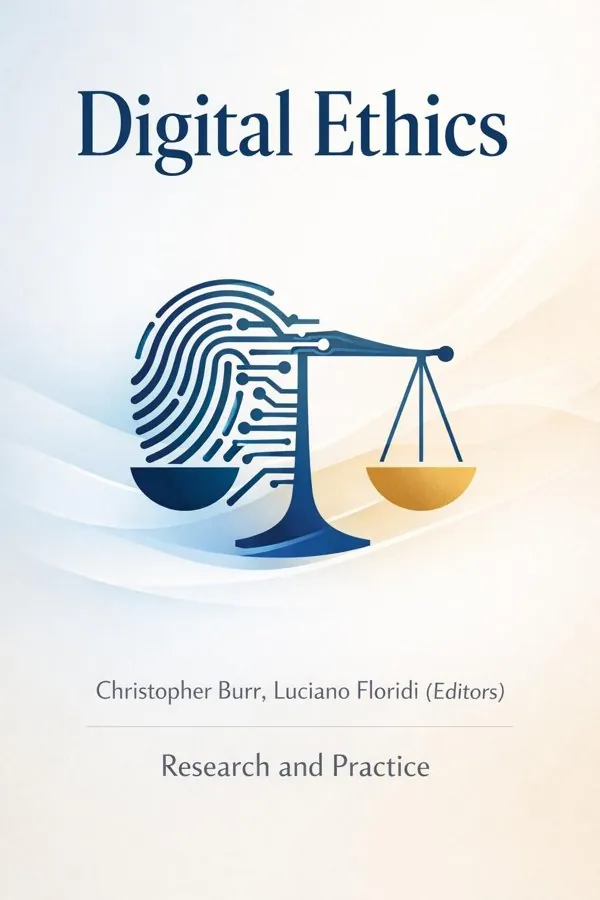
Digital Ethics: Research and Practice: Summary & Key Insights
by Christopher Burr, Luciano Floridi (Editors)
 10 min6 chaptersAudio available
What Is Digital Ethics: Research and Practice About?
Digital Ethics: Research and Practice by Christopher Burr, Luciano Floridi (Editors) is a ethics book spanning 6 pages. Digital Ethics explores the moral, social, and political implications of digital technologies. It brings together leading scholars to discuss topics such as data privacy, algorithmic bias, artificial intelligence, and the ethical responsibilities of technology companies. The book provides a comprehensive overview of how ethical frameworks can guide the development and governance of digital systems in society.
This FizzRead summary covers all 6 key chapters of Digital Ethics: Research and Practice in approximately 10 minutes, distilling the most important ideas, arguments, and takeaways from Christopher Burr, Luciano Floridi (Editors)'s work. Also available as an audio summary and Key Quotes Podcast.
Digital Ethics: Research and Practice
Digital Ethics explores the moral, social, and political implications of digital technologies. It brings together leading scholars to discuss topics such as data privacy, algorithmic bias, artificial intelligence, and the ethical responsibilities of technology companies. The book provides a comprehensive overview of how ethical frameworks can guide the development and governance of digital systems in society.
Who Should Read Digital Ethics: Research and Practice?
This book is perfect for anyone interested in ethics and looking to gain actionable insights in a short read. Whether you're a student, professional, or lifelong learner, the key ideas from Digital Ethics: Research and Practice by Christopher Burr, Luciano Floridi (Editors) will help you think differently.
- ✓Readers who enjoy ethics and want practical takeaways
- ✓Professionals looking to apply new ideas to their work and life
- ✓Anyone who wants the core insights of Digital Ethics: Research and Practice in just 10 minutes
Want the full summary?
Get instant access to this book summary and 100K+ more with Fizz Moment.
Get Free SummaryAvailable on App Store • Free to download
Key Chapters
In tracing the conceptual foundations of digital ethics, we begin by acknowledging its lineage within the broader field of information ethics. Digital ethics represents a continuation and expansion of the philosophical project of understanding information as a fundamental building block of reality. Here, Floridi’s notion of the ‘infosphere’ serves as a core idea—the infosphere as the ecological environment composed of all informational entities, processes, and relations. Within this environment, ethical questions arise not only between humans but among information systems themselves.
At the foundation of digital ethics are normative frameworks drawn from traditional moral philosophy—deontology, consequentialism, virtue ethics—but reinterpreted for the context of informational interactions. Much of our ethical thinking in the physical world assumes clear boundaries between agents and actions. In digital spaces, those boundaries blur: actions are distributed through algorithms, agency may be partial or automated, and outcomes often emerge from systems too complex for direct human oversight. Thus, a key task of digital ethics is to develop coherent principles that account for distributed agency and indirect causality.
From this perspective, the infosphere itself has moral significance. To harm information—to corrupt data, to manipulate informational relationships dishonestly—is to damage the integrity of the informational environment on which all beings depend. This idea reframes moral responsibility as stewardship of information, where ethical behavior means preserving the quality and reliability of informational exchanges. The conceptual foundation thus establishes digital ethics not as a peripheral subfield but as a fundamental ethics for the age of information.
Data ethics concerns the moral dimensions of data collection, storage, processing, and sharing. Over the last decade, data has become the lifeblood of digital economies and an essential resource for governance, medicine, and social interaction. Yet with this power comes vulnerability—the possibility that data may be misused, manipulated, or commodified in ways that compromise individual dignity.
In this section, contributors explore privacy as a moral right, not merely a regulatory constraint. They argue that informed consent in the age of big data cannot be reduced to the ticking of boxes; it requires genuine comprehension and autonomy from individuals whose lives are mapped and modeled by digital systems. Furthermore, data controllers and processors bear moral responsibilities that extend beyond compliance: they must design infrastructures that respect human values by default.
One of the central themes of data ethics is the tension between innovation and protection. Data enables progress in healthcare and social welfare, yet its accumulation concentrates power in institutions with opaque motives. The ethical stance we advocate requires a rebalancing—developing governance models that ensure data flows serve public good without sacrificing personal rights. Therefore, we focus on accountability mechanisms, fostering transparency in data practices, and cultivating public trust as an ethical resource. Data ethics, at its heart, asks us to treat information not as extractive material but as a relational good—a basis for mutual respect within the infosphere.
+ 4 more chapters — available in the FizzRead app
All Chapters in Digital Ethics: Research and Practice
About the Authors
Luciano Floridi is a Professor of Philosophy and Ethics of Information at the University of Oxford and a leading figure in the field of digital ethics. Christopher Burr is a researcher in digital ethics and AI governance, focusing on the intersection of technology, society, and moral philosophy.
Get This Summary in Your Preferred Format
Read or listen to the Digital Ethics: Research and Practice summary by Christopher Burr, Luciano Floridi (Editors) anytime, anywhere. FizzRead offers multiple formats so you can learn on your terms — all free.
Available formats: App · Audio · PDF · EPUB — All included free with FizzRead
Download Digital Ethics: Research and Practice PDF and EPUB Summary
Key Quotes from Digital Ethics: Research and Practice
“In tracing the conceptual foundations of digital ethics, we begin by acknowledging its lineage within the broader field of information ethics.”
“Data ethics concerns the moral dimensions of data collection, storage, processing, and sharing.”
Frequently Asked Questions about Digital Ethics: Research and Practice
Digital Ethics: Research and Practice by Christopher Burr, Luciano Floridi (Editors) is a ethics book that explores key ideas across 6 chapters. Digital Ethics explores the moral, social, and political implications of digital technologies. It brings together leading scholars to discuss topics such as data privacy, algorithmic bias, artificial intelligence, and the ethical responsibilities of technology companies. The book provides a comprehensive overview of how ethical frameworks can guide the development and governance of digital systems in society.
You Might Also Like

What We Owe the Future
William MacAskill
10 min
Abortion
David Boonin
10 min
Blind Spots: Why We Fail to Do What's Right and What to Do About It
Max H. Bazerman, Ann E. Tenbrunsel
10 min
Doing Good Better: Effective Altruism and a Radical New Way to Make a Difference
William MacAskill
10 min
Eating Animals
Jonathan Safran Foer
10 min
Ethics of Artificial Intelligence
Various Authors
10 minBrowse by Category
Ready to read Digital Ethics: Research and Practice?
Get the full summary and 100K+ more books with Fizz Moment.