
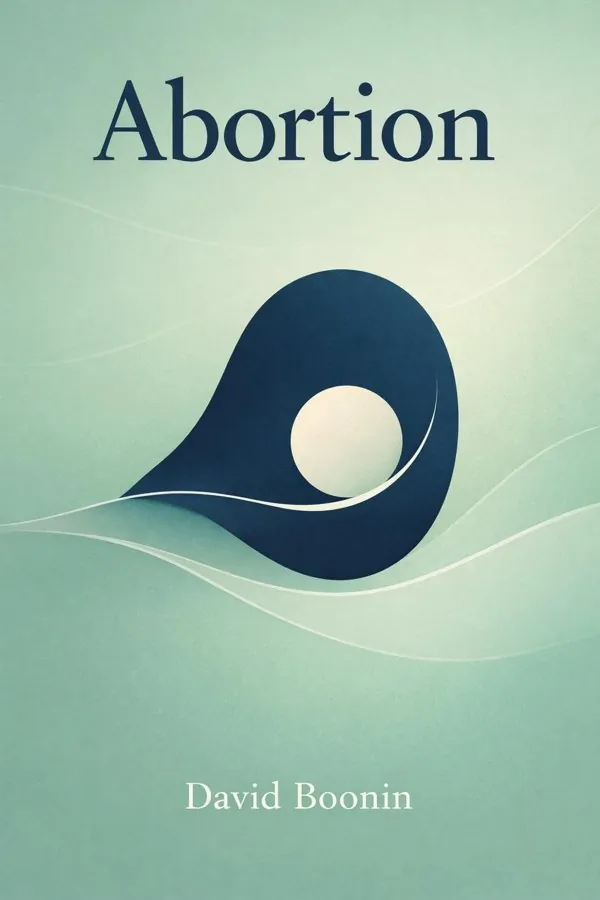
Abortion: Summary & Key Insights
by David Boonin
 10 min9 chaptersAudio available
What Is Abortion About?
Abortion by David Boonin is a ethics book spanning 9 pages. This book offers a comprehensive philosophical analysis of the moral and ethical issues surrounding abortion. Boonin examines arguments for and against abortion rights, exploring questions of personhood, moral status, and the implications of bodily autonomy. The work is recognized for its rigorous reasoning and balanced approach to one of the most controversial topics in applied ethics.
This FizzRead summary covers all 9 key chapters of Abortion in approximately 10 minutes, distilling the most important ideas, arguments, and takeaways from David Boonin's work. Also available as an audio summary and Key Quotes Podcast.
Abortion
This book offers a comprehensive philosophical analysis of the moral and ethical issues surrounding abortion. Boonin examines arguments for and against abortion rights, exploring questions of personhood, moral status, and the implications of bodily autonomy. The work is recognized for its rigorous reasoning and balanced approach to one of the most controversial topics in applied ethics.
Who Should Read Abortion?
This book is perfect for anyone interested in ethics and looking to gain actionable insights in a short read. Whether you're a student, professional, or lifelong learner, the key ideas from Abortion by David Boonin will help you think differently.
- ✓Readers who enjoy ethics and want practical takeaways
- ✓Professionals looking to apply new ideas to their work and life
- ✓Anyone who wants the core insights of Abortion in just 10 minutes
Want the full summary?
Get instant access to this book summary and 100K+ more with Fizz Moment.
Get Free SummaryAvailable on App Store • Free to download
Key Chapters
Before venturing into the moral terrain, I had to clear away ambiguities that tend to cloud the debate. The word ‘abortion’ triggers political battles, but in philosophy we must distinguish meaning carefully. There are moral questions—what is right or wrong—and legal questions—what ought to be permitted or restricted by law. While overlapping, these are not identical; a morally questionable act might be legally protected, and vice versa. My focus in this book is squarely on the moral dimension.
Another cluster of terms—human life, personhood, and moral status—requires precision. Not everything biologically human has full moral status. A skin cell is human; so is an early-stage embryo. But we do not mourn the removal of skin cells as we mourn the death of a person. This difference compels us to examine what 'personhood' means. Philosophical traditions vary: some emphasize rational capacities, others self-awareness, or the ability to desire continuation of existence. Once we define personhood in this way, we can analyze where and how the fetus fits into this framework.
Human life begins at conception, in a biological sense; this is uncontroversial. Yet conception alone does not confer personhood, because moral status arises from traits that make moral consideration appropriate—traits like consciousness, interests, and autonomy. Recognizing these distinctions allows us to navigate the arguments ahead. Without conceptual clarity, claims about rights and wrongs collapse into emotional assertion. My approach throughout this book rests on these distinctions as guiding lights for every subsequent argument.
The next step is to examine the reasoning that grounds opposition to abortion. Most pro-life arguments hinge on the claim that the fetus is a person from conception and therefore has a right to life equal to any other person. I treat this claim with seriousness, analyzing its variations and philosophical underpinnings. The argument’s power lies in its apparent simplicity—if the fetus is a person, then killing it is morally wrong. But philosophical scrutiny demands we ask: what exactly grants a being the status of 'person'? If it is mere membership in the species Homo sapiens, then any human organism, no matter how undeveloped, holds that status. Yet this approach leads to conceptual difficulties, for it would imply moral status for things like human tissue cultures.
Historically, pro-life thinkers invoke natural potential—the idea that since the embryo will naturally develop into a person under ordinary conditions, it should be treated as a person already. I show that this reasoning conflates potential with actuality. A potential doctor is not a doctor; likewise, a potential person is not yet a person. The argument also depends on metaphysical assumptions—about continuity, identity, and moral obligations—that I carefully unpack. My goal is not to dismiss these claims but to expose their logical structure and reveal whether they withstand scrutiny. Many intuitions underlying pro-life arguments are deeply human, but that does not guarantee philosophical soundness. I encourage readers to see how these intuitions can sometimes obscure the more difficult question: what foundation makes a moral right genuinely compelling?
+ 7 more chapters — available in the FizzRead app
All Chapters in Abortion
About the Author
David Boonin is an American philosopher and professor at the University of Colorado Boulder. His research focuses on ethics, applied philosophy, and social philosophy, with particular attention to controversial moral issues such as abortion, punishment, and animal rights.
Get This Summary in Your Preferred Format
Read or listen to the Abortion summary by David Boonin anytime, anywhere. FizzRead offers multiple formats so you can learn on your terms — all free.
Available formats: App · Audio · PDF · EPUB — All included free with FizzRead
Download Abortion PDF and EPUB Summary
Key Quotes from Abortion
“Before venturing into the moral terrain, I had to clear away ambiguities that tend to cloud the debate.”
“The next step is to examine the reasoning that grounds opposition to abortion.”
Frequently Asked Questions about Abortion
Abortion by David Boonin is a ethics book that explores key ideas across 9 chapters. This book offers a comprehensive philosophical analysis of the moral and ethical issues surrounding abortion. Boonin examines arguments for and against abortion rights, exploring questions of personhood, moral status, and the implications of bodily autonomy. The work is recognized for its rigorous reasoning and balanced approach to one of the most controversial topics in applied ethics.
You Might Also Like
What We Owe the Future
William MacAskill
10 min
Blind Spots: Why We Fail to Do What's Right and What to Do About It
Max H. Bazerman, Ann E. Tenbrunsel
10 min
Digital Ethics: Research and Practice
Christopher Burr, Luciano Floridi (Editors)
10 min
Doing Good Better: Effective Altruism and a Radical New Way to Make a Difference
William MacAskill
10 min
Eating Animals
Jonathan Safran Foer
10 min
Ethics of Artificial Intelligence
Various Authors
10 minFeatured In
Browse by Category
Ready to read Abortion?
Get the full summary and 100K+ more books with Fizz Moment.