
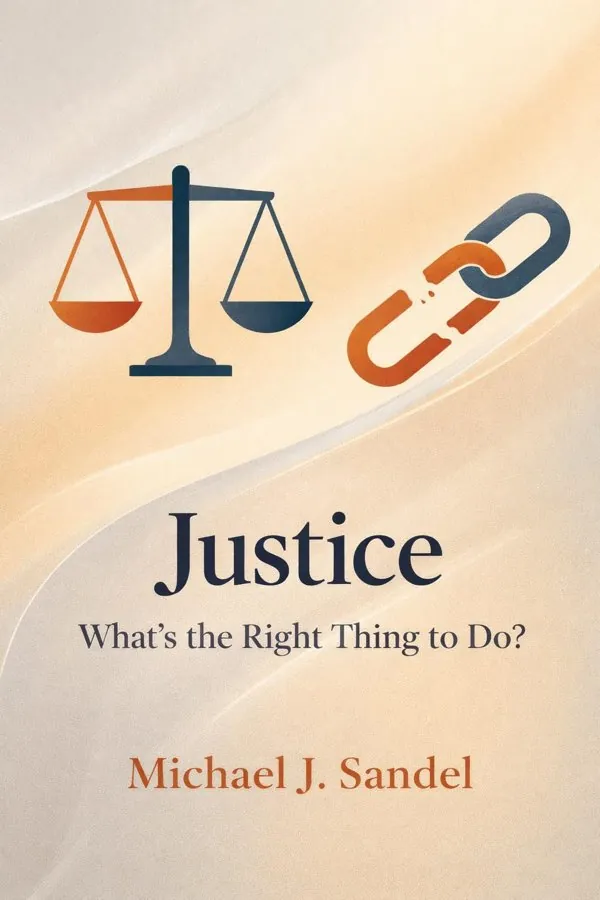
Justice: What's the Right Thing to Do?: Summary & Key Insights
 10 min10 chaptersAudio available
Key Takeaways from Justice: What's the Right Thing to Do?
Many public policies sound neutral until we ask a deeper question: should justice really be measured by the greatest happiness for the greatest number?
Freedom becomes morally charged when we ask whether people own themselves completely.
We often talk as if markets simply allocate goods efficiently, but Sandel insists that markets also express values.
Equality is not just about equal outcomes; it is also about whether social arrangements respect people as moral equals.
A good society does more than protect rights; it also shapes character.
What Is Justice: What's the Right Thing to Do? About?
Justice: What's the Right Thing to Do? by Michael J. Sandel is a ethics book spanning 10 pages. Justice: What's the Right Thing to Do? is Michael J. Sandel’s lively, accessible exploration of one of the oldest and most urgent human questions: how should we live together fairly? Rather than beginning with abstract theory alone, Sandel starts with gripping real-world dilemmas—price gouging after disasters, military drafts, affirmative action, same-sex marriage, and the buying and selling of social goods. From there, he guides readers through the major traditions of moral and political philosophy, including utilitarianism, libertarianism, Kantian ethics, Rawlsian fairness, and Aristotelian virtue. What makes this book matter is not only the range of ideas it covers, but the way it shows that public life is already saturated with moral argument. Debates about markets, rights, equality, and responsibility cannot be settled by economics or law alone; they require judgments about what is worthy, fair, and good. Sandel, a renowned Harvard political philosopher whose “Justice” course reached millions worldwide, brings rare clarity and energy to these debates. The result is a book that sharpens moral reasoning, deepens civic awareness, and invites readers to participate more thoughtfully in democratic life.
This FizzRead summary covers all 10 key chapters of Justice: What's the Right Thing to Do? in approximately 10 minutes, distilling the most important ideas, arguments, and takeaways from Michael J. Sandel's work. Also available as an audio summary and Key Quotes Podcast.
Justice: What's the Right Thing to Do?
Justice: What's the Right Thing to Do? is Michael J. Sandel’s lively, accessible exploration of one of the oldest and most urgent human questions: how should we live together fairly? Rather than beginning with abstract theory alone, Sandel starts with gripping real-world dilemmas—price gouging after disasters, military drafts, affirmative action, same-sex marriage, and the buying and selling of social goods. From there, he guides readers through the major traditions of moral and political philosophy, including utilitarianism, libertarianism, Kantian ethics, Rawlsian fairness, and Aristotelian virtue.
What makes this book matter is not only the range of ideas it covers, but the way it shows that public life is already saturated with moral argument. Debates about markets, rights, equality, and responsibility cannot be settled by economics or law alone; they require judgments about what is worthy, fair, and good. Sandel, a renowned Harvard political philosopher whose “Justice” course reached millions worldwide, brings rare clarity and energy to these debates. The result is a book that sharpens moral reasoning, deepens civic awareness, and invites readers to participate more thoughtfully in democratic life.
Who Should Read Justice: What's the Right Thing to Do??
This book is perfect for anyone interested in ethics and looking to gain actionable insights in a short read. Whether you're a student, professional, or lifelong learner, the key ideas from Justice: What's the Right Thing to Do? by Michael J. Sandel will help you think differently.
- ✓Readers who enjoy ethics and want practical takeaways
- ✓Professionals looking to apply new ideas to their work and life
- ✓Anyone who wants the core insights of Justice: What's the Right Thing to Do? in just 10 minutes
Want the full summary?
Get instant access to this book summary and 100K+ more with Fizz Moment.
Get Free SummaryAvailable on App Store • Free to download
Key Chapters
Many public policies sound neutral until we ask a deeper question: should justice really be measured by the greatest happiness for the greatest number? Sandel begins with utilitarianism because it offers a powerful and tempting answer. Associated with Jeremy Bentham and later refined by John Stuart Mill, utilitarianism argues that the right action is the one that maximizes overall welfare and minimizes suffering. It has enormous appeal in law, economics, and public policy because it promises a clear, practical standard for decision-making.
But Sandel shows that this approach, while elegant, can justify troubling conclusions. If sacrificing the interests of a few would create a larger benefit for many, utilitarian logic may permit it. That becomes morally uncomfortable in cases involving torture, forced sacrifice, or the exploitation of minorities. Even in more ordinary settings—such as setting healthcare priorities, designing traffic laws, or allocating scarce resources—utilitarianism can flatten moral distinctions by reducing everything to preference satisfaction.
Mill tried to improve Bentham’s crude arithmetic by distinguishing higher and lower pleasures, suggesting that human dignity and intellectual development matter more than raw sensation. Yet this refinement also raises a problem: who gets to decide which pleasures are higher? Sandel’s point is not that consequences do not matter, but that justice cannot be reduced to calculation alone.
In everyday life, utilitarian reasoning appears when companies optimize policies for customer satisfaction, governments justify surveillance for public safety, or institutions make decisions based on aggregate outcomes. These choices may be efficient, but efficiency is not always fairness.
Actionable takeaway: When evaluating a policy or decision, ask not only “Will this maximize benefits?” but also “Whose rights, dignity, or moral claims might be ignored in the process?”
Freedom becomes morally charged when we ask whether people own themselves completely. Libertarianism answers yes. Sandel presents this view as a forceful defense of individual liberty against paternalism and redistribution. Thinkers such as Robert Nozick argue that justice means respecting voluntary choices and property rights, not engineering social outcomes. If people acquire wealth fairly and exchange it freely, then taking some of it through taxation for redistributive purposes can look like a form of coercion.
This view has intuitive force. It honors personal responsibility, protects freedom of contract, and limits state intrusion. In practical terms, libertarianism supports free markets, opposes many forms of regulation, and treats taxation beyond minimal state functions with suspicion. It also resonates with everyday moral instincts: if I earned something honestly, why should others have a claim on it?
Yet Sandel reveals the limits of this framework. Libertarianism assumes that voluntary exchange is enough to guarantee justice, but many exchanges occur under unequal conditions. A desperately poor worker may “choose” exploitative labor, but is that choice fully free in a morally meaningful sense? Likewise, inherited wealth, social privilege, and unequal starting points complicate the idea that markets simply reward merit.
Sandel also pushes on the moral meaning of citizenship. Are we merely separate individuals with rights, or are we members of a political community with obligations to support public institutions and one another? A society governed only by noninterference may preserve liberty, but it may struggle to justify solidarity.
This debate appears in controversies over taxes, healthcare mandates, drug laws, organ sales, and business regulation. Libertarianism clarifies the value of freedom, but it may understate the importance of fairness and shared responsibility.
Actionable takeaway: Before defending or criticizing state intervention, distinguish carefully between protecting freedom, correcting coercion, and promoting the common good.
We often talk as if markets simply allocate goods efficiently, but Sandel insists that markets also express values. Once money enters an activity, the meaning of that activity can change. This is one of the book’s most practical and provocative insights. Buying and selling are not merely technical exchanges; they can reshape social norms, civic relationships, and ideas of worth.
Consider familiar examples: paying children to read, hiring line-standers to wait for congressional hearings, selling naming rights to public spaces, or allowing wealthy people to buy access, speed, and privilege. In each case, the question is not only whether a market works, but whether the good being exchanged should be treated as a commodity at all. Some things, Sandel argues, are degraded when bought and sold.
This matters because modern societies increasingly rely on markets to organize areas once governed by nonmarket norms. Education, healthcare, environmental policy, civic duty, and even human body parts can become objects of pricing. Market reasoning is attractive because it seems flexible and efficient. Yet if everything is up for sale, then inequalities in wealth begin to shape every domain of life, and citizenship itself can become unequal.
Sandel does not claim that markets are always wrong. Rather, he argues that they need moral limits. Some goods should be distributed by need, merit, or democratic equality rather than willingness to pay. A military service medal, a vote, a jury summons, or a child’s education carries social meanings that market exchange may corrupt.
In daily life, this insight applies whenever organizations use financial incentives to motivate behavior. Incentives can be useful, but they may crowd out duty, intrinsic motivation, or civic responsibility.
Actionable takeaway: When faced with a proposal to use prices or incentives, ask two questions: Is it fair, and does it corrupt the meaning of the good being exchanged?
Equality is not just about equal outcomes; it is also about whether social arrangements respect people as moral equals. Sandel explores modern theories of fairness by engaging John Rawls, who asked what principles of justice people would choose if they did not know their own social position, talents, class, religion, or race. Behind this “veil of ignorance,” people would be less likely to design institutions that unfairly favor themselves.
Rawls’s thought experiment is powerful because it connects fairness with impartiality. If no one knew whether they would be rich or poor, healthy or disabled, privileged or marginalized, they would likely endorse basic liberties for all and permit inequalities only if those inequalities improved the position of the least advantaged. This reframes justice away from reward and desert toward fairness in the design of institutions.
Sandel appreciates Rawls’s brilliance while also probing its limits. Rawls treats natural talents as morally arbitrary. Being born gifted, wealthy, or socially connected is not something we earn. That insight challenges the common belief that the successful simply deserve everything they receive. Still, Sandel asks whether a purely procedural account of justice can remain fully neutral about moral and civic goods.
The practical relevance is enormous. Debates over taxation, education, healthcare, social insurance, and labor policy all turn on whether inequalities arise from fair conditions or from arbitrary luck. For example, should elite universities reward only achievement, or also account for structural barriers? Should tax policy treat wealth as solely private property, or partly as a social product sustained by public institutions?
Thinking this way builds humility. Much of what people call merit rests on circumstances they did not choose.
Actionable takeaway: When judging inequality, look beyond outcomes and ask whether the underlying rules would seem fair if you did not know where you would land within them.
A good society does more than protect rights; it also shapes character. This older idea, rooted in Aristotle, stands at the center of Sandel’s challenge to modern liberalism. Aristotle argued that justice cannot be separated from the purpose of social practices and the virtues they cultivate. To know who deserves what, we must know what a good life and a good community are for.
This view differs sharply from theories that try to remain neutral among competing ideas of the good. Sandel suggests that neutrality is often impossible. Public debates about education, family, marriage, citizenship, and service inevitably involve judgments about virtues such as responsibility, courage, loyalty, and respect. We are not only consumers with preferences; we are citizens formed by institutions, traditions, and shared purposes.
Examples make this vivid. Should universities aim merely to provide skills, or to cultivate civic judgment? Should military service be outsourced to markets, or seen as a shared civic duty? Should public office be treated as a career path, or as stewardship? In each case, the question is not just what arrangement maximizes satisfaction or protects choice, but what kind of people and community it encourages.
Sandel does not romanticize community. Appeals to virtue can become exclusionary or oppressive if they silence dissent or enforce conformity. But he argues that avoiding moral discourse altogether leaves democratic life thin and fragmented. Citizens need a language for discussing the common good, not just rights and interests.
In ordinary life, this idea reminds us that schools, workplaces, neighborhoods, and political institutions all educate us morally, whether they intend to or not. Habits of service, honesty, and mutual respect do not arise automatically.
Actionable takeaway: Evaluate institutions not only by what they deliver, but by the character, habits, and civic virtues they encourage in the people shaped by them.
Few issues expose hidden assumptions about justice more clearly than affirmative action. At first glance, the debate seems to pit equality against fairness, but Sandel shows that the real conflict runs deeper: what is merit, what is education for, and what do institutions owe a diverse society?
Critics of affirmative action often claim that admissions or hiring should be color-blind and based solely on measurable achievement. This appears fair because it treats individuals as individuals. But Sandel asks whether achievement can ever be separated from social context. Test scores, extracurricular opportunities, polished applications, and legacy networks are shaped by family resources, neighborhood conditions, school quality, and cultural capital. If opportunity is unequal, then “neutral” criteria may simply preserve existing advantages.
Defenders of affirmative action offer different justifications. One is compensatory: helping correct historical injustice. Another is diversity-based: creating educational environments that better fulfill the mission of institutions by bringing different experiences and perspectives together. Sandel is especially interested in this latter argument because it shifts the focus from private entitlement to institutional purpose. A university is not merely awarding prizes to the most individually deserving applicants; it is assembling a community of learning.
This reframing matters far beyond admissions. Companies, public agencies, and civic organizations also face questions about representation, inclusion, and what counts as excellence. If success is always interpreted as the product of individual effort alone, institutions ignore how deeply social advantage shapes performance.
The issue remains emotionally charged because it touches identity, achievement, and recognition. Sandel’s contribution is to show that the debate cannot be resolved by procedural slogans alone. It depends on what ends institutions exist to serve.
Actionable takeaway: In controversies over selection and opportunity, move beyond “who deserves it?” and ask “what is this institution for, and which admissions or hiring criteria best serve that purpose fairly?”
Modern societies often treat consent as the gold standard of legitimacy. If two adults agree to an arrangement freely, many assume that justice is satisfied. Sandel complicates this assumption. Consent is morally important, but it is not always sufficient. Agreements can be voluntary in a legal sense while still reflecting desperation, inequality, manipulation, or morally troubling purposes.
Sandel explores this tension through cases involving military service, risky labor, surrogacy, and self-imposed obligations. Suppose someone agrees to an exploitative contract because poverty leaves no real alternative. Or imagine a person sells a deeply personal good under pressure. Was the transaction genuinely free, or merely formally voluntary? Likewise, even where consent is clear, the thing consented to may still be objectionable because it degrades persons or civic norms.
This insight challenges both libertarian and overly procedural ways of thinking. A just society cannot simply check whether a box was signed. It must also ask whether background conditions are fair and whether the object of exchange or agreement should be subject to consent in the first place. We do not allow people to sell themselves into slavery, for example, because some goods and statuses are incompatible with human dignity.
The lesson applies in workplaces, digital platforms, healthcare, and consumer life. Terms of service are technically agreed to, but few people can negotiate them. Employees may “accept” intrusive monitoring because refusal means unemployment. Students may “choose” debt because education is tied to future opportunity. Consent matters, yet it exists within structures of power.
Sandel pushes readers to move from a thin notion of choice to a richer idea of moral agency and social justice.
Actionable takeaway: Whenever consent is cited to justify an arrangement, ask two follow-up questions: Were the conditions genuinely fair, and is the thing being agreed to morally appropriate for consent-based exchange?
Not every valuable thing becomes more legitimate when a price is attached to it. Sandel’s critique of market triumphalism reaches its sharpest point when he argues that a society drifting toward “everything for sale” risks both unfairness and corruption. Unfairness arises because unequal wealth gives some people greater access to education, healthcare, influence, and even cleaner air or shorter waiting times. Corruption arises because market valuation can crowd out the norms appropriate to certain goods.
Think of blood donation, voting, jury service, friendship, or academic integrity. Paying for these may increase supply or convenience, but it can also alter their meaning. A vote is not merely a transferable asset; jury service is not just a burden to outsource; friendship is not a service to invoice. Some goods are properly governed by civic duty, altruism, honor, or equal citizenship. Introducing cash may not simply regulate them more efficiently; it may transform them into something lesser.
Sandel’s warning is especially relevant in highly commercial cultures. The logic of monetization spreads easily: if an activity can be incentivized, optimized, and traded, why not treat it as a market? Yet that mindset can hollow out public life. When every inconvenience can be bought away by those with means, citizens no longer share the same institutions or burdens.
This is visible in premium public services, private school admissions consulting, political access, concierge medicine, and environmental offsets that allow the wealthy to insulate themselves from common constraints. Markets may solve coordination problems while simultaneously deepening moral and civic inequalities.
The solution is not anti-market absolutism, but moral discrimination: deciding which goods belong in markets and which should remain governed by nonmarket norms.
Actionable takeaway: Make a habit of separating what can be sold from what should be sold, especially in areas involving dignity, citizenship, education, health, and democratic participation.
Democracy weakens when citizens stop debating substantive moral questions. Sandel’s culminating claim is that justice cannot be understood solely as maximizing welfare, respecting choice, or distributing rights fairly. It also requires public reasoning about the common good—about what we owe one another as members of a shared political community.
This is a demanding idea because it rejects the comfort of moral minimalism. Many modern political theories try to avoid conflict by keeping public life neutral among competing values. Sandel argues that this strategy often fails. Questions about war, inequality, citizenship, education, family, and the role of markets inevitably involve judgments about virtue, honor, and social purpose. Rather than suppress such disagreements, democratic life should cultivate better ways of engaging them.
A politics of the common good does not mean imposing one worldview by force. It means acknowledging that self-government requires more than procedures. Citizens need to deliberate about the ends of collective life, listen across disagreement, and develop civic habits that make shared sacrifice and mutual respect possible. This richer civic ideal helps explain why purely technocratic politics feels hollow. Expertise matters, but public life also depends on moral argument.
For readers, this final lesson ties together the book’s many case studies. The controversies Sandel examines are not isolated issues; they are invitations to recover citizenship as a moral practice. Justice is not something experts calculate for us from a distance. It emerges through thoughtful participation in public reasoning.
In practical terms, this means asking broader questions in everyday civic life: What kind of society are we becoming? Which values do our institutions reward? What responsibilities accompany our rights?
Actionable takeaway: Participate in civic debates with a willingness to discuss not only interests and rules, but also the shared goods and moral purposes that a just society should serve.
All Chapters in Justice: What's the Right Thing to Do?
About the Author
Michael J. Sandel is an American political philosopher and Anne T. and Robert M. Bass Professor of Government at Harvard University. He is widely known for bringing philosophy into public conversation through his celebrated course “Justice,” which became one of Harvard’s most popular classes and later reached global audiences through television and online platforms. Sandel’s work focuses on ethics, democracy, civic obligation, inequality, and the moral limits of markets. Often associated with communitarian critiques of liberal individualism, he challenges the idea that politics can remain neutral about moral and civic values. In addition to Justice: What's the Right Thing to Do?, he is the author of influential books such as Liberalism and the Limits of Justice, What Money Can’t Buy, and The Tyranny of Merit. His writing is known for clarity, accessibility, and public relevance.
Get This Summary in Your Preferred Format
Read or listen to the Justice: What's the Right Thing to Do? summary by Michael J. Sandel anytime, anywhere. FizzRead offers multiple formats so you can learn on your terms — all free.
Available formats: App · Audio · PDF · EPUB — All included free with FizzRead
Download Justice: What's the Right Thing to Do? PDF and EPUB Summary
Key Quotes from Justice: What's the Right Thing to Do?
“Many public policies sound neutral until we ask a deeper question: should justice really be measured by the greatest happiness for the greatest number?”
“Freedom becomes morally charged when we ask whether people own themselves completely.”
“We often talk as if markets simply allocate goods efficiently, but Sandel insists that markets also express values.”
“Equality is not just about equal outcomes; it is also about whether social arrangements respect people as moral equals.”
“A good society does more than protect rights; it also shapes character.”
Frequently Asked Questions about Justice: What's the Right Thing to Do?
Justice: What's the Right Thing to Do? by Michael J. Sandel is a ethics book that explores key ideas across 10 chapters. Justice: What's the Right Thing to Do? is Michael J. Sandel’s lively, accessible exploration of one of the oldest and most urgent human questions: how should we live together fairly? Rather than beginning with abstract theory alone, Sandel starts with gripping real-world dilemmas—price gouging after disasters, military drafts, affirmative action, same-sex marriage, and the buying and selling of social goods. From there, he guides readers through the major traditions of moral and political philosophy, including utilitarianism, libertarianism, Kantian ethics, Rawlsian fairness, and Aristotelian virtue. What makes this book matter is not only the range of ideas it covers, but the way it shows that public life is already saturated with moral argument. Debates about markets, rights, equality, and responsibility cannot be settled by economics or law alone; they require judgments about what is worthy, fair, and good. Sandel, a renowned Harvard political philosopher whose “Justice” course reached millions worldwide, brings rare clarity and energy to these debates. The result is a book that sharpens moral reasoning, deepens civic awareness, and invites readers to participate more thoughtfully in democratic life.
More by Michael J. Sandel

The Tyranny of Merit: What's Become of the Common Good?
Michael J. Sandel
10 min
What Money Can't Buy: The Moral Limits of Markets
Michael J. Sandel
10 min
Democracy's Discontent: America in Search of a Public Philosophy
Michael J. Sandel
10 min
Public Philosophy: Essays on Morality in Politics
Michael J. Sandel
10 minYou Might Also Like

What We Owe the Future
William MacAskill
10 min
Abortion
David Boonin
10 min
Blind Spots: Why We Fail to Do What's Right and What to Do About It
Max H. Bazerman, Ann E. Tenbrunsel
10 min
Digital Ethics: Research and Practice
Christopher Burr, Luciano Floridi (Editors)
10 min
Doing Good Better: Effective Altruism and a Radical New Way to Make a Difference
William MacAskill
10 min
Eating Animals
Jonathan Safran Foer
10 minBrowse by Category
Ready to read Justice: What's the Right Thing to Do??
Get the full summary and 100K+ more books with Fizz Moment.