
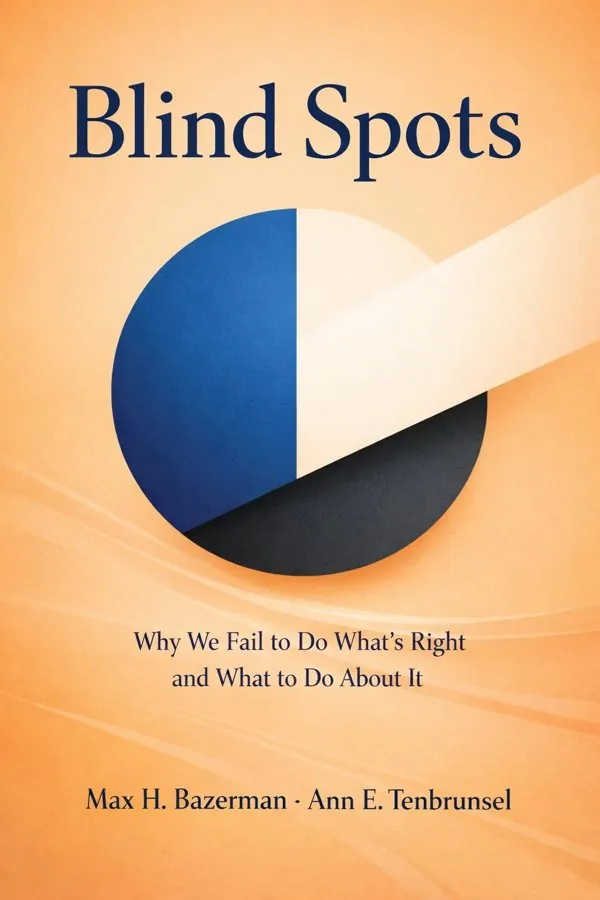
Blind Spots: Why We Fail to Do What's Right and What to Do About It: Summary & Key Insights
by Max H. Bazerman, Ann E. Tenbrunsel
 10 min6 chaptersAudio available
What Is Blind Spots: Why We Fail to Do What's Right and What to Do About It About?
Blind Spots: Why We Fail to Do What's Right and What to Do About It by Max H. Bazerman, Ann E. Tenbrunsel is a ethics book spanning 6 pages. This book explores the psychological and organizational factors that cause people and institutions to act unethically without realizing it. Drawing on behavioral research, the authors explain how cognitive biases and self-deception create 'blind spots' that prevent ethical awareness, and they offer strategies to recognize and correct these biases in decision-making.
This FizzRead summary covers all 6 key chapters of Blind Spots: Why We Fail to Do What's Right and What to Do About It in approximately 10 minutes, distilling the most important ideas, arguments, and takeaways from Max H. Bazerman, Ann E. Tenbrunsel's work. Also available as an audio summary and Key Quotes Podcast.
Blind Spots: Why We Fail to Do What's Right and What to Do About It
This book explores the psychological and organizational factors that cause people and institutions to act unethically without realizing it. Drawing on behavioral research, the authors explain how cognitive biases and self-deception create 'blind spots' that prevent ethical awareness, and they offer strategies to recognize and correct these biases in decision-making.
Who Should Read Blind Spots: Why We Fail to Do What's Right and What to Do About It?
This book is perfect for anyone interested in ethics and looking to gain actionable insights in a short read. Whether you're a student, professional, or lifelong learner, the key ideas from Blind Spots: Why We Fail to Do What's Right and What to Do About It by Max H. Bazerman, Ann E. Tenbrunsel will help you think differently.
- ✓Readers who enjoy ethics and want practical takeaways
- ✓Professionals looking to apply new ideas to their work and life
- ✓Anyone who wants the core insights of Blind Spots: Why We Fail to Do What's Right and What to Do About It in just 10 minutes
Want the full summary?
Get instant access to this book summary and 100K+ more with Fizz Moment.
Get Free SummaryAvailable on App Store • Free to download
Key Chapters
One of the most striking insights from our research is that our ethics—like our rationality—are bounded. Just as cognitive limitations prevent perfect reasoning, psychological boundaries restrict moral recognition. People fail to notice ethical dimensions of a decision because they frame it narrowly as a business or personal choice. A manager negotiating a contract may frame it in terms of profits and efficiency and not see the ethical implications for employees or customers. This bounded ethicality means even well-trained, morally committed individuals can behave in ways that contradict their values without realizing it.
Consider the classic example of auditors who review a firm’s accounts. Studies show they unconsciously interpret ambiguous data in favor of their client—the one who pays them—even though they see themselves as objective. Their professional ethics don’t vanish; they simply fade behind the frame of professional duty and a subtle self-serving bias. Bounded ethicality allows people to maintain moral self-regard while engaging in biased behavior.
What makes this especially concerning is that intentions aren’t enough. The structure of information, incentives, and cultural norms can render ethical dimensions invisible. To counter bounded ethicality, one must deliberately widen the frame of decision-making—asking not only, “What will this achieve?” but “Who might this affect, and is it consistent with my principles?” Reflection, accountability, and diverse perspectives help expand that frame and expose hidden impacts.
Each of us contains two selves that shape ethical behavior: the *should self*, which plans and aspires to ethical conduct, and the *want self*, which acts in the moment, pursuing immediate desires. We often overestimate the strength of our *should self*. Before facing temptation, people predict they’ll make ethical choices; they imagine rejecting bribes, whistleblowing against wrongdoing, or telling the truth despite consequences. Yet, when the moment arrives, the *want self* takes charge, rationalizing compromises as necessary or harmless.
Our experiments reveal that the discrepancy between these selves explains why people mispredict their ethical behavior. You may say, “I would never lie for convenience,” but under pressure from your boss or facing social disapproval, you rationalize that the lie isn’t serious. The *want self* is guided not by principle but by contextual emotions—fear, desire, approval. In organizations, this dynamic plays out vividly. Corporate scandals often originate from small ethical compromises justified by short-term goals or team loyalty, each step maintained by the *want self’s* reassurances.
Recognizing these competing selves allows you to prepare for ethical tests before they arise. By acknowledging the weakness of the *want self*, you can design precommitment strategies—setting clear standards, practicing transparency, and building decision processes that remind you of long-term values. Ethical strength, then, is not just about moral intention but about structuring environments so the *should self* speaks louder when decisions matter.
+ 4 more chapters — available in the FizzRead app
All Chapters in Blind Spots: Why We Fail to Do What's Right and What to Do About It
About the Authors
Max H. Bazerman is a professor at Harvard Business School specializing in negotiation, decision-making, and ethics. Ann E. Tenbrunsel is a professor of business ethics at the University of Notre Dame, focusing on ethical decision-making and behavioral ethics.
Get This Summary in Your Preferred Format
Read or listen to the Blind Spots: Why We Fail to Do What's Right and What to Do About It summary by Max H. Bazerman, Ann E. Tenbrunsel anytime, anywhere. FizzRead offers multiple formats so you can learn on your terms — all free.
Available formats: App · Audio · PDF · EPUB — All included free with FizzRead
Download Blind Spots: Why We Fail to Do What's Right and What to Do About It PDF and EPUB Summary
Key Quotes from Blind Spots: Why We Fail to Do What's Right and What to Do About It
“One of the most striking insights from our research is that our ethics—like our rationality—are bounded.”
“Each of us contains two selves that shape ethical behavior: the *should self*, which plans and aspires to ethical conduct, and the *want self*, which acts in the moment, pursuing immediate desires.”
Frequently Asked Questions about Blind Spots: Why We Fail to Do What's Right and What to Do About It
Blind Spots: Why We Fail to Do What's Right and What to Do About It by Max H. Bazerman, Ann E. Tenbrunsel is a ethics book that explores key ideas across 6 chapters. This book explores the psychological and organizational factors that cause people and institutions to act unethically without realizing it. Drawing on behavioral research, the authors explain how cognitive biases and self-deception create 'blind spots' that prevent ethical awareness, and they offer strategies to recognize and correct these biases in decision-making.
You Might Also Like
What We Owe the Future
William MacAskill
10 min
Abortion
David Boonin
10 min
Digital Ethics: Research and Practice
Christopher Burr, Luciano Floridi (Editors)
10 min
Doing Good Better: Effective Altruism and a Radical New Way to Make a Difference
William MacAskill
10 min
Eating Animals
Jonathan Safran Foer
10 min
Ethics of Artificial Intelligence
Various Authors
10 minFeatured In
Browse by Category
Ready to read Blind Spots: Why We Fail to Do What's Right and What to Do About It?
Get the full summary and 100K+ more books with Fizz Moment.