
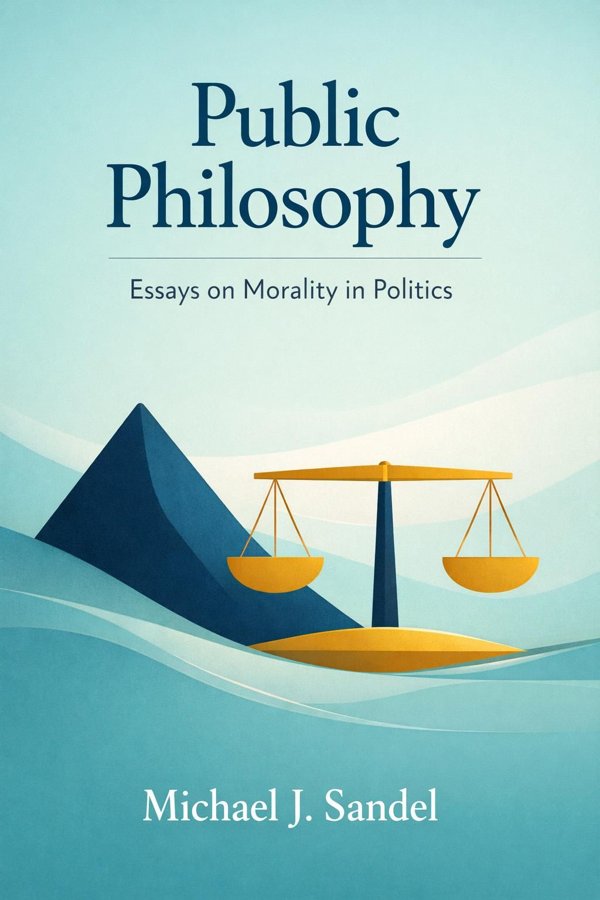
Public Philosophy: Essays on Morality in Politics: Summary & Key Insights
 10 min9 chaptersAudio available
Key Takeaways from Public Philosophy: Essays on Morality in Politics
A society cannot stay morally neutral forever, because even the decision to avoid moral judgment is itself a moral choice.
When politics loses its moral vocabulary, it often replaces purpose with process.
People often withdraw from politics not because they do not care, but because public life no longer speaks to what they care about most.
Justice is not only about what individuals can claim; it is also about what communities owe and what they hope to become together.
No theory of justice can avoid difficult moral judgments, because justice always depends on what we think human goods are for.
What Is Public Philosophy: Essays on Morality in Politics About?
Public Philosophy: Essays on Morality in Politics by Michael J. Sandel is a ethics book spanning 9 pages. Public Philosophy: Essays on Morality in Politics is Michael J. Sandel’s powerful challenge to the idea that politics should avoid moral disagreement. In this collection of essays, Sandel argues that modern public life has become too procedural, too managerial, and too reluctant to ask the deeper questions that actually shape democratic societies: What do we owe one another? What makes a just society? What is the common good? Rather than treating politics as a neutral system for managing competing interests, Sandel insists that democratic citizens must learn to reason together about values, character, responsibility, and shared purposes. The book matters because it speaks directly to a familiar frustration with contemporary politics: many public debates feel shallow, technocratic, or emotionally polarized, yet rarely morally serious. Sandel shows that avoiding moral argument does not create unity; it often produces civic emptiness and mutual mistrust. As one of the world’s most influential political philosophers and a longtime Harvard professor known for bringing ethics into public conversation, Sandel writes with unusual clarity and urgency. This book is both a diagnosis of democratic drift and an invitation to recover a richer, more humane public life.
This FizzRead summary covers all 9 key chapters of Public Philosophy: Essays on Morality in Politics in approximately 10 minutes, distilling the most important ideas, arguments, and takeaways from Michael J. Sandel's work. Also available as an audio summary and Key Quotes Podcast.
Public Philosophy: Essays on Morality in Politics
Public Philosophy: Essays on Morality in Politics is Michael J. Sandel’s powerful challenge to the idea that politics should avoid moral disagreement. In this collection of essays, Sandel argues that modern public life has become too procedural, too managerial, and too reluctant to ask the deeper questions that actually shape democratic societies: What do we owe one another? What makes a just society? What is the common good? Rather than treating politics as a neutral system for managing competing interests, Sandel insists that democratic citizens must learn to reason together about values, character, responsibility, and shared purposes.
The book matters because it speaks directly to a familiar frustration with contemporary politics: many public debates feel shallow, technocratic, or emotionally polarized, yet rarely morally serious. Sandel shows that avoiding moral argument does not create unity; it often produces civic emptiness and mutual mistrust. As one of the world’s most influential political philosophers and a longtime Harvard professor known for bringing ethics into public conversation, Sandel writes with unusual clarity and urgency. This book is both a diagnosis of democratic drift and an invitation to recover a richer, more humane public life.
Who Should Read Public Philosophy: Essays on Morality in Politics?
This book is perfect for anyone interested in ethics and looking to gain actionable insights in a short read. Whether you're a student, professional, or lifelong learner, the key ideas from Public Philosophy: Essays on Morality in Politics by Michael J. Sandel will help you think differently.
- ✓Readers who enjoy ethics and want practical takeaways
- ✓Professionals looking to apply new ideas to their work and life
- ✓Anyone who wants the core insights of Public Philosophy: Essays on Morality in Politics in just 10 minutes
Want the full summary?
Get instant access to this book summary and 100K+ more with Fizz Moment.
Get Free SummaryAvailable on App Store • Free to download
Key Chapters
A society cannot stay morally neutral forever, because even the decision to avoid moral judgment is itself a moral choice. Sandel’s critique begins with the liberal ideal of neutrality, the view that government should not endorse any particular vision of the good life. In modern political theory, this idea is often defended as a way to respect pluralism. If citizens disagree about religion, virtue, family, or human flourishing, then public institutions should supposedly remain neutral and simply protect individual rights.
Sandel argues that this aspiration sounds fair but fails in practice. Laws and institutions always rest on assumptions about what matters. Debates about abortion, marriage, education, welfare, free speech, or markets cannot be resolved by procedure alone, because they depend on contested ideas about human dignity, responsibility, and social purpose. When a government claims to be neutral, it often hides the moral commitments already built into its policies.
Consider public education. A curriculum is never value-free. It reflects beliefs about citizenship, history, character, and what young people should become. The same is true of tax policy, healthcare, and even city planning. Whether a society prioritizes consumption, family life, environmental stewardship, or civic participation reveals a substantive moral vision.
Sandel’s point is not that the state should impose one comprehensive doctrine on everyone. Rather, he believes democratic life requires open moral argument instead of pretending that such arguments can be avoided. Citizens need spaces where disagreements about the good can be expressed, examined, and contested.
Actionable takeaway: When you hear a policy described as “neutral,” ask what moral assumptions it already contains and whether those assumptions deserve public debate.
When politics loses its moral vocabulary, it often replaces purpose with process. Sandel describes this condition as the “procedural republic,” a political order that defines justice mainly through fair rules, rights, and procedures rather than through shared ends. In such a system, the highest political aspiration becomes keeping the peace among competing preferences, not cultivating a common good.
This framework has certain strengths. It can reduce coercion, protect minorities, and make coexistence possible in diverse societies. But Sandel believes it also creates a thin and unsatisfying civic life. If citizens meet one another only as bearers of rights and interests, rather than as members of a political community with mutual obligations, democracy becomes hollow. Public institutions start to look like service providers, and citizenship becomes more passive and consumer-like.
You can see this in the way many political debates are framed. Instead of asking what kind of society we want, public leaders often ask only whether a process was properly followed or whether individuals had freedom of choice. Important as those questions are, they leave out deeper issues: What should schools teach for? What responsibilities do the wealthy owe the poor? What forms of work deserve dignity? What sacrifices do citizens owe one another in times of crisis?
The procedural republic also weakens civic education. If political life is mainly about managing preferences, then citizens do not need moral judgment, only private opinion and legal awareness. Sandel thinks this impoverishes democracy and leaves people vulnerable to cynicism, resentment, and apathy.
Actionable takeaway: In discussions about public policy, move beyond asking whether procedures were fair and ask what shared purposes the policy serves.
People often withdraw from politics not because they do not care, but because public life no longer speaks to what they care about most. Sandel argues that modern democracies have encouraged a form of moral disengagement by treating political questions as technical matters for experts, courts, and bureaucracies. The result is a citizenry that feels simultaneously overmanaged and underrepresented.
When moral disagreement is pushed out of democratic debate, it does not disappear. It returns in distorted forms: culture wars, symbolic outrage, partisan tribalism, and suspicion toward elites. Citizens sense that major decisions reflect powerful moral assumptions, yet those assumptions are rarely argued openly. This gap between official neutrality and lived moral conflict creates frustration.
Take economic policy. Governments often present choices about deregulation, labor protections, or welfare as purely practical or data-driven. But these are also moral decisions about desert, dependency, dignity, and obligation. If leaders discuss only efficiency, many citizens feel that the language of fairness and respect has gone missing. Something similar happens in debates about national identity, immigration, and criminal justice. People want more than statistics; they want serious engagement with moral meaning.
Sandel does not romanticize political conflict. He knows moral argument can become heated and divisive. Still, he believes honest disagreement is healthier than technocratic avoidance. A vibrant democracy needs citizens who can articulate their convictions, listen across difference, and test their moral intuitions in public.
Actionable takeaway: If a political issue feels strangely distant or sterile, identify the moral questions beneath it and bring those questions back into the conversation.
Justice is not only about what individuals can claim; it is also about what communities owe and what they hope to become together. Sandel challenges highly individualistic pictures of political life by stressing the moral importance of community and the common good. He does not deny individual rights, but he rejects the idea that persons are best understood as detached choosers whose identities are independent of social ties.
In Sandel’s view, we are partly shaped by the communities we inhabit: families, neighborhoods, nations, religious traditions, and civic institutions. These attachments are not merely optional preferences. They help constitute our responsibilities and our sense of self. Because of this, political reasoning cannot be reduced to balancing individual interests. It must also ask how institutions sustain or weaken shared life.
The common good is not a slogan for forced conformity. It is an invitation to think about goods we can realize only together, such as public trust, civic friendship, environmental stewardship, accessible education, and a culture of mutual respect. A city with functioning parks, libraries, and public transit, for example, promotes more than convenience. It expresses a commitment to belonging and shared citizenship.
This idea has practical implications. Debates about zoning, healthcare, taxation, military service, and public holidays all involve competing visions of the common good. So do questions about whether economic arrangements support family stability, neighborhood life, and social mobility. Sandel wants citizens to see these not as merely private matters but as shared moral concerns.
Actionable takeaway: Evaluate public policies not only by how they expand choice, but by how they strengthen or erode the relationships and institutions that make common life possible.
No theory of justice can avoid difficult moral judgments, because justice always depends on what we think human goods are for. Sandel argues against the hope that political philosophy can settle public disputes through abstract principles alone. Rights matter, procedures matter, and fairness matters, but applying them requires substantive reasoning about merit, need, dignity, and purpose.
This is one reason Sandel is skeptical of purely formulaic approaches to justice. In many real-world disputes, we need to ask teleological questions: What is the institution for? What are the relevant virtues? What kind of activity is being protected or rewarded? A university, for example, is not just a sorting mechanism. A labor market is not just a price system. Marriage is not just a contract. To decide what justice demands in these domains, we must consider their social meaning.
Consider affirmative action. A neutral language of equal treatment may not be enough to decide the issue. One must also ask what higher education is meant to achieve: individual advancement, merit recognition, civic preparation, or a more inclusive public culture. The answer shapes the moral evaluation. The same logic applies to healthcare. Is medical care a commodity, a social good, or a basic condition of equal citizenship?
Sandel’s broader claim is that democracy needs citizens who can engage in this sort of reasoning without collapsing disagreement into hostility. Moral argument should not be a last resort; it should be a central democratic practice.
Actionable takeaway: When evaluating a fairness claim, ask not only who gets what, but what the relevant institution or practice is supposed to honor or achieve.
The expansion of markets changes more than prices; it changes the meaning of the goods being exchanged. Sandel repeatedly warns against treating market logic as morally neutral or universally appropriate. Markets are useful tools, but they are not the proper measure of every social practice. Some things are degraded when bought and sold.
This argument matters because modern societies increasingly use incentives, pricing, and privatization to solve public problems. We pay students to read, outsource prisons, commercialize healthcare, and assess educational success in market-style terms. These strategies may improve efficiency in some cases, but Sandel asks a prior question: What moral norms are displaced when market norms move in?
Take blood donation. If a society pays people for blood, the transaction may become more efficient, but it may also weaken the ethic of gift-giving and civic generosity. Or consider organ sales, paid surrogacy, and the privatization of public space. In each case, market exchange does not simply allocate a good; it reshapes how people value bodies, relationships, and citizenship.
Sandel does not argue that markets are evil or always corrupting. His point is that economic reasoning cannot decide where markets belong. That boundary must be drawn through moral and political judgment. A healthy democracy should ask which goods should remain governed by norms of care, honor, solidarity, or public service rather than by willingness to pay.
Actionable takeaway: Before supporting a market-based solution, ask not only whether it works efficiently, but whether it changes the character of the good or practice involved.
A democracy cannot survive on rights alone; it also depends on habits of responsibility, sacrifice, and mutual concern. Sandel argues that one of the central failures of contemporary liberal politics is its weak account of citizenship. If politics is mainly about securing fair procedures for private pursuits, then civic duty appears burdensome or optional. But if self-government is a shared project, then citizenship carries ethical obligations.
Solidarity does not mean agreement on everything. It means recognizing that our fates are connected in ways that generate duties beyond contract and consent. Citizens benefit from public institutions they did not create alone: roads, schools, legal systems, peace, inherited freedoms, and social trust. Because we are shaped by these goods, we owe something back.
This perspective affects how we think about taxes, jury service, military service, public health, and care for vulnerable populations. During a pandemic, for instance, masks, vaccines, and temporary restrictions cannot be understood only through the lens of individual preference. They also involve responsibilities to neighbors and strangers. In education, solidarity may support funding systems that do not abandon poor communities. In economic life, it may justify stronger support for workers displaced by structural change.
Sandel wants to revive a civic ethic in which people see themselves as co-authors of public life rather than isolated claimants. Without that ethic, inequality deepens, trust falls, and democratic institutions appear remote.
Actionable takeaway: Practice citizenship by asking, in any public issue, not just “What are my rights?” but also “What do I owe the community that sustains me?”
Excluding religious arguments from public life does not guarantee fairness; it can simply silence some citizens at the deepest level of conviction. Sandel argues that religion should not be banished from democratic discourse in the name of public reason. In pluralist societies, many people understand justice, dignity, and obligation through religious traditions. Asking them to translate all of their reasons into secular language may distort rather than elevate democratic debate.
This does not mean religious doctrine should automatically govern law, nor that theological claims should be immune from criticism. Sandel’s point is more modest and more democratic: citizens should be free to bring their moral and religious convictions into public argument, where they can be challenged, defended, and debated like other moral views. Democracy should not privilege secular language as the only acceptable vocabulary of seriousness.
Public movements often illustrate this. The civil rights movement in the United States drew enormous power from biblical language, religious ritual, and theological ideas about human equality. To exclude such language would have drained the movement of much of its moral force. The same is true of many campaigns around poverty, peace, immigration, and social justice.
Of course, public debate still requires reciprocity and respect. Religious citizens should engage opponents as fellow members of a shared political community, not as people to be defeated by revelation alone. But secular citizens also have a responsibility to engage religious arguments fairly rather than dismiss them as irrational by definition.
Actionable takeaway: In public debate, judge arguments by their moral substance and civic spirit, not by whether their deepest roots are secular or religious.
The health of a democracy depends less on the absence of moral conflict than on the quality of moral argument it can sustain. Sandel’s central practical lesson is that democratic life requires citizens to reason together about contested values rather than retreat into silence, procedure, or slogans. Avoiding moral disagreement may seem civil, but in the long run it leaves public life brittle, shallow, and vulnerable to demagogues.
Moral argument, in Sandel’s sense, is not preaching. It is the disciplined effort to explain why a law or policy expresses a certain vision of justice, dignity, virtue, or the good society. It invites disagreement, but also accountability. Citizens must give reasons, confront counterarguments, and acknowledge the ethical stakes of collective decisions.
This is especially important in polarized times. When people feel that elites refuse to name the moral dimensions of policy, they often turn to more simplistic and aggressive forms of identity politics. A richer public philosophy can reduce this temptation by giving citizens more meaningful ways to contest shared questions. For example, debates about immigration become more productive when they move beyond fear and legality alone toward questions of hospitality, national purpose, and obligation. Debates about inequality improve when they include concerns about dignity, merit, and the social meaning of work.
Sandel’s hope is not consensus on every issue. It is a stronger democratic culture in which citizens become capable of serious disagreement without abandoning the common project.
Actionable takeaway: Strengthen democratic life by practicing moral clarity with humility: state your values openly, listen seriously, and treat disagreement as part of citizenship rather than a failure of it.
All Chapters in Public Philosophy: Essays on Morality in Politics
About the Author
Michael J. Sandel is an American political philosopher and longtime professor at Harvard University, where he has taught political theory for decades. He is widely recognized for bringing philosophy into public life through his teaching, lectures, and bestselling books. Sandel first gained broad attention for his critique of liberal political theory, especially the idea that justice can be separated from moral conceptions of the good life. He later became internationally known through his celebrated Harvard course Justice, which reached millions through recordings and public discussions. His major works include Liberalism and the Limits of Justice, Justice, What Money Can’t Buy, and The Tyranny of Merit. Across his writing, Sandel explores ethics, citizenship, democracy, markets, and the common good with unusual clarity and public relevance.
Get This Summary in Your Preferred Format
Read or listen to the Public Philosophy: Essays on Morality in Politics summary by Michael J. Sandel anytime, anywhere. FizzRead offers multiple formats so you can learn on your terms — all free.
Available formats: App · Audio · PDF · EPUB — All included free with FizzRead
Download Public Philosophy: Essays on Morality in Politics PDF and EPUB Summary
Key Quotes from Public Philosophy: Essays on Morality in Politics
“A society cannot stay morally neutral forever, because even the decision to avoid moral judgment is itself a moral choice.”
“When politics loses its moral vocabulary, it often replaces purpose with process.”
“People often withdraw from politics not because they do not care, but because public life no longer speaks to what they care about most.”
“Justice is not only about what individuals can claim; it is also about what communities owe and what they hope to become together.”
“No theory of justice can avoid difficult moral judgments, because justice always depends on what we think human goods are for.”
Frequently Asked Questions about Public Philosophy: Essays on Morality in Politics
Public Philosophy: Essays on Morality in Politics by Michael J. Sandel is a ethics book that explores key ideas across 9 chapters. Public Philosophy: Essays on Morality in Politics is Michael J. Sandel’s powerful challenge to the idea that politics should avoid moral disagreement. In this collection of essays, Sandel argues that modern public life has become too procedural, too managerial, and too reluctant to ask the deeper questions that actually shape democratic societies: What do we owe one another? What makes a just society? What is the common good? Rather than treating politics as a neutral system for managing competing interests, Sandel insists that democratic citizens must learn to reason together about values, character, responsibility, and shared purposes. The book matters because it speaks directly to a familiar frustration with contemporary politics: many public debates feel shallow, technocratic, or emotionally polarized, yet rarely morally serious. Sandel shows that avoiding moral argument does not create unity; it often produces civic emptiness and mutual mistrust. As one of the world’s most influential political philosophers and a longtime Harvard professor known for bringing ethics into public conversation, Sandel writes with unusual clarity and urgency. This book is both a diagnosis of democratic drift and an invitation to recover a richer, more humane public life.
More by Michael J. Sandel
The Tyranny of Merit: What's Become of the Common Good?
Michael J. Sandel
10 min
Justice: What's the Right Thing to Do?
Michael J. Sandel
10 min
What Money Can't Buy: The Moral Limits of Markets
Michael J. Sandel
10 min
Democracy's Discontent: America in Search of a Public Philosophy
Michael J. Sandel
10 minYou Might Also Like
What We Owe the Future
William MacAskill
10 min
Abortion
David Boonin
10 min
Blind Spots: Why We Fail to Do What's Right and What to Do About It
Max H. Bazerman, Ann E. Tenbrunsel
10 min
Digital Ethics: Research and Practice
Christopher Burr, Luciano Floridi (Editors)
10 min
Doing Good Better: Effective Altruism and a Radical New Way to Make a Difference
William MacAskill
10 min
Eating Animals
Jonathan Safran Foer
10 minBrowse by Category
Ready to read Public Philosophy: Essays on Morality in Politics?
Get the full summary and 100K+ more books with Fizz Moment.