
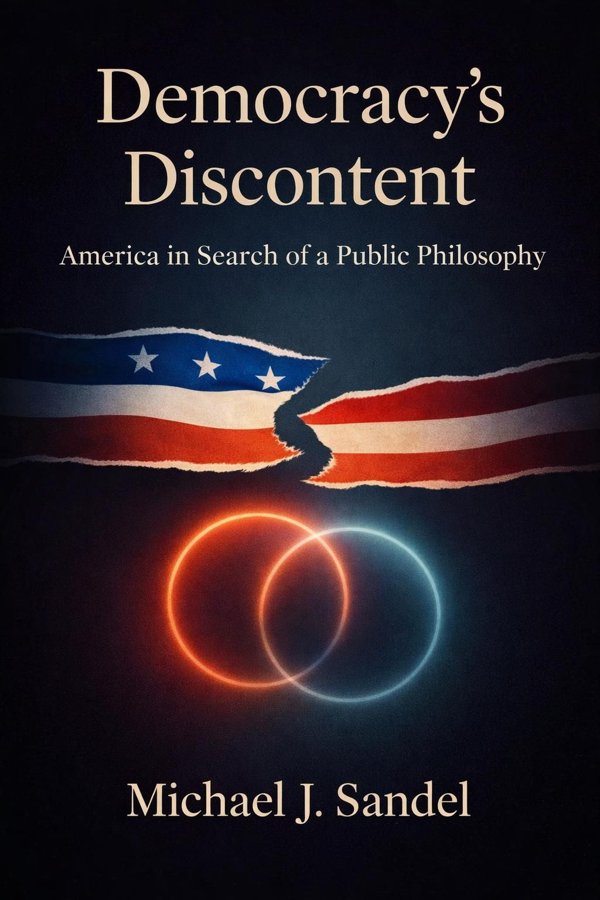
Democracy's Discontent: America in Search of a Public Philosophy: Summary & Key Insights
 10 min8 chaptersAudio available
Key Takeaways from Democracy's Discontent: America in Search of a Public Philosophy
A democracy weakens when freedom is reduced to being left alone.
Political ideas do not merely describe society; they teach people how to see themselves.
Economic transformation can quietly rewrite political ideals.
Modern reform often tries to solve civic problems administratively rather than politically.
The expansion of rights can liberate people while also narrowing political imagination.
What Is Democracy's Discontent: America in Search of a Public Philosophy About?
Democracy's Discontent: America in Search of a Public Philosophy by Michael J. Sandel is a politics book spanning 8 pages. Why do citizens in wealthy, formally free societies so often feel politically powerless, morally unmoored, and disconnected from one another? In Democracy's Discontent, Michael J. Sandel argues that America’s unrest is not just a matter of policy failure or partisan conflict. It reflects a deeper philosophical loss: the erosion of a shared public understanding of citizenship, self-government, and the common good. Sandel traces how an older republican tradition—one that linked freedom to civic participation and moral formation—gradually gave way to a liberal individualism centered on rights, choice, and personal autonomy. The book matters because it explains why democratic life can feel hollow even when legal rights are protected and markets are flourishing. Sandel shows that citizens need more than procedures and private liberty; they also need institutions and ideals that cultivate public responsibility. A renowned Harvard political philosopher known for making complex moral questions accessible, Sandel brings history, constitutional thought, and political theory together in a powerful diagnosis of modern democratic unease. This is a searching and still-relevant book about what American democracy has become—and what it could yet recover.
This FizzRead summary covers all 8 key chapters of Democracy's Discontent: America in Search of a Public Philosophy in approximately 10 minutes, distilling the most important ideas, arguments, and takeaways from Michael J. Sandel's work. Also available as an audio summary and Key Quotes Podcast.
Democracy's Discontent: America in Search of a Public Philosophy
Why do citizens in wealthy, formally free societies so often feel politically powerless, morally unmoored, and disconnected from one another? In Democracy's Discontent, Michael J. Sandel argues that America’s unrest is not just a matter of policy failure or partisan conflict. It reflects a deeper philosophical loss: the erosion of a shared public understanding of citizenship, self-government, and the common good. Sandel traces how an older republican tradition—one that linked freedom to civic participation and moral formation—gradually gave way to a liberal individualism centered on rights, choice, and personal autonomy.
The book matters because it explains why democratic life can feel hollow even when legal rights are protected and markets are flourishing. Sandel shows that citizens need more than procedures and private liberty; they also need institutions and ideals that cultivate public responsibility. A renowned Harvard political philosopher known for making complex moral questions accessible, Sandel brings history, constitutional thought, and political theory together in a powerful diagnosis of modern democratic unease. This is a searching and still-relevant book about what American democracy has become—and what it could yet recover.
Who Should Read Democracy's Discontent: America in Search of a Public Philosophy?
This book is perfect for anyone interested in politics and looking to gain actionable insights in a short read. Whether you're a student, professional, or lifelong learner, the key ideas from Democracy's Discontent: America in Search of a Public Philosophy by Michael J. Sandel will help you think differently.
- ✓Readers who enjoy politics and want practical takeaways
- ✓Professionals looking to apply new ideas to their work and life
- ✓Anyone who wants the core insights of Democracy's Discontent: America in Search of a Public Philosophy in just 10 minutes
Want the full summary?
Get instant access to this book summary and 100K+ more with Fizz Moment.
Get Free SummaryAvailable on App Store • Free to download
Key Chapters
Political ideas do not merely describe society; they teach people how to see themselves. Sandel argues that over time the American understanding of freedom shifted from civic participation to personal autonomy. Liberal individualism came to define citizens less as members of a common project and more as independent choosers entitled to pursue their own conceptions of the good life. Rights, consent, and neutrality became the dominant vocabulary of public life.
This shift brought genuine gains. Liberalism helped protect individuals from oppressive majorities, state coercion, and inherited hierarchies. It created a framework in which pluralism could flourish. But Sandel believes something important was lost. When public philosophy refuses to speak about substantive moral purposes, politics becomes thinner and more procedural. Citizens may enjoy rights, yet still feel that no shared moral horizon binds them together.
Under this newer view, public institutions are expected to remain neutral among competing values. The state protects fair rules while individuals pursue private ends. Sandel questions whether such neutrality is ever complete or desirable. Schools, markets, workplaces, and laws inevitably shape character and social norms. Refusing to debate the common good does not eliminate moral judgment; it often hides it.
This helps explain why modern political arguments can feel both intense and empty. People fight fiercely over rights claims, but lack a language for discussing what collective purposes are worth pursuing together. In practice, this appears in debates over education, work, and family policy, where procedural fairness alone rarely settles disagreement.
The takeaway is to listen for the assumptions beneath political language. When a public issue is framed only in terms of individual choice, ask what vision of citizenship and community is being left out. That question can reopen deeper democratic conversation.
Economic transformation can quietly rewrite political ideals. Sandel shows that the rise of industrial capitalism challenged the republican belief that free citizens required a degree of economic independence. Earlier republican thought feared dependence because citizens who relied too heavily on patrons, employers, or concentrated power could be dominated and thus unable to govern themselves well.
As America industrialized, ownership and labor changed dramatically. Small producers, farmers, and artisans increasingly gave way to wage labor, large factories, and corporate organization. This shift did not simply alter how wealth was produced. It changed the social conditions of citizenship. The old connection between productive independence and political freedom became harder to sustain in a world of mass employment and economic concentration.
Sandel explores how this economic change pushed American thought away from republican ideals and toward a more liberal acceptance of market society. Instead of asking whether economic arrangements cultivated self-governing citizens, public debate increasingly focused on contract, mobility, and individual opportunity. Yet feelings of powerlessness grew as workers became subject to forces far beyond their control.
The issue remains familiar today. Gig work, algorithmic management, monopolistic platforms, and precarious employment can produce a new form of dependence. People may be formally free yet lack meaningful control over the conditions shaping their lives. Sandel’s point is not that democracy requires everyone to be self-employed. It is that a democratic society must care whether its economy fosters agency, dignity, and the capacity for civic participation.
A practical application is to examine work not only in terms of income but in terms of citizenship. Ask of any economic system or workplace: does it leave people with security, voice, and time for public life? Support institutions—such as worker representation, local enterprise, and fair labor protections—that strengthen independence in this broader sense.
Modern reform often tries to solve civic problems administratively rather than politically. In Sandel’s account, the Progressive Era and the New Deal responded to the disruptions of industrial capitalism with important reforms, but they did not fully restore the republican ideal of active citizenship. Instead, they often substituted expertise, regulation, and centralized administration for direct democratic participation.
Progressives recognized that laissez-faire individualism could not handle the social consequences of industrialization. New forms of corporate power required public oversight. Later, the New Deal accepted a stronger national state as necessary to secure economic stability and social protection. These achievements mattered enormously. They improved working conditions, expanded security, and curbed some market abuses.
Yet Sandel identifies a tension. As government became more managerial, citizens increasingly related to politics as clients, beneficiaries, or spectators rather than co-authors of the common good. The language of citizenship shifted again. Problems were to be solved by experts applying technical knowledge, not primarily by citizens deliberating together about public purposes. Administrative competence replaced civic formation as the ideal.
This tension is still visible whenever policy debates treat the public as an audience to be informed rather than participants to be engaged. Expert knowledge is indispensable in complex societies, but expertise alone cannot generate legitimacy, trust, or shared purpose. A technocratic state may function efficiently while citizens still feel alienated.
The actionable lesson is not to reject expertise but to democratize it. In schools, cities, workplaces, and national politics, look for ways public decisions can combine professional knowledge with citizen voice. Participatory budgeting, deliberative forums, and transparent local planning are examples of reforms that preserve competence without giving up self-government.
The expansion of rights can liberate people while also narrowing political imagination. Sandel’s treatment of the postwar liberal consensus and the civil rights era is careful and nuanced. He recognizes the immense moral significance of movements that dismantled segregation, challenged arbitrary authority, and secured equal protection for those long denied it. Rights language became a powerful tool for justice.
At the same time, Sandel argues that the growing dominance of rights-based discourse reshaped public philosophy in ways that had unintended costs. As constitutional law and political theory increasingly centered on individual rights and state neutrality, public life was less often understood as a forum for cultivating common purposes. Courts became especially important arbiters of moral conflict, while democratic debate about shared ends became more difficult.
This is not an argument against civil rights or constitutional protection. It is an argument that a healthy democracy needs more than a framework of rights. Rights protect persons from oppression, but they do not by themselves tell a society what goods it should honor together, what civic virtues it should encourage, or how citizens should understand obligations to one another.
You can observe this tension in contemporary disputes over speech, education, religion, and identity. Rights claims are essential, yet they rarely exhaust the issue. Communities still need to ask what forms of mutual respect, historical understanding, and civic responsibility should guide public institutions.
The practical takeaway is to hold two commitments together: defend rights firmly, and resist the idea that rights language settles every moral question. In public disagreement, add a second layer to the conversation by asking not only what individuals may claim, but also what kind of community the decision helps create.
A society organized around consumption can forget how to be a republic. Sandel argues that the spread of market values and consumer culture has intensified democratic discontent by training citizens to think of themselves primarily as preference-satisfying individuals. When the market becomes the dominant social model, public goods are harder to defend and civic identity becomes thinner.
Consumer culture encourages people to approach institutions instrumentally. Schools become service providers, neighborhoods become lifestyle choices, and politics becomes another arena for expressing preferences rather than exercising judgment. The citizen begins to resemble a customer. This outlook can be seductive because it promises convenience, personalization, and freedom from obligation. But it also weakens habits of sacrifice, solidarity, and common purpose.
Sandel is especially concerned that market logic can migrate into spheres where it does not belong. If every social relationship is evaluated by efficiency or choice satisfaction, then the language of duty, honor, public service, and civic virtue begins to sound strange. Democratic life requires spaces governed by norms other than profit and preference.
Examples are everywhere: underfunded public spaces replaced by private amenities, education treated as a private investment rather than a civic institution, and political campaigns marketed like brands. Even digital life can reinforce this pattern when algorithms feed personalization at the expense of shared attention.
The response is not to abolish markets but to limit their moral authority. Protect institutions that gather people as citizens rather than segregate them as consumers. Use public libraries, parks, transit, schools, and civic organizations. Make at least one important life decision—where to live, how to spend time, where to volunteer—based not only on personal gain but on the quality of the common world it helps sustain.
People do not become fully human in isolation. One of Sandel’s major contributions is his critique of the unencumbered self assumed by some liberal theories. He argues that individuals are not simply free-floating choosers who step back from all attachments to select their values. In reality, people are partly shaped by histories, communities, obligations, and identities they do not wholly choose.
This communitarian insight does not deny personal freedom. Rather, it challenges the idea that political philosophy should treat persons as detached from their moral and civic ties. Our languages, loyalties, memories, and responsibilities help constitute who we are. A politics that ignores this will struggle to explain civic obligation, shared sacrifice, or the moral depth of belonging.
Sandel uses this critique to revive interest in republican thought. If selves are socially situated, then political institutions should not pretend to be morally empty frameworks. They should ask how laws, schools, markets, and public rituals shape character and community. The common good is not an optional extra added to private freedom. It is part of the setting in which freedom becomes meaningful.
This idea has practical implications for education, military or national service debates, public ceremonies, and local institutions. A school curriculum, for example, is never merely neutral information transfer. It forms citizens by conveying what a society remembers, honors, and expects.
An actionable takeaway is to examine your own obligations through a richer lens. Instead of asking only, “What do I choose?” also ask, “What do I owe to the communities and histories that have shaped me?” That question can deepen both personal ethics and democratic responsibility.
A democracy cannot thrive if it has no public language for shared purpose. Sandel’s central claim is that America needs a renewed public philosophy—one capable of speaking about the common good, civic virtue, and the moral purposes of political community without collapsing into intolerance or coercion. Procedural fairness matters, but it is not enough to sustain democratic life.
Public philosophy, in Sandel’s usage, is not an abstract academic system. It is the set of moral assumptions embedded in institutions, laws, and political argument. When those assumptions become incoherent or too thin, citizens experience discontent: they feel governed but not empowered, protected but not connected. The cure is not nostalgia for a simpler past, but a more candid and participatory public debate about the ends of common life.
This means recovering confidence that democratic citizens can reason together about moral questions. What should education cultivate? What obligations accompany economic power? What virtues support pluralism? What sacrifices does citizenship require? Liberal neutrality often tries to bracket such questions, but Sandel believes they are unavoidable and should be addressed openly.
Practical renewal can begin locally. Civic education that includes moral reasoning, institutions that mix people across class lines, public service opportunities, and political forums oriented toward deliberation rather than performance all help rebuild public philosophy. National unity is rarely achieved by slogans alone; it grows from shared practices and common institutions.
The actionable lesson is to make moral argument more public, not less. In your civic conversations, move beyond preferences and outrage. Ask what purposes an institution should serve, what virtues a policy rewards, and what conception of citizenship it assumes. That is how democratic reflection becomes democratic renewal.
All Chapters in Democracy's Discontent: America in Search of a Public Philosophy
About the Author
Michael J. Sandel is a leading American political philosopher and Anne T. and Robert M. Bass Professor of Government at Harvard University. He is best known for bringing moral and political philosophy into public debate through widely read books and internationally popular lectures. Sandel’s work explores justice, democracy, citizenship, bioethics, inequality, merit, and the moral limits of markets. Often associated with the communitarian critique of liberalism, he challenges the idea that politics can remain neutral about values and the common good. His major books include Liberalism and the Limits of Justice, Democracy's Discontent, Justice, What Money Can't Buy, and The Tyranny of Merit. Through his teaching and writing, Sandel has become one of the world’s most recognizable public intellectuals in contemporary political thought.
Get This Summary in Your Preferred Format
Read or listen to the Democracy's Discontent: America in Search of a Public Philosophy summary by Michael J. Sandel anytime, anywhere. FizzRead offers multiple formats so you can learn on your terms — all free.
Available formats: App · Audio · PDF · EPUB — All included free with FizzRead
Download Democracy's Discontent: America in Search of a Public Philosophy PDF and EPUB Summary
Key Quotes from Democracy's Discontent: America in Search of a Public Philosophy
“A democracy weakens when freedom is reduced to being left alone.”
“Political ideas do not merely describe society; they teach people how to see themselves.”
“Economic transformation can quietly rewrite political ideals.”
“Modern reform often tries to solve civic problems administratively rather than politically.”
“The expansion of rights can liberate people while also narrowing political imagination.”
Frequently Asked Questions about Democracy's Discontent: America in Search of a Public Philosophy
Democracy's Discontent: America in Search of a Public Philosophy by Michael J. Sandel is a politics book that explores key ideas across 8 chapters. Why do citizens in wealthy, formally free societies so often feel politically powerless, morally unmoored, and disconnected from one another? In Democracy's Discontent, Michael J. Sandel argues that America’s unrest is not just a matter of policy failure or partisan conflict. It reflects a deeper philosophical loss: the erosion of a shared public understanding of citizenship, self-government, and the common good. Sandel traces how an older republican tradition—one that linked freedom to civic participation and moral formation—gradually gave way to a liberal individualism centered on rights, choice, and personal autonomy. The book matters because it explains why democratic life can feel hollow even when legal rights are protected and markets are flourishing. Sandel shows that citizens need more than procedures and private liberty; they also need institutions and ideals that cultivate public responsibility. A renowned Harvard political philosopher known for making complex moral questions accessible, Sandel brings history, constitutional thought, and political theory together in a powerful diagnosis of modern democratic unease. This is a searching and still-relevant book about what American democracy has become—and what it could yet recover.
More by Michael J. Sandel
The Tyranny of Merit: What's Become of the Common Good?
Michael J. Sandel
10 min
Justice: What's the Right Thing to Do?
Michael J. Sandel
10 min
What Money Can't Buy: The Moral Limits of Markets
Michael J. Sandel
10 min
Public Philosophy: Essays on Morality in Politics
Michael J. Sandel
10 minYou Might Also Like
Antifa: The Anti-Fascist Handbook
Mark Bray
10 min
Attack from Within: How Disinformation Is Sabotaging America
Barbara McQuade
10 min
Coercion, Capital, and European States, AD 990–1992
Charles Tilly
10 min
Digital Democracy: Concepts, Methodologies, Tools, and Applications
Various Authors
10 min
Fascism
Stanley G. Payne
10 min
Fire And Fury: Inside The Trump White House
Michael Wolff
10 minBrowse by Category
Ready to read Democracy's Discontent: America in Search of a Public Philosophy?
Get the full summary and 100K+ more books with Fizz Moment.