
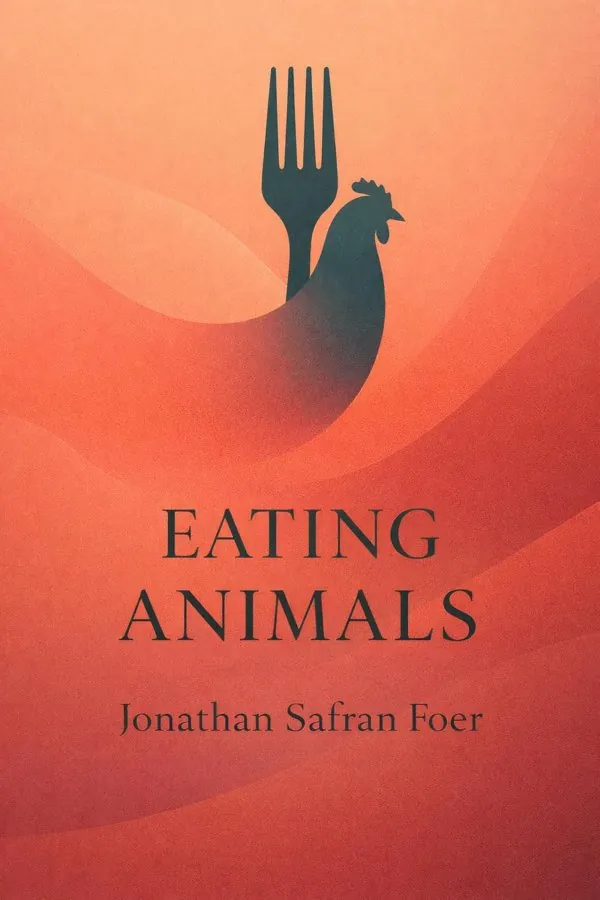
Eating Animals: Summary & Key Insights
 10 min6 chaptersAudio available
What Is Eating Animals About?
Eating Animals by Jonathan Safran Foer is a ethics book spanning 6 pages. Eating Animals is a nonfiction work that explores the moral, environmental, and health implications of meat consumption. Through a blend of personal narrative, investigative journalism, and philosophical reflection, Foer examines factory farming practices and the cultural meaning of eating animals, urging readers to reconsider their dietary choices.
This FizzRead summary covers all 6 key chapters of Eating Animals in approximately 10 minutes, distilling the most important ideas, arguments, and takeaways from Jonathan Safran Foer's work. Also available as an audio summary and Key Quotes Podcast.
Eating Animals
Eating Animals is a nonfiction work that explores the moral, environmental, and health implications of meat consumption. Through a blend of personal narrative, investigative journalism, and philosophical reflection, Foer examines factory farming practices and the cultural meaning of eating animals, urging readers to reconsider their dietary choices.
Who Should Read Eating Animals?
This book is perfect for anyone interested in ethics and looking to gain actionable insights in a short read. Whether you're a student, professional, or lifelong learner, the key ideas from Eating Animals by Jonathan Safran Foer will help you think differently.
- ✓Readers who enjoy ethics and want practical takeaways
- ✓Professionals looking to apply new ideas to their work and life
- ✓Anyone who wants the core insights of Eating Animals in just 10 minutes
Want the full summary?
Get instant access to this book summary and 100K+ more with Fizz Moment.
Get Free SummaryAvailable on App Store • Free to download
Key Chapters
In the beginning, I ask myself a question that seems deceptively small: why do we eat the way we do? Our choices around food are rarely rational—they’re inherited, whispered from generation to generation, encoded in tradition and in habit. In my own family, food was an expression of love, of belonging. I remember my grandmother surviving on scraps during the Holocaust and later feeding us with sacred care, measuring out ingredients as if transmitting history itself.
Yet her reverence for food was also bound up in morality—especially the idea of not wasting life. When I became a father, I realized that the food I would feed my child represented a collision between those family memories and the realities of industrial food production. I had inherited this profound sense that eating is a moral act, but I had never truly examined its consequences in a modern context.
Foer’s reflections trace how meat, once a symbol of abundance and generational continuity, has become an emblem of disconnection. We eat in ignorance; we celebrate with dishes whose origins we would rather not know. In rediscovering his own past, Foer sees the act of eating as storytelling, and stories, he reminds us, are the moral fabric of our identity. Whether we eat pork, chicken, beef, or avoid animal products altogether, our habits express what kind of world we believe in—and what kind of world we’re helping to sustain.
+ 4 more chapters — available in the FizzRead app
All Chapters in Eating Animals
About the Author
Jonathan Safran Foer is an American novelist and essayist known for his works that combine emotional depth with ethical inquiry. Born in 1977 in Washington, D.C., he gained recognition for his novels 'Everything Is Illuminated' and 'Extremely Loud & Incredibly Close' before publishing 'Eating Animals', his first major nonfiction book.
Get This Summary in Your Preferred Format
Read or listen to the Eating Animals summary by Jonathan Safran Foer anytime, anywhere. FizzRead offers multiple formats so you can learn on your terms — all free.
Available formats: App · Audio · PDF · EPUB — All included free with FizzRead
Download Eating Animals PDF and EPUB Summary
Key Quotes from Eating Animals
“In the beginning, I ask myself a question that seems deceptively small: why do we eat the way we do?”
“Instead, I found a system so vast, secretive, and violent that its reality fundamentally contradicts the stories our culture tells about food.”
Frequently Asked Questions about Eating Animals
Eating Animals by Jonathan Safran Foer is a ethics book that explores key ideas across 6 chapters. Eating Animals is a nonfiction work that explores the moral, environmental, and health implications of meat consumption. Through a blend of personal narrative, investigative journalism, and philosophical reflection, Foer examines factory farming practices and the cultural meaning of eating animals, urging readers to reconsider their dietary choices.
More by Jonathan Safran Foer

You Might Also Like
What We Owe the Future
William MacAskill
10 min
Abortion
David Boonin
10 min
Blind Spots: Why We Fail to Do What's Right and What to Do About It
Max H. Bazerman, Ann E. Tenbrunsel
10 min
Digital Ethics: Research and Practice
Christopher Burr, Luciano Floridi (Editors)
10 min
Doing Good Better: Effective Altruism and a Radical New Way to Make a Difference
William MacAskill
10 min
Ethics of Artificial Intelligence
Various Authors
10 minBrowse by Category
Ready to read Eating Animals?
Get the full summary and 100K+ more books with Fizz Moment.