
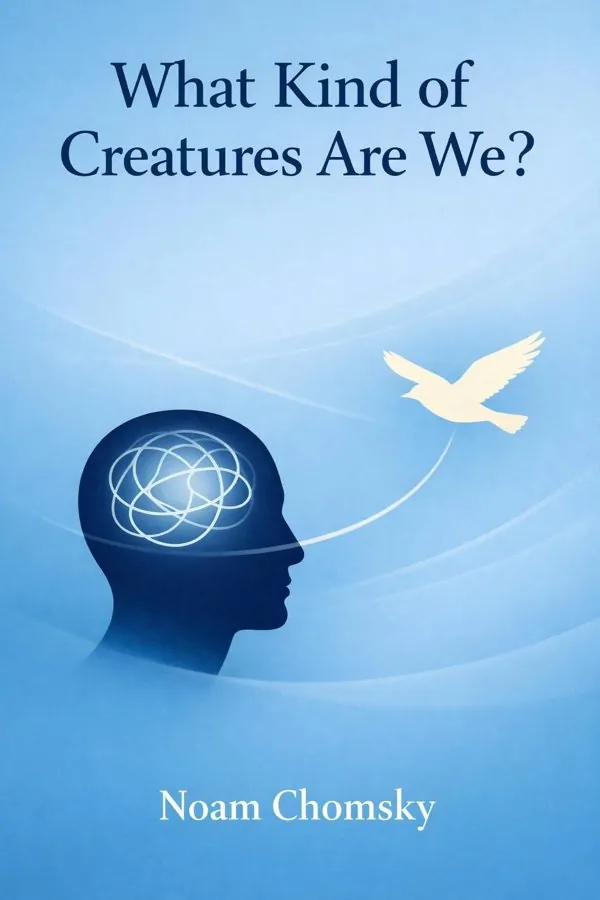
What Kind of Creatures Are We?: Summary & Key Insights
by Noam Chomsky
 10 min8 chaptersAudio available
What Is What Kind of Creatures Are We? About?
What Kind of Creatures Are We? by Noam Chomsky is a western_phil book spanning 8 pages. In this collection of lectures, Noam Chomsky explores fundamental questions about human nature, language, and cognition. He examines what makes humans unique as a species, the nature of our knowledge and understanding, and the limits of scientific inquiry into the mind. The book synthesizes Chomsky’s lifelong work in linguistics, philosophy, and cognitive science, offering a concise reflection on what it means to be human.
This FizzRead summary covers all 8 key chapters of What Kind of Creatures Are We? in approximately 10 minutes, distilling the most important ideas, arguments, and takeaways from Noam Chomsky's work. Also available as an audio summary and Key Quotes Podcast.
What Kind of Creatures Are We?
In this collection of lectures, Noam Chomsky explores fundamental questions about human nature, language, and cognition. He examines what makes humans unique as a species, the nature of our knowledge and understanding, and the limits of scientific inquiry into the mind. The book synthesizes Chomsky’s lifelong work in linguistics, philosophy, and cognitive science, offering a concise reflection on what it means to be human.
Who Should Read What Kind of Creatures Are We??
This book is perfect for anyone interested in western_phil and looking to gain actionable insights in a short read. Whether you're a student, professional, or lifelong learner, the key ideas from What Kind of Creatures Are We? by Noam Chomsky will help you think differently.
- ✓Readers who enjoy western_phil and want practical takeaways
- ✓Professionals looking to apply new ideas to their work and life
- ✓Anyone who wants the core insights of What Kind of Creatures Are We? in just 10 minutes
Want the full summary?
Get instant access to this book summary and 100K+ more with Fizz Moment.
Get Free SummaryAvailable on App Store • Free to download
Key Chapters
If we begin by comparing ourselves to other living beings, the differences can seem both subtle and vast. Animals communicate, solve problems, and even exhibit empathy, yet none demonstrate the boundless combinatorial creativity that human language allows. From a few phonemes and syntactic rules, we can generate endless expressions, each conveying novel ideas. This power to form infinite thoughts from finite means is perhaps the clearest window into what makes us unique.
From my perspective, this uniqueness lies not in superiority but in structure. The human mind possesses an internal design—a generative system that underlies every form of linguistic and conceptual creativity. This system is invisible, abstract, and universal. It lets us move beyond immediate experience into realms of imagination, science, and ethics. The same mental architecture that allows us to describe the world also enables us to reshape it.
While evolutionary theories attempt to trace the biological origins of these capacities, the focus here must remain on what these capacities reveal about our nature. They show that our minds are not passive mirrors of reality but active constructors of meaning. Every thought is a creation, every sentence an act of design. We are not merely creatures reacting to the world; we are creatures recreating it through the symbolic and moral languages we invent.
Decades ago, I proposed what became known as generative grammar—a theory suggesting that language is not learned piecemeal but emerges from an innate cognitive faculty. Children acquire language effortlessly not because they memorize sentences but because they possess an internal system of rules, a universal grammar that guides the formation of possible structures.
This claim goes beyond linguistics; it touches the essence of what it means to think. Language does not simply express thought—it shapes it. Our capacity to reason, question, and imagine depends on the same creative principles that generate grammar. This is why language, though realized differently in every culture, reflects a shared cognitive heritage.
In this view, language is a window into the human mind. It reveals an inherent logic and elegance—a self-organizing structure rooted in biological design yet manifesting in infinite cultural variety. Understanding this structure helps us see that the study of language is not about cataloging words and rules but about exploring the architecture of creativity itself. Through this lens, linguistics becomes a path toward understanding the broader nature of human intelligence and freedom.
+ 6 more chapters — available in the FizzRead app
All Chapters in What Kind of Creatures Are We?
About the Author
Noam Chomsky is an American linguist, philosopher, cognitive scientist, historian, and social critic. Widely regarded as the father of modern linguistics, he has made groundbreaking contributions to the study of language and mind, and is also known for his influential political writings and activism.
Get This Summary in Your Preferred Format
Read or listen to the What Kind of Creatures Are We? summary by Noam Chomsky anytime, anywhere. FizzRead offers multiple formats so you can learn on your terms — all free.
Available formats: App · Audio · PDF · EPUB — All included free with FizzRead
Download What Kind of Creatures Are We? PDF and EPUB Summary
Key Quotes from What Kind of Creatures Are We?
“If we begin by comparing ourselves to other living beings, the differences can seem both subtle and vast.”
“Decades ago, I proposed what became known as generative grammar—a theory suggesting that language is not learned piecemeal but emerges from an innate cognitive faculty.”
Frequently Asked Questions about What Kind of Creatures Are We?
What Kind of Creatures Are We? by Noam Chomsky is a western_phil book that explores key ideas across 8 chapters. In this collection of lectures, Noam Chomsky explores fundamental questions about human nature, language, and cognition. He examines what makes humans unique as a species, the nature of our knowledge and understanding, and the limits of scientific inquiry into the mind. The book synthesizes Chomsky’s lifelong work in linguistics, philosophy, and cognitive science, offering a concise reflection on what it means to be human.
More by Noam Chomsky
Manufacturing Consent: The Political Economy of the Mass Media
Edward S. Herman, Noam Chomsky
10 min
Understanding Power: The Indispensable Chomsky
Noam Chomsky
10 min
Profit Over People: Neoliberalism and Global Order
Noam Chomsky
10 min
Failed States: The Abuse of Power and the Assault on Democracy
Noam Chomsky
10 minYou Might Also Like
A Little History of Philosophy
Nigel Warburton
10 min
Areopagitica
John Milton
10 min
How To Think Like A Philosopher: Essential Principles For Clear Thinking
Peter Cave
10 min
Language, Truth and Logic
A. J. Ayer
10 min
The Age of Reason
Thomas Paine
10 min
The Essays
Michel De Montaigne
10 minBrowse by Category
Ready to read What Kind of Creatures Are We??
Get the full summary and 100K+ more books with Fizz Moment.