
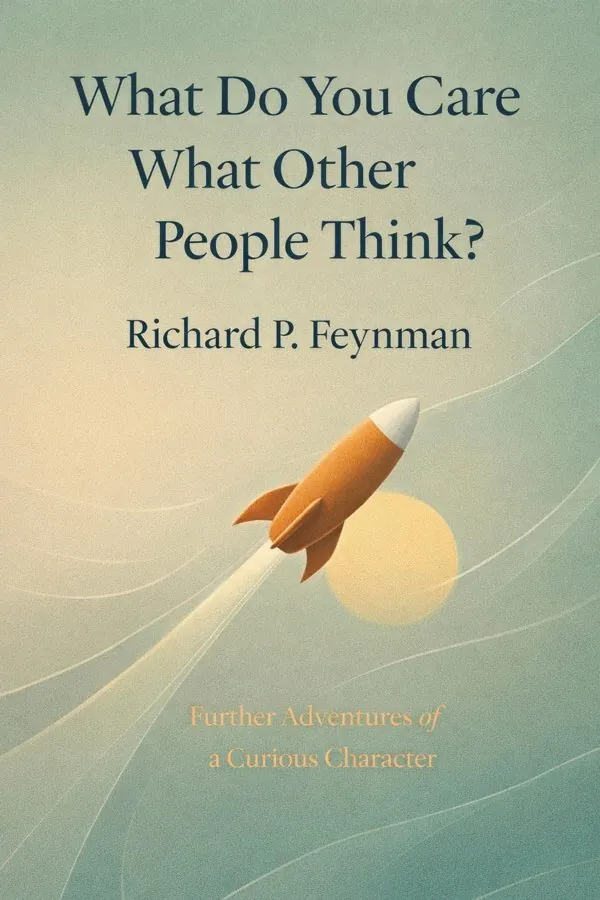
What Do You Care What Other People Think?: Further Adventures of a Curious Character: Summary & Key Insights
 10 min10 chaptersAudio available
Key Takeaways from What Do You Care What Other People Think?: Further Adventures of a Curious Character
The way we learn to look at the world often matters more than the facts we memorize.
Real knowledge often begins with the courage to tinker.
A life devoted to reason is not a life untouched by sorrow.
The words we write in private often reveal truths that public confidence conceals.
The true measure of a scientist is not intelligence alone, but responsibility toward reality.
What Is What Do You Care What Other People Think?: Further Adventures of a Curious Character About?
What Do You Care What Other People Think?: Further Adventures of a Curious Character by Richard P. Feynman is a biographies book spanning 11 pages. Richard P. Feynman’s What Do You Care What Other People Think? is not a conventional autobiography, and that is precisely why it remains so compelling. Part memoir, part reflection on science, part love story, and part moral argument for intellectual honesty, the book gathers episodes from Feynman’s life that reveal how curiosity and integrity can shape both a career and a character. It continues the spirit of Surely You’re Joking, Mr. Feynman! but adds greater emotional depth, especially in its portrait of his first wife, Arline, and its account of his role in the Challenger disaster investigation. What makes this book matter is that Feynman never treats science as a remote or purely technical pursuit. For him, understanding the world is inseparable from independence of mind, skepticism toward authority, and delight in figuring things out for oneself. He writes as one of the twentieth century’s great physicists—a Nobel laureate whose work transformed modern physics—but also as a vivid storyteller who makes profound principles feel personal and practical. The result is a biography that speaks not only to scientists, but to anyone trying to live more truthfully, courageously, and curiously.
This FizzRead summary covers all 10 key chapters of What Do You Care What Other People Think?: Further Adventures of a Curious Character in approximately 10 minutes, distilling the most important ideas, arguments, and takeaways from Richard P. Feynman's work. Also available as an audio summary and Key Quotes Podcast.
What Do You Care What Other People Think?: Further Adventures of a Curious Character
Richard P. Feynman’s What Do You Care What Other People Think? is not a conventional autobiography, and that is precisely why it remains so compelling. Part memoir, part reflection on science, part love story, and part moral argument for intellectual honesty, the book gathers episodes from Feynman’s life that reveal how curiosity and integrity can shape both a career and a character. It continues the spirit of Surely You’re Joking, Mr. Feynman! but adds greater emotional depth, especially in its portrait of his first wife, Arline, and its account of his role in the Challenger disaster investigation.
What makes this book matter is that Feynman never treats science as a remote or purely technical pursuit. For him, understanding the world is inseparable from independence of mind, skepticism toward authority, and delight in figuring things out for oneself. He writes as one of the twentieth century’s great physicists—a Nobel laureate whose work transformed modern physics—but also as a vivid storyteller who makes profound principles feel personal and practical. The result is a biography that speaks not only to scientists, but to anyone trying to live more truthfully, courageously, and curiously.
Who Should Read What Do You Care What Other People Think?: Further Adventures of a Curious Character?
This book is perfect for anyone interested in biographies and looking to gain actionable insights in a short read. Whether you're a student, professional, or lifelong learner, the key ideas from What Do You Care What Other People Think?: Further Adventures of a Curious Character by Richard P. Feynman will help you think differently.
- ✓Readers who enjoy biographies and want practical takeaways
- ✓Professionals looking to apply new ideas to their work and life
- ✓Anyone who wants the core insights of What Do You Care What Other People Think?: Further Adventures of a Curious Character in just 10 minutes
Want the full summary?
Get instant access to this book summary and 100K+ more with Fizz Moment.
Get Free SummaryAvailable on App Store • Free to download
Key Chapters
The way we learn to look at the world often matters more than the facts we memorize. One of the deepest influences on Feynman’s life was his father, who taught him that naming something is not the same as understanding it. Instead of encouraging empty recitation, he trained his son to ask questions: Why does a bird behave this way? What is really happening? What can we observe for ourselves? This distinction between labels and understanding became foundational to Feynman’s scientific style.
His father did something rare: he turned ordinary life into a laboratory for wonder. A walk in the woods became an exercise in pattern recognition, observation, and humility. The lesson was not simply to know more, but to think better. This early training instilled a habit of skepticism toward superficial expertise. If someone uses impressive terminology but cannot explain the underlying mechanism, real understanding may still be missing.
This idea applies far beyond physics. In business, education, and everyday life, people often confuse jargon with insight. A manager may speak fluently about “synergy” and “optimization” while failing to solve practical problems. A student may repeat textbook definitions without grasping the concept. Feynman’s example urges us to test whether we truly understand something by explaining it plainly, observing it directly, and asking what evidence supports it.
The deeper message is that curiosity is teachable. It grows when adults reward questions rather than compliance. Whether you are parenting, learning, or leading, the goal is not to sound informed but to become genuinely attentive to reality.
Actionable takeaway: The next time you encounter a complex idea, pause and explain it in simple language without jargon. If you cannot, keep asking questions until you reach real understanding.
Real knowledge often begins with the courage to tinker. As a child, Feynman loved opening radios, examining gadgets, and figuring out why things worked or failed. This hands-on curiosity followed him into MIT and Princeton, where he developed the same instinct at a higher level: do not merely accept formulas, derive them; do not just trust explanations, test them. For Feynman, the joy of discovery came from active engagement, not passive reception.
This mindset explains why he became such an original thinker. He was less interested in performing brilliance than in solving problems. If he could rebuild an idea from first principles, it became his own. That habit made him unusually flexible. He was not trapped by prestige, tradition, or academic ceremony because he had trained himself to approach problems directly.
The broader lesson is that mastery is experimental. Many people stay intimidated by difficult subjects because they imagine expertise as something bestowed by institutions. Feynman’s life suggests the opposite: understanding grows through playful persistence, trial and error, and the willingness to be temporarily confused. Students can apply this by working problems before reading solutions. Professionals can apply it by building small prototypes before drafting grand strategies. Anyone can apply it by moving from abstract admiration to concrete experimentation.
There is also an emotional lesson here. Curiosity thrives when failure is treated as information rather than embarrassment. Feynman was not afraid to be wrong on the way to being right. That freedom allowed him to learn faster and enjoy the process more deeply.
Actionable takeaway: Pick one topic you have been postponing because it feels difficult, and approach it experimentally—solve, sketch, rebuild, or test something yourself before seeking the expert explanation.
A life devoted to reason is not a life untouched by sorrow. One of the most moving parts of the book is Feynman’s remembrance of his first wife, Arline. Their relationship unfolded under the shadow of her severe illness, and yet what emerges is not only tragedy but extraordinary tenderness, humor, and loyalty. Feynman does not sentimentalize their bond; he shows love as something lived through daily attention, shared courage, and the refusal to deny reality.
What makes this section so powerful is its emotional honesty. Feynman is often remembered as playful, irreverent, and fiercely rational, but these recollections reveal vulnerability without self-dramatization. He loved Arline deeply while fully aware of the fragility of their future. The relationship becomes a lesson in how intellect and feeling need not be enemies. Clear-eyed realism did not make him cold; it made his devotion more meaningful.
This matters because many people think strength means emotional distance. Feynman’s story suggests otherwise. Strength can mean staying present when circumstances are painful, speaking truthfully even when truth hurts, and valuing someone fully despite uncertainty. In caregiving, partnership, and friendship, the temptation is often to hide behind efficiency or avoidance. Feynman shows that tenderness is not weakness; it is a form of courage.
Readers can also learn from the way he remembers Arline as a whole person, not merely as a victim of illness. He preserves her wit, spirit, and individuality. This is a quiet ethical lesson: love means seeing the other person in their fullness, not reducing them to their condition.
Actionable takeaway: In your closest relationships, practice one act of direct emotional honesty this week—say what matters, acknowledge what is real, and be fully present rather than protective through distance.
The words we write in private often reveal truths that public confidence conceals. Feynman’s letters to Arline show a side of him that readers might not expect: deeply affectionate, exposed, and human in ways that contrast with his public image as the witty genius. These letters matter because they challenge the stereotype that intellectual brilliance requires emotional detachment. Instead, they show a man whose private life was shaped by longing, grief, tenderness, and devotion.
The letters also illuminate an important aspect of communication: writing can preserve what spoken conversation cannot. In moments of illness, separation, or impending loss, letters become vessels for sincerity. They slow thought down. They make us choose words carefully. In Feynman’s case, they reveal a person trying to remain connected across circumstances he could not control.
For modern readers, this part of the book feels especially relevant because much of contemporary communication is fast, disposable, and shallow. Texts and posts often prioritize speed over substance. Feynman’s letters remind us that deliberate expression can deepen relationships and clarify inner life. Writing helps us discover what we actually feel, not just what we instantly react to.
There is another lesson here about selfhood. Public identity is always partial. A scientist, executive, teacher, or artist may be known for professional competence while carrying a rich, private emotional world. Recognizing this in others can make us less reductive and more compassionate.
Actionable takeaway: Write a thoughtful message or letter to someone important to you without rushing. Say something specific, sincere, and lasting—something worth rereading years from now.
The true measure of a scientist is not intelligence alone, but responsibility toward reality. Across the book, Feynman shows that scientific work is meaningful because it demands honesty about what we know, what we do not know, and what the evidence actually says. His career brought recognition and influence, but he consistently resisted being seduced by status. For him, the point of science was not admiration; it was discovering what is true.
This principle shaped the way he approached research, teaching, and public life. He distrusted empty ceremony and disliked situations where reputation insulated ideas from criticism. In science, prestige can become dangerous when it discourages questions. Feynman believed that every claim must remain accountable to experiment and logic, regardless of who makes it.
The lesson extends beyond laboratories. In medicine, law, technology, and policy, expertise matters, but expertise without accountability can become self-protective. Organizations often reward confidence, polish, and hierarchy more visibly than rigor. Feynman’s example suggests a higher standard: the responsible professional welcomes scrutiny because truth matters more than image.
This also changes how we think about success. Instead of asking, “How can I look impressive?” Feynman asks, “Have I understood the problem correctly?” That shift from performance to substance improves judgment. It encourages people to seek disconfirming evidence, admit mistakes quickly, and avoid turning identity into a barrier against correction.
In a culture obsessed with visibility, Feynman’s attitude feels refreshing. He reminds us that credibility should be earned through contact with reality, not merely through credentials or applause.
Actionable takeaway: In your work, identify one area where appearance may be outrunning substance, and deliberately test the underlying assumptions before moving forward.
Some of the best problem solving begins where play is allowed. Feynman’s adventures often look eccentric or amusing on the surface, but beneath them lies a powerful intellectual method: experimentation without unnecessary solemnity. He approached puzzles, social situations, and scientific questions with the same playful energy. That playfulness was not distraction from serious work; it was often the condition that made insight possible.
When people become too concerned with appearing competent, they stop exploring. They narrow their thinking to safe, approved paths. Feynman resisted this. He followed odd questions, tried unusual approaches, and treated confusion as an invitation rather than a threat. This allowed him to notice solutions that more rigid thinkers might miss.
Playfulness also lowers fear. In learning environments, students often freeze because they assume mistakes are humiliating. But if inquiry feels like experimentation, mistakes become useful. Teams can apply this by creating low-stakes prototypes, brainstorming strange possibilities, or running quick tests before formalizing plans. Individuals can apply it by treating creative work as iteration rather than judgment.
Importantly, Feynman’s playfulness coexisted with rigor. He was not careless. He simply understood that freedom of thought often precedes precision. First you roam, then you refine. First you ask naive questions, then you sharpen them. This is true in science, art, entrepreneurship, and personal growth.
The larger philosophical message is that delight is intellectually productive. Curiosity sustained by enjoyment lasts longer than effort sustained only by duty. If you want to become better at solving hard problems, protecting your sense of play may be as important as increasing your discipline.
Actionable takeaway: Choose one challenge you are treating too rigidly, and spend 20 minutes exploring it in a playful way—brainstorm wildly, sketch alternatives, or test unconventional ideas without judging them immediately.
Travel becomes transformative when it challenges not just our habits, but our assumptions about what matters. Feynman’s experiences in Brazil exposed him to a different social rhythm, educational culture, and way of relating to performance, prestige, and learning. He was fascinated not merely by the novelty of another place, but by what it revealed about hidden conventions in his own world.
One recurring theme is the gap between formal systems and genuine understanding. Feynman noticed environments where people seemed highly invested in ceremony, recitation, or appearance, while actual comprehension lagged behind. Rather than judging from a distance, he used these experiences to sharpen his broader critique of education and public life: systems often reward symbols of knowledge more reliably than knowledge itself.
At the same time, Brazil represented vitality, music, spontaneity, and openness to experience. Feynman did not travel as a detached observer collecting exotic impressions. He participated, learned, and allowed himself to be changed by contact with another culture. That matters because authenticity is not achieved by rigidly defending one’s identity; it is often deepened by crossing boundaries and seeing one’s own blind spots more clearly.
For modern readers, this section offers a practical lesson in cultural humility. When entering a new organization, city, or country, it helps to ask not only “How do they do things here?” but also “What does this reveal about what I have taken for granted?” Exposure to difference can uncover both inefficiencies and gifts.
Actionable takeaway: The next time you encounter a different culture or work environment, observe one practice without immediate judgment and ask what it reveals about your own assumptions about learning, status, and authenticity.
Catastrophe often reveals whether institutions value truth or image. Feynman’s role in the investigation of the Space Shuttle Challenger disaster is one of the book’s most consequential sections. Faced with a tragedy surrounded by bureaucratic language, political pressure, and organizational defensiveness, he focused on the evidence. His now-famous demonstration involving the shuttle’s O-rings was powerful not because it was theatrical, but because it made a complicated technical failure unmistakably clear.
The Challenger episode is about more than engineering. It exposes how large organizations can drift into self-deception. Warnings get normalized. Risks are reframed to fit schedules. Uncertainty is softened in official communication. Decision-makers begin to protect momentum instead of confronting reality. Feynman saw that the central failure was not only technical but moral: when institutions stop telling themselves the truth, danger compounds.
This lesson applies in every field. In companies, ignored product flaws can become scandals. In hospitals, unreported near misses can become patient harm. In personal life, avoided problems often worsen simply because no one names them honestly. Feynman models a discipline of clarity: reduce claims to evidence, distinguish probability from hope, and refuse language that hides the stakes.
He also demonstrates personal courage. Challenging authority is costly, especially when others prefer reassurance. Yet integrity requires willingness to be inconvenient when facts demand it. That is one reason this episode continues to resonate far beyond science.
Actionable takeaway: In a decision involving real risk, ask one uncomfortable but necessary question: What evidence are we minimizing because it conflicts with what we want to believe?
The easiest person to deceive is often the person in the mirror. Feynman’s most enduring ethical principle is that scientific integrity begins with a ruthless refusal to fool oneself. This idea is simple, but it cuts deeply. People naturally prefer confirming evidence, flattering narratives, and conclusions that protect identity or ambition. Feynman insists that serious thinking requires active resistance to those temptations.
He does not frame integrity as saintliness. It is a method. You search for weaknesses in your own argument. You disclose uncertainties. You do not omit awkward data because it complicates the story. In science this is essential, but the principle is equally relevant to careers, relationships, and self-assessment. A leader who only hears good news, a student who overestimates preparation, or a partner who avoids hard conversations is engaged in some form of self-deception.
What makes this idea especially valuable is its practicality. Integrity is not only about not lying to others; it is about designing habits that make self-correction more likely. That might mean inviting criticism, keeping written assumptions, reviewing decisions after outcomes, or separating what is known from what is hoped. Feynman teaches that truthfulness is not a mood; it is a discipline.
This discipline also brings freedom. When you stop protecting illusions, you become more adaptable. Mistakes become easier to correct because they no longer threaten your identity. In that sense, honesty is not merely morally admirable; it is intellectually efficient.
Actionable takeaway: This week, examine one strongly held belief or plan and list three ways it could be wrong. Then look for evidence you have been ignoring or undervaluing.
Many people live under the invisible rule of imagined audiences. The title of the book captures one of Feynman’s central attitudes: if you are overly governed by what other people think, you lose the independence required for genuine inquiry and authentic living. This does not mean becoming arrogant or indifferent to everyone else. It means refusing to let social approval overrule your contact with truth, curiosity, and conscience.
Feynman’s life offers many examples of this independence. He ignored status rituals, resisted intellectual fashion, and often behaved in ways that puzzled more conventional observers. What mattered to him was not whether he fit an approved image of a physicist, but whether he was thinking honestly and living directly. That freedom made him more original, more adventurous, and arguably more ethical.
The relevance today is enormous. Social media, professional branding, and constant comparison intensify the temptation to perform rather than live. People edit themselves to match expectations, avoid asking basic questions for fear of sounding foolish, and pursue visible success over meaningful work. Feynman’s attitude provides a corrective: respect evidence more than applause, and value sincerity more than reputation.
Of course, complete indifference to others is neither possible nor desirable. Feedback can be useful. Community matters. But approval becomes corrosive when it replaces judgment. The goal is not isolation; it is inner steadiness. You listen to others without surrendering your ability to think for yourself.
Actionable takeaway: Notice one decision you are making mainly to avoid disapproval. Reevaluate it by asking what you would choose if reputation were not part of the equation.
All Chapters in What Do You Care What Other People Think?: Further Adventures of a Curious Character
About the Author
Richard Phillips Feynman (1918–1988) was an American theoretical physicist widely regarded as one of the most original scientific minds of the twentieth century. He made foundational contributions to quantum electrodynamics, particle physics, and quantum mechanics, and shared the 1965 Nobel Prize in Physics for his work on the behavior of subatomic particles. Feynman taught for many years at the California Institute of Technology, where he became equally famous for his brilliant lectures and unconventional personality. Beyond academia, he was admired for his wit, clarity, and insistence on intellectual honesty. His memoirs and essays introduced millions of readers to the pleasures of curiosity, skepticism, and discovery, while his role in the Challenger disaster investigation demonstrated his public commitment to truth over institutional convenience.
Get This Summary in Your Preferred Format
Read or listen to the What Do You Care What Other People Think?: Further Adventures of a Curious Character summary by Richard P. Feynman anytime, anywhere. FizzRead offers multiple formats so you can learn on your terms — all free.
Available formats: App · Audio · PDF · EPUB — All included free with FizzRead
Download What Do You Care What Other People Think?: Further Adventures of a Curious Character PDF and EPUB Summary
Key Quotes from What Do You Care What Other People Think?: Further Adventures of a Curious Character
“The way we learn to look at the world often matters more than the facts we memorize.”
“Real knowledge often begins with the courage to tinker.”
“A life devoted to reason is not a life untouched by sorrow.”
“The words we write in private often reveal truths that public confidence conceals.”
“The true measure of a scientist is not intelligence alone, but responsibility toward reality.”
Frequently Asked Questions about What Do You Care What Other People Think?: Further Adventures of a Curious Character
What Do You Care What Other People Think?: Further Adventures of a Curious Character by Richard P. Feynman is a biographies book that explores key ideas across 10 chapters. Richard P. Feynman’s What Do You Care What Other People Think? is not a conventional autobiography, and that is precisely why it remains so compelling. Part memoir, part reflection on science, part love story, and part moral argument for intellectual honesty, the book gathers episodes from Feynman’s life that reveal how curiosity and integrity can shape both a career and a character. It continues the spirit of Surely You’re Joking, Mr. Feynman! but adds greater emotional depth, especially in its portrait of his first wife, Arline, and its account of his role in the Challenger disaster investigation. What makes this book matter is that Feynman never treats science as a remote or purely technical pursuit. For him, understanding the world is inseparable from independence of mind, skepticism toward authority, and delight in figuring things out for oneself. He writes as one of the twentieth century’s great physicists—a Nobel laureate whose work transformed modern physics—but also as a vivid storyteller who makes profound principles feel personal and practical. The result is a biography that speaks not only to scientists, but to anyone trying to live more truthfully, courageously, and curiously.
More by Richard P. Feynman
Surely You're Joking, Mr. Feynman!
Richard P. Feynman
10 min
The Feynman Lectures on Physics
Richard P. Feynman
10 min
The Character of Physical Law
Richard P. Feynman
10 min
Surely You’re Joking, Mr. Feynman!: Adventures of a Curious Character
Richard P. Feynman
10 minYou Might Also Like

An American Marriage
Tayari Jones
10 min
Benjamin Franklin: An American Life
Walter Isaacson
10 min
I Know Why The Caged Bird Sings
Maya Angelou
10 min
Long Walk to Freedom
Nelson Mandela
10 min
Persepolis
Marjane Satrapi
10 minSurely You're Joking, Mr. Feynman!
Richard P. Feynman
10 minBrowse by Category
Ready to read What Do You Care What Other People Think?: Further Adventures of a Curious Character?
Get the full summary and 100K+ more books with Fizz Moment.