
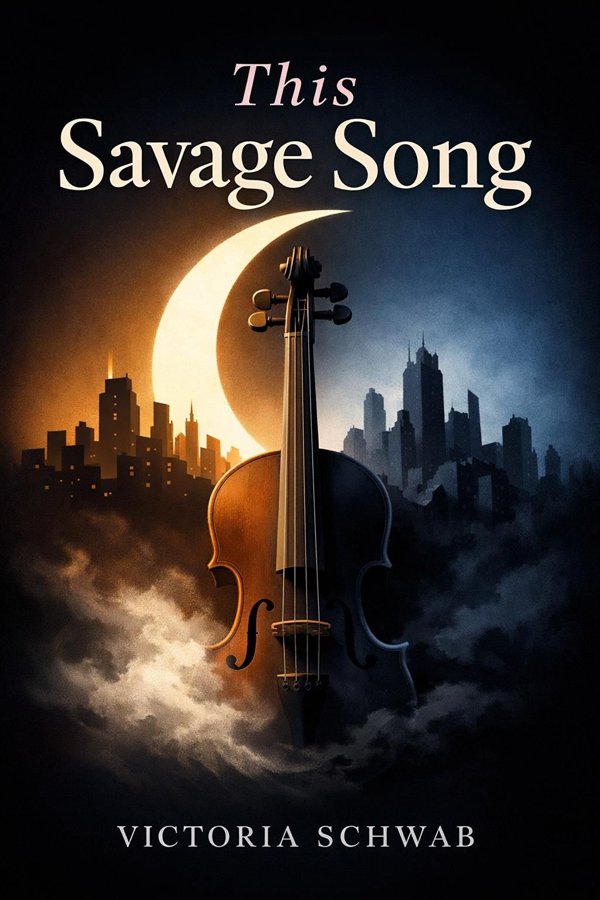
This Savage Song: Summary & Key Insights
 10 min9 chaptersAudio available
Key Takeaways from This Savage Song
One of the most unsettling ideas in This Savage Song is that violence never stays contained.
A person can become dangerous not only because they are cruel, but because they believe cruelty is the price of love.
It is easy to think morality belongs naturally to humans and monstrosity belongs naturally to monsters, but August Flynn dismantles that assumption.
Some encounters do not simply alter a plot; they expose hidden truths in the people involved.
One of the sharpest political insights in This Savage Song is that fear can become a business model.
What Is This Savage Song About?
This Savage Song by Victoria Schwab is a scifi_fantasy book spanning 6 pages. What if violence did not end with its victims, but took physical form and continued walking the streets? In This Savage Song, Victoria Schwab imagines exactly that kind of world: Verity, a divided city where acts of brutality create monsters, and survival depends as much on moral compromise as on strength. At the center of the story are two unforgettable teens. Kate Harker, the daughter of a ruthless ruler, wants to prove she belongs in a world built on fear. August Flynn, raised by her father’s rival, is a monster who desperately wishes he could be human. When their lives collide, the novel becomes more than a dark fantasy. It turns into a sharp exploration of identity, violence, power, and choice. Schwab is one of modern fantasy’s most acclaimed storytellers, celebrated for blending high-concept worldbuilding with emotional depth. Here, she uses a supernatural premise to ask unsettlingly real questions: Are people defined by what they are, what they want, or what they choose to do? That tension is what makes This Savage Song so haunting, timely, and memorable.
This FizzRead summary covers all 9 key chapters of This Savage Song in approximately 10 minutes, distilling the most important ideas, arguments, and takeaways from Victoria Schwab's work. Also available as an audio summary and Key Quotes Podcast.
This Savage Song
What if violence did not end with its victims, but took physical form and continued walking the streets? In This Savage Song, Victoria Schwab imagines exactly that kind of world: Verity, a divided city where acts of brutality create monsters, and survival depends as much on moral compromise as on strength. At the center of the story are two unforgettable teens. Kate Harker, the daughter of a ruthless ruler, wants to prove she belongs in a world built on fear. August Flynn, raised by her father’s rival, is a monster who desperately wishes he could be human. When their lives collide, the novel becomes more than a dark fantasy. It turns into a sharp exploration of identity, violence, power, and choice. Schwab is one of modern fantasy’s most acclaimed storytellers, celebrated for blending high-concept worldbuilding with emotional depth. Here, she uses a supernatural premise to ask unsettlingly real questions: Are people defined by what they are, what they want, or what they choose to do? That tension is what makes This Savage Song so haunting, timely, and memorable.
Who Should Read This Savage Song?
This book is perfect for anyone interested in scifi_fantasy and looking to gain actionable insights in a short read. Whether you're a student, professional, or lifelong learner, the key ideas from This Savage Song by Victoria Schwab will help you think differently.
- ✓Readers who enjoy scifi_fantasy and want practical takeaways
- ✓Professionals looking to apply new ideas to their work and life
- ✓Anyone who wants the core insights of This Savage Song in just 10 minutes
Want the full summary?
Get instant access to this book summary and 100K+ more with Fizz Moment.
Get Free SummaryAvailable on App Store • Free to download
Key Chapters
One of the most unsettling ideas in This Savage Song is that violence never stays contained. In Verity, cruelty does not simply leave emotional scars or social damage; it produces monsters. Murder and brutal acts give rise to Corsai and Malchai, while the most extreme evil can create Sunai, rare beings who steal souls through music. This concept turns a familiar truth into a physical reality: societies are shaped by what they tolerate. Schwab’s worldbuilding is powerful because it treats violence as contagious. A city filled with fear, revenge, and corruption inevitably becomes a city filled with creatures born from those very forces.
The divided city of Verity reflects this moral architecture. One side is ruled by Harker, who profits by offering protection from monsters. The other is led by Flynn, who tries to impose order and restraint. Neither side is free from danger, but each represents a different response to chaos. Through this setting, the novel suggests that systems built around violence cannot escape its consequences. They may manage it, weaponize it, or deny it, but they cannot erase it.
This idea has clear relevance beyond fantasy. In real life, communities shaped by neglect, cruelty, and exploitation often produce cycles of fear and harm that become difficult to contain. Verity dramatizes that process in visible form. Monsters are not random intrusions; they are social consequences made flesh.
The actionable takeaway is simple but profound: pay attention to the culture your choices help create. Small acts of cruelty may seem temporary, but repeated over time, they build environments that become dangerous for everyone.
A person can become dangerous not only because they are cruel, but because they believe cruelty is the price of love. Kate Harker is driven by a deep and painful need to earn her father’s respect. As the daughter of Callum Harker, one of Verity’s most feared men, she has been raised to associate power with survival and ruthlessness with belonging. Her rebellion, recklessness, and hard exterior are not signs of confidence. They are survival mechanisms shaped by abandonment and emotional deprivation.
Kate is compelling because she is not trying to become good. At least not at first. She wants to become hard enough, fearless enough, and merciless enough to stand beside her father. That ambition makes her more interesting than a conventional heroic protagonist. She understands the rules of her world and is willing to adapt herself to them, even when that means suppressing vulnerability. Yet Schwab gradually reveals the cost of this posture. Kate’s anger protects her, but it also isolates her. Her toughness gives her control, but it does not give her peace.
Her arc shows how easily identity can be built around performance. Many people, especially young people, shape themselves according to what they think others will value: strength, indifference, daring, dominance. Kate embodies that impulse in a heightened, dangerous form. Over time, she begins to question whether becoming like her father is actually a victory.
The practical lesson is to examine the standards you are chasing. Ask yourself whether your ambition reflects your values or merely your desire to be accepted. The actionable takeaway: do not confuse emotional armor with identity. What protects you in one season can distort who you become.
It is easy to think morality belongs naturally to humans and monstrosity belongs naturally to monsters, but August Flynn dismantles that assumption. August is a Sunai, one of the rarest and most feared monsters in Verity. He can steal souls with music, and his very existence is tied to violence. Yet he is also thoughtful, restrained, compassionate, and deeply disturbed by what he is forced to do. More than anything, August wants to be human, not because humans are pure, but because he believes humanity offers the possibility of choice.
That desire makes him one of the novel’s emotional anchors. August is trapped in a painful contradiction. He has a conscience, but he must act in ways that violate it. He wants to protect others, but his nature makes him terrifying. He lives in a family that loves him, yet he never fully feels he belongs. Schwab uses him to explore a central question: if your nature inclines you toward harm, can your choices still define you? August’s answer is imperfect but powerful. He keeps choosing restraint, empathy, and responsibility even when those choices cost him.
His story resonates because many readers know what it feels like to fear some part of themselves, whether it is anger, shame, trauma, or an unwanted label. August represents the struggle to live ethically while carrying something heavy inside. He is not human, but his moral effort is profoundly human.
The actionable takeaway is this: identity is not only what you are made of, but what you repeatedly choose to do. When you feel trapped by your impulses or history, focus on your next decision. Character grows through practiced choices, not perfect origins.
Some encounters do not simply alter a plot; they expose hidden truths in the people involved. When Kate and August meet, they initially stand on opposite sides of Verity’s fractured political and moral landscape. Kate is the daughter of Harker, whose rule relies on fear and transactional protection. August is aligned with Flynn, whose family tries to preserve order and resist full collapse. Their relationship begins with deception, suspicion, and danger, yet it quickly becomes the novel’s most transformative force.
What makes their connection compelling is that it is not built on easy trust or instant romance. Instead, it develops through mutual recognition. Kate sees that August’s supposed monstrosity contains conscience. August sees that Kate’s aggression hides loneliness and pain. Each becomes a mirror for the other’s struggle. Through August, Kate begins to understand that power without moral direction is hollow. Through Kate, August is pushed to act with greater courage rather than passive guilt.
This is one of the novel’s strongest insights: people often discover who they are through confrontation with someone radically different. True change does not always come from comfort. It can come from being challenged by another person’s values, wounds, or contradictions. Kate and August make each other harder to simplify. In doing so, they become harder to manipulate.
In practical terms, this idea applies to real relationships. The most meaningful connections are not always the easiest ones; they are often the ones that call you into honesty. The actionable takeaway: pay attention to the people who complicate your self-image in useful ways. If someone helps you see beyond your defenses, that relationship may be shaping your growth.
One of the sharpest political insights in This Savage Song is that fear can become a business model. Callum Harker does not simply fight monsters; he profits from the terror they create. His side of the city operates through protection, extortion, and carefully maintained insecurity. People depend on him because he controls access to safety. In contrast, Henry Flynn tries to govern through principle and structure, though his model is far from perfect. By placing these two regimes side by side, Schwab shows how power often depends less on justice than on managing what people fear.
Harker understands a cynical truth: if people feel constantly threatened, they will accept harsh leadership in exchange for survival. He does not need peace. He needs controlled instability. This makes him more than a villain; he becomes a symbol of systems that benefit from crisis. The monsters in Verity are real, but so is the political manipulation surrounding them. That combination makes the novel feel unusually grounded for a fantasy story.
The book encourages readers to ask hard questions about authority. Who benefits from your fear? Who gains power by keeping danger unresolved? Who presents themselves as indispensable while helping sustain the conditions that made them necessary? These questions apply in schools, workplaces, media ecosystems, and political life.
The actionable takeaway is to become more critical of leaders who rely on panic, dependency, or division. Safety matters, but so does scrutiny. When someone offers protection, ask what kind of system they are preserving. Real leadership reduces fear over time; exploitative leadership monetizes it.
People can survive for a long time behind roles, stories, and half-truths, but eventually reality demands a reckoning. As This Savage Song unfolds, betrayals surface, loyalties shift, and long-held assumptions collapse. Kate learns more about her father, the city, and her own place in the conflict. August is forced to confront the limits of self-denial and the burden of his hidden identity. The result is a narrative where masks do not simply fall off; they are ripped away by pressure.
This matters because both protagonists begin the novel performing versions of themselves. Kate performs hardness. August performs normality. Both roles are understandable, but neither is sustainable. As danger escalates, they can no longer rely on those simplified identities. Schwab uses conspiracy and revelation not merely to create suspense, but to deepen the novel’s moral vision. Truth in this story is painful because it eliminates excuses. Once Kate sees what her father truly is, she cannot remain just his loyal daughter. Once August accepts what he is capable of, he cannot pretend innocence is enough.
The novel suggests that maturity often begins when comforting narratives fail. We all tell ourselves stories that make life easier: I am only doing what I must. I am not like them. I have no real choice. But growth begins when those stories stop working. That is when values must become actions.
The actionable takeaway is to examine the roles you play for self-protection. Ask which ones are helping you survive and which are preventing you from living honestly. The truth may destabilize you at first, but it also creates the possibility of integrity.
The central philosophical argument of This Savage Song is both simple and unsettling: being human is not the same as acting humanely. Throughout the novel, some humans behave with extraordinary cruelty, while at least one monster struggles to act with compassion and self-control. Schwab deliberately blurs the line between species and morality to challenge the idea that goodness is an inherited trait. In Verity, biology matters, but ethics matter more.
This theme appears most clearly in the contrast between appearance and action. August looks monstrous only in certain moments, but he worries constantly about the harm he might do. Callum Harker is fully human, yet he treats people as assets, threats, or tools. Kate stands between these models, trying to determine whether she will inherit brutality or reject it. The book refuses simplistic categories. Monster is not only what you are. It is also what you permit, what you normalize, and what you become through repeated choices.
That message gives the story its staying power. It is not merely asking whether monsters can be good. It is asking whether humans are willing to take responsibility for their own capacity for harm. In everyday life, this can mean paying attention to how we use power, how we speak to people with less influence, or how easily we excuse cruelty when it benefits us.
The actionable takeaway is to judge character by patterns of choice rather than labels, identities, or appearances. If you want to protect your humanity, practice it deliberately: in restraint, empathy, accountability, and the refusal to dehumanize others.
In many fantasy novels, magic is a tool. In This Savage Song, music becomes something more intimate and morally charged. For August, music is how his monstrous power is expressed, but it is also how the novel explores memory, guilt, and the invisible weight of a soul. When he plays, he does not merely attack. He reaches into what someone is, what they have done, and what they carry. This gives the Sunai ability an eerie emotional depth that sets the book apart from more conventional supernatural stories.
Music in the novel works as a bridge between inner and outer worlds. It gives shape to suffering that cannot easily be spoken. It also functions as judgment. August’s songs reveal that no one is only what they show on the surface. Beneath public masks lie histories of damage, responsibility, and grief. By tying power to music rather than brute force alone, Schwab makes violence feel deeply personal rather than merely spectacular.
This idea has a broader application. Art often reaches truths that direct argument cannot. A song, story, painting, or poem can expose contradictions, awaken empathy, or force confrontation with memory. In that sense, August’s music symbolizes the power of art to make hidden realities impossible to ignore.
The actionable takeaway is to treat art as more than entertainment. Pay attention to what forms of music or storytelling reveal about your emotional life. If something unsettles you, ask why. The things that move you most strongly may be showing you truths you have not yet named.
In dangerous environments, survival can start to feel like the only rule that matters. This Savage Song understands that temptation, but it also warns against it. Nearly every major character justifies harsh decisions by appealing to necessity. Protect the city. Stop the monsters. Keep order. Stay alive. Yet the novel repeatedly asks what happens when survival is separated from ethics. The answer is grim: pragmatism becomes cruelty, leadership becomes domination, and self-protection becomes moral surrender.
This tension is especially visible in the city’s competing powers. Harker openly embraces fear as strategy. Flynn seeks structure but is willing to make compromises in a world where idealism alone is not enough. Kate and August both inherit systems that tell them difficult choices excuse almost anything. Their challenge is to decide whether necessity must always erase compassion. Schwab does not offer naive answers. Sometimes force is required. Sometimes danger is immediate. But the book insists that methods shape outcomes. If you save a world by becoming indistinguishable from what threatens it, the victory is hollow.
This is one of the novel’s most useful real-world lessons. In pressure-filled moments, people often excuse behavior they would normally reject: manipulation, dishonesty, dehumanization, silence. The logic is familiar: this is what the situation demands. But repeated enough, that logic changes who you are.
The actionable takeaway is to decide your non-negotiable values before crisis arrives. Know what lines you do not want to cross. Pressure reveals character, but preparation protects it.
All Chapters in This Savage Song
About the Author
Victoria Schwab is an American novelist celebrated for her fantasy and speculative fiction for both young adult and adult readers. She also publishes some of her adult work under the name V. E. Schwab. Known for inventive premises and emotionally complex storytelling, she often writes about identity, power, memory, loneliness, and the blurred boundary between good and evil. Her best-known books include the Shades of Magic series, Vicious, The Invisible Life of Addie LaRue, and the Monsters of Verity duology, which begins with This Savage Song. Schwab has earned a devoted international readership for combining accessible prose with layered themes and morally ambiguous characters. Her work consistently asks difficult questions about what people are, what they want, and what they are willing to become.
Get This Summary in Your Preferred Format
Read or listen to the This Savage Song summary by Victoria Schwab anytime, anywhere. FizzRead offers multiple formats so you can learn on your terms — all free.
Available formats: App · Audio · PDF · EPUB — All included free with FizzRead
Download This Savage Song PDF and EPUB Summary
Key Quotes from This Savage Song
“One of the most unsettling ideas in This Savage Song is that violence never stays contained.”
“A person can become dangerous not only because they are cruel, but because they believe cruelty is the price of love.”
“It is easy to think morality belongs naturally to humans and monstrosity belongs naturally to monsters, but August Flynn dismantles that assumption.”
“Some encounters do not simply alter a plot; they expose hidden truths in the people involved.”
“One of the sharpest political insights in This Savage Song is that fear can become a business model.”
Frequently Asked Questions about This Savage Song
This Savage Song by Victoria Schwab is a scifi_fantasy book that explores key ideas across 9 chapters. What if violence did not end with its victims, but took physical form and continued walking the streets? In This Savage Song, Victoria Schwab imagines exactly that kind of world: Verity, a divided city where acts of brutality create monsters, and survival depends as much on moral compromise as on strength. At the center of the story are two unforgettable teens. Kate Harker, the daughter of a ruthless ruler, wants to prove she belongs in a world built on fear. August Flynn, raised by her father’s rival, is a monster who desperately wishes he could be human. When their lives collide, the novel becomes more than a dark fantasy. It turns into a sharp exploration of identity, violence, power, and choice. Schwab is one of modern fantasy’s most acclaimed storytellers, celebrated for blending high-concept worldbuilding with emotional depth. Here, she uses a supernatural premise to ask unsettlingly real questions: Are people defined by what they are, what they want, or what they choose to do? That tension is what makes This Savage Song so haunting, timely, and memorable.
More by Victoria Schwab
You Might Also Like
Red Rising
Pierce Brown
10 min
Stranger in a Strange Land
Robert A. Heinlein
10 min
AI Valley
Chen Qiufan
10 min
Bloodchild
Octavia E. Butler
10 min
Do Androids Dream of Electric Sheep?
Philip K. Dick
10 min
Jujutsu Kaisen, Vol. 24
Gege Akutami
10 minBrowse by Category
Ready to read This Savage Song?
Get the full summary and 100K+ more books with Fizz Moment.