
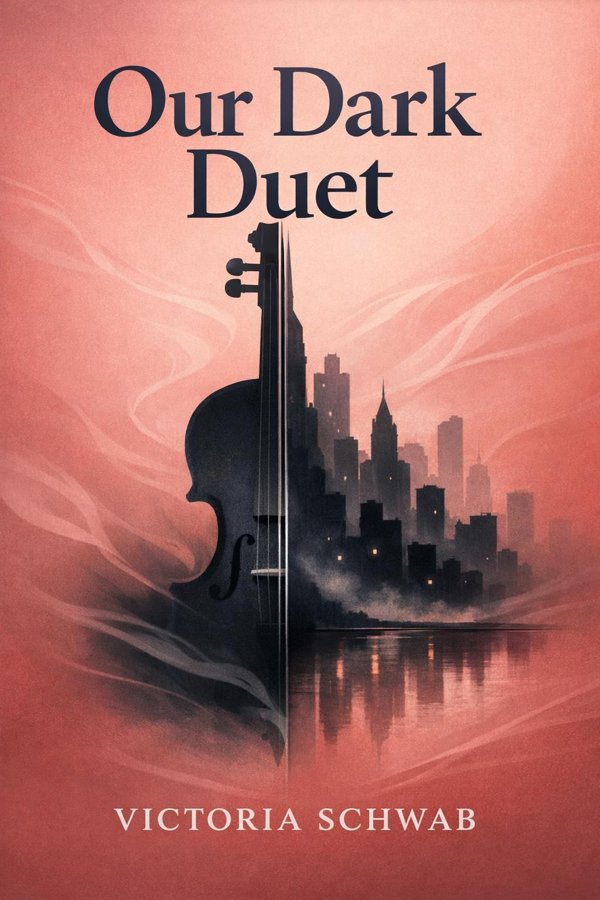
Our Dark Duet: Summary & Key Insights
 10 min8 chaptersAudio available
Key Takeaways from Our Dark Duet
Reinvention can look powerful from the outside while hiding deep unresolved pain within.
Power becomes dangerous when conscience is treated as weakness, yet conscience without action can collapse under pressure.
A city is shaped not only by laws and leaders, but by the emotional habits of the people living inside it.
The most dangerous threats are often the ones that exploit what people already feel.
Reunions are most revealing when they expose how much growth has a cost.
What Is Our Dark Duet About?
Our Dark Duet by Victoria Schwab is a scifi_fantasy book spanning 5 pages. What if the monsters destroying your city were not the only threat, but mirrors of the violence, grief, and hatred living inside human hearts? In Our Dark Duet, Victoria Schwab brings the Monsters of Verity duology to a powerful close, following Kate Harker, a ruthless hunter of supernatural predators, and August Flynn, a monster who longs to be more human than the people around him. Separated by distance and transformed by war, both must confront a world where survival demands hard choices and innocence has long since vanished. Set in a fractured city where acts of violence create literal monsters, the novel blends dark fantasy, dystopian tension, and emotional depth into a story about identity, conscience, and sacrifice. Schwab’s gift lies in making moral conflict feel immediate and visceral: every battle is also an inner struggle, every monster a symbol of what people create through fear and cruelty. As a bestselling author celebrated for exploring the blurry line between good and evil, Schwab delivers a haunting, character-driven finale that asks whether redemption is still possible after the darkness has already taken root.
This FizzRead summary covers all 8 key chapters of Our Dark Duet in approximately 10 minutes, distilling the most important ideas, arguments, and takeaways from Victoria Schwab's work. Also available as an audio summary and Key Quotes Podcast.
Our Dark Duet
What if the monsters destroying your city were not the only threat, but mirrors of the violence, grief, and hatred living inside human hearts? In Our Dark Duet, Victoria Schwab brings the Monsters of Verity duology to a powerful close, following Kate Harker, a ruthless hunter of supernatural predators, and August Flynn, a monster who longs to be more human than the people around him. Separated by distance and transformed by war, both must confront a world where survival demands hard choices and innocence has long since vanished.
Set in a fractured city where acts of violence create literal monsters, the novel blends dark fantasy, dystopian tension, and emotional depth into a story about identity, conscience, and sacrifice. Schwab’s gift lies in making moral conflict feel immediate and visceral: every battle is also an inner struggle, every monster a symbol of what people create through fear and cruelty. As a bestselling author celebrated for exploring the blurry line between good and evil, Schwab delivers a haunting, character-driven finale that asks whether redemption is still possible after the darkness has already taken root.
Who Should Read Our Dark Duet?
This book is perfect for anyone interested in scifi_fantasy and looking to gain actionable insights in a short read. Whether you're a student, professional, or lifelong learner, the key ideas from Our Dark Duet by Victoria Schwab will help you think differently.
- ✓Readers who enjoy scifi_fantasy and want practical takeaways
- ✓Professionals looking to apply new ideas to their work and life
- ✓Anyone who wants the core insights of Our Dark Duet in just 10 minutes
Want the full summary?
Get instant access to this book summary and 100K+ more with Fizz Moment.
Get Free SummaryAvailable on App Store • Free to download
Key Chapters
Reinvention can look powerful from the outside while hiding deep unresolved pain within. When Our Dark Duet begins, Kate Harker is far from Verity, operating in Prosperity as a capable and feared monster hunter. She has built herself into a weapon: efficient, detached, and committed to a mission that gives shape to her anger. No longer the girl desperate for her father’s approval, she now defines herself through action. Yet Schwab makes it clear that identity forged only through opposition is unstable. Kate knows what she is against, but she is still learning what she is for.
Her work hunting malchai and other creatures gives her purpose, but it also becomes a way to avoid vulnerability. She channels grief and guilt into control, convincing herself that if she keeps moving, she does not have to examine the emotional cost of who she has become. This makes her compelling because she is not simply brave; she is defended. Her toughness is real, but it is also armor.
This idea matters beyond fantasy. Many people rebuild themselves after betrayal, family trauma, or failure by becoming hyper-competent. A student may become obsessively self-reliant after disappointment. A professional may define success by never needing help. Like Kate, they may gain strength while losing softness.
Schwab suggests that true identity is not built solely by rejecting the past or mastering survival. It also requires choosing values, relationships, and a future worth protecting. Strength without inner clarity becomes another kind of exile.
Actionable takeaway: Ask yourself whether your current identity is built only on what you escaped, or also on what you genuinely want to become.
Power becomes dangerous when conscience is treated as weakness, yet conscience without action can collapse under pressure. August Flynn stands at the center of this tension. Back in Verity, he has assumed greater responsibility within the Flynn Task Force, helping maintain order in a city where violence breeds monsters and fear governs daily life. Unlike his father, August does not naturally command through certainty. He leads while questioning himself, and that uncertainty is both his vulnerability and his moral strength.
As a sunai, August carries a terrible gift: his music can draw out and consume the souls of the violent. This ability turns him into an executioner of sorts, someone whose existence is tied to judgment. He wants to believe in goodness, mercy, and restraint, but leadership keeps forcing him into impossible choices. The city needs protection. The people around him need decisiveness. His own nature unsettles him. Schwab uses August to explore what happens when someone compassionate is asked to become an instrument of order in a brutal world.
This struggle feels recognizable in real life. Managers, parents, teachers, and community leaders often discover that caring deeply does not eliminate hard decisions. In fact, it can make them more painful. The challenge is not choosing between empathy and strength, but integrating them.
August’s arc shows that leadership is not the absence of fear or doubt. It is the willingness to act without surrendering one’s moral center. He is most dangerous when he sees himself as nothing but a monster, and most effective when he remembers that restraint is a form of power.
Actionable takeaway: If you are in a position of responsibility, define the values you refuse to abandon before crisis forces your hand.
A city is shaped not only by laws and leaders, but by the emotional habits of the people living inside it. Verity is one of Schwab’s most striking creations because it externalizes a terrifying idea: violence has consequences that do not end when the act is over. In this world, monstrous beings are born from human wrongdoing. Malchai emerge from murder, corsai from acts of violence, and sunai from catastrophic evil. The city is therefore not merely haunted by monsters; it manufactures them.
In Our Dark Duet, Verity is exhausted, divided, and barely holding itself together. Patrols and barricades may create temporary order, but they cannot address the deeper disease. Fear fuels aggression, aggression creates monsters, and monsters provoke more fear. It is a self-perpetuating cycle. Schwab turns urban decay into moral commentary: when a society normalizes harm, it eventually lives among the visible embodiment of its own choices.
This idea extends far beyond fantasy. Communities affected by cruelty, corruption, or ongoing hostility often experience similar cycles. Distrust produces isolation. Isolation creates suspicion. Suspicion leads to harsher behavior. Over time, damage becomes structural. The “monsters” may not be literal, but the effects are.
The genius of Verity is that it refuses simplistic blame. No single villain caused everything. Instead, collective violence accumulates until it transforms the environment itself. That makes the novel especially resonant in conversations about public trauma, social breakdown, and inherited fear.
Schwab’s warning is clear: if people do not confront the roots of violence, they will eventually be ruled by its consequences.
Actionable takeaway: Look for cycles of harm in your environment and intervene early; unchallenged patterns grow harder to contain with time.
The most dangerous threats are often the ones that exploit what people already feel. One of the novel’s central developments is the emergence of a new kind of monster: the Hollow Men. Unlike the more familiar creatures born from direct acts of violence, these beings spread emptiness, despair, and emotional corruption. They do not simply attack bodies; they erode hope, selfhood, and the ability to resist. Through them, Schwab shifts the conflict from physical survival to psychological and moral collapse.
The Hollow Men matter because they embody an especially modern kind of terror. They thrive in a city already worn down by grief and instability, making them symbols of how fear can be manipulated and amplified. A society does not need to be physically conquered if its people can be rendered numb, isolated, or convinced that resistance is pointless. This makes the monsters feel less like random fantasy inventions and more like expressions of depression, propaganda, and collective hopelessness.
In practical terms, the idea is deeply relevant. Harmful systems often succeed not by dramatic force alone but by draining energy, weakening trust, and making people feel too overwhelmed to act. A toxic workplace can do this. So can relentless bad news, online outrage cycles, or social environments that reward cynicism.
Schwab suggests that emotional vacancy is not neutral. It is dangerous because it creates space for manipulation. To fight back, characters must protect not only their bodies but their sense of meaning.
Actionable takeaway: When fear or numbness begins to define your thinking, deliberately reconnect with purpose, community, and small acts of agency before emptiness hardens into surrender.
Reunions are most revealing when they expose how much growth has a cost. When Kate and August meet again, they are no longer the wary, emotionally unformed teenagers from This Savage Song. Distance, grief, and responsibility have altered them both. Kate has become sharper, more guarded, and more willing to embrace danger. August has become heavier with duty, more isolated by his role, and more uncertain about what remains of his humanity. Their reconnection is charged not just by affection, but by recognition: each sees what the other has lost.
What makes their relationship powerful is that Schwab avoids easy romance. The emotional core is not whether they will become a conventional couple, but whether two damaged people can still understand each other without asking the other to become simpler. Their bond rests on shared loneliness, mutual respect, and the knowledge that both have crossed moral and emotional boundaries they cannot uncross.
This gives the novel unusual emotional maturity. In many stories, reunion restores what was broken. Here, reunion clarifies that nothing can return unchanged. Real connection requires meeting someone as they are now, not as you wish they had remained.
That insight applies outside fiction. Friendships, family ties, and romantic relationships often strain when people evolve under pressure. The challenge is not preserving an earlier version of closeness, but creating a new one based on honesty. Kate and August do not offer each other easy comfort; they offer recognition, which is often more valuable.
Actionable takeaway: In important relationships, stop demanding old versions of people and start asking who they have become through what they survived.
The novel’s darkest truth is that monstrosity is not the opposite of humanity; it may be one of its products. Throughout Our Dark Duet, Schwab dismantles any comforting idea that evil belongs neatly to supernatural beings while innocence belongs to people. The monsters in Verity are born from human violence, and the humans fighting them are fully capable of cruelty, manipulation, and destruction. This moral symmetry gives the book its force.
August, as a monster who longs to be good, becomes the clearest challenge to simplistic labels. His very existence asks whether morality is determined by origin, instinct, choice, or action. At the same time, human characters repeatedly show that fear can justify terrible behavior. By placing these truths side by side, Schwab argues that categories like monster and human are ethically insufficient. What matters is not what someone is called, but what they choose to do with power, pain, and fear.
This idea has strong practical value. In ordinary life, people often divide the world into villains and innocents, assuming harm is caused only by clearly bad actors. But many destructive patterns come from rationalization, dehumanization, and refusal to examine one’s own motives. The book invites self-scrutiny rather than moral superiority.
That is why the story feels haunting rather than merely exciting. It insists that everyone carries the potential to create darkness, whether through direct action, passive complicity, or emotional surrender. The purpose of recognizing that truth is not despair. It is responsibility.
Actionable takeaway: Before condemning external threats, examine the habits, resentments, or justifications in your own life that could quietly produce harm.
Some gifts are really burdens that reveal what kind of person you are under pressure. August’s music is one of the most memorable devices in the novel because it combines beauty with horror. When he plays his violin, he can call forth the souls of those marked by violent acts. This makes music more than atmosphere; it becomes moral confrontation. August’s power forces people to face what they have done, but it also forces him to bear the weight of judgment again and again.
Schwab uses this ability to explore compassion in a damaged world. August is not simply afraid of what he can do; he is afraid of what repeated use of power will do to him. If he keeps consuming the souls of the wicked, does he become less merciful? More numb? More monstrous? The question matters because people in difficult professions often face similar dilemmas. Therapists, nurses, investigators, soldiers, and caregivers may begin with empathy but risk burnout, detachment, or moral fatigue from constant exposure to suffering.
Music in the novel therefore symbolizes the tension between expression and consequence. It is intimate, emotional, and humanizing, yet in August’s hands it also destroys. That paradox reflects the broader theme of the series: the things that make us powerful can also wound us if used without care.
Compassion, Schwab suggests, is not passive softness. It is a disciplined refusal to let suffering turn into indifference. August’s struggle reminds us that staying humane while doing hard things requires conscious effort.
Actionable takeaway: If your role requires difficult decisions, build regular practices of reflection and recovery so your necessary strength does not become emotional numbness.
A story about darkness reaches its emotional peak when characters decide what they are willing to lose for something larger than themselves. In its final movement, Our Dark Duet becomes a meditation on sacrifice. Battles matter, but the deeper question is what kind of cost makes resistance meaningful. Schwab does not romanticize suffering; instead, she shows that sacrifice is tragic precisely because the characters understand its value. They are not disposable heroes. They are people who have already lost much and still choose to stand between destruction and the vulnerable.
This theme is especially potent because the novel never promises that courage guarantees reward. Some choices cannot preserve both life and innocence. Some victories arrive too late to feel triumphant. Yet sacrifice still matters because it interrupts the logic of fear. Fear says protect only yourself. Despair says nothing will change. Sacrifice says some things are worth defending even when success is uncertain.
In real life, sacrifice rarely appears as grand heroism. More often it looks like time, attention, honesty, restraint, or risk taken on behalf of others. A person may speak up against injustice despite professional cost. A parent may absorb hardship to create safety for a child. A friend may stay present through another’s crisis rather than choosing convenience.
Schwab’s ending underscores that meaning is not found in escaping darkness untouched. It is found in choosing who and what you will protect despite the darkness.
Actionable takeaway: Identify one value or person you are willing to inconvenience yourself for, and let that commitment guide your choices when comfort and conscience collide.
All Chapters in Our Dark Duet
About the Author
Victoria Schwab is an American bestselling author of fantasy and speculative fiction for both young adult and adult audiences. She also writes adult fiction under the name V.E. Schwab. Known for atmospheric prose, inventive worldbuilding, and morally complex characters, Schwab often explores themes such as identity, memory, power, violence, and the blurred boundary between good and evil. Her most recognized works include the Shades of Magic series, Vicious, The Invisible Life of Addie LaRue, Gallant, and the Monsters of Verity duology. Across her books, she has built a reputation for pairing high-concept fantasy with strong emotional and psychological depth. Schwab is widely regarded as one of the most influential contemporary voices in modern fantasy fiction.
Get This Summary in Your Preferred Format
Read or listen to the Our Dark Duet summary by Victoria Schwab anytime, anywhere. FizzRead offers multiple formats so you can learn on your terms — all free.
Available formats: App · Audio · PDF · EPUB — All included free with FizzRead
Download Our Dark Duet PDF and EPUB Summary
Key Quotes from Our Dark Duet
“Reinvention can look powerful from the outside while hiding deep unresolved pain within.”
“Power becomes dangerous when conscience is treated as weakness, yet conscience without action can collapse under pressure.”
“A city is shaped not only by laws and leaders, but by the emotional habits of the people living inside it.”
“The most dangerous threats are often the ones that exploit what people already feel.”
“Reunions are most revealing when they expose how much growth has a cost.”
Frequently Asked Questions about Our Dark Duet
Our Dark Duet by Victoria Schwab is a scifi_fantasy book that explores key ideas across 8 chapters. What if the monsters destroying your city were not the only threat, but mirrors of the violence, grief, and hatred living inside human hearts? In Our Dark Duet, Victoria Schwab brings the Monsters of Verity duology to a powerful close, following Kate Harker, a ruthless hunter of supernatural predators, and August Flynn, a monster who longs to be more human than the people around him. Separated by distance and transformed by war, both must confront a world where survival demands hard choices and innocence has long since vanished. Set in a fractured city where acts of violence create literal monsters, the novel blends dark fantasy, dystopian tension, and emotional depth into a story about identity, conscience, and sacrifice. Schwab’s gift lies in making moral conflict feel immediate and visceral: every battle is also an inner struggle, every monster a symbol of what people create through fear and cruelty. As a bestselling author celebrated for exploring the blurry line between good and evil, Schwab delivers a haunting, character-driven finale that asks whether redemption is still possible after the darkness has already taken root.
More by Victoria Schwab
You Might Also Like
Red Rising
Pierce Brown
10 min
Stranger in a Strange Land
Robert A. Heinlein
10 min
AI Valley
Chen Qiufan
10 min
Bloodchild
Octavia E. Butler
10 min
Do Androids Dream of Electric Sheep?
Philip K. Dick
10 min
Jujutsu Kaisen, Vol. 24
Gege Akutami
10 minBrowse by Category
Ready to read Our Dark Duet?
Get the full summary and 100K+ more books with Fizz Moment.