
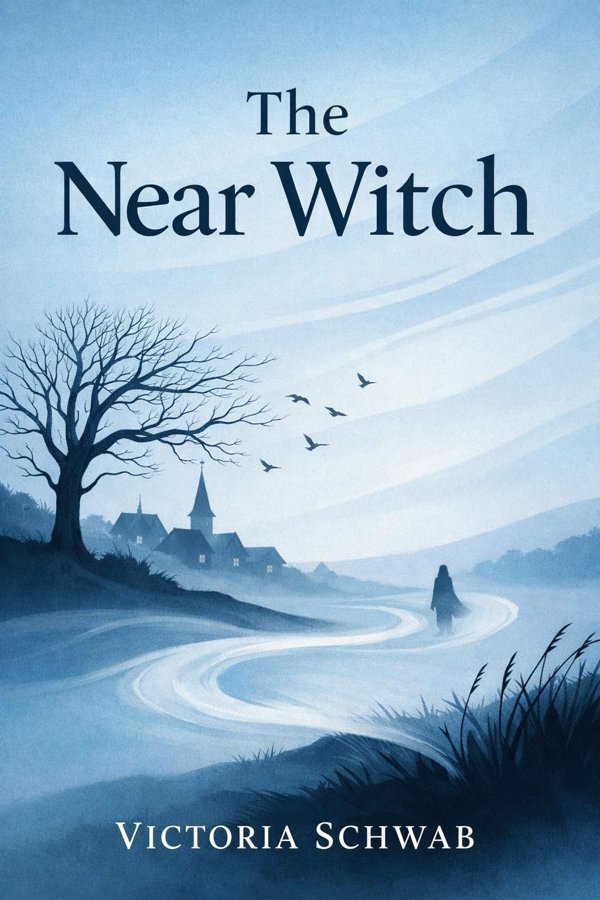
The Near Witch: Summary & Key Insights
 10 min9 chaptersAudio available
Key Takeaways from The Near Witch
Fear often looks like tradition when a community has repeated it for long enough.
Communities rarely fear the unknown in the abstract; they give it a face.
A story can be a shelter, but it can also be a cage.
Wisdom often survives at the edges, in the voices respectable society ignores.
What a society calls monstrous often begins as a wound it refused to understand.
What Is The Near Witch About?
The Near Witch by Victoria Schwab is a scifi_fantasy book spanning 5 pages. Some stories begin as warnings. Others become prisons. In The Near Witch, Victoria Schwab turns a village legend into a haunting, lyrical fantasy about fear, belonging, and the danger of mistaking rumor for truth. The novel is set in Near, an isolated town where people trust what is familiar, distrust what is different, and repeat old tales as if they were facts. When a stranger named Cole arrives and children begin disappearing, the village blames the outsider. But Lexi Harris, a sharp-minded girl rooted in Near’s history yet willing to question it, senses that the real threat lies deeper in the town’s buried past. What makes this novel matter is not only its eerie atmosphere, but its emotional precision. Beneath the witchcraft, wind, and folklore is a story about how communities create enemies, how women’s voices are dismissed, and how courage often begins with refusing the easy explanation. Schwab, celebrated for imaginative fantasy worlds and morally layered characters, shows early in this novel the gifts that would define her career: elegant prose, mythic tension, and a keen understanding of loneliness. The Near Witch is a dark fairy tale, but also a deeply human one.
This FizzRead summary covers all 9 key chapters of The Near Witch in approximately 10 minutes, distilling the most important ideas, arguments, and takeaways from Victoria Schwab's work. Also available as an audio summary and Key Quotes Podcast.
The Near Witch
Some stories begin as warnings. Others become prisons. In The Near Witch, Victoria Schwab turns a village legend into a haunting, lyrical fantasy about fear, belonging, and the danger of mistaking rumor for truth. The novel is set in Near, an isolated town where people trust what is familiar, distrust what is different, and repeat old tales as if they were facts. When a stranger named Cole arrives and children begin disappearing, the village blames the outsider. But Lexi Harris, a sharp-minded girl rooted in Near’s history yet willing to question it, senses that the real threat lies deeper in the town’s buried past.
What makes this novel matter is not only its eerie atmosphere, but its emotional precision. Beneath the witchcraft, wind, and folklore is a story about how communities create enemies, how women’s voices are dismissed, and how courage often begins with refusing the easy explanation. Schwab, celebrated for imaginative fantasy worlds and morally layered characters, shows early in this novel the gifts that would define her career: elegant prose, mythic tension, and a keen understanding of loneliness. The Near Witch is a dark fairy tale, but also a deeply human one.
Who Should Read The Near Witch?
This book is perfect for anyone interested in scifi_fantasy and looking to gain actionable insights in a short read. Whether you're a student, professional, or lifelong learner, the key ideas from The Near Witch by Victoria Schwab will help you think differently.
- ✓Readers who enjoy scifi_fantasy and want practical takeaways
- ✓Professionals looking to apply new ideas to their work and life
- ✓Anyone who wants the core insights of The Near Witch in just 10 minutes
Want the full summary?
Get instant access to this book summary and 100K+ more with Fizz Moment.
Get Free SummaryAvailable on App Store • Free to download
Key Chapters
Fear often looks like tradition when a community has repeated it for long enough. That idea sits at the heart of Near, a village so isolated that its customs feel less like choices and more like laws of nature. The people of Near live by inherited stories, gendered expectations, and strict boundaries between what belongs and what must stay outside. Lexi Harris grows up inside this world, but unlike many around her, she listens carefully enough to hear the cracks in it. She understands the old tales, respects the land, and loves her home, yet she does not mistake custom for truth.
This tension makes Lexi compelling. She is not a rebel because she hates Near; she is brave because she cares enough to challenge its blind spots. She helps support her family after her father’s death, watches over her younger sister Wren, and moves through a society that assumes girls should be quiet, useful, and obedient. Her intelligence is practical as much as emotional. She notices patterns. She questions easy explanations. She pays attention when others dismiss what they do not understand.
Near itself functions almost like a character. It is hemmed in by moor, wind, and ritual. The village rewards conformity and punishes difference, creating the conditions for collective suspicion. In real life, this mirrors how small groups—families, workplaces, neighborhoods—can become attached to “the way things are done,” even when those ways cause harm.
The practical lesson is simple but difficult: loving a place or a tradition does not require accepting its flaws. Lexi shows that true loyalty sometimes means asking harder questions than anyone else is willing to ask. Actionable takeaway: examine one belief you inherited from family or community and ask whether it is rooted in wisdom, fear, or habit.
Communities rarely fear the unknown in the abstract; they give it a face. In The Near Witch, that face first belongs to the legend every child in Near grows up hearing. The Near Witch is presented as a cautionary tale, a woman cast beyond the village and transformed by retelling into something monstrous. Her story is used to control behavior, define danger, and reassure the townspeople that evil always comes from elsewhere. When Cole, an outsider, appears in Near, the village quickly folds him into that same pattern. He is different, so he must be suspicious. He is silent, so he must be hiding something.
Schwab uses this pairing—the old legend and the new stranger—to explore how prejudice works. People often do not need evidence when a narrative is already waiting for them. Cole’s presence becomes a convenient answer to the terror of missing children because he fits the role the village has prepared. Lexi, however, resists this reflex. She senses that stories can preserve truth, but they can also distort it. Her willingness to look at Cole as a person instead of a symbol becomes one of the book’s moral turning points.
This idea resonates far beyond fantasy. In everyday life, outsiders in communities, companies, or social circles are often judged before they are known. Someone with a different accent, background, or personality can become a target simply because they disrupt familiarity. Schwab reminds us that fear seeks shortcuts, and stereotypes provide them.
The deeper insight is that legends are powerful not because they are always true, but because people behave as though they are. Actionable takeaway: the next time you feel immediate suspicion toward someone unfamiliar, pause and ask whether you are responding to evidence—or to a story you have already been taught to believe.
A story can be a shelter, but it can also be a cage. One of the most fascinating dimensions of The Near Witch is the way folklore shapes behavior in Near. Tales are not background decoration here; they regulate what people fear, whom they trust, and what they are willing to see. Children are warned through legend. Adults justify suspicion through legend. Men in authority use accepted stories to preserve accepted power. The result is a village where narrative carries almost as much force as law.
Schwab does not dismiss stories themselves. In fact, she treats them with reverence. Stories preserve memory, carry history, and connect one generation to another. But the novel insists that stories are never neutral. Whoever tells them, edits them, and repeats them decides which truths survive and which are buried. The Near Witch legend has been retold so many times that the woman at its center has become almost unrecognizable. Her pain is flattened into warning. Her humanity is lost beneath usefulness.
This matters because many real-world assumptions work the same way. Families pass down myths about who is strong, who is difficult, who belongs, who cannot be trusted. Institutions create narratives about merit, normalcy, or danger that shape decisions without being questioned. The power of these stories lies in their invisibility. People stop seeing them as narratives and start treating them as reality itself.
Lexi’s growth depends on learning how to listen differently. She must hear not only the story everyone repeats, but the silence around it. That is where suppressed truth often lives. The novel encourages readers to become better interpreters of inherited narratives rather than passive recipients.
Actionable takeaway: identify one story your environment repeats often—about success, gender, outsiders, or safety—and ask who benefits from that story, who is harmed by it, and what version might be missing.
Wisdom often survives at the edges, in the voices respectable society ignores. Lexi’s search for the missing children leads her toward the Thorne sisters, whose presence broadens the novel’s understanding of femininity, age, and knowledge. These older women live outside the village’s center of power, yet they understand Near’s hidden currents more deeply than many of its louder authorities. Their knowledge is intuitive, experiential, and tied to old ways of seeing—forms of insight the village is quick to dismiss when frightened.
The Thorne sisters matter because they reveal an alternative lineage of power. In Near, official authority largely belongs to men who respond to crisis with control, blame, and force. The sisters represent another tradition: observation, memory, and attunement to what others overlook. They are not sentimental figures. They are unsettling, ambiguous, and difficult to categorize. That complexity is exactly what gives them weight. Schwab suggests that truth is often found not in neat certainty but in those willing to sit with mystery.
For Lexi, engaging with the sisters is also an act of self-expansion. She learns that knowledge can come from marginalized places and that listening is sometimes more powerful than commanding. This has practical relevance beyond the novel. In any crisis, we tend to prioritize the most confident voices, not necessarily the most perceptive ones. Yet insight frequently comes from people who have been sidelined: elders, caretakers, observers, or those with long memories of past mistakes.
The Thorne sisters show that expertise does not always look official. Sometimes it appears in lived experience, emotional intelligence, or historical memory. Lexi grows stronger because she seeks guidance without surrendering her judgment.
Actionable takeaway: when facing a difficult decision, consult someone whose perspective is usually overlooked. Ask what they notice that dominant voices might be missing.
What a society calls monstrous often begins as a wound it refused to understand. As The Near Witch unfolds, the supernatural threat becomes inseparable from the village’s buried history. The awakening of the witch is not merely a horror twist; it is the return of suppressed grief, anger, and injustice. Schwab frames magic less as spectacle than as emotional consequence. The haunting power in the book emerges from what Near tried to cast away and forget.
This is why the witch feels tragic as well as terrifying. She is not evil in the simplest sense. She is the outcome of fear, exile, and distortion. By transforming a woman into legend and then legend into warning, the village avoids confronting its own role in her fate. The awakened witch embodies the danger of unresolved wrongs. What is not acknowledged does not disappear; it changes form.
The novel’s emotional intelligence shines here. Rather than offering a clean battle between innocence and evil, Schwab gives readers a layered confrontation between past and present. Lexi’s task is not only to stop harm but to understand it. That distinction matters. Force alone cannot solve a crisis rooted in denial. Truth must be recovered before peace can be restored.
In everyday terms, this idea applies to family conflict, institutional failure, and social injustice. When harm is denied or rewritten, it tends to resurface through repetition, resentment, or breakdown. The “ghosts” in our lives often come from what we have refused to name.
The lesson is that healing requires recognition. If we simplify pain into villainy, we miss both its origins and its warning. Actionable takeaway: think about a recurring conflict in your life or community and ask what older hurt or ignored truth may be feeding it beneath the surface.
Sometimes the setting tells the truth before the characters can. In The Near Witch, the wind is not just weather and the moor is not just scenery. Schwab creates a world where landscape feels animate, responsive, and morally significant. The environment carries memory. It whispers warnings, heightens unease, and blurs the line between natural and supernatural. This atmospheric design is one reason the novel lingers in the mind long after the plot ends.
The wind in particular functions almost like a messenger. It reflects Near’s instability and amplifies the sense that something unseen is moving through the village. The moor, meanwhile, embodies the border between civilization and wildness, the known and the feared. Villagers imagine safety inside their routines, but the natural world constantly reminds readers that control is fragile. Human rules are local; the world beyond them is older, stranger, and less obedient.
This use of setting deepens the novel’s themes. Near’s people try to define danger as external, yet the landscape suggests that boundaries are porous. Fear travels. Memory lingers. What has been buried can rise. Schwab’s atmosphere is not decorative; it is interpretive. Readers learn how to feel the story through fog, sound, distance, and silence.
There is a practical reading lesson here as well. Great fiction often uses setting to express psychology and conflict. A town, room, season, or storm can reveal what characters refuse to say. In life, environments also shape emotion more than we admit. The places we inhabit influence how we think, react, and relate.
Actionable takeaway: when reading any novel—or reflecting on your own life—pay attention to place. Ask how the environment reinforces the emotional truth of what is happening and what it might be trying to tell you before the characters do.
Trust is most meaningful when fear makes it irrational. The growing bond between Lexi and Cole is one of the novel’s quiet strengths because it is built not on instant certainty but on mutual recognition in a climate of suspicion. Cole is marked as other from the beginning, and Lexi risks social judgment by seeing him as more than a threat. Their connection develops within danger, grief, and uncertainty, which gives it tenderness without making it sentimental.
Schwab handles this relationship with restraint. Romance is present, but it never overwhelms the larger story. Instead, it sharpens the novel’s central concerns. To trust Cole, Lexi must resist her community’s assumptions and her own understandable caution. To trust Lexi, Cole must risk exposure in a place hostile to difference. Their bond becomes an act of courage, proof that intimacy requires vulnerability and that seeing another person clearly is often a moral choice before it becomes an emotional one.
This matters because fear tends to flatten people. Under pressure, communities sort individuals into categories: safe or dangerous, ours or theirs, familiar or suspect. Love and trust complicate that simplification. They ask us to remain attentive to personhood when panic encourages abstraction.
The dynamic between Lexi and Cole also offers a practical relational insight. Healthy trust does not ignore danger; it grows through observation, consistency, and shared action. Lexi does not trust blindly. She watches, listens, and learns. In real life, strong relationships often form the same way—not by instant faith, but by repeated evidence of character.
Actionable takeaway: in a relationship strained by uncertainty, focus less on labels and more on patterns. Ask what someone consistently does, not merely what others say about them.
Silencing women is one of the oldest forms of social order, and The Near Witch exposes how costly that silence can be. Lexi, the Thorne sisters, and the witch herself all exist in relation to a community that undervalues female knowledge unless it becomes useful or dangerous to men. Women in Near are expected to endure, assist, and obey. Yet they are also the ones carrying memory, perception, and survival skills the village desperately needs.
What makes this theme powerful is its range. Lexi is young, practical, and still becoming herself. The Thorne sisters are older, enigmatic, and socially peripheral. The witch is the most extreme case: a woman pushed outside the community until she can only return as legend and threat. Together, they form a map of how female power is contained, dismissed, feared, and reinterpreted. The novel suggests that patriarchy does not merely oppress women through open force; it also distorts their stories, strips context from their suffering, and then uses that distorted version as justification for further control.
Lexi’s resistance therefore matters on more than a personal level. Every time she speaks when ignored, acts when forbidden, or investigates when warned away, she challenges the village’s assumption that authority belongs elsewhere. Her courage is not loud domination. It is persistence, clarity, and refusal.
This idea remains deeply relevant. In workplaces, families, and institutions, women are still often expected to soften truths, carry emotional labor, or defer to louder voices. The novel reminds readers that insight without permission is still insight, and courage without status is still courage.
Actionable takeaway: notice one setting in your life where a valuable voice is routinely minimized. Make space for that perspective—or if it is your own, practice stating it clearly without apology.
Surviving a crisis is not the same as learning from it. The final movement of The Near Witch, often summarized as the period after the storm, gives the novel its lasting moral weight. Once the immediate danger passes, the deeper question emerges: what does a community do with the truth when the truth implicates it? Near cannot return unchanged if it honestly confronts what happened. The disappearances, the legend, the blame placed on outsiders, and the suffering hidden beneath superstition all demand reckoning.
Schwab resists a simplistic ending. There is relief, but not perfect repair. There is connection, but also loss. This is important because it honors the emotional reality of healing. Real change rarely arrives as complete closure. Instead, it begins when people stop protecting the stories that made harm possible. Lexi’s journey leaves her with greater knowledge, but knowledge comes at a price: innocence cannot survive contact with buried truth.
The aftermath also reveals the novel’s central ethical point. Fear can unify a group temporarily, but only honesty can restore it. Communities that define themselves through exclusion will keep generating new scapegoats until they examine the beliefs beneath their panic. Near’s future depends less on defeating one supernatural force than on reconsidering the worldview that gave that force shape.
This applies broadly. After conflict at home, at work, or in society, people often rush toward normalcy. But “normal” may be what allowed the damage in the first place. Reflection is slower than denial, yet more durable.
Actionable takeaway: after any major conflict, resist the urge to move on too quickly. Ask what must change structurally, relationally, or emotionally so that the same harm is not repeated under a different name.
All Chapters in The Near Witch
About the Author
Victoria Schwab is an American bestselling author of fantasy and speculative fiction, widely recognized for both young adult and adult novels. She often publishes adult work under the name V.E. Schwab and has built a reputation for lyrical prose, inventive world-building, and morally complex characters. Her books frequently explore themes such as memory, loneliness, identity, violence, and the blurry line between hero and monster. Among her best-known works are Vicious, the Shades of Magic series, Gallant, and The Invisible Life of Addie LaRue. The Near Witch was her debut novel and introduced many of the qualities that would later define her career: atmospheric storytelling, emotional depth, and a fascination with the hidden power of stories. Schwab is now considered one of the most distinctive voices in contemporary fantasy.
Get This Summary in Your Preferred Format
Read or listen to the The Near Witch summary by Victoria Schwab anytime, anywhere. FizzRead offers multiple formats so you can learn on your terms — all free.
Available formats: App · Audio · PDF · EPUB — All included free with FizzRead
Download The Near Witch PDF and EPUB Summary
Key Quotes from The Near Witch
“Fear often looks like tradition when a community has repeated it for long enough.”
“Communities rarely fear the unknown in the abstract; they give it a face.”
“A story can be a shelter, but it can also be a cage.”
“Wisdom often survives at the edges, in the voices respectable society ignores.”
“What a society calls monstrous often begins as a wound it refused to understand.”
Frequently Asked Questions about The Near Witch
The Near Witch by Victoria Schwab is a scifi_fantasy book that explores key ideas across 9 chapters. Some stories begin as warnings. Others become prisons. In The Near Witch, Victoria Schwab turns a village legend into a haunting, lyrical fantasy about fear, belonging, and the danger of mistaking rumor for truth. The novel is set in Near, an isolated town where people trust what is familiar, distrust what is different, and repeat old tales as if they were facts. When a stranger named Cole arrives and children begin disappearing, the village blames the outsider. But Lexi Harris, a sharp-minded girl rooted in Near’s history yet willing to question it, senses that the real threat lies deeper in the town’s buried past. What makes this novel matter is not only its eerie atmosphere, but its emotional precision. Beneath the witchcraft, wind, and folklore is a story about how communities create enemies, how women’s voices are dismissed, and how courage often begins with refusing the easy explanation. Schwab, celebrated for imaginative fantasy worlds and morally layered characters, shows early in this novel the gifts that would define her career: elegant prose, mythic tension, and a keen understanding of loneliness. The Near Witch is a dark fairy tale, but also a deeply human one.
More by Victoria Schwab



You Might Also Like

Red Rising
Pierce Brown
10 min
Stranger in a Strange Land
Robert A. Heinlein
10 min
AI Valley
Chen Qiufan
10 min
Bloodchild
Octavia E. Butler
10 min
Do Androids Dream of Electric Sheep?
Philip K. Dick
10 min
Jujutsu Kaisen, Vol. 24
Gege Akutami
10 minBrowse by Category
Ready to read The Near Witch?
Get the full summary and 100K+ more books with Fizz Moment.