
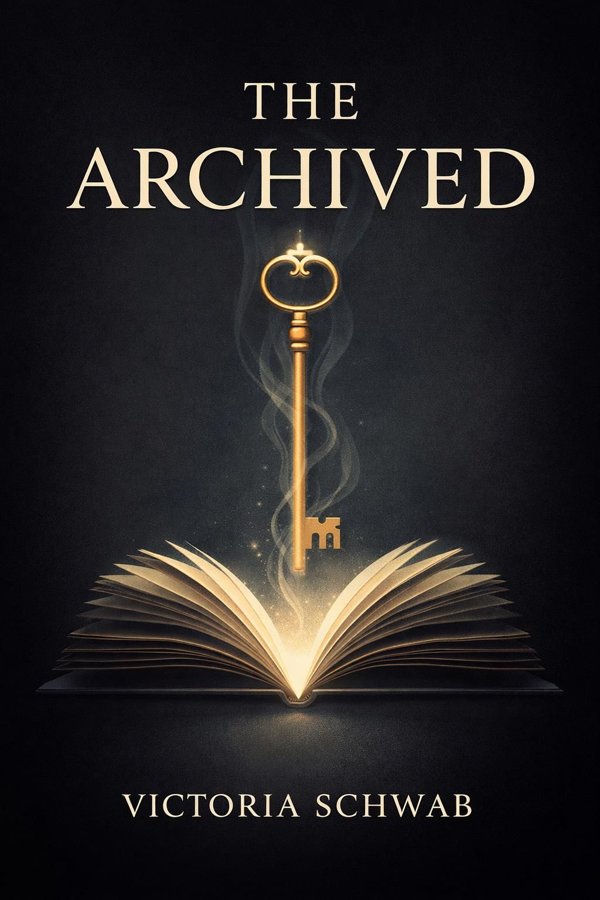
The Archived: Summary & Key Insights
 10 min9 chaptersAudio available
Key Takeaways from The Archived
The most powerful inheritances are not always comforting; sometimes they are burdens disguised as duty.
Grief rarely arrives as a single emotion; more often, it settles into a place and changes the atmosphere of everything around it.
Systems that promise perfect order often conceal an equally perfect blindness.
The first crack in any worldview is often the most frightening, because it forces us to question everything we thought was stable.
We like to think memory preserves identity, but sometimes it freezes us in a version of ourselves we can no longer survive.
What Is The Archived About?
The Archived by Victoria Schwab is a scifi_fantasy book spanning 6 pages. What if every human life could be shelved, preserved, and revisited like a book? In The Archived, Victoria Schwab builds a chillingly original fantasy around that idea, imagining a hidden institution called the Archive, where the dead are stored as Histories and selected guardians make sure those echoes of the past stay contained. At the center is Mackenzie Bishop, a teenager trained to capture restless Histories that wake and wander, even as she struggles with the very real grief of losing her younger brother. When her family moves into the old Coronado hotel, strange disturbances begin to blur the line between personal mourning and institutional conspiracy. What starts as a supernatural mystery becomes a story about memory, trauma, secrecy, and the cost of carrying pain alone. Schwab, known for crafting dark, emotionally intelligent fantasy, brings unusual authority to this world through her gift for combining elegant world-building with intimate character psychology. The Archived matters because beneath its ghostly premise lies a piercing truth: remembering can preserve us, but it can also trap us if we never learn how to let go.
This FizzRead summary covers all 9 key chapters of The Archived in approximately 10 minutes, distilling the most important ideas, arguments, and takeaways from Victoria Schwab's work. Also available as an audio summary and Key Quotes Podcast.
The Archived
What if every human life could be shelved, preserved, and revisited like a book? In The Archived, Victoria Schwab builds a chillingly original fantasy around that idea, imagining a hidden institution called the Archive, where the dead are stored as Histories and selected guardians make sure those echoes of the past stay contained. At the center is Mackenzie Bishop, a teenager trained to capture restless Histories that wake and wander, even as she struggles with the very real grief of losing her younger brother. When her family moves into the old Coronado hotel, strange disturbances begin to blur the line between personal mourning and institutional conspiracy. What starts as a supernatural mystery becomes a story about memory, trauma, secrecy, and the cost of carrying pain alone. Schwab, known for crafting dark, emotionally intelligent fantasy, brings unusual authority to this world through her gift for combining elegant world-building with intimate character psychology. The Archived matters because beneath its ghostly premise lies a piercing truth: remembering can preserve us, but it can also trap us if we never learn how to let go.
Who Should Read The Archived?
This book is perfect for anyone interested in scifi_fantasy and looking to gain actionable insights in a short read. Whether you're a student, professional, or lifelong learner, the key ideas from The Archived by Victoria Schwab will help you think differently.
- ✓Readers who enjoy scifi_fantasy and want practical takeaways
- ✓Professionals looking to apply new ideas to their work and life
- ✓Anyone who wants the core insights of The Archived in just 10 minutes
Want the full summary?
Get instant access to this book summary and 100K+ more with Fizz Moment.
Get Free SummaryAvailable on App Store • Free to download
Key Chapters
The most powerful inheritances are not always comforting; sometimes they are burdens disguised as duty. Mackenzie Bishop’s relationship to the Archive begins with her grandfather, Da, who introduces her to a hidden system that catalogs the dead as Histories and appoints Keepers to return those Histories when they wake and escape. To Da, the Archive is sacred order. It gives shape to chaos, honors the past, and protects the living from the dangerous force of memory uncontained. Mackenzie absorbs that worldview early, and with it she inherits a role far larger than herself.
This legacy matters because it defines how Mackenzie sees both the world and her own emotions. She is trained to be efficient, observant, and contained. A Keeper does not indulge panic or sentiment while working. That discipline helps her function in dangerous situations, but it also teaches her to compartmentalize pain. After Da dies, Mackenzie is left with not only his lessons but also the pressure to live up to them alone. The Archive becomes both a calling and a cage.
Schwab uses this intergenerational bond to show how family traditions shape identity. In everyday life, many people inherit unspoken rules from parents or grandparents: be strong, stay quiet, keep going, do not ask for help. Those values can create resilience, but they can also become limitations if never examined.
Mackenzie’s journey asks an important question: when does honoring a legacy become surrendering your own voice? Her growth depends on learning that inheritance should guide, not imprison.
Actionable takeaway: Reflect on one belief or habit you inherited from family, and ask whether it still serves the person you are becoming.
Grief rarely arrives as a single emotion; more often, it settles into a place and changes the atmosphere of everything around it. After the death of Mackenzie’s younger brother Ben, her family moves into the Coronado, a former hotel converted into apartments. The building is full of old rooms, hidden passages, and lingering impressions, making it the perfect setting for a story where memory is almost physically alive. But the Coronado is not just a gothic backdrop. It reflects the emotional condition of the Bishop family, who are all mourning in different, incompatible ways.
Mackenzie’s parents want a new start, hoping a change of place might soften the ache of loss. Instead, the Coronado amplifies absence. Every hallway feels heavy with what is unsaid. Mackenzie carries her grief inward, protecting her family from the truth of her Keeper duties while also hiding the scale of her emotional unraveling. Her mother and father, absorbed in their own sorrow, cannot fully reach her. That loneliness becomes one of the novel’s deepest tensions.
The move illustrates a familiar human impulse: when pain becomes unbearable, people often try to outrun it through relocation, reinvention, or distraction. But The Archived insists that grief does not stay behind. It travels with us, taking up residence in ordinary routines, architecture, and silence. Healing requires more than escape; it requires acknowledgment.
Readers can recognize this in everyday experiences such as returning to a room after loss, avoiding certain topics at home, or pretending to be fine to protect others. The Coronado becomes a metaphor for all the ways sorrow turns familiar spaces strange.
Actionable takeaway: If you are carrying grief, identify one safe person or place where you can stop performing “okay” and name what you actually feel.
The first crack in any worldview is often the most frightening, because it forces us to question everything we thought was stable. For Mackenzie, that crack appears when Histories begin waking and escaping with unusual frequency. These are not random incidents but signs of a deeper disorder. As a Keeper, she is trained to believe that disturbances happen within known limits. When those limits start failing, she has to confront the possibility that the system itself is compromised.
This section of the novel turns supernatural patrol work into a compelling mystery. Mackenzie notices patterns that others dismiss or minimize. The missing Histories, irregular behavior, and mounting danger suggest intentional tampering rather than accidental breakdown. Her instincts sharpen because she has learned from Da to trust observations over appearances. Still, recognizing a problem is not the same as proving one, especially when authority prefers denial.
Schwab captures a truth that extends far beyond fantasy: anomalies matter. In daily life, people often ignore inconsistencies because they are inconvenient. A workplace reports numbers that do not match experience. A friend’s behavior shifts in subtle but troubling ways. A family story contains details no one wants to examine. The temptation is to explain away the irregularity and preserve comfort. But unresolved anomalies usually point to a hidden cause.
Mackenzie’s attention to these fractures makes her effective, but it also isolates her. Being the person who notices what others refuse to see can feel lonely and destabilizing. Yet the novel frames that discomfort as necessary courage.
Actionable takeaway: When something repeatedly feels “off,” write down the pattern instead of dismissing it. Clarity often begins with noticing what does not fit.
We like to think memory preserves identity, but sometimes it freezes us in a version of ourselves we can no longer survive. The central invention of The Archived is the idea that every life becomes a History, a recorded existence stored on shelves like a book. This gives the novel its eerie beauty, but it also drives its emotional and philosophical depth. If a person can be reduced to an accessible record, what remains sacred, private, or unfinished about a human life?
For Mackenzie, Histories are not abstract objects. They resemble people enough to be unsettling, and their escapes are dangerous precisely because memory carries force. The novel suggests that the past is never inert. It moves, resurfaces, and shapes the present, especially when ignored or mishandled. Mackenzie’s own grief over Ben mirrors this dynamic. She cannot simply file away his absence. Her memories of him continue to animate her choices, vulnerabilities, and sense of self.
In practical terms, the book speaks to anyone who has felt defined by old versions of themselves: a former failure, a past relationship, a childhood wound, a family role that no longer fits. Memory can help us learn, but it can also trap us if we treat it as destiny. Schwab’s world makes literal what many readers already know emotionally: the past must be handled with care because it does not always stay on the shelf.
The Archived does not argue for forgetting. Instead, it distinguishes between honoring memory and living inside it. Identity requires both remembrance and movement.
Actionable takeaway: Choose one memory that still controls how you see yourself, and rewrite its meaning by asking what it taught you rather than what it took from you.
Sometimes the people who unsettle us most are the ones who make honesty possible. Wesley Ayers enters Mackenzie’s life as an infuriating, charming, observant presence in the Coronado. He is curious in ways that feel intrusive, perceptive in ways that make it hard for Mackenzie to maintain her usual defenses, and emotionally alive in contrast to her tightly controlled habits. In another story, he might simply function as comic relief or romantic tension. Here, he serves a larger purpose: he challenges Mackenzie’s isolation.
Wes matters because he represents a different way of carrying pain. He is not untouched by difficulty, but he meets the world with openness, humor, and persistence. Mackenzie, by contrast, has learned secrecy as survival. Her role as Keeper already separates her from normal adolescence, and her grief over Ben deepens that divide. Wesley’s presence creates the possibility of connection without full explanation. He reminds her that being seen does not always equal being exposed.
This dynamic reflects a practical emotional truth. People who are used to self-protection often believe they need to solve their pain alone before they can let others close. But healing relationships rarely wait for perfect readiness. Instead, they grow through small acts of trust: answering one personal question honestly, accepting help, staying in conversation instead of retreating.
Wesley does not erase Mackenzie’s struggles, and that is exactly why he works. He offers companionship, perspective, and emotional interruption. In a story full of secrecy and manipulation, his sincerity becomes a counterweight.
Actionable takeaway: Strengthen one relationship this week by sharing a truth you usually keep hidden behind humor, busyness, or silence.
The most dangerous villains are often those who believe they are correcting a flawed system. As Mackenzie investigates the disturbances in the Archive, suspicion narrows toward Owen, a figure whose charm, instability, and pain make him more complex than a simple antagonist. His actions reveal that the Archive’s problems are not just external breaches but internal wounds. Tampering has occurred because someone close to the machinery of order has lost faith in its justice.
Owen’s role intensifies the novel’s moral ambiguity. He is frightening, but he is also tragic. Through him, Schwab explores what happens when grief, betrayal, and institutional neglect curdle into obsession. He does not merely want to disrupt the Archive; he wants to force recognition of what it has failed to protect. That motivation does not excuse his actions, but it does make them legible. The confrontation with Owen becomes a confrontation with the Archive’s omissions as much as with one person’s violence.
In real life, breakdowns within systems often emerge from ignored pain. A student lashes out after being overlooked. An employee sabotages a workplace after prolonged invisibility. A family conflict explodes after years of suppression. The lesson is not that harm is justified, but that unresolved suffering can become combustible when institutions reward silence over care.
For Mackenzie, facing Owen means recognizing that competence alone cannot guarantee safety. She must combine courage, discernment, and emotional clarity. The enemy is not only chaos, but the false belief that pain can be contained indefinitely.
Actionable takeaway: When conflict escalates around you, look beyond the surface incident and ask what neglected hurt or unmet need may be feeding the crisis.
Silence inside an institution is rarely empty; it is usually a strategy. One of The Archived’s sharpest insights is that secrecy does not merely protect mysteries, it protects hierarchies. The Archive withholds information from Keepers under the logic of necessity, but the result is dependence. Mackenzie is expected to perform dangerous work without full context, which leaves her vulnerable to manipulation and slow to recognize the scale of corruption around her.
This dynamic deepens the novel beyond a supernatural thriller. Schwab shows how power operates through selective knowledge. Those closest to the truth decide what others are “ready” to know, and that decision keeps authority intact. Mackenzie’s frustration comes not just from being deceived but from realizing that obedience has been mistaken for virtue. Once she starts asking questions, she sees that silence is part of the system’s design.
The relevance to ordinary life is immediate. Institutions often frame secrecy as professionalism, tradition, privacy, or stability. Sometimes those explanations are legitimate. But they can also become tools for avoiding accountability. A workplace may hide decision-making behind vague language. A family may maintain “peace” by refusing to discuss harm. A school or organization may celebrate loyalty while punishing transparency.
The novel encourages readers to examine the emotional cost of being kept in partial darkness. When people are denied context, they begin to doubt their own perceptions. Mackenzie’s persistence is therefore an act of reclaiming agency.
Actionable takeaway: In any group you belong to, notice where information is consistently withheld, and ask one clear, respectful question that helps bring hidden assumptions into the open.
Survival is not the same as healing, but it can be the first honest step toward it. By the end of The Archived, Mackenzie has confronted escaped Histories, institutional deception, dangerous manipulation, and her own unprocessed grief. The resolution does not offer perfect closure, and that is one of the novel’s strengths. Schwab understands that trauma rarely ends with one revelation or one act of bravery. Instead, recovery begins when a person chooses not to be ruled entirely by fear, memory, or duty.
Mackenzie emerges changed. She still belongs to a world of shadows, but she no longer accepts its rules with the same unquestioning reverence. She has learned that loyalty without scrutiny is dangerous, that grief cannot be outrun, and that connection is not weakness. Most importantly, she begins to reclaim the possibility of a future. Ben’s death remains real, Da’s absence remains painful, and the Archive remains complicated, yet she is no longer defined solely by what she has lost.
This is a meaningful lesson for readers facing their own transitions. Renewal is often quieter than people expect. It may look like returning a call, making a plan, setting a boundary, asking for help, or allowing joy to coexist with sorrow. The novel does not suggest that pain disappears; it suggests that life can continue expanding around it.
That balance makes The Archived more than a mystery or fantasy. It becomes a story about choosing engagement over numbness, even when the world has proven unstable.
Actionable takeaway: Identify one small act that signals you are moving forward, and do it even if you still feel uncertain. Progress often begins before confidence arrives.
All Chapters in The Archived
About the Author
Victoria Schwab is an American novelist celebrated for writing imaginative fantasy that blends high-concept world-building with emotional depth. She writes young adult fiction as Victoria Schwab and adult fiction as V.E. Schwab, though readers across both audiences recognize her for her interest in memory, identity, power, and the blurred boundary between life and death. Her books often feature morally complex characters, haunting settings, and elegant prose, qualities that have earned her an international readership. Among her best-known works are The Invisible Life of Addie LaRue, the Shades of Magic trilogy, and Vicious. In The Archived, Schwab showcases many of the strengths that define her career: a striking supernatural premise, layered themes, and a sharp understanding of grief, secrecy, and human resilience.
Get This Summary in Your Preferred Format
Read or listen to the The Archived summary by Victoria Schwab anytime, anywhere. FizzRead offers multiple formats so you can learn on your terms — all free.
Available formats: App · Audio · PDF · EPUB — All included free with FizzRead
Download The Archived PDF and EPUB Summary
Key Quotes from The Archived
“The most powerful inheritances are not always comforting; sometimes they are burdens disguised as duty.”
“Grief rarely arrives as a single emotion; more often, it settles into a place and changes the atmosphere of everything around it.”
“Systems that promise perfect order often conceal an equally perfect blindness.”
“The first crack in any worldview is often the most frightening, because it forces us to question everything we thought was stable.”
“We like to think memory preserves identity, but sometimes it freezes us in a version of ourselves we can no longer survive.”
Frequently Asked Questions about The Archived
The Archived by Victoria Schwab is a scifi_fantasy book that explores key ideas across 9 chapters. What if every human life could be shelved, preserved, and revisited like a book? In The Archived, Victoria Schwab builds a chillingly original fantasy around that idea, imagining a hidden institution called the Archive, where the dead are stored as Histories and selected guardians make sure those echoes of the past stay contained. At the center is Mackenzie Bishop, a teenager trained to capture restless Histories that wake and wander, even as she struggles with the very real grief of losing her younger brother. When her family moves into the old Coronado hotel, strange disturbances begin to blur the line between personal mourning and institutional conspiracy. What starts as a supernatural mystery becomes a story about memory, trauma, secrecy, and the cost of carrying pain alone. Schwab, known for crafting dark, emotionally intelligent fantasy, brings unusual authority to this world through her gift for combining elegant world-building with intimate character psychology. The Archived matters because beneath its ghostly premise lies a piercing truth: remembering can preserve us, but it can also trap us if we never learn how to let go.
More by Victoria Schwab



You Might Also Like

Red Rising
Pierce Brown
10 min
Stranger in a Strange Land
Robert A. Heinlein
10 min
AI Valley
Chen Qiufan
10 min
Bloodchild
Octavia E. Butler
10 min
Do Androids Dream of Electric Sheep?
Philip K. Dick
10 min
Jujutsu Kaisen, Vol. 24
Gege Akutami
10 minBrowse by Category
Ready to read The Archived?
Get the full summary and 100K+ more books with Fizz Moment.