
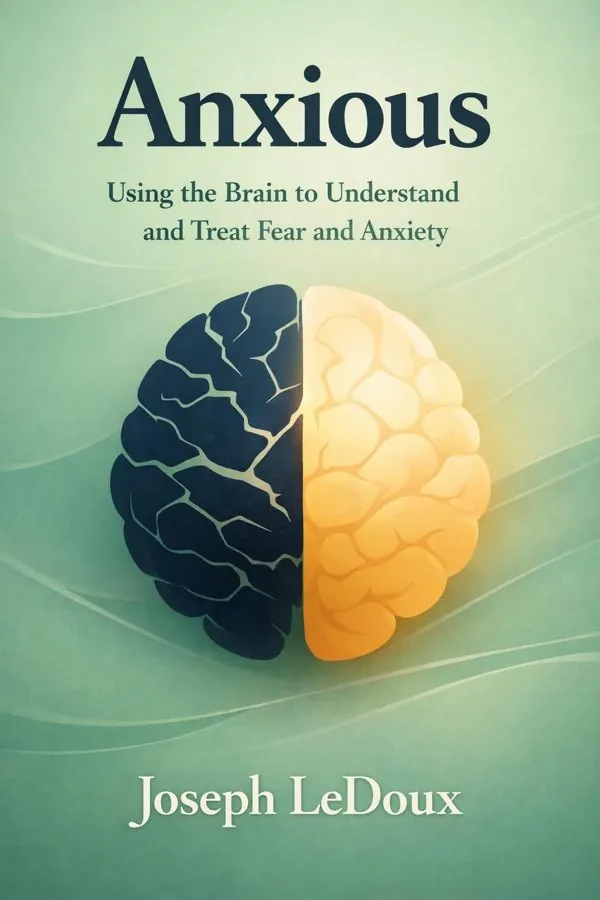
Anxious: Summary & Key Insights
 10 min9 chaptersAudio available
Key Takeaways from Anxious
One of the biggest obstacles to understanding anxiety is that we often use the same word for very different processes.
A simple tone paired with a mild shock can teach an animal to freeze in anticipation—and that elegant experiment helped transform modern neuroscience.
We often assume that if the brain triggers a defensive response, the feeling of fear must already exist.
The very trait that lets humans plan, imagine, and prepare also makes us vulnerable to chronic distress.
Many people imagine emotions as things hidden inside the brain, waiting to be triggered like buttons.
What Is Anxious About?
Anxious by Joseph LeDoux is a neuroscience book published in 2015 spanning 4 pages. Anxiety can feel deeply personal, but Joseph LeDoux shows that it is also profoundly biological. In Anxious, the renowned neuroscientist explores how the brain detects danger, stores threat memories, and generates the conscious experience we call fear and anxiety. Rather than treating these emotions as vague psychological states, LeDoux traces them to specific neural systems shaped by evolution to help organisms survive. Yet the same systems that once protected us can misfire in modern life, producing chronic worry, panic, phobias, and debilitating stress. What makes this book so important is its insistence on precision. LeDoux challenges common assumptions about emotion, especially the tendency to blur automatic survival responses with the subjective feeling of fear. Drawing on decades of groundbreaking research on the amygdala, conditioning, memory, and consciousness, he offers a more rigorous framework for understanding anxiety disorders and improving treatment. The result is a book that bridges neuroscience, psychology, psychiatry, and philosophy. For anyone who wants to understand why the brain so easily turns anticipation into suffering—and what science can do about it—Anxious is both illuminating and urgently relevant.
This FizzRead summary covers all 9 key chapters of Anxious in approximately 10 minutes, distilling the most important ideas, arguments, and takeaways from Joseph LeDoux's work. Also available as an audio summary and Key Quotes Podcast.
Anxious
Anxiety can feel deeply personal, but Joseph LeDoux shows that it is also profoundly biological. In Anxious, the renowned neuroscientist explores how the brain detects danger, stores threat memories, and generates the conscious experience we call fear and anxiety. Rather than treating these emotions as vague psychological states, LeDoux traces them to specific neural systems shaped by evolution to help organisms survive. Yet the same systems that once protected us can misfire in modern life, producing chronic worry, panic, phobias, and debilitating stress.
What makes this book so important is its insistence on precision. LeDoux challenges common assumptions about emotion, especially the tendency to blur automatic survival responses with the subjective feeling of fear. Drawing on decades of groundbreaking research on the amygdala, conditioning, memory, and consciousness, he offers a more rigorous framework for understanding anxiety disorders and improving treatment. The result is a book that bridges neuroscience, psychology, psychiatry, and philosophy. For anyone who wants to understand why the brain so easily turns anticipation into suffering—and what science can do about it—Anxious is both illuminating and urgently relevant.
Who Should Read Anxious?
This book is perfect for anyone interested in neuroscience and looking to gain actionable insights in a short read. Whether you're a student, professional, or lifelong learner, the key ideas from Anxious by Joseph LeDoux will help you think differently.
- ✓Readers who enjoy neuroscience and want practical takeaways
- ✓Professionals looking to apply new ideas to their work and life
- ✓Anyone who wants the core insights of Anxious in just 10 minutes
Want the full summary?
Get instant access to this book summary and 100K+ more with Fizz Moment.
Get Free SummaryAvailable on App Store • Free to download
Key Chapters
One of the biggest obstacles to understanding anxiety is that we often use the same word for very different processes. LeDoux argues that science has been slowed by this conceptual blur. In everyday language, we say we are “afraid” when our heart races, when we avoid a crowded room, when we panic before a speech, or when we consciously imagine disaster. But these experiences do not all arise from the same mechanism. Some are automatic survival responses; others are conscious feelings constructed by the mind.
LeDoux’s key contribution is to separate defensive survival circuits from the subjective experience of fear and anxiety. Threat detection can happen quickly and outside awareness, preparing the body to freeze, flee, or fight. That does not necessarily mean a person is consciously feeling fear in the same moment. The conscious state comes later, when the brain interprets bodily arousal, context, memories, and thoughts. This distinction matters because it helps explain why people can react to danger before they know what is happening, and why anxiety disorders involve more than simple “overactive fear.”
A practical example is stage fright. Before giving a presentation, your palms may sweat and your pulse may spike automatically. Then your mind adds meaning: “I’m going to embarrass myself.” The bodily response and the conscious story interact, but they are not identical. Recognizing that difference can reduce shame. You are not weak because your body reacts; you are experiencing an ancient survival system doing its job, perhaps too well.
For clinicians and readers alike, this sharper language improves treatment. Some interventions target physiological reactivity, while others target conscious beliefs and interpretations. Actionable takeaway: when anxiety arises, distinguish between what your body is doing automatically and what your mind is saying about it. Naming those separately is the first step toward managing both.
A simple tone paired with a mild shock can teach an animal to freeze in anticipation—and that elegant experiment helped transform modern neuroscience. LeDoux’s work on threat conditioning showed that the amygdala plays a central role in detecting learned danger and triggering defensive responses. This does not mean the amygdala is the “fear center,” as pop culture often claims. Rather, it is a crucial hub in a broader survival network that links sensory input to rapid protective action.
When a neutral cue becomes associated with harm, the brain stores that connection. Later, the cue alone can activate defensive circuits: increased heart rate, muscle tension, vigilance, freezing, avoidance. These reactions are efficient because they do not require deliberate reasoning. Evolution favored organisms that could respond to danger quickly, even at the cost of occasional false alarms.
This helps explain many everyday experiences. If you were bitten by a dog as a child, hearing barking years later may trigger instant unease before you consciously remember the event. A veteran may react to fireworks as if they signal attack. A person who once fainted on the subway may feel their body brace the moment train doors close. In each case, threat learning has linked a cue to a survival response.
LeDoux also highlights that memory is not fixed. Threat associations can be strengthened, generalized, inhibited, or updated under certain conditions. That insight underlies exposure-based therapies, which do not erase old fear memories but teach the brain new learning: the cue is now safe.
Actionable takeaway: if a harmless trigger repeatedly sets off anxiety, treat it as learned threat memory rather than personal failure. Gradual, structured exposure with support can help the brain build new associations.
We often assume that if the brain triggers a defensive response, the feeling of fear must already exist. LeDoux argues this assumption is mistaken. The body can mobilize for survival without a fully formed conscious emotion. A rustle in the dark may make you jump before you know whether it is a burglar, a cat, or the wind. The initial reaction is generated by neural systems designed for speed. The feeling comes when the brain interprets what happened.
This distinction has deep implications. For one thing, it helps explain why animals can show defensive behavior without proving they experience human-like fear in the same way. It also clarifies why people sometimes have panic-like bodily symptoms that seem to appear out of nowhere. Conscious fear is not a simple readout of a single circuit. It is a mental state assembled from perception, memory, attention, bodily signals, language, and self-awareness.
Think of waking suddenly at night with your heart pounding. For a few seconds, your body is already in alarm mode. Then your mind starts searching for a cause: Did I hear something? Is something wrong with my health? Am I under too much stress? The conscious feeling of anxiety grows as the brain constructs meaning around the bodily state. This means that part of suffering lies not only in the reaction itself, but in the interpretation layered on top of it.
For treatment, this suggests two targets. One is the automatic response system. The other is the conscious appraisal system that turns arousal into a frightening narrative. Medication, breathing techniques, exposure, cognitive therapy, and mindfulness may each affect different levels of the process.
Actionable takeaway: the next time your body reacts before your mind catches up, remind yourself that activation is not the whole story. Pause long enough to separate sensation from interpretation before assuming danger.
The very trait that lets humans plan, imagine, and prepare also makes us vulnerable to chronic distress. LeDoux shows that anxiety is not a design flaw added to an otherwise rational mind. It is an outgrowth of evolved survival systems combined with advanced cognition. Animals need mechanisms to detect and escape immediate threats. Humans, with memory and imagination, can also anticipate future threats, simulate what might happen, and worry long before anything occurs.
That capacity is adaptive. It helps us save money for emergencies, avoid risky situations, prepare for storms, and rehearse difficult conversations. A species unable to anticipate danger would not survive for long. But the same predictive ability becomes costly when it turns inward and runs unchecked. The brain begins treating imagined scenarios as if they are imminent realities. We rehearse humiliation, illness, failure, rejection, catastrophe. Anxiety is therefore tied not just to present danger, but to the uniquely human talent for mental time travel.
Modern life amplifies this mismatch. Our brains evolved in environments with acute, concrete threats. Today, many of our dangers are abstract, symbolic, and prolonged: job insecurity, social comparison, digital overload, constant news, performance pressure. The body’s ancient response systems still mobilize as if a predator were near, but the “predator” may be an email, a deadline, or a memory.
This perspective can be liberating. It reframes anxiety not as evidence of personal defect, but as the overextension of capacities that are otherwise useful. Planning and imagination are strengths; they become painful when not regulated.
Actionable takeaway: when worry spirals, ask whether your brain is solving a real problem or simulating endless possibilities. Limit anxiety’s grip by shifting from vague future threats to one concrete step you can take in the present.
Many people imagine emotions as things hidden inside the brain, waiting to be triggered like buttons. LeDoux offers a more nuanced view: conscious feelings are constructed mental experiences, not simple products of one dedicated emotional center. Fear is not merely “released” by the amygdala. Instead, the brain builds the feeling by integrating sensory information, context, memory, bodily arousal, and higher-order cognition.
This view aligns emotion with broader theories of consciousness. To feel afraid, the brain must do more than detect threat. It must represent that threat in relation to the self: something dangerous is happening, and it matters to me. Language, self-reflection, and conceptual knowledge all shape that experience. That is why two people can react differently to the same bodily state. One person interprets a racing heart as excitement before a challenge; another interprets it as a sign of looming disaster.
The practical importance is enormous. If emotional experience is constructed, then it can also be reconstructed. This does not mean feelings are fake or voluntary. It means they are influenced by how the brain organizes information. Context matters. Labels matter. Stories matter. Attention matters. Athletes are taught to reinterpret arousal as readiness. People with panic disorder may learn that dizziness and palpitations are uncomfortable but not dangerous. Mindfulness trains observation without catastrophic meaning-making.
LeDoux’s framework also reduces simplistic thinking about mental health. Instead of searching for a single broken “fear switch,” we can ask how bodily responses, memories, beliefs, and conscious interpretation combine to produce suffering.
Actionable takeaway: when intense emotion appears, experiment with changing the frame around it. Ask, “What meaning am I giving these sensations?” A different interpretation can alter the feeling that follows.
Anxiety disorders are not just exaggerated reactions to danger; they are patterns of learning, memory, and interpretation that become self-reinforcing. LeDoux emphasizes that once threat associations form, they can spread beyond their original trigger. A person frightened in one elevator may start fearing all elevators, then tall buildings, then enclosed spaces generally. This process of generalization turns a narrow protective response into a broad limitation on life.
Avoidance plays a central role. In the short term, avoiding a trigger brings relief, which teaches the brain that avoidance works. But that same relief prevents new learning. The person never has the chance to discover that the situation can be tolerated and may even be safe. Over time, the feared category expands while confidence shrinks.
Meaning-making intensifies the cycle. Suppose someone has a panic attack in a grocery store. They may begin not only to fear stores, but to fear the sensations themselves: dizziness, heat, breathlessness, trembling. Then anxiety becomes anxiety about anxiety. The brain starts monitoring internal states as if they are threats, creating a loop in which vigilance magnifies symptoms and symptoms magnify vigilance.
LeDoux’s analysis helps explain why treatment often requires more than reassurance. Facts alone rarely override deeply learned threat memory. Change usually depends on repeated experiences that update the brain’s predictions. This may include exposure therapy, cognitive restructuring, interoceptive exercises, stress regulation, and compassionate attention to the person’s narrative.
Actionable takeaway: notice whether your coping strategies reduce anxiety only briefly while making your world smaller over time. If so, choose one avoided but safe situation and re-enter it gradually, allowing new learning to occur.
There is no single master cure for anxiety because anxiety itself arises from several interacting systems. LeDoux makes clear that effective treatment must address physiology, learning, memory, attention, and conscious thought. This is why some people benefit from medication, some from psychotherapy, and many from a combination. Different interventions target different components of the anxious process.
Exposure therapy is powerful because it directly engages learned threat associations. By approaching a feared but safe cue under controlled conditions, the brain acquires inhibitory learning: this stimulus does not always predict harm. Cognitive therapies help people examine catastrophic beliefs and reinterpret ambiguous sensations. Relaxation and breathing techniques can reduce bodily escalation. Medication may dampen hyperarousal or make it easier to participate in therapy. Mindfulness can reduce overidentification with anxious thoughts.
LeDoux is especially valuable in showing why treatment can be difficult even when people intellectually “know better.” Rational understanding lives alongside older survival learning. Someone may know airplanes are statistically safe and still feel intense panic during takeoff. The goal is not merely to persuade the thinking mind, but to retrain the systems that predict threat automatically.
A practical application is to stop asking whether one method is universally best and instead ask which mechanism needs attention. Is the problem mostly anticipatory worry, bodily panic, trauma-linked cues, rigid avoidance, or all of the above? Precision improves outcomes.
Actionable takeaway: if anxiety persists, build a treatment plan that addresses at least two levels at once—for example, exposure plus cognitive work, or medication plus behavioral practice—rather than relying on insight alone.
What we call an experience changes how we live through it. LeDoux’s emphasis on conceptual clarity extends beyond laboratories into ordinary life. The labels we use—fear, stress, panic, dread, unease, threat, excitement—guide attention and interpretation. Language can sharpen understanding, but it can also trap us in misleading simplifications.
If someone says, “My amygdala is broken,” they may feel doomed by biology. If they say, “My body learned to react quickly to certain cues,” the same experience becomes more workable. The first label suggests a fixed defect; the second suggests plasticity and retraining. Likewise, calling every form of distress “anxiety” may obscure important differences between social fear, trauma response, generalized worry, and health anxiety. Better language leads to better questions and better help.
This applies in relationships too. A partner who says, “I need a minute because my body is on high alert,” is communicating more usefully than one who simply snaps or withdraws. Parents can help children by naming sensations without dramatizing them: “Your heart is beating fast because your body thinks something important is happening.” Clinicians can reduce stigma by explaining symptoms as learned and embodied rather than irrational or weak.
LeDoux’s larger point is that consciousness depends partly on concepts. The categories available to us shape emotional awareness. More precise words can soften confusion, reduce shame, and open paths to change.
Actionable takeaway: upgrade your emotional vocabulary. Instead of saying only “I’m anxious,” try identifying whether you are feeling bodily arousal, catastrophic thinking, avoidance, uncertainty, or a specific fear. Precision creates leverage.
People often worry that a biological explanation of anxiety will reduce them to circuits and chemicals. LeDoux argues the opposite. Good neuroscience can deepen compassion by showing that suffering emerges from lawful brain processes, not moral weakness. Understanding the mechanisms behind fear and anxiety does not erase the human experience; it helps explain why it feels so compelling and why change can be hard.
This humane dimension runs throughout the book. Anxiety is not merely a research topic. It affects relationships, work, sleep, confidence, identity, and freedom. A person may know their fears are excessive and still feel trapped by them. Neuroscience clarifies why insight does not automatically liberate us. Survival systems are ancient, efficient, and not designed to wait for reflective permission.
At the same time, LeDoux avoids fatalism. The brain is plastic. Memories can be updated. Interpretations can shift. Habits of avoidance can be reversed. Treatments can improve. The more precisely science maps the components of anxiety, the better we can tailor interventions and reduce suffering. This is especially important in a world where anxiety disorders are common, often misunderstood, and frequently stigmatized.
For readers, the broader lesson is that explanation and empathy belong together. Knowing more about the brain should make us kinder to ourselves and others, not more mechanical. A person struggling with panic, phobia, or chronic worry is not failing at life; they are confronting systems built for survival that have become overprotective.
Actionable takeaway: use scientific understanding to replace self-blame with curiosity. Ask not “What is wrong with me?” but “What has my brain learned, and how can I help it learn differently?”
All Chapters in Anxious
About the Author
Joseph LeDoux is a leading American neuroscientist whose work has transformed the study of fear, emotion, and anxiety. He is a professor at New York University and director of the Emotional Brain Institute, where he has spent decades investigating how the brain detects threats, forms emotional memories, and produces defensive responses. LeDoux is especially known for his groundbreaking research on the amygdala and threat conditioning, which helped shape modern neuroscience’s understanding of survival circuits. Beyond the lab, he has become an influential public thinker, writing accessible books that connect brain science with psychology, psychiatry, and philosophy. His work stands out for combining rigorous experimental research with conceptual clarity, challenging simplistic views of emotion and offering more precise ways to understand mental suffering.
Get This Summary in Your Preferred Format
Read or listen to the Anxious summary by Joseph LeDoux anytime, anywhere. FizzRead offers multiple formats so you can learn on your terms — all free.
Available formats: App · Audio · PDF · EPUB — All included free with FizzRead
Download Anxious PDF and EPUB Summary
Key Quotes from Anxious
“One of the biggest obstacles to understanding anxiety is that we often use the same word for very different processes.”
“A simple tone paired with a mild shock can teach an animal to freeze in anticipation—and that elegant experiment helped transform modern neuroscience.”
“We often assume that if the brain triggers a defensive response, the feeling of fear must already exist.”
“The very trait that lets humans plan, imagine, and prepare also makes us vulnerable to chronic distress.”
“Many people imagine emotions as things hidden inside the brain, waiting to be triggered like buttons.”
Frequently Asked Questions about Anxious
Anxious by Joseph LeDoux is a neuroscience book that explores key ideas across 9 chapters. Anxiety can feel deeply personal, but Joseph LeDoux shows that it is also profoundly biological. In Anxious, the renowned neuroscientist explores how the brain detects danger, stores threat memories, and generates the conscious experience we call fear and anxiety. Rather than treating these emotions as vague psychological states, LeDoux traces them to specific neural systems shaped by evolution to help organisms survive. Yet the same systems that once protected us can misfire in modern life, producing chronic worry, panic, phobias, and debilitating stress. What makes this book so important is its insistence on precision. LeDoux challenges common assumptions about emotion, especially the tendency to blur automatic survival responses with the subjective feeling of fear. Drawing on decades of groundbreaking research on the amygdala, conditioning, memory, and consciousness, he offers a more rigorous framework for understanding anxiety disorders and improving treatment. The result is a book that bridges neuroscience, psychology, psychiatry, and philosophy. For anyone who wants to understand why the brain so easily turns anticipation into suffering—and what science can do about it—Anxious is both illuminating and urgently relevant.
More by Joseph LeDoux
You Might Also Like

Hallucinations
Oliver Sacks
10 min
The Biological Mind: How Brain, Body, and Environment Collaborate to Make Us Who We Are
Alan Jasanoff
10 min
The Feeling of Life Itself: Why Consciousness Is Widespread but Can't Be Computed
Christof Koch
10 min
The No-Nonsense Meditation Book
Steven Laureys
10 min
A General Theory of Love
Thomas Lewis, Fari Amini, Richard Lannon
10 min
A Thousand Brains: A New Theory of Intelligence
Jeff Hawkins
10 minFeatured In
Browse by Category
Ready to read Anxious?
Get the full summary and 100K+ more books with Fizz Moment.