
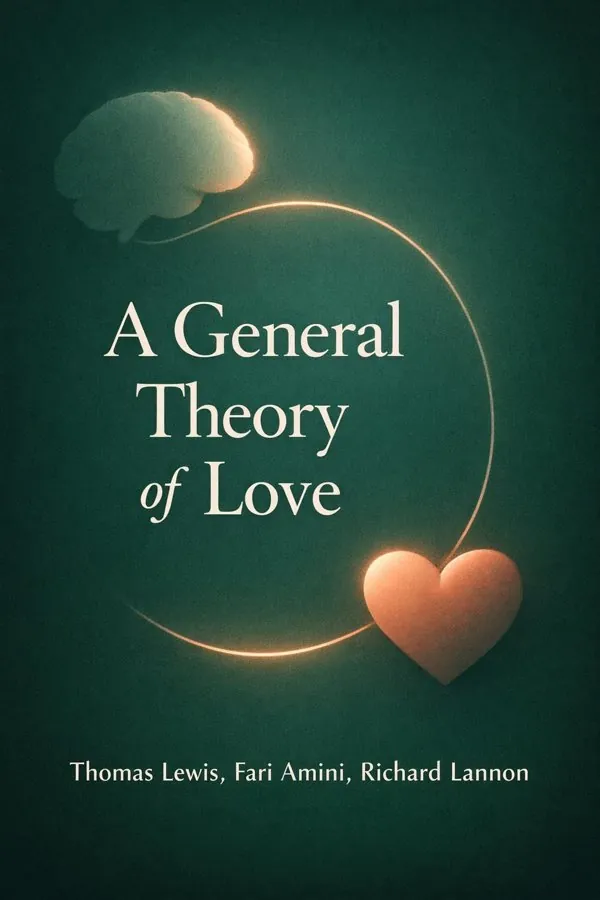
A General Theory of Love: Summary & Key Insights
by Thomas Lewis, Fari Amini, Richard Lannon
 10 min7 chaptersAudio available
What Is A General Theory of Love About?
A General Theory of Love by Thomas Lewis, Fari Amini, Richard Lannon is a neuroscience book spanning 7 pages. A General Theory of Love explores the biological and emotional foundations of human affection, attachment, and relationships. Drawing from neuroscience and psychiatry, the authors explain how love shapes our brains, influences our emotional health, and determines our capacity for connection and empathy. The book bridges science and human experience, showing that love is not merely a feeling but a vital biological process essential to well-being.
This FizzRead summary covers all 7 key chapters of A General Theory of Love in approximately 10 minutes, distilling the most important ideas, arguments, and takeaways from Thomas Lewis, Fari Amini, Richard Lannon's work. Also available as an audio summary and Key Quotes Podcast.
A General Theory of Love
A General Theory of Love explores the biological and emotional foundations of human affection, attachment, and relationships. Drawing from neuroscience and psychiatry, the authors explain how love shapes our brains, influences our emotional health, and determines our capacity for connection and empathy. The book bridges science and human experience, showing that love is not merely a feeling but a vital biological process essential to well-being.
Who Should Read A General Theory of Love?
This book is perfect for anyone interested in neuroscience and looking to gain actionable insights in a short read. Whether you're a student, professional, or lifelong learner, the key ideas from A General Theory of Love by Thomas Lewis, Fari Amini, Richard Lannon will help you think differently.
- ✓Readers who enjoy neuroscience and want practical takeaways
- ✓Professionals looking to apply new ideas to their work and life
- ✓Anyone who wants the core insights of A General Theory of Love in just 10 minutes
Want the full summary?
Get instant access to this book summary and 100K+ more with Fizz Moment.
Get Free SummaryAvailable on App Store • Free to download
Key Chapters
In exploring love, we begin with the limbic system — the constellation of neural structures that make up the emotional core of the human brain. While older parts of the brain, such as the reptilian brainstem, regulate survival functions like breathing or heartbeat, the limbic brain introduced a radically new capacity into evolution: the ability to feel, to bond, and to shape one’s internal world through connection with others.
From this perspective, emotions are not mere chemical fluctuations; they are biological signals meant to be shared. The limbic system evolved not for solitary efficiency but for intimate communication. Its circuitry thrives on feedback — on the presence of other limbic systems. We are designed to live in resonance with others, each of us part of a network of hearts and minds constantly adjusting to one another. This interdependence defines emotional life: the regulation of feeling through relationship.
In development, the limbic brain acts as an apprentice. It learns emotional patterns from those around it — primarily from parents or caregivers. Every smile, every soothing touch, every responsive glance builds the neural pathways that determine how the child will later manage emotions. When connection is consistent and loving, the limbic brain learns security and calm; when absent or chaotic, it learns fear and instability.
This structure of learning is permanent and physical. The neural architecture of attachment becomes the blueprint for adult emotional style. Thus, to understand love is to understand the biology of feeling: the way our limbic brains synchronize and mold one another. The limbic brain doesn’t just feel emotions; it builds them into patterns of meaning that persist throughout life.
Limbic resonance is the heart’s quiet miracle — the phenomenon by which two people literally tune to each other’s emotional wavelengths. When you are near someone you trust, your heartbeat, breathing, and even hormonal activity begin to fall into rhythm. Emotional states are contagious, but not through words or logic; they are transmitted by the limbic circuitry that recognizes and mirrors another’s feeling.
As we describe in the book, limbic resonance explains why infants calm in the arms of a loving parent, why friends laugh together without saying a word, and why lovers sense each other’s moods even in silence. It is the brain’s way of saying: you are not alone. The limbic system constantly scans and matches the emotional landscapes of others, creating a shared field of feeling.
This resonance is what makes empathy possible. It bypasses intellectual analysis and operates at the level of biology — through facial expressions, tone, posture, and even subtle changes in physiology. Human beings were never designed to manage emotions in isolation. Our equilibrium depends on the synchrony supplied by contact. Without it, the limbic system struggles for stability, often yielding anxiety, depression, or a persistent sense of emptiness.
Understanding limbic resonance helps explain why supportive relationships heal and why neglect wounds so deeply. Emotional connection literally re-regulates internal biology. Love is not just experienced; it is embodied. This is why the presence of others can restore balance, while isolation distorts perception and emotion alike.
+ 5 more chapters — available in the FizzRead app
All Chapters in A General Theory of Love
About the Authors
Thomas Lewis, Fari Amini, and Richard Lannon are psychiatrists affiliated with the University of California, San Francisco. Their collaborative work integrates neuroscience, psychology, and psychiatry to explore the emotional and biological underpinnings of human relationships.
Get This Summary in Your Preferred Format
Read or listen to the A General Theory of Love summary by Thomas Lewis, Fari Amini, Richard Lannon anytime, anywhere. FizzRead offers multiple formats so you can learn on your terms — all free.
Available formats: App · Audio · PDF · EPUB — All included free with FizzRead
Download A General Theory of Love PDF and EPUB Summary
Key Quotes from A General Theory of Love
“In exploring love, we begin with the limbic system — the constellation of neural structures that make up the emotional core of the human brain.”
“Limbic resonance is the heart’s quiet miracle — the phenomenon by which two people literally tune to each other’s emotional wavelengths.”
Frequently Asked Questions about A General Theory of Love
A General Theory of Love by Thomas Lewis, Fari Amini, Richard Lannon is a neuroscience book that explores key ideas across 7 chapters. A General Theory of Love explores the biological and emotional foundations of human affection, attachment, and relationships. Drawing from neuroscience and psychiatry, the authors explain how love shapes our brains, influences our emotional health, and determines our capacity for connection and empathy. The book bridges science and human experience, showing that love is not merely a feeling but a vital biological process essential to well-being.
You Might Also Like
Anxious
Joseph LeDoux
10 min
Hallucinations
Oliver Sacks
10 min
The Biological Mind: How Brain, Body, and Environment Collaborate to Make Us Who We Are
Alan Jasanoff
10 min
The Feeling of Life Itself: Why Consciousness Is Widespread but Can't Be Computed
Christof Koch
10 min
The No-Nonsense Meditation Book
Steven Laureys
10 min
A Thousand Brains: A New Theory of Intelligence
Jeff Hawkins
10 minBrowse by Category
Ready to read A General Theory of Love?
Get the full summary and 100K+ more books with Fizz Moment.