
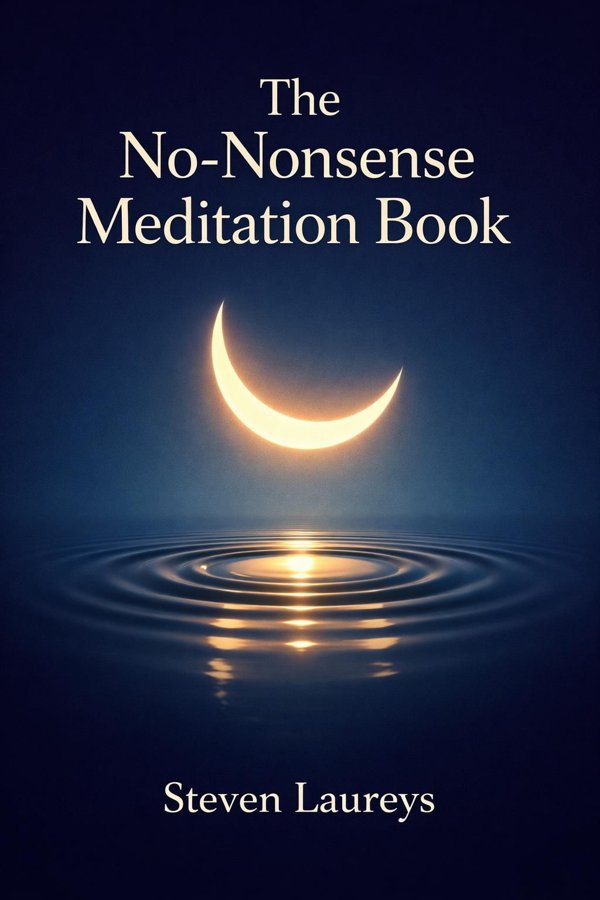
The No-Nonsense Meditation Book: Summary & Key Insights
 10 min8 chaptersAudio available
Key Takeaways from The No-Nonsense Meditation Book
The most liberating idea in the book is that meditation is not an exotic gift; it is a form of training.
One of the book’s strongest contributions is its insistence that meditation is not just a subjective experience; it is a biological process.
A powerful idea running through the book is that modern life is not only busy; it is attention-fragmenting.
Much suffering comes not from what we experience, but from how automatically we react to it.
A common mistake is to think meditation happens only in the head.
What Is The No-Nonsense Meditation Book About?
The No-Nonsense Meditation Book by Steven Laureys is a neuroscience book. Meditation is often surrounded by mysticism, vague promises, and intimidating spiritual language. In The No-Nonsense Meditation Book, neurologist Steven Laureys strips all that away and asks a simpler, more useful question: what actually happens in the brain and body when we meditate, and how can ordinary people use it to live better? The result is a grounded, accessible guide that treats meditation not as a mysterious talent reserved for monks, but as a trainable mental skill with measurable effects. Laureys brings unusual authority to the subject. As a renowned neuroscientist known for his work on consciousness, he approaches meditation with scientific rigor while also taking its practical benefits seriously. He explores how attention, awareness, stress regulation, sleep, pain, and emotional balance are shaped by contemplative practice, translating research into clear lessons for everyday life. What makes this book matter is its balance. It neither overhypes meditation as a cure-all nor dismisses it as soft self-help. Instead, it offers a realistic, evidence-based path for anyone curious about improving focus, resilience, and well-being. For readers who want meditation explained plainly, intelligently, and usefully, this book delivers exactly what its title promises.
This FizzRead summary covers all 8 key chapters of The No-Nonsense Meditation Book in approximately 10 minutes, distilling the most important ideas, arguments, and takeaways from Steven Laureys's work. Also available as an audio summary and Key Quotes Podcast.
The No-Nonsense Meditation Book
Meditation is often surrounded by mysticism, vague promises, and intimidating spiritual language. In The No-Nonsense Meditation Book, neurologist Steven Laureys strips all that away and asks a simpler, more useful question: what actually happens in the brain and body when we meditate, and how can ordinary people use it to live better? The result is a grounded, accessible guide that treats meditation not as a mysterious talent reserved for monks, but as a trainable mental skill with measurable effects.
Laureys brings unusual authority to the subject. As a renowned neuroscientist known for his work on consciousness, he approaches meditation with scientific rigor while also taking its practical benefits seriously. He explores how attention, awareness, stress regulation, sleep, pain, and emotional balance are shaped by contemplative practice, translating research into clear lessons for everyday life.
What makes this book matter is its balance. It neither overhypes meditation as a cure-all nor dismisses it as soft self-help. Instead, it offers a realistic, evidence-based path for anyone curious about improving focus, resilience, and well-being. For readers who want meditation explained plainly, intelligently, and usefully, this book delivers exactly what its title promises.
Who Should Read The No-Nonsense Meditation Book?
This book is perfect for anyone interested in neuroscience and looking to gain actionable insights in a short read. Whether you're a student, professional, or lifelong learner, the key ideas from The No-Nonsense Meditation Book by Steven Laureys will help you think differently.
- ✓Readers who enjoy neuroscience and want practical takeaways
- ✓Professionals looking to apply new ideas to their work and life
- ✓Anyone who wants the core insights of The No-Nonsense Meditation Book in just 10 minutes
Want the full summary?
Get instant access to this book summary and 100K+ more with Fizz Moment.
Get Free SummaryAvailable on App Store • Free to download
Key Chapters
The most liberating idea in the book is that meditation is not an exotic gift; it is a form of training. Steven Laureys challenges the common belief that meditation requires a special personality, a spiritual calling, or a perfectly quiet mind. Instead, he frames it as a discipline of learning how to notice, return, and regulate attention. That shift matters because it replaces intimidation with practicality. If meditation is training, then difficulty is not failure. Difficulty is the exercise.
Laureys explains that the mind naturally wanders. Thoughts drift toward regrets, plans, anxieties, fantasies, and unfinished tasks. Meditation does not eliminate this tendency overnight. It teaches us to observe it sooner and become less controlled by it. Much like physical exercise strengthens muscles through repetition, meditation strengthens mental capacities through repeated returns to the present moment. Each time you notice your mind wandering and gently bring it back to your breath, body, or chosen focus, you are doing the core work.
This scientific framing also makes meditation more inclusive. A stressed executive, a student preparing for exams, a parent overwhelmed by responsibility, or someone dealing with chronic pain can all use meditation as a skill-building practice. You do not need incense, retreat centers, or an ideal lifestyle. You need consistency, curiosity, and realistic expectations.
A practical application is to begin with five minutes a day of breath awareness. Sit comfortably, notice the sensation of breathing, and when distraction appears, label it silently as thinking and return. The goal is not a blank mind. The goal is noticing and returning.
Actionable takeaway: Treat meditation like brushing your teeth or stretching after exercise. Start small, practice regularly, and measure progress by how often you return, not by how calm you feel.
One of the book’s strongest contributions is its insistence that meditation is not just a subjective experience; it is a biological process. Laureys draws on neuroscience to show that regular practice can influence brain networks involved in attention, self-awareness, emotional regulation, and stress response. This is not presented as hype but as evidence that mental habits shape neural patterns over time.
A central insight is that the brain is plastic. It changes with experience. Just as learning a language or instrument reorganizes neural pathways, meditation can alter how the brain processes internal and external events. Laureys links contemplative practices to changes in regions associated with focus, bodily awareness, and the monitoring of thoughts and emotions. He also discusses how meditation may reduce over-identification with the constant stream of mental chatter that many people mistake for their entire self.
This matters because many readers assume their stress patterns are fixed. They think, “I’m just an anxious person,” or “My mind has always been restless.” Laureys offers a more hopeful perspective: while temperament and circumstances matter, the brain remains trainable. Meditation becomes a method for reshaping habitual reactivity.
In everyday life, this means that short but repeated practice can slowly improve how you handle distractions, tension, and emotional spikes. For example, someone who tends to panic before meetings might use daily mindfulness and notice, after several weeks, that anticipatory anxiety still appears but escalates less dramatically. The external event has not changed, but the internal response has.
Actionable takeaway: Think in terms of neural training cycles. Commit to a few weeks of regular meditation before judging its value, and pay attention to subtle changes in reactivity, concentration, and recovery from stress.
A powerful idea running through the book is that modern life is not only busy; it is attention-fragmenting. Laureys presents meditation as a way of reclaiming one of our most precious cognitive resources. In a world of notifications, multitasking, endless scrolling, and mental overload, the ability to direct and stabilize attention becomes a form of freedom.
Meditation trains this capacity by giving the mind a simple object of focus, such as the breath, bodily sensations, sounds, or open awareness itself. At first this can feel almost absurdly basic. Yet the simplicity is the point. When attention drifts, you notice where it has gone and return. Over time, this repeated process can sharpen concentration and reduce the feeling that the mind is being pulled around by every external stimulus and internal impulse.
Laureys helps readers understand that poor attention is not just a productivity problem. It affects relationships, learning, memory, and emotional life. If you are never fully present, you do not only work less effectively; you also listen less deeply, rest less completely, and recover less well. Meditation therefore supports both performance and presence.
A practical example is using mini-practices during transitions. Before opening email, take three conscious breaths. Before entering a conversation, feel your feet on the ground. During a walk, spend one minute noticing sounds without labeling them. These short resets build attentional control in real conditions, not only during formal sitting.
Actionable takeaway: Protect attention like a limited budget. Use meditation to strengthen it daily, and add brief mindfulness pauses before high-value tasks, conversations, and decisions.
Much suffering comes not from what we experience, but from how automatically we react to it. Laureys emphasizes that meditation develops a crucial space between stimulus and response. In that space lies the possibility of choice. This is one of meditation’s most practical benefits because it applies directly to anger, stress, cravings, fear, and self-criticism.
Through mindfulness, you learn to observe thoughts, feelings, and bodily sensations as events occurring in consciousness rather than commands that must be obeyed. A surge of irritation becomes something noticed rather than instantly expressed. A wave of anxiety becomes a pattern of tightness, rapid thought, and anticipation rather than proof that disaster is imminent. Meditation does not erase difficult emotions, but it weakens automatic fusion with them.
Laureys connects this skill to both psychological resilience and neurobiological regulation. If you can observe an emotion early, you are more likely to prevent escalation. This can improve conflict management, reduce impulsive behavior, and help people recover faster after emotional disruption.
Imagine receiving a critical message at work. The untrained mind might launch into defensiveness, rumination, or panic. A more mindful response notices the body tensing, the urge to react, and the story forming in the mind. That small moment of observation may be enough to pause, breathe, and respond later with clarity.
This approach is especially useful in family life. Parents can notice frustration before snapping. Partners can recognize defensiveness before a disagreement hardens. Individuals struggling with cravings can watch the rise and fall of urges rather than acting immediately.
Actionable takeaway: The next time a strong emotion appears, pause and name what is happening: “tight chest,” “anger rising,” “catastrophic thinking.” Naming creates distance, and distance gives you options.
A common mistake is to think meditation happens only in the head. Laureys strongly counters this by showing how deeply consciousness is tied to the body. Breath, posture, heartbeat, tension, fatigue, and sensory signals all shape mental states. Meditation works partly because it restores contact with this embodied dimension of experience.
Body awareness is not secondary; it is foundational. When attention settles on breathing or scans through physical sensations, you are learning to perceive internal signals more clearly. This increased interoceptive awareness can improve stress detection, emotional regulation, and self-care. Many people do not realize they are anxious, exhausted, or overstimulated until those states are severe. Meditation helps detect them earlier.
Laureys also highlights how the body can be used as an anchor when the mind feels chaotic. The breath provides a portable focus. Grounding in physical sensation can interrupt spirals of abstract thinking. This is particularly valuable for people who feel trapped in overanalysis or worry.
Practical applications are straightforward. Before a difficult meeting, spend one minute lengthening the exhale. During an afternoon slump, close your eyes and scan your shoulders, jaw, and hands for tension. If racing thoughts intensify at night, shift focus from mental content to the rhythm of breathing in the abdomen. These are not escapes from reality but ways of regulating the nervous system through embodied attention.
The book’s broader message is that well-being is not achieved by dominating the body with willpower. It emerges from listening to the body more intelligently.
Actionable takeaway: Add one body-based practice to your day, such as a two-minute breath check, posture reset, or body scan, and use physical signals as early indicators of mental overload.
Meditation becomes truly persuasive when it is connected to real-life problems. Laureys is especially effective at explaining how contemplative practice can help with stress, sleep disturbances, and even the experience of pain. He does not present meditation as a replacement for medical care, but as a meaningful complementary tool grounded in physiology and awareness.
With stress, the mechanism is relatively intuitive. Meditation can lower baseline arousal, improve emotional regulation, and reduce the tendency to feed stress through repetitive thinking. By practicing calm attention, people may recover more quickly after pressure and become less chronically activated. This is important because prolonged stress affects cognition, mood, immunity, and overall health.
Sleep is another area where meditation can help indirectly and directly. Many people do not struggle with sleep because their bodies cannot rest, but because their minds cannot stop rehearsing the day or anticipating tomorrow. Meditation trains disengagement from compulsive thought loops and fosters bodily relaxation. Even when it does not solve insomnia entirely, it can reduce the anxiety around not sleeping, which often worsens the problem.
Pain is perhaps the most striking example. Laureys suggests that meditation may not always remove pain sensations, but it can change the relationship to pain. By observing sensation with less fear and resistance, some people experience reduced suffering even when discomfort remains. The mind adds layers of tension and narrative to pain; meditation can soften those layers.
Actionable takeaway: Match the practice to the problem. For stress, use breath-focused meditation. For sleep, try a body scan at bedtime. For pain, gently observe the sensation with curiosity instead of immediately bracing against it.
Many people fail at meditation before they begin because they imagine the ideal practice instead of building a realistic one. Laureys repeatedly brings the reader back to a practical truth: regular, sustainable practice matters far more than occasional intensity. A small habit done often will usually outperform a perfect routine done rarely.
This is an important corrective to all-or-nothing thinking. Beginners often expect immediate calm, deep insight, or dramatic transformation. When they instead encounter restlessness, boredom, sleepiness, or impatience, they assume they are doing it wrong. Laureys normalizes these experiences. Meditation is not a performance. Some sessions feel settled, others scattered. The benefit comes from repetition across varying conditions.
This perspective also lowers the barrier to entry. A daily ten-minute session can be powerful if maintained. Even shorter sessions can help establish identity and rhythm. Once meditation becomes a regular part of the day, it is easier to deepen or diversify practice. Without consistency, however, even the most ambitious plan collapses.
A helpful strategy is habit pairing. Attach meditation to an existing routine, such as after waking up, after making coffee, before lunch, or before bed. Use environmental cues: a chair by the window, a timer, headphones for guided practice. Remove friction instead of relying on motivation alone.
In professional settings, teams can adopt brief group pauses before meetings. In education, students can begin classes with sixty seconds of settling attention. At home, families can build shared quiet moments. Meditation becomes more durable when integrated into life rather than isolated from it.
Actionable takeaway: Choose a duration so easy that you are unlikely to skip it, schedule it at the same time each day, and focus on building streaks of practice rather than chasing exceptional sessions.
One reason many intelligent, skeptical readers avoid meditation is that they assume it comes with beliefs they do not share. Laureys pushes back against this hesitation by presenting meditation as a flexible practice that can be approached in a secular, evidence-based way. While meditation has deep roots in contemplative traditions, its practical methods can be used without adopting a religious identity.
This does not mean stripping meditation of depth. It means recognizing that people come to it for different reasons: better focus, emotional balance, recovery from burnout, improved sleep, curiosity about consciousness, or personal growth. Laureys respects this variety and avoids forcing a single interpretation. Meditation can be scientific and meaningful, disciplined and accessible.
He also makes room for different techniques. Not everyone benefits most from the same entry point. Some prefer breath awareness. Others respond better to walking meditation, body scans, loving-kindness practice, or open monitoring. Flexibility matters because adherence improves when the method fits the person.
In practice, this means experimentation is part of learning. A highly restless person may begin with mindful movement rather than long sitting. Someone grieving may find compassion-based meditation more supportive than strict concentration. A data-driven reader may enjoy using an app to track consistency, while another may prefer silence and simplicity.
The deeper message is that meditation should serve life, not become another rigid standard for self-judgment. When tailored intelligently, it becomes sustainable and relevant.
Actionable takeaway: Drop the idea that there is one correct way to meditate. Try two or three styles, keep what helps, and build a practice that fits your goals, temperament, and daily reality.
All Chapters in The No-Nonsense Meditation Book
About the Author
Steven Laureys is a Belgian neurologist, neuroscientist, and internationally recognized expert on consciousness. He is widely known for his pioneering research into coma, vegetative states, brain function, and altered awareness, helping advance scientific understanding of how consciousness arises and how it can be measured. Laureys has worked at the intersection of clinical neurology and cutting-edge brain research, making complex topics accessible to both specialists and general readers. In addition to his scientific work, he has taken a strong interest in meditation and contemplative practice, examining their effects through the lens of neuroscience. This combination of rigorous research and practical curiosity makes him a compelling guide to the subject. In The No-Nonsense Meditation Book, he brings scientific credibility, clarity, and realism to a practice often clouded by myths and exaggeration.
Get This Summary in Your Preferred Format
Read or listen to the The No-Nonsense Meditation Book summary by Steven Laureys anytime, anywhere. FizzRead offers multiple formats so you can learn on your terms — all free.
Available formats: App · Audio · PDF · EPUB — All included free with FizzRead
Download The No-Nonsense Meditation Book PDF and EPUB Summary
Key Quotes from The No-Nonsense Meditation Book
“The most liberating idea in the book is that meditation is not an exotic gift; it is a form of training.”
“One of the book’s strongest contributions is its insistence that meditation is not just a subjective experience; it is a biological process.”
“A powerful idea running through the book is that modern life is not only busy; it is attention-fragmenting.”
“Much suffering comes not from what we experience, but from how automatically we react to it.”
“A common mistake is to think meditation happens only in the head.”
Frequently Asked Questions about The No-Nonsense Meditation Book
The No-Nonsense Meditation Book by Steven Laureys is a neuroscience book that explores key ideas across 8 chapters. Meditation is often surrounded by mysticism, vague promises, and intimidating spiritual language. In The No-Nonsense Meditation Book, neurologist Steven Laureys strips all that away and asks a simpler, more useful question: what actually happens in the brain and body when we meditate, and how can ordinary people use it to live better? The result is a grounded, accessible guide that treats meditation not as a mysterious talent reserved for monks, but as a trainable mental skill with measurable effects. Laureys brings unusual authority to the subject. As a renowned neuroscientist known for his work on consciousness, he approaches meditation with scientific rigor while also taking its practical benefits seriously. He explores how attention, awareness, stress regulation, sleep, pain, and emotional balance are shaped by contemplative practice, translating research into clear lessons for everyday life. What makes this book matter is its balance. It neither overhypes meditation as a cure-all nor dismisses it as soft self-help. Instead, it offers a realistic, evidence-based path for anyone curious about improving focus, resilience, and well-being. For readers who want meditation explained plainly, intelligently, and usefully, this book delivers exactly what its title promises.
You Might Also Like
Anxious
Joseph LeDoux
10 min
Hallucinations
Oliver Sacks
10 min
The Biological Mind: How Brain, Body, and Environment Collaborate to Make Us Who We Are
Alan Jasanoff
10 min
The Feeling of Life Itself: Why Consciousness Is Widespread but Can't Be Computed
Christof Koch
10 min
A General Theory of Love
Thomas Lewis, Fari Amini, Richard Lannon
10 min
A Thousand Brains: A New Theory of Intelligence
Jeff Hawkins
10 minBrowse by Category
Ready to read The No-Nonsense Meditation Book?
Get the full summary and 100K+ more books with Fizz Moment.