
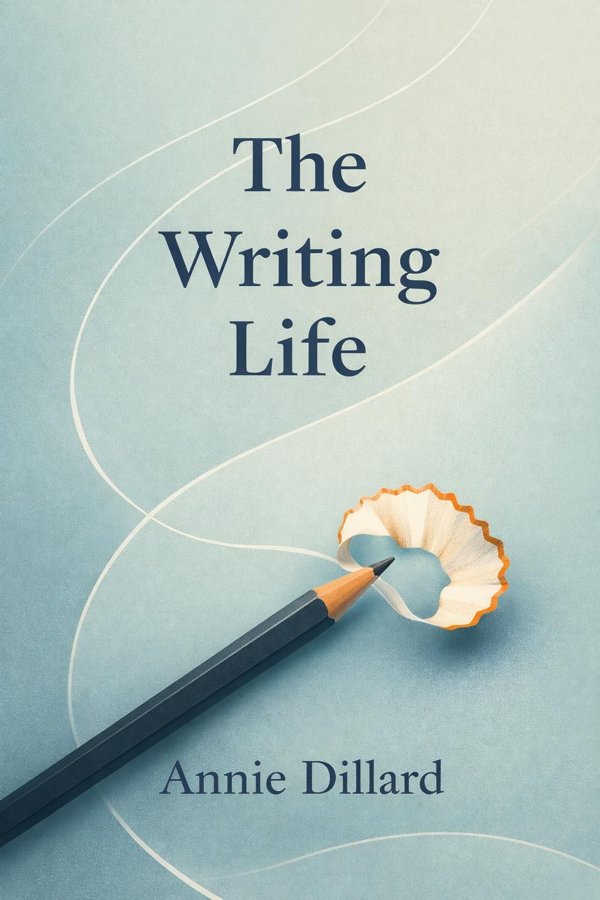
The Writing Life: Summary & Key Insights
 10 min11 chaptersAudio available
What Is The Writing Life About?
The Writing Life by Annie Dillard is a writing book spanning 11 pages. A meditation on the art and discipline of writing, Annie Dillard’s 'The Writing Life' explores the joys, struggles, and solitude of the creative process. Through vivid metaphors and personal reflections, Dillard examines what it means to live as a writer, balancing inspiration with the demands of craft and perseverance.
This FizzRead summary covers all 11 key chapters of The Writing Life in approximately 10 minutes, distilling the most important ideas, arguments, and takeaways from Annie Dillard's work. Also available as an audio summary and Key Quotes Podcast.
The Writing Life
A meditation on the art and discipline of writing, Annie Dillard’s 'The Writing Life' explores the joys, struggles, and solitude of the creative process. Through vivid metaphors and personal reflections, Dillard examines what it means to live as a writer, balancing inspiration with the demands of craft and perseverance.
Who Should Read The Writing Life?
This book is perfect for anyone interested in writing and looking to gain actionable insights in a short read. Whether you're a student, professional, or lifelong learner, the key ideas from The Writing Life by Annie Dillard will help you think differently.
- ✓Readers who enjoy writing and want practical takeaways
- ✓Professionals looking to apply new ideas to their work and life
- ✓Anyone who wants the core insights of The Writing Life in just 10 minutes
Want the full summary?
Get instant access to this book summary and 100K+ more with Fizz Moment.
Get Free SummaryAvailable on App Store • Free to download
Key Chapters
Every writer I know has at some point faced the stark silence of a room with nothing but a desk, a chair, and a window. The physical and mental space of writing demands solitude, and it is in that solitude that attentiveness begins. To write, one must consent to see—to spend hours watching light shift across a wall, to notice the rhythm of words forming in the mind. I remember my own rooms: a cabin in the Pacific Northwest, an apartment with a leaking roof. In each space, the conditions varied, but the struggle remained the same: finding within the isolation a doorway to the world.
Solitude is both a discipline and a reward. At first, it feels like deprivation—the absence of voices, of comfort, of reassurance. But as the hours pass, something miraculous can occur: the interior life begins to deepen. The mind tunes itself to subtler frequencies. The sound of language arrives like a stream in spring melt—cold, unstoppable, pure. You learn to live not against the quiet but inside it, to take that quiet as the very medium in which your work breathes.
There are days of despair too, when nothing seems to move, when time itself feels inert. But those are not wasted days. They are the soil from which sentences will later rise. Writing, I have come to learn, is less about production than attention. The writer sits still long enough for the world to show itself. You do not conquer your solitude; you apprentice yourself to it.
Every book begins as a flicker, a glimpse—a scent of something unformed. Starting a new work feels like standing at the edge of a vast plain, knowing you must cross it without a map. The blank page stares back with indifference, and in that indifference the writer must find her courage. You begin anyway. You write something crude, approximate, alive. You let the first words stumble, because only by making a mess of beginnings can anything real emerge.
When I began each book, I felt both terror and excitement. The terror came from the knowledge that whatever came out first was doomed to be wrong. The excitement came from the wild, unbounded potential of the unwritten. Writing is, in truth, not a matter of inspiration but of return. You return to the page each day, facing the same uncertainty, wrestling the shape of what you cannot yet know. You carve, erase, carve again.
The labor of writing—its physicality—is something outsiders rarely see. The drafts, the torn pages, the long stretches of staring out a window: these are not avoidance but the visible shape of thinking. Inspiration, when it visits, descends on those who have already shown up. It rewards the hand that has spent days coaxing language to move. And when it comes, it floods the room with light—a light you can’t own, only catch in passing. But it never stays. So the writer learns to begin, lose, and begin again. That cycle is the work’s heartbeat.
+ 9 more chapters — available in the FizzRead app
All Chapters in The Writing Life
About the Author
Annie Dillard is an American author known for her narrative essays and contemplative prose. She won the Pulitzer Prize for 'Pilgrim at Tinker Creek' and has written extensively on nature, spirituality, and the creative process.
Get This Summary in Your Preferred Format
Read or listen to the The Writing Life summary by Annie Dillard anytime, anywhere. FizzRead offers multiple formats so you can learn on your terms — all free.
Available formats: App · Audio · PDF · EPUB — All included free with FizzRead
Download The Writing Life PDF and EPUB Summary
Key Quotes from The Writing Life
“Every writer I know has at some point faced the stark silence of a room with nothing but a desk, a chair, and a window.”
“Every book begins as a flicker, a glimpse—a scent of something unformed.”
Frequently Asked Questions about The Writing Life
The Writing Life by Annie Dillard is a writing book that explores key ideas across 11 chapters. A meditation on the art and discipline of writing, Annie Dillard’s 'The Writing Life' explores the joys, struggles, and solitude of the creative process. Through vivid metaphors and personal reflections, Dillard examines what it means to live as a writer, balancing inspiration with the demands of craft and perseverance.
More by Annie Dillard

You Might Also Like
The Art of Perspective
Christopher Castellani
10 min
Making a Point: The Persnickety Story of English Punctuation
David Crystal
10 min
The Elements Of Eloquence: How To Turn The Perfect English Phrase
Mark Forsyth
10 min
The Pocket Muse: Ideas and Inspirations for Writing
Monica Wood
10 min
A Little Book on Form: An Exploration into the Formal Imagination of Poetry
Robert Hass
10 min
Adventures In The Screen Trade: A Personal View Of Hollywood And Screenwriting
William Goldman
10 minBrowse by Category
Ready to read The Writing Life?
Get the full summary and 100K+ more books with Fizz Moment.