
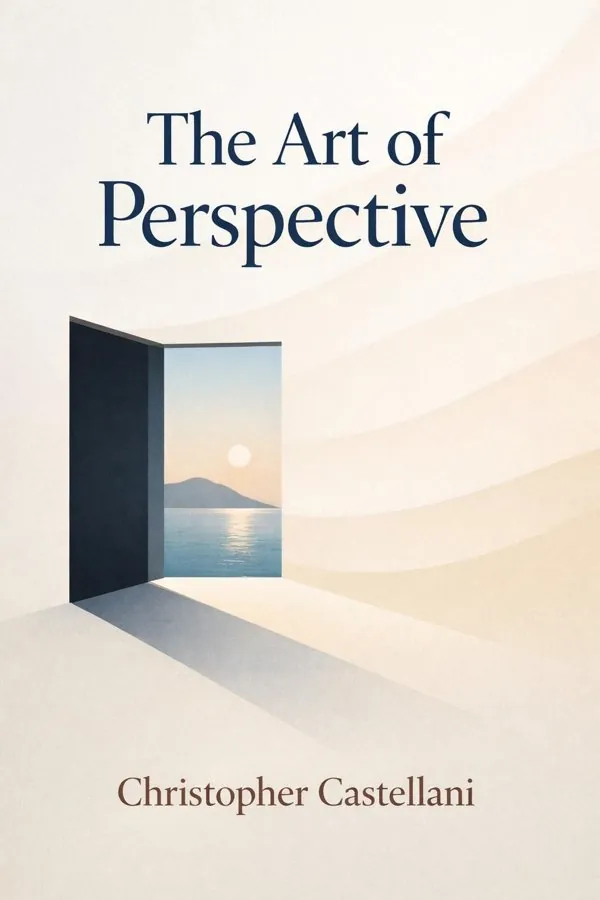
The Art of Perspective: Summary & Key Insights
 10 min10 chapters
Key Takeaways from The Art of Perspective
One of fiction’s most important illusions is also one of its most persistent confusions: readers and writers alike often assume the voice on the page is simply the author speaking.
The first-person voice feels honest even when it is lying.
Distance in fiction is not a flaw; it is a tool.
To know everything in a story is not the same as being able to tell it well.
A narrator does not need to tell the truth to tell a powerful story.
What Is The Art of Perspective About?
The Art of Perspective by Christopher Castellani is a writing book published in 2016 spanning 10 pages. Christopher Castellani’s The Art of Perspective is a sharp, practical, and deeply literary guide to one of fiction’s most consequential choices: who gets to tell the story. Rather than treating point of view as a dry technical category, Castellani shows that perspective determines nearly everything that matters in a narrative—its emotional temperature, moral complexity, pacing, tension, and the reader’s access to truth. A scene told by a grieving son, an amused outsider, or an all-knowing narrator becomes three different stories, even when the events remain the same. What makes this book especially valuable is Castellani’s dual authority. He is both an accomplished novelist and a seasoned teacher of writing, so he understands perspective not only as a literary concept but as a daily craft problem writers struggle to solve. Drawing on classic and contemporary fiction, he explores first person, close third, omniscience, unreliability, memory, and multi-voiced narration with clarity and nuance. For writers, the book offers concrete guidance. For readers, it reveals how narrative voice quietly shapes interpretation. In either case, it becomes a compelling reminder that perspective is not a decorative choice—it is the engine of meaning itself.
This FizzRead summary covers all 10 key chapters of The Art of Perspective in approximately 10 minutes, distilling the most important ideas, arguments, and takeaways from Christopher Castellani's work.
The Art of Perspective
Christopher Castellani’s The Art of Perspective is a sharp, practical, and deeply literary guide to one of fiction’s most consequential choices: who gets to tell the story. Rather than treating point of view as a dry technical category, Castellani shows that perspective determines nearly everything that matters in a narrative—its emotional temperature, moral complexity, pacing, tension, and the reader’s access to truth. A scene told by a grieving son, an amused outsider, or an all-knowing narrator becomes three different stories, even when the events remain the same.
What makes this book especially valuable is Castellani’s dual authority. He is both an accomplished novelist and a seasoned teacher of writing, so he understands perspective not only as a literary concept but as a daily craft problem writers struggle to solve. Drawing on classic and contemporary fiction, he explores first person, close third, omniscience, unreliability, memory, and multi-voiced narration with clarity and nuance. For writers, the book offers concrete guidance. For readers, it reveals how narrative voice quietly shapes interpretation. In either case, it becomes a compelling reminder that perspective is not a decorative choice—it is the engine of meaning itself.
Who Should Read The Art of Perspective?
This book is perfect for anyone interested in writing and looking to gain actionable insights in a short read. Whether you're a student, professional, or lifelong learner, the key ideas from The Art of Perspective by Christopher Castellani will help you think differently.
- ✓Readers who enjoy writing and want practical takeaways
- ✓Professionals looking to apply new ideas to their work and life
- ✓Anyone who wants the core insights of The Art of Perspective in just 10 minutes
Want the full summary?
Get instant access to this book summary and 100K+ more with Fizz Moment.
Get Free SummaryAvailable on App Store • Free to download
Key Chapters
The first-person voice feels honest even when it is lying. That is part of its power. Castellani shows that the “I” draws readers close with the promise of direct access to experience, but this closeness comes with an unavoidable narrowing of vision. First person gives us consciousness at close range, not objective truth.
Writers are often seduced by first person because it seems natural, confessional, and emotionally immediate. Yet it is a highly strategic choice. A first-person narrator can only know what they perceive, infer, remember, or imagine. That limitation can intensify suspense, deepen character, and produce irony when readers perceive more than the narrator does. At the same time, it can constrain a story that depends on social breadth, hidden parallel action, or perspectives beyond one consciousness.
Castellani encourages writers to think beyond grammar. First person is not simply a matter of using “I.” It requires a fully imagined speaker whose worldview shapes every sentence. Two narrators describing a family dinner might present entirely different realities: one might dwell on resentment under polite chatter; another might focus on culinary detail; a third might miss the emotional drama altogether. The style, rhythm, and selective noticing are as important as the facts.
A practical test is to ask whether the story’s emotional center lives inside one consciousness strongly enough to justify this closeness. If the most compelling part of the story is how one person misunderstands events, first person may be ideal. If the story needs a wider social field, another perspective may serve it better.
Actionable takeaway: draft the same scene in first person, then underline every sentence that only this narrator could say. If too few lines feel uniquely owned by that mind, the voice needs deepening—or the POV may be wrong.
Distance in fiction is not a flaw; it is a tool. Castellani treats third person not as a neutral default but as an adjustable instrument for controlling access, texture, and emotional proximity. A third-person narration can move from intimate interiority to measured observation, and that flexibility makes it one of fiction’s most powerful forms.
Writers often think of third person as less personal than first person, but Castellani shows that close third can feel almost as immediate while preserving greater structural freedom. In close third, the narration stays tethered to one character’s perceptions, thoughts, and idiom. This allows the writer to inhabit a mind deeply without the explicit self-reporting of “I.” A sentence like “He told himself he wasn’t jealous” can suggest self-deception differently than “I wasn’t jealous,” because third person can imply tension between narration and consciousness.
More distant third person, by contrast, can create breadth, irony, and perspective. It can help writers depict a social environment, map relationships, or reveal patterns no single character could articulate. The challenge is consistency. Slipping accidentally between close access and broad commentary can make the narration feel unstable unless the shifts are deliberate.
In practice, choosing third person means choosing how close the camera sits. In a grief scene, close third may linger inside bodily sensation and fractured thought. In a political or family saga, a somewhat wider third person may allow the reader to see systems, not just feelings. Castellani reminds writers that distance affects not only information but moral experience: how close we stand to a consciousness shapes how we judge it.
Actionable takeaway: identify your current project’s default narrative distance on a scale from 1 to 10, with 1 as highly intimate and 10 as panoramic. Then revise one scene by moving two steps closer and another by moving two steps farther to discover which serves the material best.
A narrator does not need to tell the truth to tell a powerful story. In fact, Castellani shows that unreliability can become one of fiction’s richest engines because it turns reading into an act of interpretation. When the narrator distorts, omits, rationalizes, or misunderstands, the reader becomes alert not only to what is said but to what is being hidden.
Unreliability is often misunderstood as simple deceit, but Castellani treats it more broadly. A narrator may be unreliable because they are naïve, traumatized, self-protective, vain, intoxicated, morally evasive, or limited by age and social position. This complexity matters. The most compelling unreliable narrators are not trick machines; they are believable people whose distortions arise organically from character. Their gaps and contradictions reveal psychology.
Used well, unreliability creates multiple layers of narrative pleasure. On the surface, readers follow events. Beneath that, they assemble a second story from tonal clues, evasions, contradictions, and details the narrator fails to interpret correctly. For example, a narrator who insists repeatedly that a friendship is “perfectly normal” may alert us to jealousy or desire. A memoir-like voice that skips over key incidents may suggest shame. The writer’s task is to calibrate this carefully. If the clues are too obvious, the effect becomes mechanical; too vague, and readers feel cheated.
Castellani’s insight is that unreliability also deepens theme. It dramatizes how human beings narrate themselves—how identity is built from partial stories. Writers can use it not just to surprise readers, but to explore denial, memory, class, love, and power.
Actionable takeaway: list three things your narrator cannot admit, even to themselves. Then revise scenes so those truths leak through indirectly in word choice, omission, defensiveness, or repeated overexplanation.
No single witness can contain a complex reality. Castellani explores multi-perspective fiction as a way of enlarging narrative truth, especially when stories involve family conflict, social tension, historical upheaval, or moral ambiguity. By allowing several consciousnesses to speak, a writer can reveal how differently people inhabit the same event.
This structure offers obvious advantages. It broadens emotional range, prevents a story from becoming trapped in one consciousness, and creates productive friction between accounts. A father, daughter, and outsider may each interpret a single argument differently, and those differences can become the story’s central drama. Multiple perspectives are especially useful when no one character fully understands the whole, or when the theme concerns misrecognition, fractured memory, or contested power.
But Castellani warns that more voices do not automatically mean more depth. Each perspective must earn its place. Weakly differentiated voices flatten into repetition, while too many narrators can dissipate momentum. The writer must decide what each viewpoint contributes that no other can. One voice may provide emotional access, another social context, another the destabilizing countertruth that reframes everything.
Structure becomes crucial. Where do viewpoint shifts occur? At chapter breaks, scene changes, or within a patterned design? How does the sequence build suspense rather than simply distribute information? Readers should feel progression, not fragmentation. It also helps if each voice possesses distinct language, priorities, and narrative pressure.
In practice, multi-POV works best when the story’s core question cannot be answered from one angle alone. If the novel asks, “What really happened?” or “Who owns this history?” then layered perspectives can become the form of the inquiry itself.
Actionable takeaway: for every narrator in a multi-voice project, write a sentence completing this prompt: “Without this perspective, the reader would never understand ______.” If the answer is vague or interchangeable, reconsider that viewpoint.
Every narrator speaks from a when as much as from a who. Castellani highlights an often-overlooked dimension of perspective: the temporal distance between the experiencing self and the telling self. A story narrated in the heat of events feels different from one told years later through memory, regret, or newly acquired understanding.
Retrospective narration introduces a fascinating duality. The younger self lives through the event with limited awareness; the older narrating self interprets, edits, and sometimes judges that earlier life. This can create poignancy, irony, and moral depth. A narrator recalling adolescence may now understand the class dynamics, desire, or cruelty they once missed. Or they may still resist the truth, exposing the persistence of self-deception over time.
Memory is not a neutral archive. It selects, dramatizes, suppresses, and rearranges. Castellani shows that writers can use this instability productively. The way a narrator remembers an event may reveal as much as the event itself. Repetition of certain details, vagueness around others, or sudden ruptures in chronology can all signal emotional significance. A war veteran who vividly recalls a cracked teacup but glosses over the battle may be telling us where the trauma truly resides.
Temporal perspective also affects tone. Immediate narration often carries urgency and uncertainty; retrospective narration can add wisdom, melancholy, or self-revision. The challenge is to manage both levels clearly so the reader senses the relationship between then and now.
For writers, this means asking not just “Who tells this story?” but “From how far away?” The answer influences syntax, reflection, suspense, and emotional complexity.
Actionable takeaway: write a key scene twice—once as if narrated the same day it occurred, and once twenty years later. Compare what changes in judgment, detail, and emotional emphasis to discover the most revealing temporal distance.
We do not merely observe characters through perspective; we learn how to feel toward them. Castellani argues that point of view is one of fiction’s primary engines of empathy because it determines what readers know, how they know it, and how long they remain inside a consciousness before judging it.
Empathy in fiction is not the same as approval. A deeply rendered perspective can make even difficult, compromised, or morally troubling characters understandable without excusing them. By granting readers access to fear, desire, shame, or longing, perspective complicates easy moral sorting. A bitter mother may become newly legible when we experience the humiliations beneath her anger. A charismatic liar may become more frightening when we understand how expertly he narrates himself.
Castellani’s insight is especially useful for writers creating characters unlike themselves. Perspective demands imaginative rigor, not appropriation by stereotype. To inhabit another consciousness convincingly, the writer must move beyond surface traits into patterns of attention, language, and emotional logic. What does this person notice first in a room? What assumptions shape their interpretation of danger, affection, or status? Empathy begins in these particulars.
At the same time, perspective can intentionally withhold empathy. A distant or external narration may keep readers from identifying too quickly, prompting scrutiny instead. This can be effective when the writer wants to preserve ambiguity or dramatize social alienation. The key is choosing the reader’s emotional route deliberately.
In reading as in writing, perspective teaches humility. It reminds us that every account is filtered, every self partly opaque, and every judgment shaped by access. That is one reason fiction remains ethically powerful.
Actionable takeaway: choose a secondary character in your work and freewrite a page in that person’s voice describing the protagonist. This exercise often reveals hidden tensions, broadens empathy, and clarifies whose perspective the story most needs.
Choosing a perspective is only the beginning; sustaining it scene after scene is the real craft challenge. Castellani stresses that point of view is not a label attached at the start of a draft but a continuous practice of selective perception. A novel may announce its perspective clearly in chapter one and still weaken if the writer forgets whose mind is guiding each sentence.
POV errors often occur in small moments. The narrator notices details they would never notice, explains information they already know, or drifts into another character’s thoughts without a clear structural reason. These lapses can seem minor, but they erode the reader’s trust. Strong perspective depends on fidelity to what the focal consciousness can perceive, value, and language.
One practical strategy is to filter description through character rather than through neutral summary. A real estate agent, a child, and a burglar entering the same house will not describe it the same way. Their priorities generate distinct imagery. Emotional state matters too: a frightened character sees exits; a lovestruck one sees gestures and textures; an ashamed one notices signs of judgment. Sustained POV means allowing every level of narration—description, metaphor, reflection, even scene transitions—to carry that shaping influence.
Revision is where this discipline sharpens. Castellani encourages writers to reread for perspective alone, separate from plot or prose quality. Where does the camera drift? Where does the diction belong more to the author than the character? Where are thoughts summarized when they should be dramatized—or dramatized when distance would be stronger?
The payoff is immersion. When perspective is sustained, readers stop noticing technique and begin inhabiting the story from within.
Actionable takeaway: on a revision pass, mark every sentence in a scene as one of three things: observable from outside, accessible from the POV character’s mind, or author commentary. If the balance feels accidental, revise until each choice is intentional.
A story’s perspective does not deliver meaning fully formed; it invites the reader to participate in making it. Castellani closes the circle between craft and interpretation by showing that point of view shapes not only what is told but how actively the reader must infer, judge, and assemble significance.
Every perspective creates a relationship with the reader. A candid first-person voice may solicit intimacy. An unreliable narrator recruits skepticism. Omniscience can offer broad interpretive guidance or withhold it strategically. Multi-voiced narratives encourage readers to compare testimonies and detect patterns. In each case, the writer is designing a reading experience, not just a mode of delivery.
This matters because literature thrives on the gap between intention and reception. An author may choose a perspective to generate sympathy, irony, uncertainty, or moral pressure, but the reader ultimately completes the circuit. Different readers bring different assumptions to a narrator’s authority, a character’s blindness, or a structure’s implied truth. Perspective therefore becomes the site where authorial control meets readerly freedom.
For writers, the lesson is subtle but crucial: do not over-explain what the perspective can imply. Trust the reader to participate. If an unreliable narrator reveals vanity through inflated diction, there is no need to append explanatory judgment. If alternating viewpoints expose a family’s fractures, the structure itself may carry the argument. Overstatement often flattens the very complexity perspective makes possible.
Castellani’s broader contribution is to frame point of view as an ethical and artistic collaboration. The writer chooses the lens, but the reader discovers what that lens reveals and distorts.
Actionable takeaway: after finishing a draft, ask an early reader not “Did you understand it?” but “What did the narrator make you believe at first, and when did that belief change?” Their answer will show how effectively your perspective is shaping interpretation.
All Chapters in The Art of Perspective
About the Author
Christopher Castellani is an American novelist, essayist, and educator whose work is known for its emotional intelligence, stylistic control, and deep engagement with character and voice. He is the author of several acclaimed books, including Leading Men, and has built a parallel reputation as an influential teacher of creative writing. Castellani has long been associated with GrubStreet, the renowned Boston-based writing center, where he has served as artistic director and helped mentor emerging and established writers alike. His experience as both practitioner and instructor gives his craft writing unusual authority: he understands not only how fiction works on the page, but how writers wrestle with narrative decisions in practice. In The Art of Perspective, he brings those strengths together in a clear, nuanced exploration of point of view.
Get This Summary in Your Preferred Format
Read or listen to the The Art of Perspective summary by Christopher Castellani anytime, anywhere. FizzRead offers multiple formats so you can learn on your terms — all free.
Available formats: App · Audio · PDF · EPUB — All included free with FizzRead
Download The Art of Perspective PDF and EPUB Summary
Key Quotes from The Art of Perspective
“One of fiction’s most important illusions is also one of its most persistent confusions: readers and writers alike often assume the voice on the page is simply the author speaking.”
“The first-person voice feels honest even when it is lying.”
“Distance in fiction is not a flaw; it is a tool.”
“To know everything in a story is not the same as being able to tell it well.”
“A narrator does not need to tell the truth to tell a powerful story.”
Frequently Asked Questions about The Art of Perspective
The Art of Perspective by Christopher Castellani is a writing book that explores key ideas across 10 chapters. Christopher Castellani’s The Art of Perspective is a sharp, practical, and deeply literary guide to one of fiction’s most consequential choices: who gets to tell the story. Rather than treating point of view as a dry technical category, Castellani shows that perspective determines nearly everything that matters in a narrative—its emotional temperature, moral complexity, pacing, tension, and the reader’s access to truth. A scene told by a grieving son, an amused outsider, or an all-knowing narrator becomes three different stories, even when the events remain the same. What makes this book especially valuable is Castellani’s dual authority. He is both an accomplished novelist and a seasoned teacher of writing, so he understands perspective not only as a literary concept but as a daily craft problem writers struggle to solve. Drawing on classic and contemporary fiction, he explores first person, close third, omniscience, unreliability, memory, and multi-voiced narration with clarity and nuance. For writers, the book offers concrete guidance. For readers, it reveals how narrative voice quietly shapes interpretation. In either case, it becomes a compelling reminder that perspective is not a decorative choice—it is the engine of meaning itself.
More by Christopher Castellani
You Might Also Like
Making a Point: The Persnickety Story of English Punctuation
David Crystal
10 min
The Elements Of Eloquence: How To Turn The Perfect English Phrase
Mark Forsyth
10 min
The Pocket Muse: Ideas and Inspirations for Writing
Monica Wood
10 min
A Little Book on Form: An Exploration into the Formal Imagination of Poetry
Robert Hass
10 min
Adventures In The Screen Trade: A Personal View Of Hollywood And Screenwriting
William Goldman
10 min
Becoming a Writer
Dorothea Brande
10 minBrowse by Category
Ready to read The Art of Perspective?
Get the full summary and 100K+ more books with Fizz Moment.