
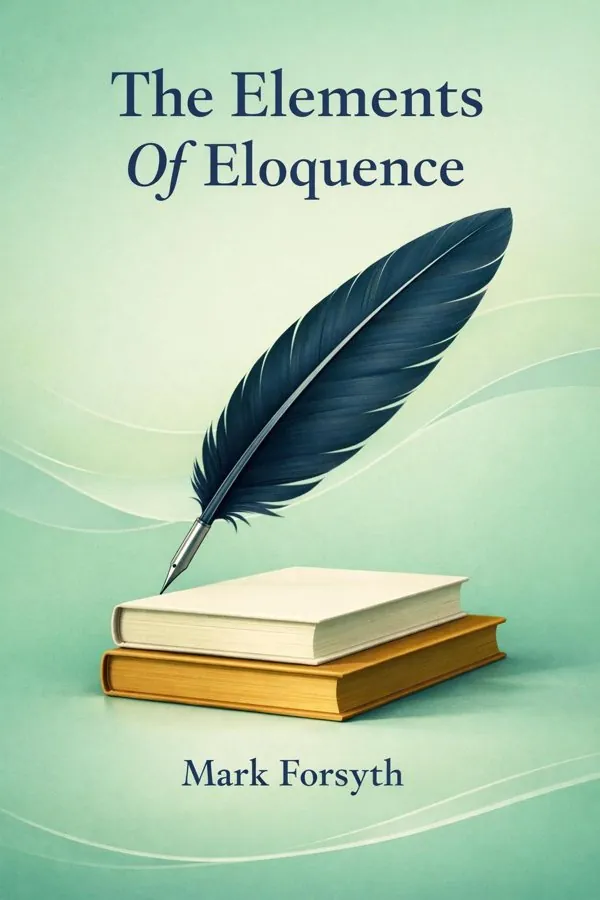
The Elements Of Eloquence: How To Turn The Perfect English Phrase: Summary & Key Insights
by Mark Forsyth
 10 min9 chaptersAudio available
Key Takeaways from The Elements Of Eloquence: How To Turn The Perfect English Phrase
The most memorable lines in English often feel spontaneous, but they are usually built on repeatable patterns.
People often assume that rhetoric means manipulation, ornament, or empty style.
A repeated word or structure can turn an ordinary sentence into something unforgettable.
Nothing clarifies an idea faster than setting it against its opposite.
We often think meaning lies in the words themselves, but Forsyth reminds us that arrangement matters just as much.
What Is The Elements Of Eloquence: How To Turn The Perfect English Phrase About?
The Elements Of Eloquence: How To Turn The Perfect English Phrase by Mark Forsyth is a writing book. Why do some sentences lodge in the mind while others vanish the moment they are spoken? In The Elements Of Eloquence, Mark Forsyth answers that question by uncovering the hidden devices that make language memorable, persuasive, funny, and beautiful. Rather than treating rhetoric as a dusty school subject, Forsyth turns it into a lively tour of the tricks used by Shakespeare, Churchill, the Bible, advertising slogans, and everyday speech. He shows that great phrasing is not magic. It is built from patterns anyone can learn to recognize and use. This book matters because clear writing is rarely enough in a world full of noise. To stand out, language must have rhythm, contrast, surprise, and shape. Forsyth, a witty writer and passionate lover of words, makes classical rhetoric feel practical, modern, and entertaining. His gift lies in explaining complex literary techniques with humor and memorable examples, so readers can immediately hear how eloquence works. Whether you are a writer, speaker, marketer, student, or simply someone who loves language, this book reveals how English achieves its most powerful effects.
This FizzRead summary covers all 9 key chapters of The Elements Of Eloquence: How To Turn The Perfect English Phrase in approximately 10 minutes, distilling the most important ideas, arguments, and takeaways from Mark Forsyth's work. Also available as an audio summary and Key Quotes Podcast.
The Elements Of Eloquence: How To Turn The Perfect English Phrase
Why do some sentences lodge in the mind while others vanish the moment they are spoken? In The Elements Of Eloquence, Mark Forsyth answers that question by uncovering the hidden devices that make language memorable, persuasive, funny, and beautiful. Rather than treating rhetoric as a dusty school subject, Forsyth turns it into a lively tour of the tricks used by Shakespeare, Churchill, the Bible, advertising slogans, and everyday speech. He shows that great phrasing is not magic. It is built from patterns anyone can learn to recognize and use.
This book matters because clear writing is rarely enough in a world full of noise. To stand out, language must have rhythm, contrast, surprise, and shape. Forsyth, a witty writer and passionate lover of words, makes classical rhetoric feel practical, modern, and entertaining. His gift lies in explaining complex literary techniques with humor and memorable examples, so readers can immediately hear how eloquence works. Whether you are a writer, speaker, marketer, student, or simply someone who loves language, this book reveals how English achieves its most powerful effects.
Who Should Read The Elements Of Eloquence: How To Turn The Perfect English Phrase?
This book is perfect for anyone interested in writing and looking to gain actionable insights in a short read. Whether you're a student, professional, or lifelong learner, the key ideas from The Elements Of Eloquence: How To Turn The Perfect English Phrase by Mark Forsyth will help you think differently.
- ✓Readers who enjoy writing and want practical takeaways
- ✓Professionals looking to apply new ideas to their work and life
- ✓Anyone who wants the core insights of The Elements Of Eloquence: How To Turn The Perfect English Phrase in just 10 minutes
Want the full summary?
Get instant access to this book summary and 100K+ more with Fizz Moment.
Get Free SummaryAvailable on App Store • Free to download
Key Chapters
The most memorable lines in English often feel spontaneous, but they are usually built on repeatable patterns. That is the first liberating insight of The Elements Of Eloquence: eloquence is not a mysterious talent possessed by a gifted few. It is a craft made from structures that can be identified, studied, and practiced. Forsyth argues that when a phrase sounds perfect, it is often because it uses one or more rhetorical figures that shape the reader’s expectations and satisfy the ear.
These patterns include balance, repetition, inversion, climax, and strategic contrast. We hear them in poetry, political speeches, sermons, novels, jokes, and headlines. A line becomes stronger when it has architecture. Compare a flat sentence like “We need courage in hard times” with a more patterned one such as “In comfort, we drift; in crisis, we decide.” The second sentence feels more forceful because it has rhythm and opposition. Its structure makes the thought easier to remember.
Forsyth’s great contribution is to demystify these techniques without draining them of delight. He does not reduce language to formula. Instead, he shows that form intensifies meaning. A writer who learns rhetorical patterns gains not just decorative flourishes but practical tools for emphasis and persuasion.
This idea has immediate applications. Business writers can sharpen taglines. Teachers can make explanations stick. Speakers can frame key messages so audiences retain them. Even personal writing, from emails to wedding toasts, can become more vivid when shaped consciously.
Actionable takeaway: Start collecting sentences you admire and ask not only what they say, but how they are built. Once you notice the pattern, try imitating it in your own writing.
People often assume that rhetoric means manipulation, ornament, or empty style. Forsyth turns that assumption upside down. Rhetoric, in his account, is what gives language emotional force. It is the means by which words move beyond information and begin to persuade, stir, delight, or haunt. Facts matter, but form determines whether those facts live in the listener’s mind.
A plain statement may communicate the basics, yet a rhetorically shaped statement creates impact. Consider the difference between “This was a difficult struggle” and “We fought in the dark, and we fought for the dawn.” The second line does more than inform. It creates an image, a rhythm, and an emotional arc. It uses rhetoric to embody the struggle.
Forsyth demonstrates that the greatest writers and speakers understand this instinctively. Shakespeare does not merely tell us what a character feels; he gives feeling a verbal shape. The Bible does not simply announce truth; it arranges words into cadences that sound inevitable. Political speeches that endure do so because their phrasing makes belief audible.
In practical terms, this means good communication is not only about clarity. It is also about emphasis, memorability, and emotional texture. Writers in business, education, journalism, or creative work can all benefit from this lesson. A proposal, a lecture, or a social media post becomes stronger when its language creates momentum and resonance rather than just transmitting data.
Actionable takeaway: When revising, ask yourself where you want the reader to feel something, not just understand something. Then strengthen those lines with rhythm, repetition, contrast, or imagery so the emotion has a verbal engine.
A repeated word or structure can turn an ordinary sentence into something unforgettable. One of Forsyth’s central lessons is that repetition is not laziness. Used artfully, it is one of the oldest and most powerful tools in eloquence. Repetition works because the mind responds to pattern. It creates expectation, emphasis, and musicality, helping a phrase land with greater authority.
The book explores forms of repetition such as anaphora, where successive clauses begin with the same words, and epistrophe, where they end the same way. These devices appear constantly in famous speechmaking. “We shall fight on the beaches, we shall fight on the landing grounds...” endures because the repeated opening builds rhythm and resolve. The audience feels determination accumulating clause by clause.
Repetition can also work subtly. In marketing, a repeated structure can make a slogan catchy. In teaching, repeating key terms in varied contexts improves retention. In storytelling, repeated phrases can build tension or create a sense of destiny. Even casual conversation benefits when repetition is used deliberately to highlight a point instead of merely filling space.
The danger is overuse. Mechanical repetition becomes tedious. Effective repetition usually involves variation in meaning, intensity, or surrounding context. The form remains stable while the implications grow. This gives the audience both familiarity and movement.
Forsyth shows that repetition is one of the places where rhetoric becomes almost physical. The body hears it, anticipates it, and responds to it. That is why repeated phrases can inspire crowds, comfort listeners, or fix an idea in memory long after the moment has passed.
Actionable takeaway: Identify the single idea you most want your reader or audience to remember, then repeat its key word or structure two or three times in strategically important places.
Nothing clarifies an idea faster than setting it against its opposite. Forsyth highlights antithesis as one of the most effective rhetorical figures because contrast sharpens both meaning and memory. When two opposing ideas are placed in parallel form, the mind grasps the distinction immediately. The sentence gains energy because it stages an argument inside itself.
Classic examples show how powerfully this works: “Ask not what your country can do for you; ask what you can do for your country.” The grammar is nearly identical in both halves, but the reversal of meaning creates surprise and force. Antithesis is not just decorative balance. It is a machine for thought. It allows a writer to define one thing by showing what it is not.
In everyday writing, antithesis can rescue vague language. Instead of saying “Good leaders are resilient,” you might write, “They do not collapse under pressure; they become clearer within it.” The second version is more vivid because it contrasts failure and strength in a mirrored structure. In branding, antithesis can distinguish a product. In essays, it can frame an argument cleanly. In speeches, it can crystallize a choice.
Forsyth’s broader point is that rhetoric often improves thinking, not merely expression. To create strong contrast, the writer must identify the true opposite, the real tension, the actual stakes. This discipline produces clearer ideas as well as better sentences.
Actionable takeaway: When a point feels abstract or weak, rewrite it as a contrast between two alternatives. Use parallel grammar so the opposition is easy to hear and hard to forget.
We often think meaning lies in the words themselves, but Forsyth reminds us that arrangement matters just as much. Word order can create suspense, emphasis, elegance, or surprise. The same vocabulary, rearranged, may lose all impact or suddenly become memorable. Eloquence depends not only on what is said but on when each word arrives.
One striking device is inversion, where ordinary word order is altered to give a phrase more force. Poetry uses this frequently, but so does dramatic prose. Another technique is the periodic sentence, which delays completion until the end. By holding back the main point, the sentence creates anticipation. In contrast, a loose sentence delivers the main clause early and then expands. Each structure has a different emotional effect.
Forsyth shows that skilled writers control sequence carefully. They place the most important word at the end of a clause, where it will echo. They delay revelation when they want drama. They front-load a sentence when they want bluntness. This is more than style for style’s sake. It is timing, and timing is persuasion.
For modern writers, this lesson is invaluable. In emails, placing the action first can improve clarity. In speeches, delaying a key phrase can heighten impact. In narrative writing, arranging details in the right order can turn information into suspense. Even headlines live or die by sequencing.
Writers who revise for word order often discover that they do not need bigger vocabulary. They need better placement. Eloquence frequently comes from changing the order of familiar words until the sentence clicks.
Actionable takeaway: In revision, experiment with moving your strongest word or phrase to the end of the sentence. Read the line aloud and notice whether the emphasis becomes sharper.
A sentence can be true, intelligent, and clear, yet still fail because it sounds dead. Forsyth insists that eloquence lives in the ear as much as in the intellect. Devices such as alliteration, assonance, consonance, and rhythm make language pleasurable to hear, and pleasure increases attention. Sound is not superficial. It helps determine whether language sticks.
Alliteration, for instance, gives a phrase snap and cohesion. Assonance creates internal harmony through repeated vowel sounds. Consonance adds texture through repeated consonants. These effects are common in poetry, but they also shape slogans, headlines, and memorable prose. A phrase like “safe, simple, secure” feels more unified because the sounds cooperate. We process it more easily and recall it more readily.
Forsyth does not suggest stuffing writing with obvious sound effects. Forced alliteration can become comic by accident. The deeper lesson is to listen for cadence. Great lines often have a beat. They rise and fall with deliberate stress patterns. This is why some speeches sound inevitable and some paragraphs feel smooth while others stumble.
This principle is practical across contexts. Teachers can craft phrases that students remember. Leaders can make messages sound steadier and more confident. Fiction writers can tune dialogue for character and mood. Even website copy improves when sentences have auditory shape.
Reading aloud is the best test. Silent reading often hides awkward rhythms; the ear exposes them immediately. If a sentence sounds clumsy, it probably is. If it has music, readers will trust it more and remember it longer.
Actionable takeaway: Read your important sentences aloud and revise for sound. Replace awkward combinations, strengthen rhythm, and use subtle echoing sounds to make the line more memorable.
One of the book’s most delightful revelations is that ancient rhetorical devices are not relics. They still drive modern communication, often invisibly. The same techniques found in Greek rhetoric, Shakespearean drama, and biblical prose appear in political messaging, advertising, journalism, comedy, and digital content. Human ears have not changed nearly as much as our technologies have.
Forsyth’s examples make this clear. The figures of speech that once elevated epic poetry now help sell cars, win elections, and launch viral slogans. Parallelism structures mission statements. hyperbole fuels headlines. Tricolon gives punch to brand messaging. Antithesis powers debate sound bites. This continuity is encouraging because it means that learning rhetoric is not academic trivia. It is training in how language still works today.
For modern professionals, this has strategic value. Marketers can use classical balance and rhythm to create slogans that linger. Leaders can use rhetorical structure to make values sound coherent. Content creators can improve hooks, captions, and calls to action. Students can write essays that sound more deliberate and persuasive. The devices are old, but their uses are current.
This also changes how we read. Once we notice rhetorical patterns, we become less passive consumers of language. We hear when someone is using repetition to stir emotion or contrast to frame a choice. We become more appreciative of verbal craftsmanship and more alert to verbal influence.
Forsyth’s broader achievement is to reconnect readers with a living tradition. Eloquence is not locked in the past. It is active all around us, shaping public and private speech every day.
Actionable takeaway: Study examples from current speeches, ads, and articles, then identify the rhetorical device at work. Practice borrowing the structure, not the wording, for your own communication.
Many books about language become intimidating because they treat rhetoric as technical machinery. Forsyth succeeds largely because he makes the subject funny. Humor is not just his style; it is part of his teaching method. By making readers laugh, he lowers resistance, keeps attention high, and proves that rhetorical devices are not dry abstractions but lively tools that shape jokes, absurdities, and everyday expression.
This matters because fear of sounding pretentious prevents many people from trying to write well. They assume eloquence means stiffness. Forsyth shows the opposite. Rhetorical devices can produce wit as easily as grandeur. Reversal creates punchlines. Exaggeration creates comedy. Surprise in syntax creates delight. Once readers see these patterns in humorous examples, they understand them more naturally and remember them more easily.
There is also a deeper lesson here: delight is a serious communicative advantage. If readers enjoy the form of what you say, they are more willing to stay with the content. A little charm can carry a complex point farther than a purely functional explanation. This does not mean every piece of writing should be playful, but it does mean that liveliness improves learning and persuasion.
Writers, teachers, and speakers can apply this by allowing themselves more verbal personality. A well-placed rhetorical twist can make an example vivid or make a message feel human rather than mechanical. The goal is not ornament for its own sake. It is engagement.
Actionable takeaway: When explaining something complex, include one sentence that uses a rhetorical flourish with a touch of wit. If it makes the idea clearer and more memorable, keep it.
The book’s most empowering message is that eloquence can be practiced. Forsyth does not present rhetorical figures as museum pieces to admire from afar. He presents them as tools available to any attentive writer or speaker. This turns the study of style from passive appreciation into active training.
Deliberate practice begins with noticing. Read speeches, poems, novels, and even advertisements with an ear for structure. Then imitate. If you admire a line built on repetition, write your own version on a different subject. If a sentence uses antithesis beautifully, create three of your own. This kind of imitation is not theft. It is apprenticeship, the traditional way writers learn form.
Another useful practice is constraint. Pick one rhetorical device and write a paragraph using it intentionally. Then revise the paragraph so the device feels natural rather than forced. Over time, the patterns become part of your instinct. You begin to hear when a sentence wants symmetry, when an idea needs contrast, and when a paragraph would benefit from climax.
Forsyth also implies an important balance: eloquence serves meaning. A rhetorical figure should sharpen the point, not distract from it. Good practice therefore includes judgment. Ask whether the device makes the sentence clearer, stronger, or more memorable. If not, cut it.
For anyone who writes regularly, this is exciting news. Improvement does not require waiting for inspiration. It requires attention, imitation, revision, and listening.
Actionable takeaway: Choose one rhetorical device each week, collect two real examples of it, and then write five original sentences using the same pattern until it starts to feel natural.
All Chapters in The Elements Of Eloquence: How To Turn The Perfect English Phrase
About the Author
Mark Forsyth is a British author and journalist best known for writing clever, accessible books about language, rhetoric, and the hidden logic of words. He has a talent for taking subjects that can seem scholarly or intimidating and turning them into lively, funny, memorable reading for a general audience. Forsyth gained broad attention through works that explore etymology, expression, and the pleasures of English, combining literary knowledge with sharp wit and an instinct for vivid examples. In The Elements Of Eloquence, he brings classical rhetoric to life by showing how the patterns behind Shakespeare, the Bible, and famous speeches still shape modern communication. His work appeals to readers who love language and to anyone who wants to write or speak with greater power.
Get This Summary in Your Preferred Format
Read or listen to the The Elements Of Eloquence: How To Turn The Perfect English Phrase summary by Mark Forsyth anytime, anywhere. FizzRead offers multiple formats so you can learn on your terms — all free.
Available formats: App · Audio · PDF · EPUB — All included free with FizzRead
Download The Elements Of Eloquence: How To Turn The Perfect English Phrase PDF and EPUB Summary
Key Quotes from The Elements Of Eloquence: How To Turn The Perfect English Phrase
“The most memorable lines in English often feel spontaneous, but they are usually built on repeatable patterns.”
“People often assume that rhetoric means manipulation, ornament, or empty style.”
“A repeated word or structure can turn an ordinary sentence into something unforgettable.”
“Nothing clarifies an idea faster than setting it against its opposite.”
“We often think meaning lies in the words themselves, but Forsyth reminds us that arrangement matters just as much.”
Frequently Asked Questions about The Elements Of Eloquence: How To Turn The Perfect English Phrase
The Elements Of Eloquence: How To Turn The Perfect English Phrase by Mark Forsyth is a writing book that explores key ideas across 9 chapters. Why do some sentences lodge in the mind while others vanish the moment they are spoken? In The Elements Of Eloquence, Mark Forsyth answers that question by uncovering the hidden devices that make language memorable, persuasive, funny, and beautiful. Rather than treating rhetoric as a dusty school subject, Forsyth turns it into a lively tour of the tricks used by Shakespeare, Churchill, the Bible, advertising slogans, and everyday speech. He shows that great phrasing is not magic. It is built from patterns anyone can learn to recognize and use. This book matters because clear writing is rarely enough in a world full of noise. To stand out, language must have rhythm, contrast, surprise, and shape. Forsyth, a witty writer and passionate lover of words, makes classical rhetoric feel practical, modern, and entertaining. His gift lies in explaining complex literary techniques with humor and memorable examples, so readers can immediately hear how eloquence works. Whether you are a writer, speaker, marketer, student, or simply someone who loves language, this book reveals how English achieves its most powerful effects.
You Might Also Like
The Art of Perspective
Christopher Castellani
10 min
Making a Point: The Persnickety Story of English Punctuation
David Crystal
10 min
The Pocket Muse: Ideas and Inspirations for Writing
Monica Wood
10 min
A Little Book on Form: An Exploration into the Formal Imagination of Poetry
Robert Hass
10 min
Adventures In The Screen Trade: A Personal View Of Hollywood And Screenwriting
William Goldman
10 min
Becoming a Writer
Dorothea Brande
10 minBrowse by Category
Ready to read The Elements Of Eloquence: How To Turn The Perfect English Phrase?
Get the full summary and 100K+ more books with Fizz Moment.