
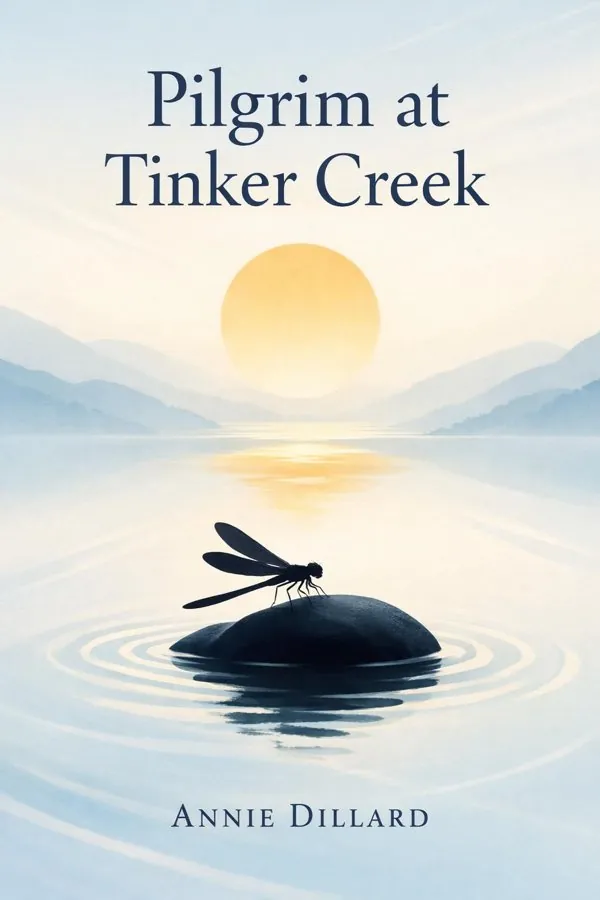
Pilgrim at Tinker Creek: Summary & Key Insights
 10 min12 chaptersAudio available
What Is Pilgrim at Tinker Creek About?
Pilgrim at Tinker Creek by Annie Dillard is a environment book spanning 12 pages. Pilgrim at Tinker Creek is a nonfiction narrative by Annie Dillard that explores the natural world surrounding Tinker Creek in Virginia’s Blue Ridge Mountains. Through vivid observation and philosophical reflection, Dillard examines themes of nature, spirituality, and the human experience, blending scientific detail with poetic insight. The book is often regarded as a modern classic of nature writing and won the 1975 Pulitzer Prize for General Nonfiction.
This FizzRead summary covers all 12 key chapters of Pilgrim at Tinker Creek in approximately 10 minutes, distilling the most important ideas, arguments, and takeaways from Annie Dillard's work. Also available as an audio summary and Key Quotes Podcast.
Pilgrim at Tinker Creek
Pilgrim at Tinker Creek is a nonfiction narrative by Annie Dillard that explores the natural world surrounding Tinker Creek in Virginia’s Blue Ridge Mountains. Through vivid observation and philosophical reflection, Dillard examines themes of nature, spirituality, and the human experience, blending scientific detail with poetic insight. The book is often regarded as a modern classic of nature writing and won the 1975 Pulitzer Prize for General Nonfiction.
Who Should Read Pilgrim at Tinker Creek?
This book is perfect for anyone interested in environment and looking to gain actionable insights in a short read. Whether you're a student, professional, or lifelong learner, the key ideas from Pilgrim at Tinker Creek by Annie Dillard will help you think differently.
- ✓Readers who enjoy environment and want practical takeaways
- ✓Professionals looking to apply new ideas to their work and life
- ✓Anyone who wants the core insights of Pilgrim at Tinker Creek in just 10 minutes
Want the full summary?
Get instant access to this book summary and 100K+ more with Fizz Moment.
Get Free SummaryAvailable on App Store • Free to download
Key Chapters
To see is the first and hardest thing. I had to learn that looking and seeing are not the same act. There are two ways of seeing, I wrote: one is the kind of unconscious glance we toss upon the world as we move through it; the other is deliberate, almost religious in its focus. The first noticing may dissolve things into categories—tree, bird, stone—but the second requires a stripping away of labels until all that remains is direct encounter.
I spent days training my eyes to pierce the veil—to witness a frog breathing in the reeds or a water strider slicing the surface tension without breaking it. I realized that vision is both gift and discipline. Sometimes it comes without effort, like grace, and sometimes it evades me no matter how I strain. When I stopped trying so hard—when I relaxed the eye’s hunger and let things announce themselves—the world bloomed open. Grass blades shimmered with a wild significance. Even shadows carried presence.
Seeing, then, became not only a physical act but a moral stance. The world offers itself freely; our task is to meet it with humility and readiness. As I walked Tinker Creek, I learned that perception shapes experience—that what we see depends as much on the inner eye as on the light falling from above. To see clearly is, paradoxically, to surrender control.
Winter at Tinker Creek taught me about absence. Everything appeared still, stripped, almost dead. Yet beneath that fast of life, I felt a humming persistence. I watched the creek ice over, the trees shed their weight of leaves, animals retreat underground. It seemed the world was holding its breath. I began to understand survival as an art of patience, a discipline of endurance.
In that season’s silence, I could hear details that summer’s noise drowned out: the creak of ice shifting, the faint drumbeat of a woodpecker miles away, the muted flicker of a fox’s paws on snow. The austerity of winter revealed a hidden joy—the way life conserves itself in the face of apparent death. The sparseness taught me to value the subtle signs of motion, to trust that energy flows even through frozen things.
Seasons, I came to see, are lessons about time: nothing vanishes; it merely transforms. Death is not the negation of life but its secret engine. In the long blue afternoons of January, the world honed me like a knife.
+ 10 more chapters — available in the FizzRead app
All Chapters in Pilgrim at Tinker Creek
About the Author
Annie Dillard is an American author, essayist, and poet known for her keen observations of nature and philosophical prose. Born in 1945 in Pittsburgh, Pennsylvania, she gained prominence with Pilgrim at Tinker Creek, which earned her the Pulitzer Prize. Her other works include Teaching a Stone to Talk, An American Childhood, and The Writing Life.
Get This Summary in Your Preferred Format
Read or listen to the Pilgrim at Tinker Creek summary by Annie Dillard anytime, anywhere. FizzRead offers multiple formats so you can learn on your terms — all free.
Available formats: App · Audio · PDF · EPUB — All included free with FizzRead
Download Pilgrim at Tinker Creek PDF and EPUB Summary
Key Quotes from Pilgrim at Tinker Creek
“I had to learn that looking and seeing are not the same act.”
“Winter at Tinker Creek taught me about absence.”
Frequently Asked Questions about Pilgrim at Tinker Creek
Pilgrim at Tinker Creek by Annie Dillard is a environment book that explores key ideas across 12 chapters. Pilgrim at Tinker Creek is a nonfiction narrative by Annie Dillard that explores the natural world surrounding Tinker Creek in Virginia’s Blue Ridge Mountains. Through vivid observation and philosophical reflection, Dillard examines themes of nature, spirituality, and the human experience, blending scientific detail with poetic insight. The book is often regarded as a modern classic of nature writing and won the 1975 Pulitzer Prize for General Nonfiction.
More by Annie Dillard
You Might Also Like
A Life on Our Planet: My Witness Statement and a Vision for the Future
David Attenborough
10 min
A Sky Full Of Birds
Matt Merritt
10 min
Carbon Zero: Imagining Cities That Can Save the Planet
Alex Steffen
10 min
Eaarth: Making a Life on a Tough New Planet
Bill McKibben
10 min
The Social Contract and Environmental Governance
Various Editors
10 min
The Wild Places
Robert Macfarlane
10 minBrowse by Category
Ready to read Pilgrim at Tinker Creek?
Get the full summary and 100K+ more books with Fizz Moment.