
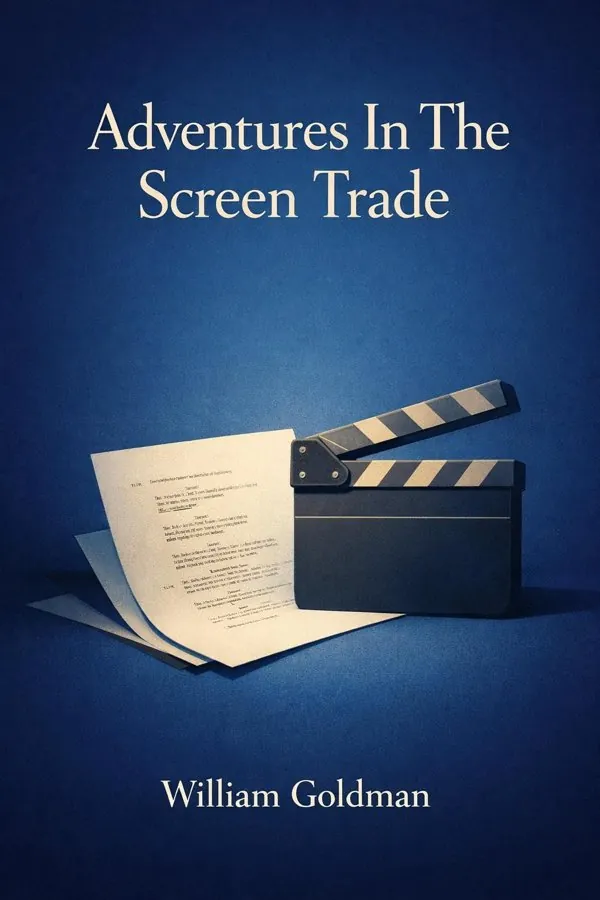
Adventures In The Screen Trade: A Personal View Of Hollywood And Screenwriting: Summary & Key Insights
 10 min4 chaptersAudio available
What Is Adventures In The Screen Trade: A Personal View Of Hollywood And Screenwriting About?
Adventures In The Screen Trade: A Personal View Of Hollywood And Screenwriting by William Goldman is a writing book spanning 4 pages. This book is a memoir and guide by screenwriter William Goldman, offering an insider’s look at Hollywood and the craft of screenwriting. Combining anecdotes from his own career with practical advice, Goldman explores the realities of the film industry, the process of writing for the screen, and the unpredictable nature of success in Hollywood.
This FizzRead summary covers all 4 key chapters of Adventures In The Screen Trade: A Personal View Of Hollywood And Screenwriting in approximately 10 minutes, distilling the most important ideas, arguments, and takeaways from William Goldman's work. Also available as an audio summary and Key Quotes Podcast.
Adventures In The Screen Trade: A Personal View Of Hollywood And Screenwriting
This book is a memoir and guide by screenwriter William Goldman, offering an insider’s look at Hollywood and the craft of screenwriting. Combining anecdotes from his own career with practical advice, Goldman explores the realities of the film industry, the process of writing for the screen, and the unpredictable nature of success in Hollywood.
Who Should Read Adventures In The Screen Trade: A Personal View Of Hollywood And Screenwriting?
This book is perfect for anyone interested in writing and looking to gain actionable insights in a short read. Whether you're a student, professional, or lifelong learner, the key ideas from Adventures In The Screen Trade: A Personal View Of Hollywood And Screenwriting by William Goldman will help you think differently.
- ✓Readers who enjoy writing and want practical takeaways
- ✓Professionals looking to apply new ideas to their work and life
- ✓Anyone who wants the core insights of Adventures In The Screen Trade: A Personal View Of Hollywood And Screenwriting in just 10 minutes
Want the full summary?
Get instant access to this book summary and 100K+ more with Fizz Moment.
Get Free SummaryAvailable on App Store • Free to download
Key Chapters
Hollywood loves mythology—the cigar-chomping producer, the visionary director, the misunderstood genius in his lonely garret hammering out scenes that will one day be studied in film schools. But if you actually live here, you learn fast that these are just masks. The movie business is, above all, a hierarchy of power, and most of that power has nothing to do with storytelling.
In the first part of *Adventures in the Screen Trade*, I pull apart the machinery of Hollywood: the agents who broker relationships and rewrite dreams in negotiation rooms, the producers who can be saviors or saboteurs depending on the day, and the directors who have their own visions but often need the studio’s blessing to realize them. It’s a system where everyone wants to seem indispensable—and where fear drives more decisions than artistry. People think producers read scripts because they love stories. Most read them to find reasons *not* to make a movie. It’s risk management disguised as taste.
The screenwriter, in this vast mechanism, often lands at the bottom of the food chain. We’re the ones whose work starts the process, yet whose names can vanish from the poster after a single rewrite. My experiences taught me how volatile that position is. One moment, you’re the brilliant writer who solved the narrative; the next, you’re the person the actor’s friend’s girlfriend thinks wrote a part that’s all wrong. In Hollywood, creative control is a myth unless you’re the one signing the checks.
I remember vividly when *All the President’s Men* was being made. The number of drafts, the number of voices tugging at the material—it was dizzying. And yet, somehow, the movie emerged. That paradox is the heart of Hollywood: chaos can occasionally give birth to coherence. The business of screenwriting is a test of endurance, one where luck, timing, and tact are every bit as valuable as talent. If you can accept that truth and still find joy in the work, you’ve already beaten half the odds.
Once we get past the machinery of the industry, what’s left is the thing that made us fall in love with movies in the first place: story. Hollywood may be unpredictable, but storytelling itself has a shape, rhythm, and internal music that never changes. In this section, I take apart those structures—not as a theorist, but as a working writer trying to wrestle a story into motion picture form.
At its simplest, I still believe the best screenplays follow a three-act design. Hollywood didn’t invent that; it’s as old as drama itself. Act One sets the world and the problem. Act Two deepens the conflict and the stakes. Act Three resolves it—sometimes neatly, sometimes not. The real craft lies in knowing how much of each act the audience needs to *feel*, not just see. You write not for reading, but for projection, for rhythm and movement. A movie is not words on paper; it’s what happens in the space between the frames.
Characters fuel all of it. When I created Butch and Sundance, I wasn’t thinking of them as historical figures—I was writing two men caught in the tragedy of their own charm, two outlaws out of time. Their banter, their absurd loyalty, that’s what makes you believe in them. Dialogue isn’t about being clever; it’s about revealing humanity through speech. There’s a kind of invisible math to it—all rhythm and reaction, music and silence.
Adaptation is another battle altogether. With *All the President’s Men*, I faced a book filled with dense political reporting. My job wasn’t to repeat facts but to find drama—to turn process into suspense, research into urgency. The hardest thing about adaptation is the act of betrayal: the moment you realize you must disappoint the source material to serve the screen. But that’s the truth of screenwriting. Every scene, every line, every beat must earn its existence on film.
+ 2 more chapters — available in the FizzRead app
All Chapters in Adventures In The Screen Trade: A Personal View Of Hollywood And Screenwriting
About the Author
William Goldman (1931–2018) was an American novelist, playwright, and screenwriter. He won two Academy Awards for his screenplays for 'Butch Cassidy and the Sundance Kid' and 'All the President’s Men'. Known for his wit and insight into storytelling, Goldman was one of the most influential voices in modern screenwriting.
Get This Summary in Your Preferred Format
Read or listen to the Adventures In The Screen Trade: A Personal View Of Hollywood And Screenwriting summary by William Goldman anytime, anywhere. FizzRead offers multiple formats so you can learn on your terms — all free.
Available formats: App · Audio · PDF · EPUB — All included free with FizzRead
Download Adventures In The Screen Trade: A Personal View Of Hollywood And Screenwriting PDF and EPUB Summary
Key Quotes from Adventures In The Screen Trade: A Personal View Of Hollywood And Screenwriting
“Hollywood loves mythology—the cigar-chomping producer, the visionary director, the misunderstood genius in his lonely garret hammering out scenes that will one day be studied in film schools.”
“Once we get past the machinery of the industry, what’s left is the thing that made us fall in love with movies in the first place: story.”
Frequently Asked Questions about Adventures In The Screen Trade: A Personal View Of Hollywood And Screenwriting
Adventures In The Screen Trade: A Personal View Of Hollywood And Screenwriting by William Goldman is a writing book that explores key ideas across 4 chapters. This book is a memoir and guide by screenwriter William Goldman, offering an insider’s look at Hollywood and the craft of screenwriting. Combining anecdotes from his own career with practical advice, Goldman explores the realities of the film industry, the process of writing for the screen, and the unpredictable nature of success in Hollywood.
More by William Goldman
You Might Also Like
The Art of Perspective
Christopher Castellani
10 min
Making a Point: The Persnickety Story of English Punctuation
David Crystal
10 min
The Elements Of Eloquence: How To Turn The Perfect English Phrase
Mark Forsyth
10 min
The Pocket Muse: Ideas and Inspirations for Writing
Monica Wood
10 min
A Little Book on Form: An Exploration into the Formal Imagination of Poetry
Robert Hass
10 min
Becoming a Writer
Dorothea Brande
10 minBrowse by Category
Ready to read Adventures In The Screen Trade: A Personal View Of Hollywood And Screenwriting?
Get the full summary and 100K+ more books with Fizz Moment.