
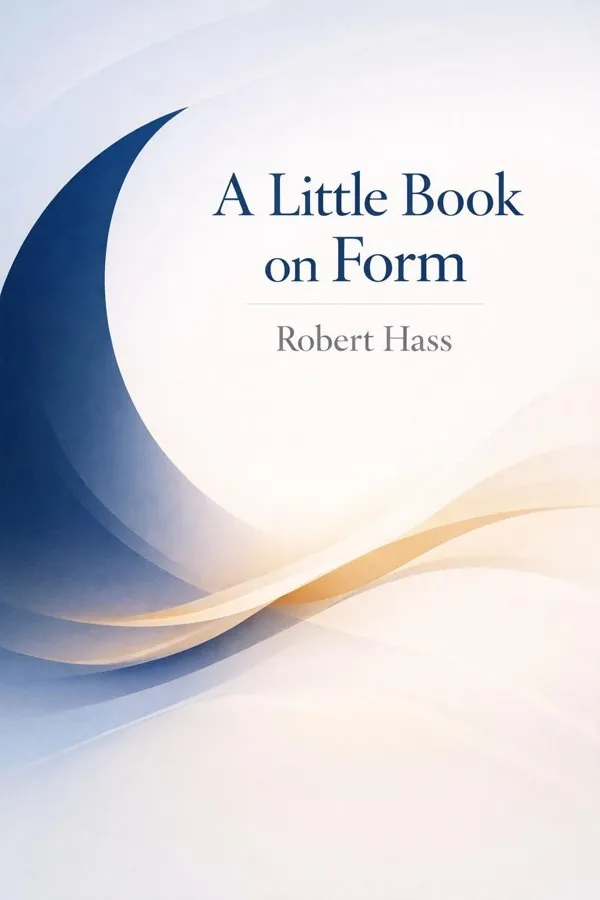
A Little Book on Form: An Exploration into the Formal Imagination of Poetry: Summary & Key Insights
by Robert Hass
 10 min7 chaptersAudio available
What Is A Little Book on Form: An Exploration into the Formal Imagination of Poetry About?
A Little Book on Form: An Exploration into the Formal Imagination of Poetry by Robert Hass is a writing book spanning 7 pages. A Little Book on Form es una meditación sobre la estructura y la música del verso. Robert Hass explora cómo la forma poética —desde el ritmo y la métrica hasta la disposición visual— da vida al pensamiento y la emoción. Con ejemplos de la tradición inglesa y americana, el libro ofrece una guía profunda sobre cómo los poetas conciben y transforman la experiencia a través de la forma.
This FizzRead summary covers all 7 key chapters of A Little Book on Form: An Exploration into the Formal Imagination of Poetry in approximately 10 minutes, distilling the most important ideas, arguments, and takeaways from Robert Hass's work. Also available as an audio summary and Key Quotes Podcast.
A Little Book on Form: An Exploration into the Formal Imagination of Poetry
A Little Book on Form es una meditación sobre la estructura y la música del verso. Robert Hass explora cómo la forma poética —desde el ritmo y la métrica hasta la disposición visual— da vida al pensamiento y la emoción. Con ejemplos de la tradición inglesa y americana, el libro ofrece una guía profunda sobre cómo los poetas conciben y transforman la experiencia a través de la forma.
Who Should Read A Little Book on Form: An Exploration into the Formal Imagination of Poetry?
This book is perfect for anyone interested in writing and looking to gain actionable insights in a short read. Whether you're a student, professional, or lifelong learner, the key ideas from A Little Book on Form: An Exploration into the Formal Imagination of Poetry by Robert Hass will help you think differently.
- ✓Readers who enjoy writing and want practical takeaways
- ✓Professionals looking to apply new ideas to their work and life
- ✓Anyone who wants the core insights of A Little Book on Form: An Exploration into the Formal Imagination of Poetry in just 10 minutes
Want the full summary?
Get instant access to this book summary and 100K+ more with Fizz Moment.
Get Free SummaryAvailable on App Store • Free to download
Key Chapters
Form in poetry has never been static; it has evolved as our sense of time, speech, and experience has evolved. If you trace the history of English and American verse, as I do in this book, you begin to see how the heartbeat of meter once mirrored the cadence of prayer and chant. In early English verse, form was bound to stress and repetition, rooted in the oral tradition. When Chaucer introduced the iambic pentameter, it wasn’t merely a technical shift—it was a transformation of consciousness. The line began to mimic human breath and conversational rhythm, allowing the language of poetry to hold both regularity and variation, giving poetry its subtle sway between order and wildness.
The sonnet, the heroic couplet, blank verse—all these arose out of particular moments in linguistic and cultural life. Each represented an attempt to balance the music of speech with the discipline of pattern. When Whitman broke the line open in the nineteenth century, he was breaking through not just prosody but a way of thinking about the self. His free verse became the form of democratic revelation. Half a century later, modernism brought the fragmentation of the line and the page—a reflection of the fractured consciousness of the age. Yet, through all of this, what persisted was form as imagination’s structure—the way energy sought clarity through design.
Looking back allows us to see that form is not rigidity but inheritance. It carries memory, voice, and rhythm across generations. When you read a sonnet, you step into a centuries-long conversation. When you write free verse, you are in dialogue with Whitman, Williams, and the modern world’s broken music. The evolution of form is the story of how poetry continues to reinvent the shape of attention.
Rhythm, I’ve always believed, is the body’s first knowledge. Long before we understand words, we understand motion, pulse, the fall and lift of air. Meter is that embodied sense translated into time and measure. In the book, I explore how metrical patterns like iambic pentameter, with its da-DUM heartbeat, carry both natural speech and artificial grace. It is the instrument of English poetry’s song, and yet, within it, infinite variations live. The slightest substitution, the break of rhythm, can turn the emotional meaning of a line.
The study of rhythm is, at its heart, the study of listening. I recall how Frost described meter as an old drumbeat in the ear; to write metrical verse is to write against and with that internal percussion. When we attend to rhythm, we attend to the hearing mind. Poems move through time, and rhythm is their measure of consciousness moving. Think of how a steady beat comforts, how a syncopation startles—it is how emotion lives in pattern.
In exploring examples, I show how Shakespeare’s pentameter absorbs speech, how Milton stretches it toward the sublime, and how contemporary poets—Heaney, Bishop, and Rich—find new kinds of rhythm even within inherited frames. The point is not mastery for tradition’s sake but awakening to the music that makes meaning possible. In a line’s pulse resides its truth, its bodily sincerity. To understand meter is to understand that poetry is not an escape from time, but time made conscious.
+ 5 more chapters — available in the FizzRead app
All Chapters in A Little Book on Form: An Exploration into the Formal Imagination of Poetry
About the Author
Robert Hass es un poeta, ensayista y traductor estadounidense. Ganador del Premio Pulitzer y del National Book Award, fue Poeta Laureado de los Estados Unidos entre 1995 y 1997. Su obra se caracteriza por una atención minuciosa al lenguaje y la naturaleza, y por su compromiso con la enseñanza de la poesía.
Get This Summary in Your Preferred Format
Read or listen to the A Little Book on Form: An Exploration into the Formal Imagination of Poetry summary by Robert Hass anytime, anywhere. FizzRead offers multiple formats so you can learn on your terms — all free.
Available formats: App · Audio · PDF · EPUB — All included free with FizzRead
Download A Little Book on Form: An Exploration into the Formal Imagination of Poetry PDF and EPUB Summary
Key Quotes from A Little Book on Form: An Exploration into the Formal Imagination of Poetry
“Form in poetry has never been static; it has evolved as our sense of time, speech, and experience has evolved.”
“Rhythm, I’ve always believed, is the body’s first knowledge.”
Frequently Asked Questions about A Little Book on Form: An Exploration into the Formal Imagination of Poetry
A Little Book on Form: An Exploration into the Formal Imagination of Poetry by Robert Hass is a writing book that explores key ideas across 7 chapters. A Little Book on Form es una meditación sobre la estructura y la música del verso. Robert Hass explora cómo la forma poética —desde el ritmo y la métrica hasta la disposición visual— da vida al pensamiento y la emoción. Con ejemplos de la tradición inglesa y americana, el libro ofrece una guía profunda sobre cómo los poetas conciben y transforman la experiencia a través de la forma.
You Might Also Like
The Art of Perspective
Christopher Castellani
10 min
Making a Point: The Persnickety Story of English Punctuation
David Crystal
10 min
The Elements Of Eloquence: How To Turn The Perfect English Phrase
Mark Forsyth
10 min
The Pocket Muse: Ideas and Inspirations for Writing
Monica Wood
10 min
Adventures In The Screen Trade: A Personal View Of Hollywood And Screenwriting
William Goldman
10 min
Becoming a Writer
Dorothea Brande
10 minBrowse by Category
Ready to read A Little Book on Form: An Exploration into the Formal Imagination of Poetry?
Get the full summary and 100K+ more books with Fizz Moment.