
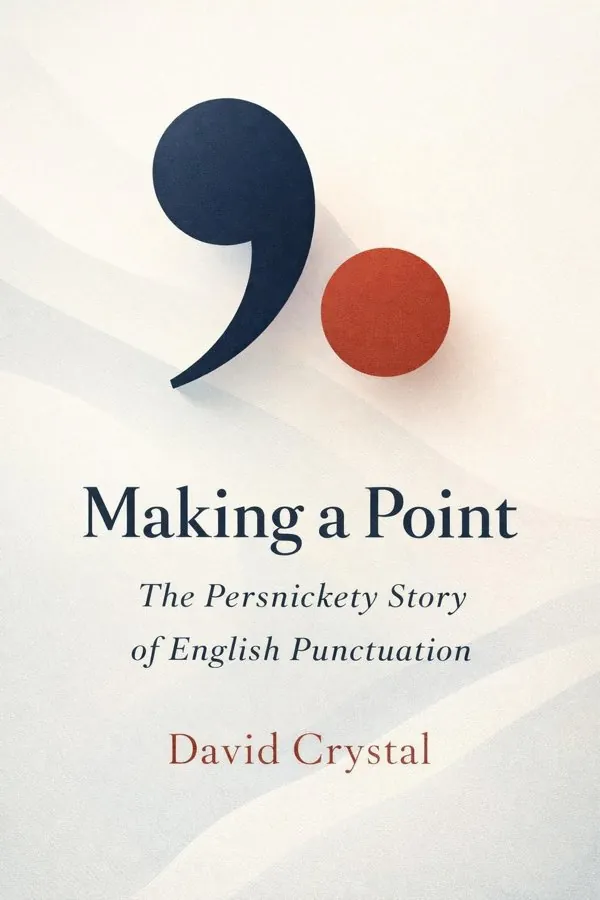
Making a Point: The Persnickety Story of English Punctuation: Summary & Key Insights
 10 min9 chaptersAudio available
Key Takeaways from Making a Point: The Persnickety Story of English Punctuation
A punctuation mark is never just a mark; it is a trace of centuries of reading, printing, rhetoric, and habit.
Good punctuation is not blind obedience; it is intelligent judgment.
Few marks inspire more outrage than the apostrophe, yet Crystal shows that much of this outrage rests on shaky historical memory.
A comma is small, but it can quietly control how a sentence is understood, paced, and felt.
Strong writers know that not every idea deserves a full stop, and not every connection should be blurred by a comma.
What Is Making a Point: The Persnickety Story of English Punctuation About?
Making a Point: The Persnickety Story of English Punctuation by David Crystal is a writing book. Punctuation is often treated as a set of dry rules, scolding teachers, and tiny marks that matter only to copyeditors. David Crystal’s Making a Point overturns that assumption. This lively, deeply informed book shows that punctuation is not a minor technical detail but one of the most expressive, historical, and misunderstood features of written English. Crystal explores where marks such as the comma, apostrophe, semicolon, dash, and quotation marks came from, how their uses have changed over time, and why modern arguments about “correct” punctuation are rarely as simple as they seem. What makes the book especially valuable is Crystal’s combination of scholarship and practicality. As one of the world’s best-known linguists, he brings historical evidence, literary examples, and a sharp sense of how language actually works in everyday life. He does not mock standards, but he also resists rigid dogma. Instead, he argues for informed, purposeful punctuation: understanding the options, the audience, and the effect you want to create. For writers, students, editors, teachers, and anyone who has ever worried about a comma or apostrophe, this book turns punctuation from a source of anxiety into a source of control, nuance, and style.
This FizzRead summary covers all 9 key chapters of Making a Point: The Persnickety Story of English Punctuation in approximately 10 minutes, distilling the most important ideas, arguments, and takeaways from David Crystal's work. Also available as an audio summary and Key Quotes Podcast.
Making a Point: The Persnickety Story of English Punctuation
Punctuation is often treated as a set of dry rules, scolding teachers, and tiny marks that matter only to copyeditors. David Crystal’s Making a Point overturns that assumption. This lively, deeply informed book shows that punctuation is not a minor technical detail but one of the most expressive, historical, and misunderstood features of written English. Crystal explores where marks such as the comma, apostrophe, semicolon, dash, and quotation marks came from, how their uses have changed over time, and why modern arguments about “correct” punctuation are rarely as simple as they seem.
What makes the book especially valuable is Crystal’s combination of scholarship and practicality. As one of the world’s best-known linguists, he brings historical evidence, literary examples, and a sharp sense of how language actually works in everyday life. He does not mock standards, but he also resists rigid dogma. Instead, he argues for informed, purposeful punctuation: understanding the options, the audience, and the effect you want to create. For writers, students, editors, teachers, and anyone who has ever worried about a comma or apostrophe, this book turns punctuation from a source of anxiety into a source of control, nuance, and style.
Who Should Read Making a Point: The Persnickety Story of English Punctuation?
This book is perfect for anyone interested in writing and looking to gain actionable insights in a short read. Whether you're a student, professional, or lifelong learner, the key ideas from Making a Point: The Persnickety Story of English Punctuation by David Crystal will help you think differently.
- ✓Readers who enjoy writing and want practical takeaways
- ✓Professionals looking to apply new ideas to their work and life
- ✓Anyone who wants the core insights of Making a Point: The Persnickety Story of English Punctuation in just 10 minutes
Want the full summary?
Get instant access to this book summary and 100K+ more with Fizz Moment.
Get Free SummaryAvailable on App Store • Free to download
Key Chapters
A punctuation mark is never just a mark; it is a trace of centuries of reading, printing, rhetoric, and habit. One of David Crystal’s most important insights is that punctuation did not emerge as a complete and permanent system. It evolved gradually as writers, scribes, printers, and readers tried to solve practical problems: how to signal pauses, separate ideas, indicate speech, and make texts easier to understand. That historical perspective immediately softens modern certainty. Many “rules” people treat as eternal are actually relatively recent conventions.
Crystal shows that punctuation began in relation to spoken delivery. Early systems often helped readers know where to pause when reading aloud. Later, punctuation became increasingly tied to grammar, syntax, and visual organization on the page. The development of printing accelerated standardization, but even then usage remained variable. Different authors, publishers, and periods preferred different practices. This matters because it reminds us that punctuation is a human invention shaped by needs, technologies, and tastes.
In practical terms, this historical lens can make you a better writer. When you realize punctuation was designed to help meaning, not to punish deviation, you start asking better questions: What does the reader need here? Where might confusion arise? Which mark best reflects the relationship between these ideas? For example, a dash may capture interruption or emphasis better than a comma, while a colon may prepare a reader for explanation more elegantly than a full stop.
The actionable takeaway is simple: stop treating punctuation as a sacred list of timeless commandments. Learn the history behind the marks, then use that knowledge to make deliberate, reader-friendly choices.
Good punctuation is not blind obedience; it is intelligent judgment. Crystal does not argue that anything goes, but he does challenge the belief that every punctuation issue has one universally correct answer. Many disputes arise because people confuse style preferences, schoolroom simplifications, and editorial house rules with absolute truths. The result is unnecessary anxiety and pointless argument.
The book repeatedly demonstrates that context shapes what counts as effective punctuation. Genre matters. A legal contract needs precision and consistency. A novel may use dashes, ellipses, and fragments for dramatic voice. A text message, marketing slogan, or social media post may intentionally break standard expectations to create speed, intimacy, or emphasis. Audience matters too. Academic readers may expect more formal sentence structure; general readers may benefit from lighter punctuation and shorter units.
Crystal’s approach helps writers move from rule-following to rule-understanding. Consider the comma. In one sentence, it clarifies a list; in another, it separates subordinate clauses; in another, it interrupts flow unnecessarily. A semicolon may elegantly join related independent clauses, but if the relationship is weak or the sentence already feels dense, two sentences may work better. The best choice depends on rhythm, clarity, and intention.
This way of thinking is liberating for editors and writers alike. It allows consistency without rigidity. You can maintain standards while accepting that those standards may vary by publication or purpose. It also helps when reading others charitably; variation is not always ignorance.
Actionable takeaway: before changing punctuation, ask three questions—what is the genre, who is the audience, and what effect is intended? Let those answers guide your decision more than abstract dogma.
Few marks inspire more outrage than the apostrophe, yet Crystal shows that much of this outrage rests on shaky historical memory. People often speak as if apostrophe rules were always stable and obvious, but the record tells a messier story. The apostrophe entered English for specific purposes, especially to mark omission, and its possessive uses developed and spread over time. Even after that, actual practice remained inconsistent for long periods.
This matters because the apostrophe has become a symbol of linguistic respectability. Missing apostrophes on public signs or misused possessives in advertisements trigger emotional reactions out of proportion to their size. Crystal does not dismiss these reactions entirely; apostrophes can affect clarity and credibility. But he argues that the panic often exceeds the practical problem. In many contexts, readers understand meaning easily even when apostrophes are absent or unconventional.
That said, careful use still matters. A writer should know the difference between “it’s” and “its,” “they’re” and “their,” and singular versus plural possession. Business writing, academic work, and professional communication benefit from standard apostrophe use because it signals competence and reduces distraction. Yet there are edge cases: names ending in s, plural abbreviations, or branding choices that drop apostrophes altogether. These are not always signs of ignorance; sometimes they reflect house style, readability, or visual design.
Crystal’s larger point is that punctuation debates often reveal social attitudes as much as linguistic facts. The apostrophe becomes a way people police standards, class, education, and taste.
Actionable takeaway: master conventional apostrophe use for credibility, but do not confuse every deviation with civilizational decline. Correct what genuinely impairs clarity, and keep perspective about the rest.
A comma is small, but it can quietly control how a sentence is understood, paced, and felt. Crystal treats the comma not as a simple pause mark with mechanical rules, but as one of the most flexible tools in English writing. Because commas perform several jobs at once—separating list items, marking clauses, setting off parenthetical material, and shaping rhythm—they often become the focus of uncertainty. Writers ask where commas “go,” when the better question is what they are trying to achieve.
The historical and practical lesson is that comma usage has always involved a blend of grammar and style. Some commas are essential because they prevent ambiguity. Compare “Let’s eat, Grandma” with “Let’s eat Grandma.” Others are optional but tonal. “However, we decided to leave” feels more formally signposted than “However we decided to leave,” which may even risk confusion depending on context. Then there is the serial, or Oxford, comma: “red, white, and blue.” Crystal treats such controversies sensibly. In some cases the final comma prevents ambiguity; in others it is simply a matter of house style.
For writers, comma decisions improve when made at the sentence level, not by memorizing disconnected rules. Read the sentence for structure. Identify the main clause. Notice where interruption begins and ends. Ask whether a comma helps the reader process the information in one pass. In digital writing, lighter comma use can create speed, but too little punctuation can force rereading.
Actionable takeaway: use commas to support both clarity and rhythm. If a comma changes meaning, removes confusion, or improves readability, keep it. If it adds clutter without helping the reader, cut it.
Strong writers know that not every idea deserves a full stop, and not every connection should be blurred by a comma. Crystal rehabilitates two marks that many people either fear or misuse: the semicolon and the colon. Both marks are often seen as formal, old-fashioned, or pretentious, but the book shows they remain powerful tools when used with purpose.
The semicolon sits between separation and continuity. It links two independent clauses that could stand alone as sentences but are closely related in thought. Used well, it creates a sense of balance, contrast, or development. For example: “The deadline was impossible; the team delivered anyway.” The semicolon signals a stronger relationship than a period would. It can also help organize complex lists when the items already contain commas, making information easier to parse.
The colon, by contrast, creates expectation. It tells the reader that what follows will explain, illustrate, summarize, or amplify what came before. “She had one goal: clarity.” That forward-pointing force can be especially effective in essays, reports, presentations, and persuasive writing. It allows a writer to introduce examples or conclusions with crisp authority.
Crystal’s broader argument is that these marks should not be abandoned just because they are less common in casual digital communication. They offer nuance that simpler punctuation cannot always supply. But they should also not be inserted to sound sophisticated. Their value lies in accurately signaling logical relationships.
Actionable takeaway: use a semicolon when two complete thoughts are tightly linked, and use a colon when the second part fulfills a promise made by the first. If the connection is weak, choose a different mark.
Quotation marks seem straightforward until you notice how many questions surround them: single or double marks, inside or outside punctuation, scare quotes, titles, dialogue, irony, and digital conventions. Crystal uses quotation marks to demonstrate how punctuation evolves alongside publishing habits, national preferences, and shifts in style. What many writers think of as fixed correctness often turns out to be a mixture of convention and editorial tradition.
Different English-speaking regions have long handled quotation marks differently. British and American usage, for example, often diverge in their preference for single versus double quotation marks and in where they place commas and periods in relation to closing marks. These differences are not signs that one system is logical and the other chaotic; they are evidence that punctuation standards emerge from local histories and institutional habits.
Crystal also highlights the modern spread of “scare quotes,” where quotation marks imply distance, irony, skepticism, or criticism. A sign offering “fresh” food, for instance, may produce unintended humor. This is an important practical lesson: quotation marks do more than indicate someone else’s words. They can suggest doubt or perform subtle rhetorical work. Used carelessly, they can undermine your intended message.
In dialogue-heavy writing, quotation marks also help readers track speakers and shifts in voice. In academic or journalistic prose, they carry ethical weight by clearly distinguishing sourced language from paraphrase. Their function is therefore both stylistic and moral.
Actionable takeaway: follow the quotation-mark conventions of your audience or style guide, and never use quotation marks decoratively. Ask what they signal—speech, citation, irony, or doubt—and use them only when that signal is intentional.
When writing tools change, punctuation changes with them. Crystal is especially good at showing that punctuation is not only shaped by grammar and print tradition but also by the technologies people use to communicate. Handwriting, typewriters, printing presses, email, texting, and social media all influence which marks are convenient, visible, expected, or emotionally charged.
Digital communication has altered punctuation in two major ways. First, speed encourages compression. People often drop full stops, apostrophes, or capitalization in fast messages because context makes meaning recoverable. Second, punctuation has gained new social meanings. A period at the end of a short text can feel final, cold, or annoyed in a way it does not in formal prose. Repeated exclamation marks may signal enthusiasm, friendliness, or exaggeration. Ellipses can imply hesitation, suspense, passive aggression, or simply an older texting style. The marks have not lost meaning; they have gained layers of it.
This does not mean standard punctuation is dying. Rather, writers now navigate multiple systems at once. A professional email, a legal memo, a group chat, and an Instagram caption call for different punctuation choices. Crystal’s balanced perspective prevents alarmism. Language users adapt efficiently to medium and purpose. The danger comes not from change itself but from failing to recognize context.
For practical application, writers should become code-switchers across written forms. Formal work still benefits from conventional punctuation because it supports clarity, professionalism, and broad readability. Informal digital spaces allow more experimentation, but even there punctuation sends relational signals.
Actionable takeaway: match your punctuation to the platform. Before sending a message or publishing a text, consider not only what the words say but what the punctuation implies in that medium.
Writers are often told to eliminate themselves from punctuation decisions, as if good style means becoming invisible. Crystal offers a more subtle view: punctuation is a practical system, but it is also part of voice. The marks you choose affect tempo, emphasis, intimacy, and emotional texture. A sentence broken by dashes feels different from one balanced with commas. A paragraph full of short, firmly ended sentences sounds different from one that unfolds through semicolons and parentheses.
Literary writers have always understood this. Novelists use punctuation to mimic thought, breath, hesitation, interruption, and intensity. Essayists use it to guide argument and build cadence. Even in nonliterary settings, style matters. A newsletter, speech, web page, or memo becomes more readable when punctuation supports tone and pacing instead of mechanically enforcing textbook form.
Crystal does not endorse chaos. Style works best when it grows from mastery, not from randomness. If you know what a dash does, you can deploy it for dramatic interruption. If you understand parentheses, you can create an aside without derailing the main line of thought. If you know when sentence fragments are normally avoided, you can break the pattern intentionally for emphasis. This is the difference between expressive control and mere inconsistency.
For readers, recognizing punctuation as style also creates generosity. Not every unusual sentence is wrong. Some choices reflect genre, personality, or rhetorical purpose. For writers, the lesson is especially empowering: punctuation is part of how you sound on the page.
Actionable takeaway: study how skilled writers use punctuation to create voice, then revise your own work by asking not only “Is this correct?” but also “Does this sound like the effect I want?”
The strongest message in Making a Point is that punctuation should serve communication, not vanity. Crystal is alert to the way punctuation debates can become moralized. People use tiny marks as evidence that language is decaying, standards are collapsing, or younger generations are careless. But this attitude often confuses preference with principle. It elevates annoyance into ideology.
Crystal’s alternative is not indifference. He values precision, consistency, and educated usage. He simply insists that we distinguish between errors that genuinely obstruct meaning and variations that do not. A missing apostrophe in a shop sign may be irritating, but it rarely causes misunderstanding. By contrast, weak sentence boundaries in a report or unclear comma use in instructions can create real confusion. The first issue is symbolic; the second is practical.
This distinction matters in education, editing, and public conversation. Teachers can help students more by explaining how punctuation affects readers than by presenting every deviation as disgraceful. Editors can prioritize interventions that improve comprehension and flow. Writers can focus their energy on choices that matter most, instead of obsessing over every disputed convention. Even readers benefit from becoming less reactive and more analytical.
Ultimately, punctuation should be judged by what it achieves. Does it clarify structure? Does it support rhythm? Does it accurately convey relation, tone, and emphasis? If yes, it is doing its job. If not, even technically “correct” punctuation may be ineffective.
Actionable takeaway: when reviewing punctuation, rank issues by their effect on understanding. Fix what confuses, distracts, or misleads the reader first; treat minor stylistic differences with proportion and humility.
All Chapters in Making a Point: The Persnickety Story of English Punctuation
About the Author
David Crystal is a renowned British linguist, author, and broadcaster known for making the study of language accessible to general readers. Over several decades, he has written extensively on English grammar, pronunciation, language history, child language acquisition, stylistics, and the impact of the internet on communication. His work combines scholarly rigor with an engaging, conversational style, which has made him one of the most widely read public intellectuals in linguistics. Crystal has authored numerous influential books on the English language and is frequently cited as an authority on how English changes across time, place, and medium. In Making a Point, he brings that expertise to punctuation, showing both its historical complexity and its practical importance for modern writers and readers.
Get This Summary in Your Preferred Format
Read or listen to the Making a Point: The Persnickety Story of English Punctuation summary by David Crystal anytime, anywhere. FizzRead offers multiple formats so you can learn on your terms — all free.
Available formats: App · Audio · PDF · EPUB — All included free with FizzRead
Download Making a Point: The Persnickety Story of English Punctuation PDF and EPUB Summary
Key Quotes from Making a Point: The Persnickety Story of English Punctuation
“A punctuation mark is never just a mark; it is a trace of centuries of reading, printing, rhetoric, and habit.”
“Good punctuation is not blind obedience; it is intelligent judgment.”
“Few marks inspire more outrage than the apostrophe, yet Crystal shows that much of this outrage rests on shaky historical memory.”
“A comma is small, but it can quietly control how a sentence is understood, paced, and felt.”
“Strong writers know that not every idea deserves a full stop, and not every connection should be blurred by a comma.”
Frequently Asked Questions about Making a Point: The Persnickety Story of English Punctuation
Making a Point: The Persnickety Story of English Punctuation by David Crystal is a writing book that explores key ideas across 9 chapters. Punctuation is often treated as a set of dry rules, scolding teachers, and tiny marks that matter only to copyeditors. David Crystal’s Making a Point overturns that assumption. This lively, deeply informed book shows that punctuation is not a minor technical detail but one of the most expressive, historical, and misunderstood features of written English. Crystal explores where marks such as the comma, apostrophe, semicolon, dash, and quotation marks came from, how their uses have changed over time, and why modern arguments about “correct” punctuation are rarely as simple as they seem. What makes the book especially valuable is Crystal’s combination of scholarship and practicality. As one of the world’s best-known linguists, he brings historical evidence, literary examples, and a sharp sense of how language actually works in everyday life. He does not mock standards, but he also resists rigid dogma. Instead, he argues for informed, purposeful punctuation: understanding the options, the audience, and the effect you want to create. For writers, students, editors, teachers, and anyone who has ever worried about a comma or apostrophe, this book turns punctuation from a source of anxiety into a source of control, nuance, and style.
More by David Crystal
You Might Also Like
The Art of Perspective
Christopher Castellani
10 min
The Elements Of Eloquence: How To Turn The Perfect English Phrase
Mark Forsyth
10 min
The Pocket Muse: Ideas and Inspirations for Writing
Monica Wood
10 min
A Little Book on Form: An Exploration into the Formal Imagination of Poetry
Robert Hass
10 min
Adventures In The Screen Trade: A Personal View Of Hollywood And Screenwriting
William Goldman
10 min
Becoming a Writer
Dorothea Brande
10 minBrowse by Category
Ready to read Making a Point: The Persnickety Story of English Punctuation?
Get the full summary and 100K+ more books with Fizz Moment.