
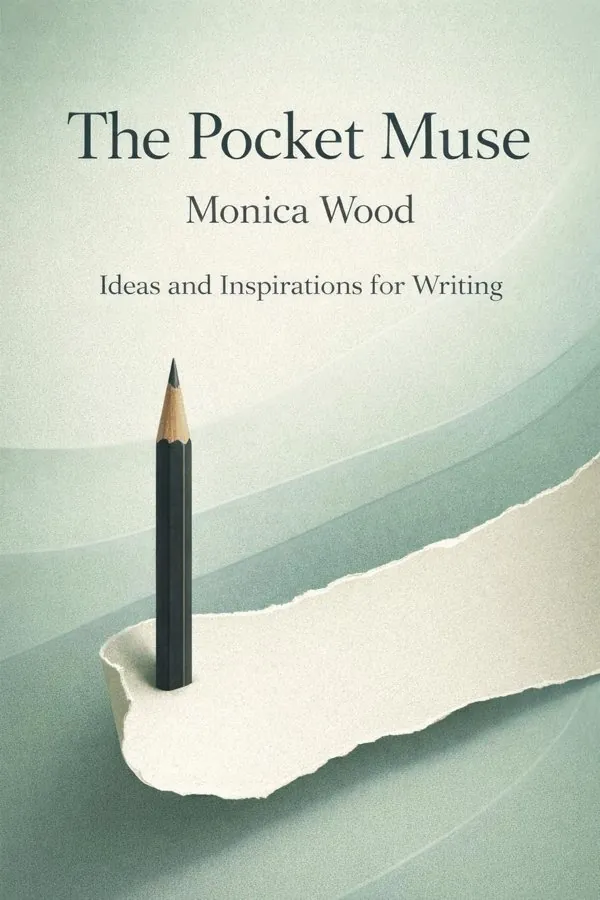
The Pocket Muse: Ideas and Inspirations for Writing: Summary & Key Insights
by Monica Wood
 10 min9 chaptersAudio available
Key Takeaways from The Pocket Muse: Ideas and Inspirations for Writing
Most writers do not run out of ideas; they stop noticing what is already around them.
Readers believe a story not because every fact is grand, but because the details feel true.
The past is never truly gone for a writer; it waits in fragments, sensations, and emotional residues that can be transformed into art.
A prompt is not a crutch; it is a doorway.
Many writers search anxiously for their voice as if it were a hidden treasure waiting to be found.
What Is The Pocket Muse: Ideas and Inspirations for Writing About?
The Pocket Muse: Ideas and Inspirations for Writing by Monica Wood is a writing book. What if the biggest obstacle to writing is not a lack of talent, but a lack of sparks? In The Pocket Muse: Ideas and Inspirations for Writing, Monica Wood offers a compact but deeply encouraging guide for writers who want to generate ideas, sharpen observation, and bring more energy to the page. Rather than presenting writing as a rigid formula, Wood treats it as a living practice built on curiosity, attention, memory, and courage. The book is filled with prompts, reflections, and creative nudges designed to help writers move past fear, perfectionism, and creative drought. Its value lies in its practicality. This is not a distant lecture on literary theory; it is a working writer’s companion that helps readers notice the world more vividly and translate those observations into scenes, characters, images, and stories. Monica Wood brings authority through experience: she is an acclaimed novelist, memoirist, and teacher who understands both the craft of writing and the emotional resistance that often surrounds it. For beginners, blocked writers, and experienced authors seeking renewed inspiration, The Pocket Muse is a reminder that ideas are everywhere if you learn how to see them.
This FizzRead summary covers all 9 key chapters of The Pocket Muse: Ideas and Inspirations for Writing in approximately 10 minutes, distilling the most important ideas, arguments, and takeaways from Monica Wood's work. Also available as an audio summary and Key Quotes Podcast.
The Pocket Muse: Ideas and Inspirations for Writing
What if the biggest obstacle to writing is not a lack of talent, but a lack of sparks? In The Pocket Muse: Ideas and Inspirations for Writing, Monica Wood offers a compact but deeply encouraging guide for writers who want to generate ideas, sharpen observation, and bring more energy to the page. Rather than presenting writing as a rigid formula, Wood treats it as a living practice built on curiosity, attention, memory, and courage. The book is filled with prompts, reflections, and creative nudges designed to help writers move past fear, perfectionism, and creative drought.
Its value lies in its practicality. This is not a distant lecture on literary theory; it is a working writer’s companion that helps readers notice the world more vividly and translate those observations into scenes, characters, images, and stories. Monica Wood brings authority through experience: she is an acclaimed novelist, memoirist, and teacher who understands both the craft of writing and the emotional resistance that often surrounds it. For beginners, blocked writers, and experienced authors seeking renewed inspiration, The Pocket Muse is a reminder that ideas are everywhere if you learn how to see them.
Who Should Read The Pocket Muse: Ideas and Inspirations for Writing?
This book is perfect for anyone interested in writing and looking to gain actionable insights in a short read. Whether you're a student, professional, or lifelong learner, the key ideas from The Pocket Muse: Ideas and Inspirations for Writing by Monica Wood will help you think differently.
- ✓Readers who enjoy writing and want practical takeaways
- ✓Professionals looking to apply new ideas to their work and life
- ✓Anyone who wants the core insights of The Pocket Muse: Ideas and Inspirations for Writing in just 10 minutes
Want the full summary?
Get instant access to this book summary and 100K+ more with Fizz Moment.
Get Free SummaryAvailable on App Store • Free to download
Key Chapters
Most writers do not run out of ideas; they stop noticing what is already around them. One of the central insights in The Pocket Muse is that inspiration is less a lightning strike than a habit of attention. Monica Wood encourages writers to become active observers of daily life: the rhythm of overheard speech, the way a stranger grips a coffee cup, the mood of a street before rain, the memory triggered by a smell. These small fragments may seem insignificant in the moment, but they are often the raw materials from which vivid writing grows.
Wood’s approach demystifies creativity. Instead of waiting for the perfect idea, the writer learns to gather details constantly. A family argument at the grocery store may become the seed of a short story. A forgotten childhood object can unlock a memoir scene. A single contradiction in someone’s behavior can spark a fictional character. What matters is developing a consciousness that asks, Why does this interest me? What story hides here?
This practice also makes writing richer because strong prose depends on specificity. General statements rarely move readers, but concrete observations do. Saying someone was nervous is functional; describing her folding and unfolding a receipt in silence is memorable. Attention creates texture, and texture creates emotional truth.
In practical terms, this means carrying a notebook, using a phone note app, or mentally collecting moments worth revisiting. Record sensory details, odd phrases, emotional reactions, and unanswered questions. The goal is not to produce finished work immediately but to build a storehouse of possibilities.
Actionable takeaway: for one week, capture five specific observations a day and review them at night for possible scenes, characters, or story ideas.
Readers believe a story not because every fact is grand, but because the details feel true. Monica Wood emphasizes that memorable writing often depends on the precise, unexpected detail that reveals character, setting, or feeling. A room is not just messy; it contains a cracked lamp, three unpaid bills under a plate, and a plant leaning toward a closed window. Those details do more than decorate a scene. They imply history, tension, class, habits, and mood.
This principle matters across genres. In fiction, detail turns cardboard characters into living people. In memoir, it restores the reality of a remembered moment. In poetry, it creates compression and resonance. Even in personal essays, detail helps readers inhabit the writer’s perspective instead of merely hearing about it from a distance.
Wood’s insight is especially useful for writers who rely too heavily on abstraction. Words like sadness, joy, fear, and loneliness are meaningful, but on the page they become powerful only when embodied. Loneliness might appear as a second coffee cup left unused. Fear might show up in a man rereading a text message without replying. Precise detail allows readers to infer emotion, which is almost always more effective than telling them what to feel.
A practical application is to revise scenes by asking what objects, gestures, sounds, or textures can replace explanation. If a draft says a woman missed her mother, perhaps the better version shows her standing in a supermarket unable to pass the canned soup aisle without stopping.
Actionable takeaway: take one abstract emotion from your draft and rewrite it using three concrete sensory details that allow the reader to feel it indirectly.
The past is never truly gone for a writer; it waits in fragments, sensations, and emotional residues that can be transformed into art. In The Pocket Muse, Monica Wood treats memory as one of the richest sources of material. Not because memory is perfectly accurate, but because it carries emotional charge. A childhood kitchen, a humiliating classroom moment, a relative’s voice, or the feeling of leaving home for the first time can all become starting points for authentic writing.
Wood invites writers to trust remembered images and moments, even when they seem incomplete. In fact, incompleteness can be productive. A writer may not remember an entire event, but may vividly recall the smell of wet wool, the color of a hallway, or the sentence someone said before a door slammed. Those fragments often hold more power than a tidy chronology because they are emotionally alive.
This approach also helps writers move beyond writer’s block. When imagination feels stalled, memory provides immediate access to scenes, people, and tensions. From there, the writer can choose whether to stay faithful to experience or use remembered material as a launch point for fiction. A real uncle can become a fictional neighbor. A true family dinner can be transformed into a completely different conflict.
The key is to write first and evaluate later. Memory work should begin with sensory exploration rather than factual policing. Ask: what do I remember seeing, hearing, touching, fearing, wanting? Let the scene unfold before deciding what it means.
Actionable takeaway: choose one vivid memory from before age twelve and write it as a scene using sight, sound, smell, and dialogue before adding any interpretation.
Many writers search anxiously for their voice as if it were a hidden treasure waiting to be found. Monica Wood offers a more grounded understanding: voice develops through sustained practice, honest attention, and the courage to sound like yourself. It is not something you invent in a single moment. It emerges from the choices you make repeatedly: what you notice, what you emphasize, how you shape sentences, where your humor appears, how you handle silence, and what emotional truths you are willing to face.
This idea is liberating because it shifts the writer away from imitation. Beginners often mimic admired authors too closely, hoping style will transfer through resemblance. Reading widely is valuable, but Wood suggests that a writer’s own voice strengthens when they write from genuine interest rather than literary performance. The page changes when you stop trying to sound impressive and start trying to be precise, awake, and truthful.
Voice is also tied to permission. Some writers weaken their own prose by overediting too soon, sanding away oddness, intensity, or intimacy. But those very qualities may be the beginnings of voice. A blunt sentence, a quirky image, an unexpected rhythm, or an unusual perspective can signal the writer’s natural sound.
Practically, this means drafting more freely and studying your own patterns afterward. Notice which lines feel alive. Which topics ignite energy? Which images recur? Which sentence structures feel native rather than forced? Voice reveals itself through these repetitions.
Actionable takeaway: reread three pieces of your own writing and highlight the sentences that feel most alive, then identify the patterns in tone, rhythm, and subject that may point to your emerging voice.
Flat writing often comes from premature certainty. Monica Wood suggests that curiosity is one of the writer’s greatest tools because it keeps people and situations open, layered, and dynamic. Instead of deciding too quickly who a character is or what a scene means, the writer should stay interested in contradictions, motives, and hidden tensions. Why does the generous man resent praise? Why does the cheerful sister avoid birthdays? Why does a woman laugh while delivering bad news? Such questions generate depth.
Curiosity matters because real people are rarely simple. When writers settle for labels such as kind, rude, lonely, or ambitious, they flatten human complexity. But when they ask how those traits coexist with fear, memory, shame, desire, or social pressure, characters become more believable. The same is true of scenes. A dinner is never just a dinner if someone wants forgiveness, someone is hiding money trouble, and someone else suspects both.
Wood’s approach encourages observation without judgment. Rather than reducing behavior to easy explanations, the writer learns to remain inquisitive. This improves dialogue, conflict, and narrative momentum. A curious writer notices not only what is said, but what is avoided; not only what happens, but what almost happens.
In practical writing, curiosity can be built into revision. Expand a scene by asking what each person wants, what each person fears, and what each person refuses to admit. The answers create subtext, and subtext creates life.
Actionable takeaway: for your next scene, write down one desire, one fear, and one contradiction for each character before revising their dialogue and actions.
Perfectionism can masquerade as high standards, but for many writers it is simply fear in polished clothing. One of the most useful lessons in The Pocket Muse is the permission to write badly in order to write at all. Monica Wood understands that the blank page becomes intimidating when every sentence is expected to arrive finished, elegant, and meaningful. That expectation kills momentum before discovery can begin.
Early drafts exist to uncover material, not to prove talent. Wood’s philosophy reminds writers that roughness is not failure; it is process. Clumsy phrasing, false starts, overwritten paragraphs, and uncertain scenes are often necessary steps toward clarity. If you refuse to produce imperfect work, you often produce nothing. But if you allow yourself to move forward messily, you create something that can be shaped.
This mindset is especially powerful for writers who edit while drafting. Constant self-correction fractures the imaginative state. A writer may spend twenty minutes adjusting the first paragraph and never reach the scene where the real energy lies. By separating drafting from revising, writers preserve flow and increase the chance of surprise.
A practical strategy is timed writing with no deletion allowed. Another is to label a file “bad first draft” to reduce internal pressure. The point is not to celebrate mediocrity, but to respect sequence: first generate, then refine.
Actionable takeaway: in your next writing session, draft for fifteen uninterrupted minutes without backspacing or correcting, and only revise after the timer ends.
A writing life is built less by occasional inspiration than by repeated return. Monica Wood emphasizes that creativity flourishes when writers develop a sustainable practice, even if the sessions are short. Many aspiring writers imagine they need large blocks of uninterrupted time, ideal conditions, or dramatic motivation. But books are more often written in ordinary hours: early mornings, lunch breaks, late evenings, and stolen weekends.
This matters because waiting for perfect conditions gives resistance too much power. A modest but regular routine trains the mind to reenter the work. Fifteen minutes a day may not feel heroic, yet it establishes continuity. Continuity reduces the emotional cost of starting. The page becomes less foreign, and ideas remain active between sessions.
Wood’s perspective is encouraging because it is practical rather than romantic. She treats writing as both art and habit. Habits do not remove mystery from creativity; they create the conditions in which mystery can appear more often. A writer who shows up consistently accumulates pages, experiments, and insights that an occasional burst of effort cannot provide.
In application, this means defining a realistic rhythm. Some writers work daily; others commit to several sessions a week. What matters most is predictability and protection of time. Rituals can help: the same chair, notebook, tea, playlist, or opening exercise. These cues teach the brain to transition into writing mode.
Actionable takeaway: choose a writing schedule you can sustain for two weeks, even if it is only twenty minutes four times a week, and track completed sessions rather than word count.
Many writers believe they need unusual experiences to produce interesting work, yet Monica Wood argues that the ordinary world is already full of narrative possibility. Daily life contains conflict, beauty, absurdity, longing, disappointment, tenderness, and revelation. The challenge is not finding dramatic events, but seeing familiar moments with enough freshness to recognize their meaning.
This insight is crucial because it frees writers from the myth that art belongs only to the exotic, tragic, or sensational. A laundromat, a bus ride, a waiting room, a family meal, or an exchange at a hardware store can contain everything a story needs: stakes, emotion, power dynamics, memory, and change. What transforms the ordinary into compelling material is perspective. Which detail unsettles the scene? What desire is hidden under routine behavior? What history sits silently between two people?
Wood’s vision also validates writers whose lives may appear uneventful from the outside. You do not need to have climbed mountains or survived extremes to write meaningfully. You need awareness, patience, and a willingness to honor the significance of what others overlook. Great writing often reveals that what seems small is not small at all.
Practically, writers can train this perception by reexamining everyday settings. Describe your kitchen as if it belonged to a stranger. Listen to a conversation in line and imagine the unseen relationship behind it. Ask what emotional weather exists inside ordinary actions.
Actionable takeaway: write a one-page scene set in a completely ordinary place, then add tension by identifying one hidden desire and one unspoken conflict in that setting.
All Chapters in The Pocket Muse: Ideas and Inspirations for Writing
About the Author
Monica Wood is an accomplished American novelist, memoirist, and writing teacher known for her clarity, warmth, and deep understanding of human experience. Over the course of her career, she has published acclaimed fiction and nonfiction, earning a reputation for emotionally intelligent storytelling and careful attention to detail. In addition to her literary work, she has taught writing extensively, helping new and experienced writers develop confidence, discipline, and craft. That combination of artistic achievement and teaching experience gives her unusual authority as a guide for writers. In The Pocket Muse, Wood brings together the sensibility of a practicing author and the generosity of an experienced mentor, offering practical inspiration rooted in real creative life.
Get This Summary in Your Preferred Format
Read or listen to the The Pocket Muse: Ideas and Inspirations for Writing summary by Monica Wood anytime, anywhere. FizzRead offers multiple formats so you can learn on your terms — all free.
Available formats: App · Audio · PDF · EPUB — All included free with FizzRead
Download The Pocket Muse: Ideas and Inspirations for Writing PDF and EPUB Summary
Key Quotes from The Pocket Muse: Ideas and Inspirations for Writing
“Most writers do not run out of ideas; they stop noticing what is already around them.”
“Readers believe a story not because every fact is grand, but because the details feel true.”
“The past is never truly gone for a writer; it waits in fragments, sensations, and emotional residues that can be transformed into art.”
“A prompt is not a crutch; it is a doorway.”
“Many writers search anxiously for their voice as if it were a hidden treasure waiting to be found.”
Frequently Asked Questions about The Pocket Muse: Ideas and Inspirations for Writing
The Pocket Muse: Ideas and Inspirations for Writing by Monica Wood is a writing book that explores key ideas across 9 chapters. What if the biggest obstacle to writing is not a lack of talent, but a lack of sparks? In The Pocket Muse: Ideas and Inspirations for Writing, Monica Wood offers a compact but deeply encouraging guide for writers who want to generate ideas, sharpen observation, and bring more energy to the page. Rather than presenting writing as a rigid formula, Wood treats it as a living practice built on curiosity, attention, memory, and courage. The book is filled with prompts, reflections, and creative nudges designed to help writers move past fear, perfectionism, and creative drought. Its value lies in its practicality. This is not a distant lecture on literary theory; it is a working writer’s companion that helps readers notice the world more vividly and translate those observations into scenes, characters, images, and stories. Monica Wood brings authority through experience: she is an acclaimed novelist, memoirist, and teacher who understands both the craft of writing and the emotional resistance that often surrounds it. For beginners, blocked writers, and experienced authors seeking renewed inspiration, The Pocket Muse is a reminder that ideas are everywhere if you learn how to see them.
You Might Also Like
The Art of Perspective
Christopher Castellani
10 min
Making a Point: The Persnickety Story of English Punctuation
David Crystal
10 min
The Elements Of Eloquence: How To Turn The Perfect English Phrase
Mark Forsyth
10 min
A Little Book on Form: An Exploration into the Formal Imagination of Poetry
Robert Hass
10 min
Adventures In The Screen Trade: A Personal View Of Hollywood And Screenwriting
William Goldman
10 min
Becoming a Writer
Dorothea Brande
10 minBrowse by Category
Ready to read The Pocket Muse: Ideas and Inspirations for Writing?
Get the full summary and 100K+ more books with Fizz Moment.