
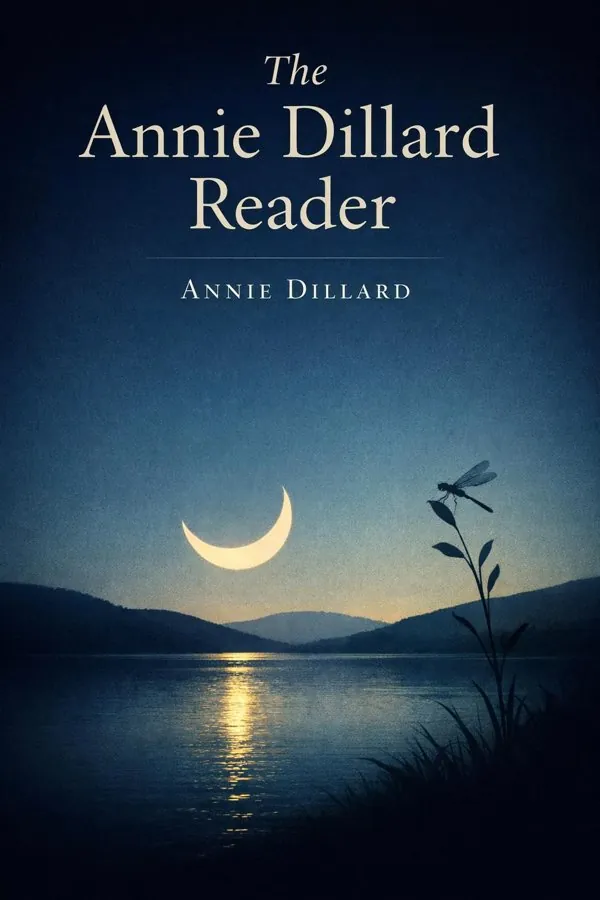
The Annie Dillard Reader: Summary & Key Insights
 10 min6 chaptersAudio available
What Is The Annie Dillard Reader About?
The Annie Dillard Reader by Annie Dillard is a classics book spanning 6 pages. A collection of essays and excerpts from Annie Dillard’s most celebrated works, including 'Pilgrim at Tinker Creek', 'An American Childhood', and 'Teaching a Stone to Talk'. The anthology showcases Dillard’s distinctive prose and her meditations on nature, spirituality, and human experience.
This FizzRead summary covers all 6 key chapters of The Annie Dillard Reader in approximately 10 minutes, distilling the most important ideas, arguments, and takeaways from Annie Dillard's work. Also available as an audio summary and Key Quotes Podcast.
The Annie Dillard Reader
A collection of essays and excerpts from Annie Dillard’s most celebrated works, including 'Pilgrim at Tinker Creek', 'An American Childhood', and 'Teaching a Stone to Talk'. The anthology showcases Dillard’s distinctive prose and her meditations on nature, spirituality, and human experience.
Who Should Read The Annie Dillard Reader?
This book is perfect for anyone interested in classics and looking to gain actionable insights in a short read. Whether you're a student, professional, or lifelong learner, the key ideas from The Annie Dillard Reader by Annie Dillard will help you think differently.
- ✓Readers who enjoy classics and want practical takeaways
- ✓Professionals looking to apply new ideas to their work and life
- ✓Anyone who wants the core insights of The Annie Dillard Reader in just 10 minutes
Want the full summary?
Get instant access to this book summary and 100K+ more with Fizz Moment.
Get Free SummaryAvailable on App Store • Free to download
Key Chapters
When I lived by Tinker Creek in Virginia’s Blue Ridge Mountains, I learned to see. The creek became a living text, written not in words but in motion, light, and blood. I spent hours sitting by its banks, watching dragonflies, frogs, muskrats, and water bugs, and what I discovered startled me: beauty and cruelty exist side by side, impossibly coupled. A frog is sucked dry by a giant water bug, and yet the marsh vibrates with light and holiness. How does one reconcile a world that is both magnificent and merciless?
For me, the act of paying close attention was the answer. The more minutely I looked, the more the world opened. I understood that creation is not tidy or moral—it is exuberant. Its beauty is extravagant, indifferent to human conceptions of goodness. Standing before nature’s fierce abundance, I had to admit that to live attentively is to live in tension: to praise the light even as we acknowledge the darkness that accompanies it.
In *Pilgrim at Tinker Creek*, I sought not to explain this paradox but to dwell within it. My walking and watching became a kind of prayer. Every observation was a rung in a ladder of revelation, carrying me from the lowlands of distraction to the high country of wonder. The creek was my teacher, the insects my theologians. What I learned there was that seeing—truly seeing—is an act of love, and perhaps our sole means of approaching the divine in a world that refuses to console us.
Seeing is more than looking—it is the art of presence. Many people move through their days shrouded in habit, their eyes open but unawakened. To learn how to see is to unlearn this numbness. When I describe the shimmer of a fish’s scales or the trembling of a shadow on snow, I am not romanticizing nature; I am reporting what can happen when we drop our filters of expectation.
Early in my time at Tinker Creek, I realized that sight itself is a moral act. To attend is to participate in creation; to ignore is a kind of spiritual blindness. I once read that certain butterflies have eyes on their wings—an evolutionary trick of survival. But for me, to grow eyes all over my life was the deeper necessity. I practiced watching light the way monks practice prayer. I waited for revelation not as a bolt from beyond but as the slow dawning of perception.
If faith means trusting that what is beyond us still resides within sight, then every act of attention becomes a form of devotion. The world reveals itself as layered—brutal, yes, but radiant. When we train our gaze upon it, we become participants in that radiance. To attend to a maple leaf, a muskrat, or a sunset is to confess: this too belongs to God’s inscrutable order. In this way, seeing becomes both knowledge and praise—a quiet assent to the holiness of what is.
+ 4 more chapters — available in the FizzRead app
All Chapters in The Annie Dillard Reader
About the Author
Annie Dillard is an American author known for her lyrical explorations of nature and philosophy. Born in Pittsburgh, Pennsylvania, she won the Pulitzer Prize for 'Pilgrim at Tinker Creek' and has written acclaimed works of nonfiction, poetry, and narrative essays.
Get This Summary in Your Preferred Format
Read or listen to the The Annie Dillard Reader summary by Annie Dillard anytime, anywhere. FizzRead offers multiple formats so you can learn on your terms — all free.
Available formats: App · Audio · PDF · EPUB — All included free with FizzRead
Download The Annie Dillard Reader PDF and EPUB Summary
Key Quotes from The Annie Dillard Reader
“When I lived by Tinker Creek in Virginia’s Blue Ridge Mountains, I learned to see.”
“Seeing is more than looking—it is the art of presence.”
Frequently Asked Questions about The Annie Dillard Reader
The Annie Dillard Reader by Annie Dillard is a classics book that explores key ideas across 6 chapters. A collection of essays and excerpts from Annie Dillard’s most celebrated works, including 'Pilgrim at Tinker Creek', 'An American Childhood', and 'Teaching a Stone to Talk'. The anthology showcases Dillard’s distinctive prose and her meditations on nature, spirituality, and human experience.
More by Annie Dillard
You Might Also Like

Browse by Category
Ready to read The Annie Dillard Reader?
Get the full summary and 100K+ more books with Fizz Moment.