
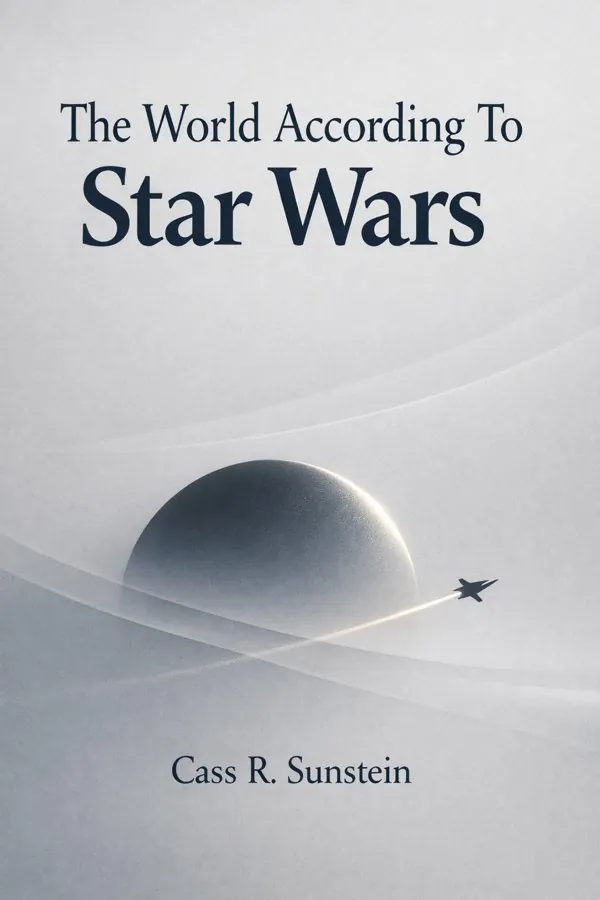
The World According To Star Wars: Summary & Key Insights
 10 min10 chaptersAudio available
What Is The World According To Star Wars About?
The World According To Star Wars by Cass R. Sunstein is a popular_sci book spanning 10 pages. In this engaging and insightful book, legal scholar Cass R. Sunstein explores how the Star Wars saga reflects and illuminates real-world themes such as politics, family, rebellion, and destiny. Blending pop culture analysis with social science and philosophy, Sunstein examines how George Lucas’s creation became a cultural phenomenon and what it reveals about human behavior, decision-making, and the power of storytelling.
This FizzRead summary covers all 10 key chapters of The World According To Star Wars in approximately 10 minutes, distilling the most important ideas, arguments, and takeaways from Cass R. Sunstein's work. Also available as an audio summary and Key Quotes Podcast.
The World According To Star Wars
In this engaging and insightful book, legal scholar Cass R. Sunstein explores how the Star Wars saga reflects and illuminates real-world themes such as politics, family, rebellion, and destiny. Blending pop culture analysis with social science and philosophy, Sunstein examines how George Lucas’s creation became a cultural phenomenon and what it reveals about human behavior, decision-making, and the power of storytelling.
Who Should Read The World According To Star Wars?
This book is perfect for anyone interested in popular_sci and looking to gain actionable insights in a short read. Whether you're a student, professional, or lifelong learner, the key ideas from The World According To Star Wars by Cass R. Sunstein will help you think differently.
- ✓Readers who enjoy popular_sci and want practical takeaways
- ✓Professionals looking to apply new ideas to their work and life
- ✓Anyone who wants the core insights of The World According To Star Wars in just 10 minutes
Want the full summary?
Get instant access to this book summary and 100K+ more with Fizz Moment.
Get Free SummaryAvailable on App Store • Free to download
Key Chapters
Every saga has its beginning, and the making of *Star Wars* is itself a story of rebellion and invention. George Lucas was a young filmmaker trying to escape the gravitational pull of mainstream Hollywood. After *American Graffiti* proved his talent, he could have pursued safe ground—but instead, he chased myth. He immersed himself in Joseph Campbell’s *The Hero with a Thousand Faces*, drawing inspiration from ancient narratives that shared a simple common rhythm: the call to adventure, the tests of self, the triumph against darkness.
Lucas was also a product of his time—the 1970s, marked by distrust of authority and post-Vietnam disillusionment. America was weary, its institutions questioned, its politicians fallible. Out of that cultural turbulence, Lucas envisioned a universe where good defied evil, where rebellion could still mean hope. Yet what fascinates me most is how contingency shaped this genesis. For every deliberate act of genius, there were hundreds of accidents, compromises, and strokes of luck—from casting decisions to technological innovations. The Force itself was a concept born of trial and error, gradually refined into something timeless.
In understanding these origins, I find a profound lesson about creativity itself: masterpieces are rarely planned with precision. They emerge through risk, perseverance, and a willingness to embrace uncertainty. *Star Wars* teaches that even in creativity—as in governance or law—progress depends not only on vision but on the resilience to learn from failure and adapt when the odds seem astronomical.
Why does a story set in a galaxy far, far away speak so intimately to us? Because its plot follows an ancient rhythm—the journey of the hero. Lucas took Campbell’s vision of myth as a mirror of human psychology and brought it to vivid cinematographic life. Luke Skywalker’s tale begins with restlessness, with the yearning to leave home and discover meaning. That impulse is universal. Each of us is, in some way, called to adventure by circumstances that demand courage and growth.
In shaping *Star Wars*, Lucas blended myth with cinematic innovation. He made the hero’s journey not abstract but visual, visceral. The twin suns of Tatooine—a symbol of longing and possibility—capture what every person feels when standing at the edge of change. And yet, storytelling here is not simply escapism. It is moral architecture. Through narrative, we internalize values of bravery, sacrifice, and choice. We learn, unconsciously, how systems of power rise and fall, how freedom survives or perishes.
When I study law and public policy, I see similar patterns. Societies tell stories about themselves—stories of liberty, justice, and equality—and these myths shape governance. In that sense, Lucas’s tale isn’t just entertainment; it’s a civic parable. The struggle of the Jedi against empire mirrors our perpetual fight between democracy and authoritarianism. Storytelling, then, becomes a form of citizenship—a way to imagine better worlds and hold real institutions accountable. That is the enduring power of *Star Wars*: it teaches through wonder, and educates through enchantment.
+ 8 more chapters — available in the FizzRead app
All Chapters in The World According To Star Wars
About the Author
Cass R. Sunstein is an American legal scholar, behavioral economist, and author. He is the Robert Walmsley University Professor at Harvard University and has written extensively on law, behavioral economics, and public policy. Sunstein served as Administrator of the White House Office of Information and Regulatory Affairs under President Barack Obama.
Get This Summary in Your Preferred Format
Read or listen to the The World According To Star Wars summary by Cass R. Sunstein anytime, anywhere. FizzRead offers multiple formats so you can learn on your terms — all free.
Available formats: App · Audio · PDF · EPUB — All included free with FizzRead
Download The World According To Star Wars PDF and EPUB Summary
Key Quotes from The World According To Star Wars
“Every saga has its beginning, and the making of *Star Wars* is itself a story of rebellion and invention.”
“Why does a story set in a galaxy far, far away speak so intimately to us?”
Frequently Asked Questions about The World According To Star Wars
The World According To Star Wars by Cass R. Sunstein is a popular_sci book that explores key ideas across 10 chapters. In this engaging and insightful book, legal scholar Cass R. Sunstein explores how the Star Wars saga reflects and illuminates real-world themes such as politics, family, rebellion, and destiny. Blending pop culture analysis with social science and philosophy, Sunstein examines how George Lucas’s creation became a cultural phenomenon and what it reveals about human behavior, decision-making, and the power of storytelling.
More by Cass R. Sunstein
You Might Also Like
Structures: Or Why Things Don"t Fall Down
J.E. Gordon
10 min
The Road to Wigan Pier
George Orwell
10 min
Bonk: The Curious Coupling of Science and Sex
Mary Roach
10 min
First Bite: How We Learn to Eat
Bee Wilson
10 min
In Pursuit Of The Unknown: 17 Equations That Changed The World
Ian Stewart
10 min
Napoleon's Buttons: 17 Molecules That Changed History
Penny Le Couteur and Jay Burreson
10 minBrowse by Category
Ready to read The World According To Star Wars?
Get the full summary and 100K+ more books with Fizz Moment.