
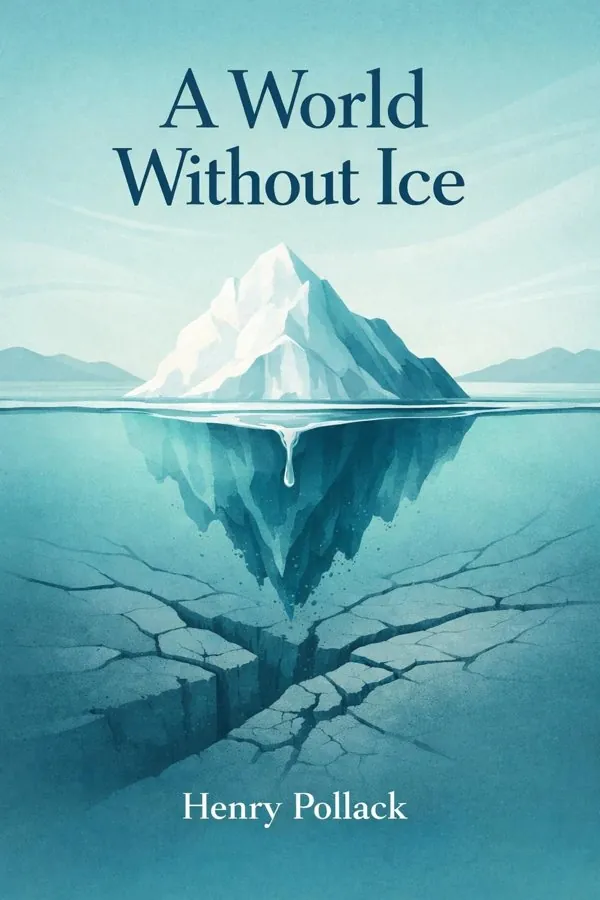
A World Without Ice: Summary & Key Insights
 10 min5 chaptersAudio available
What Is A World Without Ice About?
A World Without Ice by Henry Pollack is a environment book spanning 5 pages. This book explores the critical role of ice in Earth's climate system and the profound consequences of its melting due to global warming. Geophysicist Henry Pollack explains how ice has shaped the planet's history, influences weather and sea levels, and serves as a key indicator of climate change. Through scientific insight and accessible narrative, Pollack warns of the environmental and societal impacts of a world losing its ice cover.
This FizzRead summary covers all 5 key chapters of A World Without Ice in approximately 10 minutes, distilling the most important ideas, arguments, and takeaways from Henry Pollack's work. Also available as an audio summary and Key Quotes Podcast.
A World Without Ice
This book explores the critical role of ice in Earth's climate system and the profound consequences of its melting due to global warming. Geophysicist Henry Pollack explains how ice has shaped the planet's history, influences weather and sea levels, and serves as a key indicator of climate change. Through scientific insight and accessible narrative, Pollack warns of the environmental and societal impacts of a world losing its ice cover.
Who Should Read A World Without Ice?
This book is perfect for anyone interested in environment and looking to gain actionable insights in a short read. Whether you're a student, professional, or lifelong learner, the key ideas from A World Without Ice by Henry Pollack will help you think differently.
- ✓Readers who enjoy environment and want practical takeaways
- ✓Professionals looking to apply new ideas to their work and life
- ✓Anyone who wants the core insights of A World Without Ice in just 10 minutes
Want the full summary?
Get instant access to this book summary and 100K+ more with Fizz Moment.
Get Free SummaryAvailable on App Store • Free to download
Key Chapters
To comprehend the world we inhabit, we must first learn to read the chapters written in ice. Our planet has never been static; it breathes through cycles—warmth and cold, expansion and retreat. Over millions of years, ice has advanced and receded countless times, sculpting landscapes and influencing the course of evolution. As a geophysicist, I have spent decades studying these rhythms: how continental drift, ocean circulation, and the tilt of Earth’s axis work together to produce glacial and interglacial periods.
In deep time, ice has acted both as destroyer and creator. It carves mountains, crushes rocks into powder that feeds fertile soils, and shapes river valleys where civilizations eventually arise. When glaciers expanded during the last Ice Age, they locked vast amounts of water on land, lowering sea levels and exposing migration pathways for early humans. When they melted, the seas reshaped shores and climate zones, forcing adaptation and innovation.
Studying these cycles helps us grasp one profound truth: Earth’s climate is sensitive and interlinked. The lesson from history is not that change is new, but that never before has the pace of change been so rapid or so clearly driven by human activity. The geological record reveals natural shifts of thousands of years; now, similar magnitude changes are occurring within a single century. We are living in an accelerated moment—witnessing what typically unfolds over epochs happen within our lifetimes.
From the frozen continents of Antarctica to Greenland’s vast ice sheet, evidence accumulates of warming unprecedented in modern records. Understanding the patterns of ancient ice gives us context, but it also warns us: ice responds slowly at first, and then suddenly. Once thresholds are crossed, its retreat gains momentum that is difficult to reverse. The pulse of glacial history teaches humility—it reminds us that ice is powerful enough to reshape worlds, yet fragile enough to vanish when equilibrium is disturbed.
Ice is not passive; it is an active participant in the planet’s climate conversation. When sunlight hits ice, much of it is reflected back into space, cooling the planet. When ice melts, that reflective shield diminishes, allowing more solar energy to be absorbed by darker ocean or ground surfaces, which in turn accelerates warming. This feedback process—the albedo effect—is one of the most critical features of climate dynamics.
Through its interaction with air and ocean, ice controls the distribution of heat across the globe. Polar ice caps act as thermal reservoirs, stabilizing temperature extremes. Sea ice forms a lid atop ocean water, regulating how much warmth escapes from the sea to the atmosphere. Meanwhile, melting freshwater alters ocean salinity and circulation patterns, influencing global weather.
I have often described Earth as a finely tuned climate engine—ice being one of its key components. When that component begins to fail, the entire system shudders. Evidence from satellite measurements and polar expeditions shows a consistent trend: thinning ice sheets, retreating sea ice, and destabilized permafrost. Each of these changes carries consequences far beyond the polar regions. Jet streams meander more unpredictably, ocean currents like the Gulf Stream are disrupted, and extreme weather events grow in frequency and intensity.
These phenomena are not theoretical—they are measurable. When we watch ice melt, we are observing physics in motion: heat absorption, pressure shifts, water displacement. The result is a redefined climate system whose balance tilts toward instability. Understanding these connections helps us see why protecting ice is not a sentimental act—it is an act of global self-preservation.
+ 3 more chapters — available in the FizzRead app
All Chapters in A World Without Ice
About the Author
Henry Pollack is an American geophysicist and professor emeritus at the University of Michigan. He has contributed extensively to climate science and served as a contributing author to the Intergovernmental Panel on Climate Change (IPCC), which shared the 2007 Nobel Peace Prize. His research focuses on Earth's climate history and the effects of global warming.
Get This Summary in Your Preferred Format
Read or listen to the A World Without Ice summary by Henry Pollack anytime, anywhere. FizzRead offers multiple formats so you can learn on your terms — all free.
Available formats: App · Audio · PDF · EPUB — All included free with FizzRead
Download A World Without Ice PDF and EPUB Summary
Key Quotes from A World Without Ice
“To comprehend the world we inhabit, we must first learn to read the chapters written in ice.”
“Ice is not passive; it is an active participant in the planet’s climate conversation.”
Frequently Asked Questions about A World Without Ice
A World Without Ice by Henry Pollack is a environment book that explores key ideas across 5 chapters. This book explores the critical role of ice in Earth's climate system and the profound consequences of its melting due to global warming. Geophysicist Henry Pollack explains how ice has shaped the planet's history, influences weather and sea levels, and serves as a key indicator of climate change. Through scientific insight and accessible narrative, Pollack warns of the environmental and societal impacts of a world losing its ice cover.
You Might Also Like
A Life on Our Planet: My Witness Statement and a Vision for the Future
David Attenborough
10 min
A Sky Full Of Birds
Matt Merritt
10 min
Carbon Zero: Imagining Cities That Can Save the Planet
Alex Steffen
10 min
Eaarth: Making a Life on a Tough New Planet
Bill McKibben
10 min
The Social Contract and Environmental Governance
Various Editors
10 min
The Wild Places
Robert Macfarlane
10 minBrowse by Category
Ready to read A World Without Ice?
Get the full summary and 100K+ more books with Fizz Moment.