
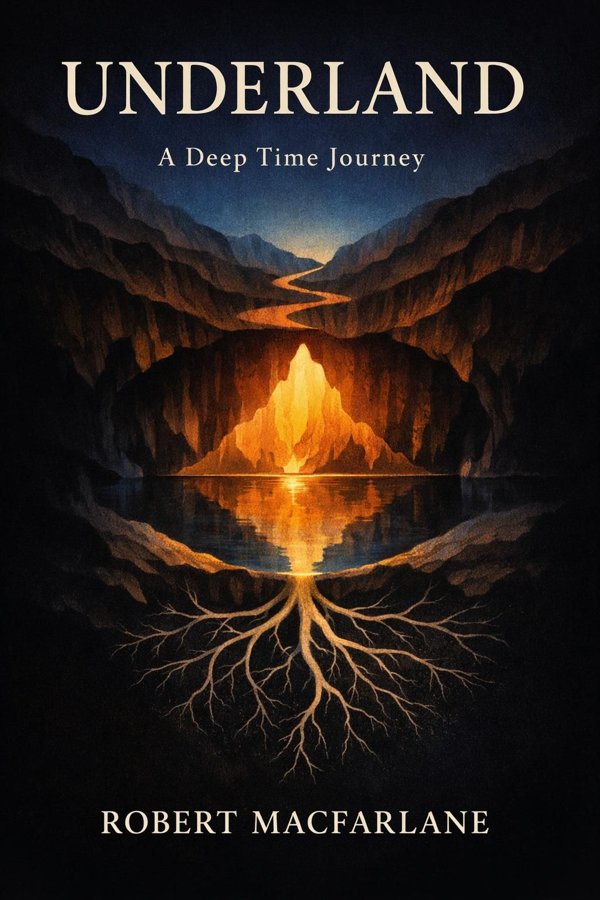
Underland: A Deep Time Journey: Summary & Key Insights
 10 min10 chaptersAudio available
Key Takeaways from Underland: A Deep Time Journey
One of humanity’s earliest acts of meaning-making was to place its dead into the earth.
A city’s surface can feel modern and immediate, but beneath it lies a layered archive of everything it has tried to build, bury, or forget.
What we place underground is often what we cannot comfortably hold in public view.
In sea caves and deep cave systems, Macfarlane shows that descending below the reach of daylight alters not only what we see but how we think.
The deepest underground spaces are not always ancient; many are modern, engineered, and morally unsettling.
What Is Underland: A Deep Time Journey About?
Underland: A Deep Time Journey by Robert Macfarlane is a environment book spanning 11 pages. Underland: A Deep Time Journey is Robert Macfarlane’s luminous exploration of the worlds beneath the surface of the earth and beneath the surface of human thought. Moving through prehistoric burial chambers, urban tunnels, sea caves, deep mines, glacial moulins, and vast cave systems, Macfarlane asks what the underworld can teach us about time, memory, mortality, and environmental responsibility. The book is part travel narrative, part natural history, part philosophical meditation, and it uses descent as a method for understanding both the planet’s ancient past and its uncertain future. What makes the book so powerful is that Macfarlane never treats the underground as merely exotic terrain. Instead, he shows it as a mirror of human values: a place where we bury our dead, hide our waste, store our secrets, and confront forces much older than civilization itself. In an age shaped by climate crisis and the long consequences of human activity, this perspective feels urgent. Macfarlane writes with the authority of a celebrated nature writer, scholar, and careful observer, combining scientific curiosity with literary grace. The result is a profound, unsettling, and often beautiful meditation on how we inhabit the earth.
This FizzRead summary covers all 10 key chapters of Underland: A Deep Time Journey in approximately 10 minutes, distilling the most important ideas, arguments, and takeaways from Robert Macfarlane's work. Also available as an audio summary and Key Quotes Podcast.
Underland: A Deep Time Journey
Underland: A Deep Time Journey is Robert Macfarlane’s luminous exploration of the worlds beneath the surface of the earth and beneath the surface of human thought. Moving through prehistoric burial chambers, urban tunnels, sea caves, deep mines, glacial moulins, and vast cave systems, Macfarlane asks what the underworld can teach us about time, memory, mortality, and environmental responsibility. The book is part travel narrative, part natural history, part philosophical meditation, and it uses descent as a method for understanding both the planet’s ancient past and its uncertain future.
What makes the book so powerful is that Macfarlane never treats the underground as merely exotic terrain. Instead, he shows it as a mirror of human values: a place where we bury our dead, hide our waste, store our secrets, and confront forces much older than civilization itself. In an age shaped by climate crisis and the long consequences of human activity, this perspective feels urgent. Macfarlane writes with the authority of a celebrated nature writer, scholar, and careful observer, combining scientific curiosity with literary grace. The result is a profound, unsettling, and often beautiful meditation on how we inhabit the earth.
Who Should Read Underland: A Deep Time Journey?
This book is perfect for anyone interested in environment and looking to gain actionable insights in a short read. Whether you're a student, professional, or lifelong learner, the key ideas from Underland: A Deep Time Journey by Robert Macfarlane will help you think differently.
- ✓Readers who enjoy environment and want practical takeaways
- ✓Professionals looking to apply new ideas to their work and life
- ✓Anyone who wants the core insights of Underland: A Deep Time Journey in just 10 minutes
Want the full summary?
Get instant access to this book summary and 100K+ more with Fizz Moment.
Get Free SummaryAvailable on App Store • Free to download
Key Chapters
One of humanity’s earliest acts of meaning-making was to place its dead into the earth. Macfarlane begins with burial because it reveals that the underland has never been just a physical space; it has also been a spiritual, emotional, and cultural realm. Ancient barrows, cairns, and stone tombs show that early people understood the ground below as a zone of transition, memory, and reverence. To bury is not simply to dispose of a body. It is to create a relationship between the living, the dead, and the land.
In these underground chambers, Macfarlane finds evidence that our ancestors thought in longer spans than modern societies often do. Burial places were built to endure, to connect generations, and to locate human life within cycles larger than any individual. The underland therefore becomes a keeper of memory. It stores grief, ritual, ancestry, and continuity. It also reminds us that human identity has always been shaped by what lies out of sight.
This idea still matters. Modern life often distances us from death, making it procedural and hidden. Yet cemeteries, memorials, and rituals remain vital because they help communities reckon with loss and remember that life is finite. Even family history research or visits to ancestral sites can restore some of this deeper awareness of belonging across time.
Macfarlane suggests that how we treat the dead reflects how we understand the living world. If the earth is only a resource, burial is merely functional. If the earth is a shared home, burial becomes an act of humility and care. Actionable takeaway: reflect on one place of remembrance in your own life and ask what it teaches you about time, belonging, and your responsibilities to future generations.
A city’s surface can feel modern and immediate, but beneath it lies a layered archive of everything it has tried to build, bury, or forget. In London, Macfarlane explores sewers, tunnels, burial grounds, bunkers, and hidden rivers, showing that the urban underland is a palimpsest where different eras overlap. The city below preserves evidence of empire, disease, engineering ambition, war, and daily survival. It reveals that civilization is not just what rises into the sky but also what is driven into the ground.
This underground perspective changes how we think about urban life. Streets and buildings can create an illusion of neat order, but beneath them run systems of waste removal, water control, transport, electricity, and storage. These hidden infrastructures make ordinary life possible. At the same time, what cities bury often reflects what they would rather not confront: mortality, pollution, danger, and the remains of previous ways of living.
Macfarlane’s London underworld also reminds us that history is never fully gone. A buried stream may shape flood risk centuries later. An abandoned tunnel can become a wartime shelter or a data conduit. Old cemeteries can re-emerge during construction. The underland is not dead space; it is active, consequential, and politically charged.
For readers, this has practical relevance. Urban resilience depends on understanding unseen systems, from drainage to transit to contamination. Citizens who want more livable cities should care about infrastructure not only above ground but below it. Actionable takeaway: learn one hidden system beneath your own city or neighborhood—water, transport, waste, or geology—and consider how it shapes daily life more than the visible surface does.
What we place underground is often what we cannot comfortably hold in public view. In the Paris Catacombs, Macfarlane encounters a subterranean realm built from necessity and transformed into a theater of memory. Millions of bones were transferred there when overcrowded cemeteries became a public health problem. The result is both practical and haunting: an enormous ossuary where the remains of countless lives are arranged into patterns, hidden from the city above yet never fully absent from it.
The catacombs illuminate a paradox. Burial underground can honor the dead, but it can also anonymize them. Bones become collective matter. Individuals disappear into systems of administration, sanitation, and urban management. Macfarlane uses this setting to ask what happens when memory is organized at scale. Does such a place preserve the past, or does it erase particular lives beneath a grand arrangement?
The question extends beyond Paris. Modern societies create many forms of subterranean forgetting: archives stored out of sight, toxic waste buried far away, mass infrastructure hidden so citizens need not see its costs. The underground can become a place where discomfort is managed rather than resolved. Yet the catacombs resist total erasure. They persist as a reminder that the dead remain part of the moral geography of the living.
Practically, this invites readers to think about how institutions handle memory. Museums, cemeteries, memorials, and archives all shape who is remembered and how. Public history is not neutral; it is curated. Actionable takeaway: visit a local memorial, cemetery, or historical archive and ask whose stories are visible, whose are absent, and what that says about your community’s relationship to memory.
Darkness changes the mind. In sea caves and deep cave systems, Macfarlane shows that descending below the reach of daylight alters not only what we see but how we think. Underground space disturbs ordinary measures of distance, sound, time, and orientation. Echoes multiply. Light becomes precious. The body becomes acutely aware of risk, fragility, and dependence on others. In such places, perception is sharpened and destabilized at once.
This is why caves have occupied such a strong place in myth, religion, and literature. They are physical spaces, but they are also imaginative thresholds. They suggest entry into origins, hidden knowledge, danger, transformation, and return. Macfarlane links real caves in places such as Norway and Slovenia with older cultural underworlds, showing that human storytelling has long used descent as a way to explore fear and revelation.
What matters is not only the grandeur of these spaces but the discipline they require. Underground movement demands slowness, trust, and attention. One cannot rush through a narrow passage or dominate a cave by force. The environment sets the terms. This creates a practical lesson for life above ground. We often assume that speed and mastery are virtues, but some realities can only be understood through patience and careful listening.
Readers can apply this beyond wilderness exploration. Complex problems—grief, conflict, ecological change, even creative work—often require a cave-like mindset: reduced distraction, tolerance for uncertainty, and willingness to proceed step by step. Actionable takeaway: when facing a difficult issue, resist the urge for instant clarity and instead create a period of deliberate, quiet attention in which you move slowly enough to notice what the surface view hides.
The deepest underground spaces are not always ancient; many are modern, engineered, and morally unsettling. In the deep mines and repository projects of Finland, Macfarlane confronts one of the most profound questions of the Anthropocene: what do we owe the far future when our technologies produce hazards that will outlast our civilizations? Nuclear waste storage forces humanity to think on timescales almost beyond comprehension. We are making materials that remain dangerous for tens of thousands of years and then trying to design underground systems that will contain them and warn unknown descendants away.
This is where Underland becomes especially urgent. The underground is no longer only a place of burial and myth; it is also where we hide the most consequential byproducts of industrial modernity. The challenge is technical, political, and philosophical. How do you communicate danger across millennia? What symbols endure when languages die? Can any institution honestly promise stewardship over such spans?
Macfarlane does not offer easy reassurance. Instead, he uses these mines to expose the mismatch between short-term political thinking and deep-time responsibility. We are excellent at invention and consumption, but less skilled at honoring the afterlives of what we create. The repository becomes a monument to both human ingenuity and human hubris.
This idea has practical implications even outside nuclear policy. Every product, building, and system has a waste stream and a lifespan. Responsible decision-making means asking not only what something does now but what legacy it leaves later. Actionable takeaway: adopt a deep-time question in your own choices—before buying, building, or supporting something, ask where its waste goes, how long it lasts, and who will bear its long-term consequences.
The underland is not solid emptiness but a living network of cracks, channels, aquifers, and chambers through which water, stone, minerals, and organisms move. In the Italian karst and the cave systems of Slovenia, Macfarlane explores landscapes shaped by dissolution and flow. Limestone yields to water over immense periods, producing sinkholes, caverns, underground rivers, and unstable thresholds between surface and depth. These places reveal a planet in process rather than a static foundation beneath our feet.
Karst landscapes carry an important lesson: what happens above ground is inseparable from what happens below. Pollute a field, and toxins may travel through groundwater. Alter a forest, and hydrology shifts. Build carelessly, and the earth may collapse under structures that seemed secure. The underground is therefore not a sealed realm but a circulatory system linking weather, ecology, geology, and human behavior.
Macfarlane also pays attention to the communities and specialists who know these worlds intimately—cavers, scientists, local guides. Their knowledge is often collaborative and embodied. It comes from mapping passages, reading water behavior, and respecting uncertainty. This contrasts with more extractive attitudes that treat the underground as inert storage or exploitable matter.
For readers, the practical application is straightforward: environmental systems are interconnected, even when the connections are invisible. Decisions about land use, waste disposal, water management, and development should be made with subterranean consequences in mind. Actionable takeaway: investigate where your drinking water comes from and where runoff or waste from your area goes; that single inquiry can deepen your understanding of how surface life depends on hidden ecological systems.
One of the book’s most transformative ideas is that the underground teaches us to think in deep time. Human history feels immense to us, yet in geological terms it is astonishingly brief. Rocks, ice, fossils, and subterranean formations record processes unfolding over millions of years. To encounter the underland is to confront durations that dwarf personal ambition, national stories, and even whole civilizations. This can be humbling, but it can also be clarifying.
Macfarlane uses deep time not to diminish human meaning but to challenge human arrogance. In the Anthropocene, our species has become a geological force, altering climate, chemistry, and ecosystems on planetary scales. We are both tiny in cosmic terms and powerful in earthly terms. That combination creates a moral tension. We cannot pretend to be insignificant when our actions leave traces in rock, ice, and sediment that may persist for ages.
This perspective changes how we interpret environmental crisis. Climate change is not just a policy dispute or a short-term inconvenience. It is an event that will reverberate across deep futures. Thinking geologically stretches ethics beyond election cycles and quarterly profits. It asks us to imagine descendants we will never meet and landscapes we may never see.
On a personal level, deep time can also recalibrate priorities. Many anxieties that dominate daily life begin to look smaller when placed against the age of stone or the patience of glaciers. That does not erase immediate concerns, but it can create steadier judgment. Actionable takeaway: regularly place one current decision—personal, civic, or professional—against a 50-year or 500-year horizon and ask how your choice looks when measured beyond the present moment.
Some underlands are not stable vaults of permanence but fragile archives already being destroyed. In Greenland’s ice caves and moulins, Macfarlane enters a realm where meltwater carves brilliant blue shafts and tunnels through the ice sheet. These spaces are beautiful, but their beauty is inseparable from crisis. They exist within systems destabilized by global warming, and their changing forms make climate change tangible in a way statistics alone often cannot.
Ice stores memory. It traps air, records temperatures, preserves traces of atmospheric history, and embodies ancient weather in frozen layers. When it melts, that archive is not merely transformed; parts of it are lost. Macfarlane’s descent into glacial interiors becomes an encounter with vanishing evidence. The underland here is not a place of timeless stillness but of acceleration, fluidity, and warning.
This is one of the book’s key contributions: it translates abstract environmental change into sensory and moral experience. Readers do not just learn that ice is melting; they feel the peril of entering a system in motion, hearing water roar through channels inside what once seemed solid. The image captures our current era precisely. Structures we assumed were permanent—climatic, political, ecological—are proving more unstable than we imagined.
The practical lesson is that environmental awareness must move beyond passive concern. Climate change is not happening elsewhere, to other people, at another time. It is reshaping the basic archives and processes of the planet now. Actionable takeaway: choose one concrete climate response—reducing personal emissions, supporting policy change, or funding restoration and science—and treat it not as symbolic virtue but as participation in protecting the earth’s threatened memory systems.
Long before geology became a science, people used stories to map what lay beneath. Myths of descent into the underworld appear across cultures because going below has always symbolized confrontation with death, truth, loss, and transformation. Macfarlane draws on literary and mythic traditions to show that the underland is not only a geographical domain but also a pattern of thought. To descend is to leave ordinary life, undergo testing, and return changed—if return is possible at all.
These stories matter because they continue to shape modern consciousness. We still speak of going into dark places, excavating memory, plumbing depths, or emerging from a difficult period transformed. The language of descent remains one of our strongest ways of describing psychological and moral experience. Macfarlane connects this symbolic inheritance with his physical journeys underground, suggesting that our imaginations have always understood something essential about subterranean space: it strips away illusion.
In practical terms, myth can be more than decorative reference. It offers models for enduring uncertainty and recognizing that some forms of understanding require passage through discomfort. Recovery from grief, serious illness, burnout, or disillusionment often resembles an underworld journey. Progress is uneven, visibility is limited, and change happens before certainty arrives.
Macfarlane’s use of myth also reminds readers that science and story need not be enemies. Facts tell us how systems work; stories help us live with what those facts mean. Actionable takeaway: when facing a period of confusion or loss, frame it not only as a problem to solve but as a descent to navigate—one that may yield a different self or a deeper truth on the way back to the surface.
The most important part of a descent may be the return. Underland is not a book about escape from the surface world but about seeing it differently after going below. Each journey underground sends Macfarlane back upward with sharpened awareness: of mortality, of ecological interdependence, of the deep past that supports the present, and of the long futures threatened by human negligence. The underland becomes a teacher, but its lessons matter only if they reshape how we live above ground.
This final movement gives the book its ethical force. Wonder alone is not enough. Awe can inspire, but it can also remain passive unless tied to action. Macfarlane shows that the hidden spaces we rarely think about are where many of our defining choices are made visible. We bury our dead there, extract fuel and minerals there, conceal waste there, store memory there, and discover climatic warning signs there. The underland therefore reveals the truth of our civilization: what we value, what we fear, and what costs we try to hide.
To return from such knowledge is to lose the luxury of innocence. Readers are asked to reconsider convenience, consumption, infrastructure, and environmental responsibility. The earth is not a backdrop to human drama. It is an active, ancient, vulnerable world with which we are entangled.
The practical power of the book lies here. You do not need to enter a cave or a nuclear repository to respond to its argument. You can cultivate attentiveness to hidden systems, support long-term environmental thinking, and reject the fantasy that consequences disappear when they are buried. Actionable takeaway: identify one hidden cost in your own lifestyle—waste, energy use, extraction, or water consumption—and make a specific change that brings your surface habits into better alignment with the realities beneath them.
All Chapters in Underland: A Deep Time Journey
About the Author
Robert Macfarlane is a British writer, academic, and leading voice in contemporary nature writing. Educated at Cambridge, where he has also taught, he is known for books that explore landscape, language, memory, and the relationship between humans and the natural world. His major works include Mountains of the Mind, The Wild Places, The Old Ways, Landmarks, and Underland, many of which have received critical acclaim for their blend of literary elegance, scholarship, and field observation. Macfarlane’s writing often crosses disciplines, drawing from ecology, geology, folklore, history, and philosophy. He is especially admired for making place feel intellectually alive and emotionally resonant. Through his books, essays, and collaborations, he has become an important public thinker on environmental awareness and the cultural meaning of the living earth.
Get This Summary in Your Preferred Format
Read or listen to the Underland: A Deep Time Journey summary by Robert Macfarlane anytime, anywhere. FizzRead offers multiple formats so you can learn on your terms — all free.
Available formats: App · Audio · PDF · EPUB — All included free with FizzRead
Download Underland: A Deep Time Journey PDF and EPUB Summary
Key Quotes from Underland: A Deep Time Journey
“One of humanity’s earliest acts of meaning-making was to place its dead into the earth.”
“A city’s surface can feel modern and immediate, but beneath it lies a layered archive of everything it has tried to build, bury, or forget.”
“What we place underground is often what we cannot comfortably hold in public view.”
“In sea caves and deep cave systems, Macfarlane shows that descending below the reach of daylight alters not only what we see but how we think.”
“The deepest underground spaces are not always ancient; many are modern, engineered, and morally unsettling.”
Frequently Asked Questions about Underland: A Deep Time Journey
Underland: A Deep Time Journey by Robert Macfarlane is a environment book that explores key ideas across 10 chapters. Underland: A Deep Time Journey is Robert Macfarlane’s luminous exploration of the worlds beneath the surface of the earth and beneath the surface of human thought. Moving through prehistoric burial chambers, urban tunnels, sea caves, deep mines, glacial moulins, and vast cave systems, Macfarlane asks what the underworld can teach us about time, memory, mortality, and environmental responsibility. The book is part travel narrative, part natural history, part philosophical meditation, and it uses descent as a method for understanding both the planet’s ancient past and its uncertain future. What makes the book so powerful is that Macfarlane never treats the underground as merely exotic terrain. Instead, he shows it as a mirror of human values: a place where we bury our dead, hide our waste, store our secrets, and confront forces much older than civilization itself. In an age shaped by climate crisis and the long consequences of human activity, this perspective feels urgent. Macfarlane writes with the authority of a celebrated nature writer, scholar, and careful observer, combining scientific curiosity with literary grace. The result is a profound, unsettling, and often beautiful meditation on how we inhabit the earth.
More by Robert Macfarlane
You Might Also Like
A Life on Our Planet: My Witness Statement and a Vision for the Future
David Attenborough
10 min
A Sky Full Of Birds
Matt Merritt
10 min
Carbon Zero: Imagining Cities That Can Save the Planet
Alex Steffen
10 min
Eaarth: Making a Life on a Tough New Planet
Bill McKibben
10 min
The Social Contract and Environmental Governance
Various Editors
10 min
The Wild Places
Robert Macfarlane
10 minBrowse by Category
Ready to read Underland: A Deep Time Journey?
Get the full summary and 100K+ more books with Fizz Moment.