
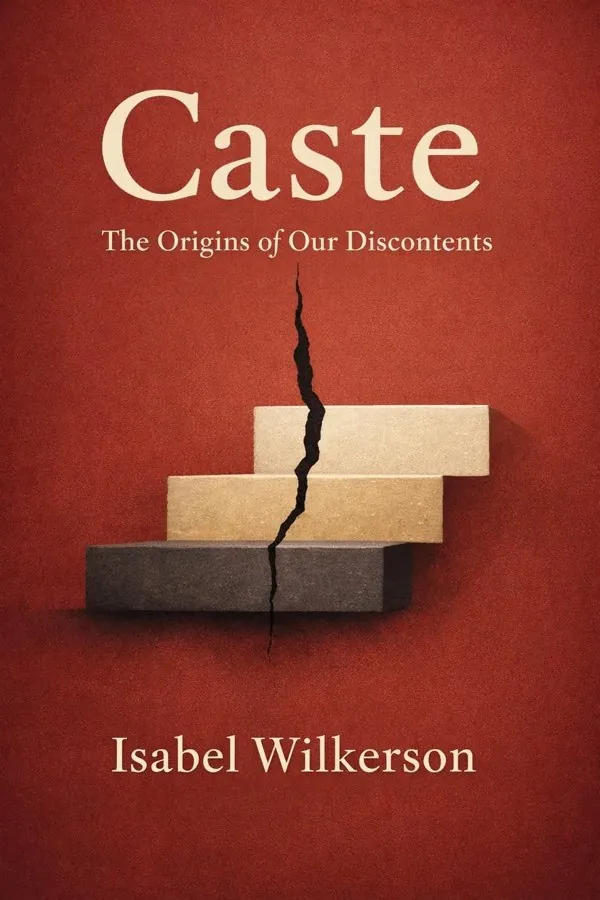
Caste: The Origins of Our Discontents: Summary & Key Insights
 10 min7 chaptersAudio available
What Is Caste: The Origins of Our Discontents About?
Caste: The Origins of Our Discontents by Isabel Wilkerson is a sociology book spanning 7 pages. In this groundbreaking work, Isabel Wilkerson examines the unspoken caste system that has shaped America and shows how our lives today are still defined by a hierarchy of human divisions. Through deeply researched narratives and historical analysis, she explores how the rigid social order of caste transcends race, class, and other identities, drawing parallels between the caste systems of the United States, India, and Nazi Germany.
This FizzRead summary covers all 7 key chapters of Caste: The Origins of Our Discontents in approximately 10 minutes, distilling the most important ideas, arguments, and takeaways from Isabel Wilkerson's work. Also available as an audio summary and Key Quotes Podcast.
Caste: The Origins of Our Discontents
In this groundbreaking work, Isabel Wilkerson examines the unspoken caste system that has shaped America and shows how our lives today are still defined by a hierarchy of human divisions. Through deeply researched narratives and historical analysis, she explores how the rigid social order of caste transcends race, class, and other identities, drawing parallels between the caste systems of the United States, India, and Nazi Germany.
Who Should Read Caste: The Origins of Our Discontents?
This book is perfect for anyone interested in sociology and looking to gain actionable insights in a short read. Whether you're a student, professional, or lifelong learner, the key ideas from Caste: The Origins of Our Discontents by Isabel Wilkerson will help you think differently.
- ✓Readers who enjoy sociology and want practical takeaways
- ✓Professionals looking to apply new ideas to their work and life
- ✓Anyone who wants the core insights of Caste: The Origins of Our Discontents in just 10 minutes
Want the full summary?
Get instant access to this book summary and 100K+ more with Fizz Moment.
Get Free SummaryAvailable on App Store • Free to download
Key Chapters
When I speak of caste, I am describing a system of human division that transcends color or wealth. Caste is an artificial hierarchy, a ranking of human worth that becomes the invisible scaffolding upon which societies are built. Unlike class, which is supposed to be dynamic and responsive to merit, caste assigns your value from birth and insists it can never be altered. It tells us who can marry whom, who can lead, who must serve, and who must remain unseen.
I turned to the work of sociologists and historians to frame what caste means across civilizations. In India, it is centuries old, codified in religion and social law. In Nazi Germany, it took the form of Aryan supremacy and Jewish persecution. In America, it emerged through slavery and continued through Jim Crow — creating a racialized caste system where those of African descent became the subordinated group, regardless of individual achievements.
The central characteristic of caste is its endurance. It does not require enforcement through constant violence; its greatest power lies in normalization. People accept it as the natural order. Its signs are subtle yet omnipresent: deference rituals, occupational boundaries, segregated spaces. Its greatest danger is that it teaches people not merely to dominate or submit, but to believe such divisions are right and inevitable. To define caste, then, is to confront the illusion that inequality is a matter of personal prejudice. It is a collective inheritance, a design so ancient and pervasive that we must name it before we can ever unbuild it.
The caste systems of the world rest upon eight enduring pillars — the ideological supports that justify hierarchy. The first is divine will and natural order, which persuades people that their place in the world is determined by a higher power or by biology itself. The second is heredity, asserting that status passes immutably from parent to child, sealing fate before life begins. The third is endogamy, the prohibition against marrying or mixing between castes, which ensures the physical and genetic boundaries of hierarchy remain intact.
The fourth pillar is purity versus pollution. Those at the top are deemed pure, those at the bottom defiled. Contact between them requires ritual cleansing, whether literal or symbolic. Then there is the occupational hierarchy: certain work — manual labor, domestic service, sanitation — is deemed inferior, while intellectual or managerial labor is exalted. The next is dehumanization and stigma, the process by which those assigned to the lower rungs are stripped of individuality and humanness.
Terror and cruelty function as yet another support — violence or the threat of it maintains obedience and fear. Finally, inherited superiority is normalized through laws, customs, and myths that teach each generation who belongs where.
I saw these pillars at work in America’s history — from laws that forbade enslaved people from learning to read to segregation that dictated where one could live, worship, or eat. The genius of caste is that it persuades everyone, even the oppressed, to believe in its legitimacy. If we can dismantle these pillars, if we can unlearn each justification for hierarchy, we may begin to imagine a social order rooted not in superiority but in shared humanity.
+ 5 more chapters — available in the FizzRead app
All Chapters in Caste: The Origins of Our Discontents
About the Author
Isabel Wilkerson is an American journalist and author, best known for her Pulitzer Prize-winning reporting and her books on race and social structure in the United States. She was the first African American woman to win a Pulitzer Prize in journalism and has received numerous awards for her contributions to literature and social understanding.
Get This Summary in Your Preferred Format
Read or listen to the Caste: The Origins of Our Discontents summary by Isabel Wilkerson anytime, anywhere. FizzRead offers multiple formats so you can learn on your terms — all free.
Available formats: App · Audio · PDF · EPUB — All included free with FizzRead
Download Caste: The Origins of Our Discontents PDF and EPUB Summary
Key Quotes from Caste: The Origins of Our Discontents
“When I speak of caste, I am describing a system of human division that transcends color or wealth.”
“The caste systems of the world rest upon eight enduring pillars — the ideological supports that justify hierarchy.”
Frequently Asked Questions about Caste: The Origins of Our Discontents
Caste: The Origins of Our Discontents by Isabel Wilkerson is a sociology book that explores key ideas across 7 chapters. In this groundbreaking work, Isabel Wilkerson examines the unspoken caste system that has shaped America and shows how our lives today are still defined by a hierarchy of human divisions. Through deeply researched narratives and historical analysis, she explores how the rigid social order of caste transcends race, class, and other identities, drawing parallels between the caste systems of the United States, India, and Nazi Germany.
More by Isabel Wilkerson

You Might Also Like
Between the World and Me
Ta-Nehisi Coates
10 min
Half the Sky
Nicholas D. Kristof, Sheryl WuDunn
10 min
Men Explain Things To Me
Rebecca Solnit
10 min
Rational Ritual
Michael Suk-Young Chwe
10 min
The New Jim Crow
Michelle Alexander
10 min
Beyond Culture
Edward T. Hall
10 minBrowse by Category
Ready to read Caste: The Origins of Our Discontents?
Get the full summary and 100K+ more books with Fizz Moment.