
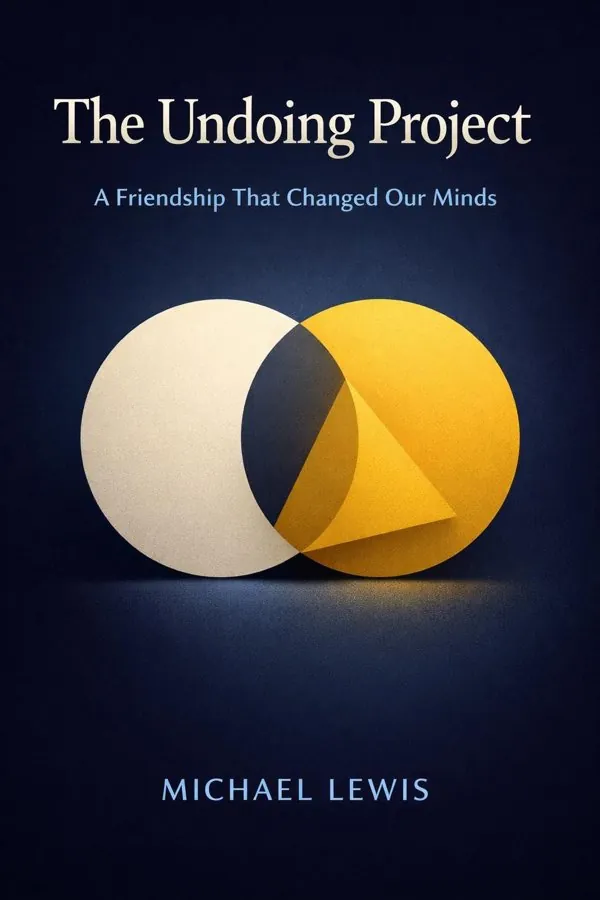
The Undoing Project: A Friendship That Changed Our Minds: Summary & Key Insights
 10 min9 chaptersAudio available
Key Takeaways from The Undoing Project: A Friendship That Changed Our Minds
Great theories often begin in private experience.
Sometimes the most important intellectual event is not a discovery but a conversation.
The mind saves effort by using shortcuts, but those shortcuts can quietly distort reality.
People do not evaluate gains and losses in the balanced way economists once assumed.
Some partnerships are productive; this one was transformative.
What Is The Undoing Project: A Friendship That Changed Our Minds About?
The Undoing Project: A Friendship That Changed Our Minds by Michael Lewis is a biographies book spanning 9 pages. What if many of your most confident judgments are not signs of wisdom, but elegant mistakes? In The Undoing Project, Michael Lewis tells the remarkable story of two Israeli psychologists, Daniel Kahneman and Amos Tversky, whose friendship produced one of the most important intellectual revolutions of the modern age. Their research showed that human beings are not the cool, rational decision-makers imagined by classical economics. Instead, we rely on mental shortcuts, emotional cues, and predictable biases that shape everything from investing and medicine to public policy and everyday life. This book is far more than a history of ideas. It is also a vivid portrait of an intense, brilliant, and ultimately fragile partnership between two very different men. Lewis, celebrated for turning complex subjects into gripping narratives, brings unusual clarity and drama to their scientific breakthroughs. He explains how their work gave rise to behavioral economics and changed the way experts understand risk, choice, confidence, and error. The result is a biography of a friendship, a study of the mind, and a practical guide to seeing how easily we fool ourselves.
This FizzRead summary covers all 9 key chapters of The Undoing Project: A Friendship That Changed Our Minds in approximately 10 minutes, distilling the most important ideas, arguments, and takeaways from Michael Lewis's work. Also available as an audio summary and Key Quotes Podcast.
The Undoing Project: A Friendship That Changed Our Minds
What if many of your most confident judgments are not signs of wisdom, but elegant mistakes? In The Undoing Project, Michael Lewis tells the remarkable story of two Israeli psychologists, Daniel Kahneman and Amos Tversky, whose friendship produced one of the most important intellectual revolutions of the modern age. Their research showed that human beings are not the cool, rational decision-makers imagined by classical economics. Instead, we rely on mental shortcuts, emotional cues, and predictable biases that shape everything from investing and medicine to public policy and everyday life.
This book is far more than a history of ideas. It is also a vivid portrait of an intense, brilliant, and ultimately fragile partnership between two very different men. Lewis, celebrated for turning complex subjects into gripping narratives, brings unusual clarity and drama to their scientific breakthroughs. He explains how their work gave rise to behavioral economics and changed the way experts understand risk, choice, confidence, and error. The result is a biography of a friendship, a study of the mind, and a practical guide to seeing how easily we fool ourselves.
Who Should Read The Undoing Project: A Friendship That Changed Our Minds?
This book is perfect for anyone interested in biographies and looking to gain actionable insights in a short read. Whether you're a student, professional, or lifelong learner, the key ideas from The Undoing Project: A Friendship That Changed Our Minds by Michael Lewis will help you think differently.
- ✓Readers who enjoy biographies and want practical takeaways
- ✓Professionals looking to apply new ideas to their work and life
- ✓Anyone who wants the core insights of The Undoing Project: A Friendship That Changed Our Minds in just 10 minutes
Want the full summary?
Get instant access to this book summary and 100K+ more with Fizz Moment.
Get Free SummaryAvailable on App Store • Free to download
Key Chapters
Great theories often begin in private experience. Before Daniel Kahneman and Amos Tversky transformed psychology, each had already been shaped by conditions that taught him something deep about uncertainty, danger, and human behavior. Kahneman’s childhood was marked by fear and instability. Born in Tel Aviv and raised largely in France, he lived through the Nazi occupation and survived through luck, vigilance, and his mother’s extraordinary judgment. These early experiences left him acutely aware of how fragile life is and how limited human control can be. He became deeply interested in doubt, error, and the ways perception can mislead us.
Tversky’s temperament was almost the opposite. He grew up in Israel and developed a reputation for courage, confidence, and sharpness. He served as a paratrooper, excelled socially, and projected intellectual fearlessness. Where Kahneman tended toward self-questioning, Tversky radiated certainty. That contrast was not incidental; it became central to their later collaboration. One was drawn to ambiguity and weakness in judgment, the other to elegant argument and decisive analysis.
Lewis shows that their differences were not obstacles but assets. Kahneman noticed the mind’s vulnerabilities because he distrusted his own intuitions. Tversky could turn those observations into crisp theories because he had unusual analytical confidence. In workplaces today, this pattern matters. Teams often overvalue similarity, but breakthroughs frequently emerge when people with contrasting habits of mind work together respectfully.
A practical example is hiring or project design. A team composed only of bold decision-makers may overlook risks. A team composed only of cautious analysts may stall. The best outcomes often come from pairing imaginative confidence with disciplined skepticism.
Actionable takeaway: When solving important problems, deliberately include people whose thinking styles differ from your own, especially those who notice risks you tend to miss.
Sometimes the most important intellectual event is not a discovery but a conversation. When Kahneman and Tversky met at Hebrew University in the 1960s, they recognized in each other a rare kind of mind. Kahneman had already been exploring perception and attention, while Tversky was gaining admiration for his brilliance in mathematical psychology. Their early exchanges quickly became more than professional discussion; they were exhilarating acts of shared thinking.
What made their meeting so powerful was not simple compatibility. In many ways, they were opposites. Kahneman was introspective, self-critical, and drawn to anomalies. Tversky was witty, fast, and uncommonly persuasive. Yet each found in the other something he lacked. Kahneman found someone who could sharpen cloudy intuitions into testable propositions. Tversky found someone who noticed psychological truths that standard theories ignored.
Lewis captures the electric quality of their partnership: they did not merely divide tasks, they generated ideas together that neither would likely have produced alone. Their conversations had a rhythm of challenge, play, and mutual refinement. This is a lesson in how innovation actually happens. We often romanticize the lone genius, but many major breakthroughs emerge from intense, sustained dialogue between complementary minds.
In practical settings, this insight applies to research, business, and creative work. Strong collaboration is not just about friendliness or efficiency. It depends on intellectual trust: the confidence that disagreement is useful, that half-formed ideas are safe to share, and that the shared goal matters more than individual credit.
A manager can use this by creating spaces where people brainstorm without premature judgment, then test ideas rigorously. A student can use it by finding a study partner who thinks differently but seriously.
Actionable takeaway: Seek collaborators who challenge your assumptions without threatening your dignity; the right intellectual partner can dramatically expand the quality of your thinking.
The mind saves effort by using shortcuts, but those shortcuts can quietly distort reality. One of Kahneman and Tversky’s most influential contributions was their research on heuristics: mental rules of thumb people use to make judgments quickly under uncertainty. These shortcuts are useful, even necessary, because life rarely gives us time for perfect analysis. But they also produce systematic errors.
Their work showed that people do not merely make random mistakes. They make predictable ones. For example, the representativeness heuristic leads us to judge likelihood based on resemblance rather than actual probability. If someone seems like a stereotypical librarian, we may assume they are more likely to be a librarian than a farmer, even when there are far more farmers. Another shortcut, availability, causes us to estimate frequency by how easily examples come to mind. After seeing dramatic news reports about plane crashes, people may overestimate air travel risk while underestimating more common dangers like driving.
This was a profound challenge to conventional models of rational decision-making. It suggested that error is built into normal cognition. Smart, educated people are not immune. In fact, intelligence can sometimes help us justify our bad intuitions more elegantly.
These insights matter everywhere. In medicine, doctors may overweight a memorable recent case. In hiring, managers may mistake confidence for competence. In personal finance, investors may react to vivid headlines rather than base rates and long-term evidence.
The practical response is not to reject intuition entirely but to know when intuition is unreliable. High-stakes decisions involving probability, forecasting, and comparisons are especially vulnerable to heuristic error. In such cases, check data, seek base rates, and slow down.
Actionable takeaway: When a judgment feels obvious, pause and ask, “Am I using evidence, or just a convincing mental shortcut?”
People do not evaluate gains and losses in the balanced way economists once assumed. Kahneman and Tversky’s prospect theory revealed that our decisions are shaped less by absolute outcomes than by how those outcomes are framed relative to a reference point. In plain terms, losing $100 usually feels worse than gaining $100 feels good. This asymmetry, known as loss aversion, helps explain why people often behave in ways that appear irrational.
Classical economic theory assumed that individuals calculate expected value consistently. But prospect theory showed that human beings are sensitive to wording, context, and emotional framing. We become risk-averse when choosing between gains and risk-seeking when trying to avoid losses. Offered a sure gain of $500 or a 50 percent chance to win $1,000, many people choose the sure gain. But offered a sure loss of $500 or a 50 percent chance to lose $1,000, many people gamble.
This insight has enormous real-world applications. Investors hold losing stocks too long because selling turns a paper loss into a real one. Consumers react strongly to price increases framed as losses but respond more positively to discounts framed as gains. Policymakers can improve public health messaging by understanding that framing affects behavior as much as facts do.
Even personal habits reflect prospect theory. A person may avoid changing careers because the possible loss of status feels more painful than the potential gain feels attractive. A company may cling to a failing product because admitting failure hurts more than continuing the gamble.
The power of prospect theory is that it explains not just that people deviate from rational models, but how they do so in patterned, measurable ways. It replaced a simplistic view of choice with a psychologically realistic one.
Actionable takeaway: Reframe important decisions in multiple ways, especially as both potential gains and potential losses, before concluding what the “best” choice is.
A powerful idea proves itself by traveling well. Kahneman and Tversky began as psychologists studying judgment, but their work quickly escaped the boundaries of academic psychology and reshaped fields that had long assumed people were rational calculators. Their research helped give rise to behavioral economics, influencing how economists think about markets, incentives, and consumer choice. It also changed medicine, law, public policy, military planning, and business strategy.
In medicine, their findings exposed the dangers of overconfidence and diagnostic bias. Doctors, like everyone else, are vulnerable to availability, anchoring, and framing effects. In economics, their work undermined the assumption that preference and choice always reveal coherent reasoning. In policy design, insights about framing and defaults led to practical interventions, such as automatically enrolling employees in retirement plans to increase savings rates.
Their influence also reached forecasting and organizational decision-making. Experts often believe that experience guarantees accuracy, but Kahneman and Tversky showed that confidence and correctness are not the same thing. This has implications for financial analysts, political strategists, and executives making high-stakes calls under uncertainty.
A practical example is customer pricing. Businesses now test whether consumers respond differently to “save $20” versus “avoid paying $20 more,” because the framing changes perceived value. Another is checklist-based decision support in hospitals and aviation, designed partly to reduce cognitive error by not relying solely on memory or intuition.
Lewis makes clear that their research did not merely add nuance to old theories; it altered the foundations of how experts think about judgment. The idea that humans are predictably irrational is now embedded in modern institutions.
Actionable takeaway: In any profession involving judgment, assume that expertise alone does not eliminate bias, and use structured tools, data, and feedback to improve decisions.
Even the most brilliant partnerships are still human. As Kahneman and Tversky gained fame, influence, and professional opportunities, the conditions that had sustained their closeness began to erode. Careers pulled them in different directions. Recognition was not distributed evenly. Their personal temperaments, once complementary, became sources of tension. What had felt like effortless intellectual fusion became harder to maintain.
Lewis handles this part of the story with sensitivity. The strain between them was not caused by a single betrayal or dramatic break. It emerged gradually from ambition, distance, changing institutions, and the emotional complexity of shared success. Tversky’s charisma and public confidence made him a natural star in many settings, while Kahneman remained more self-doubting and emotionally exposed. As outside audiences celebrated them, the imbalance in how each experienced the partnership grew more painful.
This aspect of the book matters because it corrects a common myth: that genius collaborations fail only because of ego or rivalry. Often they fail because relationships that produce great work require maintenance, honesty, and adaptation. What once worked in a tight, playful environment may not survive changing roles, geography, or recognition.
The lesson applies in startups, research labs, and long-term creative teams. Early alignment does not guarantee future health. Founders who once made every decision together may become resentful if one gets more visibility. Coauthors may drift when goals diverge. Silence can turn manageable tension into permanent distance.
A useful practice is to revisit expectations around credit, decision-making, and communication before resentment hardens. Not every collaboration can be preserved, but many can be improved through candor.
Actionable takeaway: If you are part of a high-stakes partnership, discuss recognition, roles, and changing needs early and often, before success creates invisible fractures.
The death of a great thinker can force a painful question: what remains when the mind is gone? Amos Tversky’s illness and death gave their story a tragic dimension, but it also sharpened the significance of what he and Kahneman had created together. Tversky died in 1996, before the full institutional recognition of their shared revolution had reached its peak. Because Nobel Prizes are not awarded posthumously, he would never receive one, even though his contribution was inseparable from Kahneman’s later Nobel-winning work.
Lewis does not treat Tversky’s death only as a biographical event. He shows how loss reframed the collaboration for Kahneman, who had to live on not just as an individual scholar but as the surviving half of a historic intellectual pair. The emotional complexity is profound: grief, gratitude, unfinished conversation, and the challenge of carrying forward ideas born in dialogue.
This part of the story reminds readers that knowledge is made by mortal people in specific relationships. Scientific papers can look clean and impersonal, but behind them are friendships, insecurities, illnesses, and time limits. The work lasts; the workers do not.
In practical life, this insight encourages urgency and appreciation. Many people postpone meaningful collaboration, difficult conversations, or generous acknowledgment because they assume time is abundant. It is not. Whether in research, business, or family life, waiting to express admiration or settle misunderstandings can lead to regret.
Tversky’s death also highlights how recognition systems often simplify collective achievement into individual triumph. Lewis resists that simplification by insisting on the joint nature of their legacy.
Actionable takeaway: Do not wait to recognize the people who sharpen your thinking; give credit, express appreciation, and preserve important collaborations while you still can.
A true intellectual breakthrough changes not just answers, but the questions people ask. The legacy of Kahneman and Tversky is visible in the rise of behavioral economics, the redesign of policy tools, and the broader cultural acceptance that human beings are not consistently rational. Their work made it respectable, even necessary, to study error scientifically rather than dismiss it as noise.
When Kahneman received the Nobel Prize in Economic Sciences in 2002, it symbolized more than personal achievement. It marked the formal admission of psychology into a field that had long treated human behavior as if it were governed by stable, logical preferences. Yet Lewis makes clear that the prize belonged morally to both men. Their joint research changed economics by making it more human.
The legacy continues in subtle but important ways. Governments use behavioral insights to design better forms, reminders, and default options. Companies run experiments on choice architecture. Investors and managers learn to question overconfidence. Ordinary readers become more alert to cognitive bias in news, politics, and personal relationships.
At a deeper level, their work offers humility. It suggests that being wrong is not a moral failure but a structural feature of human thinking. The goal is not to become perfectly rational. It is to build habits, institutions, and relationships that compensate for our blind spots.
This perspective is increasingly important in a world flooded with information and quick judgments. The faster decisions must be made, the more tempting it is to trust instinct alone. Kahneman and Tversky remind us that insight often begins by distrusting what feels obvious.
Actionable takeaway: Treat rationality as a practice of correction, not a personal trait; use systems, feedback, and reflection to reduce error rather than assuming you naturally see clearly.
All Chapters in The Undoing Project: A Friendship That Changed Our Minds
About the Author
Michael Lewis is an American author, journalist, and master of narrative nonfiction, widely known for explaining complex systems through memorable stories and characters. After beginning his career in finance and publishing Liar’s Poker, he became one of the most respected writers on business, economics, sports, and public policy. His bestselling books include Moneyball, The Big Short, Flash Boys, and The Fifth Risk. Lewis is especially admired for taking technical or abstract subjects and making them vivid, accessible, and deeply human. In The Undoing Project, he brings that talent to psychology, using the friendship between Daniel Kahneman and Amos Tversky to illuminate ideas that reshaped how the modern world understands judgment, uncertainty, and decision-making.
Get This Summary in Your Preferred Format
Read or listen to the The Undoing Project: A Friendship That Changed Our Minds summary by Michael Lewis anytime, anywhere. FizzRead offers multiple formats so you can learn on your terms — all free.
Available formats: App · Audio · PDF · EPUB — All included free with FizzRead
Download The Undoing Project: A Friendship That Changed Our Minds PDF and EPUB Summary
Key Quotes from The Undoing Project: A Friendship That Changed Our Minds
“Great theories often begin in private experience.”
“Sometimes the most important intellectual event is not a discovery but a conversation.”
“The mind saves effort by using shortcuts, but those shortcuts can quietly distort reality.”
“People do not evaluate gains and losses in the balanced way economists once assumed.”
“Some partnerships are productive; this one was transformative.”
Frequently Asked Questions about The Undoing Project: A Friendship That Changed Our Minds
The Undoing Project: A Friendship That Changed Our Minds by Michael Lewis is a biographies book that explores key ideas across 9 chapters. What if many of your most confident judgments are not signs of wisdom, but elegant mistakes? In The Undoing Project, Michael Lewis tells the remarkable story of two Israeli psychologists, Daniel Kahneman and Amos Tversky, whose friendship produced one of the most important intellectual revolutions of the modern age. Their research showed that human beings are not the cool, rational decision-makers imagined by classical economics. Instead, we rely on mental shortcuts, emotional cues, and predictable biases that shape everything from investing and medicine to public policy and everyday life. This book is far more than a history of ideas. It is also a vivid portrait of an intense, brilliant, and ultimately fragile partnership between two very different men. Lewis, celebrated for turning complex subjects into gripping narratives, brings unusual clarity and drama to their scientific breakthroughs. He explains how their work gave rise to behavioral economics and changed the way experts understand risk, choice, confidence, and error. The result is a biography of a friendship, a study of the mind, and a practical guide to seeing how easily we fool ourselves.
More by Michael Lewis


You Might Also Like
An American Marriage
Tayari Jones
10 min
Benjamin Franklin: An American Life
Walter Isaacson
10 min
I Know Why The Caged Bird Sings
Maya Angelou
10 min
Long Walk to Freedom
Nelson Mandela
10 min
Persepolis
Marjane Satrapi
10 min
Surely You're Joking, Mr. Feynman!
Richard P. Feynman
10 minBrowse by Category
Ready to read The Undoing Project: A Friendship That Changed Our Minds?
Get the full summary and 100K+ more books with Fizz Moment.