
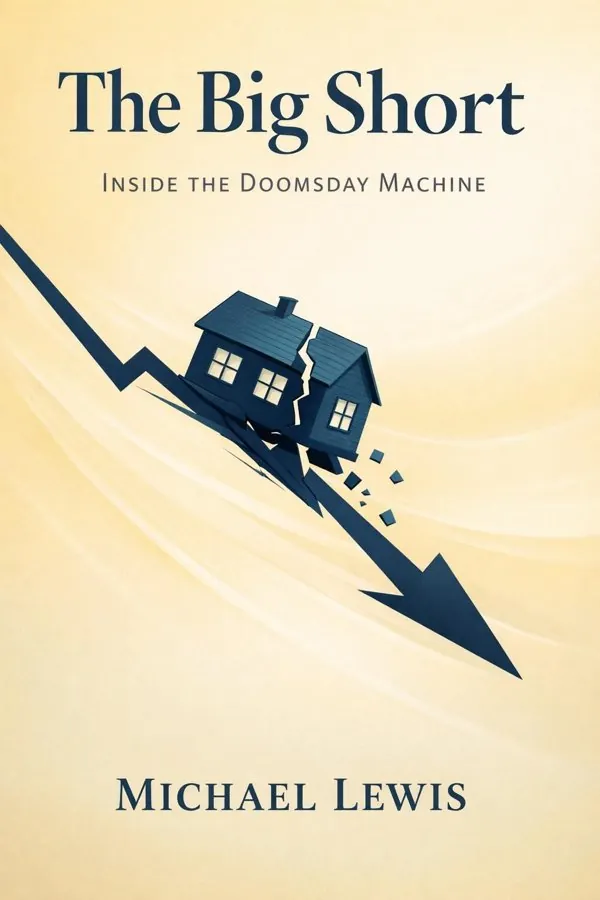
The Big Short: Summary & Key Insights
 10 min9 chaptersAudio available
Key Takeaways from The Big Short
The most dangerous bubbles are the ones that feel normal while you are living inside them.
Financial revolutions often begin with something useful and end with something unrecognizable.
Real insight often looks like eccentricity before it looks like brilliance.
Sometimes the hardest trade is not identifying the problem but acting on it when the problem is socially unthinkable.
When a system becomes too complicated for most participants to understand, confidence often rises at the exact moment caution should increase.
What Is The Big Short About?
The Big Short by Michael Lewis is a finance book. What if one of the greatest financial disasters in modern history was visible in plain sight long before it happened? In The Big Short, Michael Lewis reconstructs the years leading up to the 2007–2008 financial crisis by following a handful of investors who recognized that the American housing market was built on fantasy, bad incentives, and staggering denial. While banks, rating agencies, regulators, and investors treated mortgage-backed securities as safe and sophisticated, these outsiders saw something else: loans designed to fail, risks hidden inside layers of financial engineering, and a system so profitable that almost no one wanted to question it. Lewis turns a notoriously technical subject into a gripping human story. He explains collateralized debt obligations, credit default swaps, and subprime lending through vivid characters such as Michael Burry, Steve Eisman, Greg Lippmann, and the team at Cornwall Capital. His authority comes not just from financial fluency, but from his rare gift for exposing how institutions behave under pressure, greed, and self-deception. The result is more than a book about markets. It is a study of blind faith, moral hazard, and the dangerous costs of complexity when no one is accountable.
This FizzRead summary covers all 9 key chapters of The Big Short in approximately 10 minutes, distilling the most important ideas, arguments, and takeaways from Michael Lewis's work. Also available as an audio summary and Key Quotes Podcast.
The Big Short
What if one of the greatest financial disasters in modern history was visible in plain sight long before it happened? In The Big Short, Michael Lewis reconstructs the years leading up to the 2007–2008 financial crisis by following a handful of investors who recognized that the American housing market was built on fantasy, bad incentives, and staggering denial. While banks, rating agencies, regulators, and investors treated mortgage-backed securities as safe and sophisticated, these outsiders saw something else: loans designed to fail, risks hidden inside layers of financial engineering, and a system so profitable that almost no one wanted to question it.
Lewis turns a notoriously technical subject into a gripping human story. He explains collateralized debt obligations, credit default swaps, and subprime lending through vivid characters such as Michael Burry, Steve Eisman, Greg Lippmann, and the team at Cornwall Capital. His authority comes not just from financial fluency, but from his rare gift for exposing how institutions behave under pressure, greed, and self-deception. The result is more than a book about markets. It is a study of blind faith, moral hazard, and the dangerous costs of complexity when no one is accountable.
Who Should Read The Big Short?
This book is perfect for anyone interested in finance and looking to gain actionable insights in a short read. Whether you're a student, professional, or lifelong learner, the key ideas from The Big Short by Michael Lewis will help you think differently.
- ✓Readers who enjoy finance and want practical takeaways
- ✓Professionals looking to apply new ideas to their work and life
- ✓Anyone who wants the core insights of The Big Short in just 10 minutes
Want the full summary?
Get instant access to this book summary and 100K+ more with Fizz Moment.
Get Free SummaryAvailable on App Store • Free to download
Key Chapters
The most dangerous bubbles are the ones that feel normal while you are living inside them. That is the animating idea behind The Big Short. Michael Lewis is not simply telling the story of a market crash; he is showing how entire systems can become disconnected from reality when incentives reward optimism, salesmanship, and willful blindness. The book matters because the 2008 crisis was not caused by a single villain or one bad decision. It emerged from a chain of people doing what looked rational in the short term while collectively creating catastrophe.
Lewis introduces readers to outsiders who looked at the same market everyone else saw and came to radically different conclusions. Instead of accepting home prices, credit ratings, and Wall Street jargon at face value, they examined the underlying loans. They asked basic questions: Who is borrowing? Can they repay? Why are risky bonds being labeled safe? Those simple questions revealed a fraudulent logic beneath the housing boom.
For readers, the lesson extends far beyond finance. Any industry can drift into unreality when complexity hides accountability. In business, this might look like a company celebrating growth while ignoring unit economics. In personal life, it might mean trusting expert language instead of understanding the actual risk in a mortgage, investment, or insurance product. Lewis shows that independent thinking is not merely a competitive edge; sometimes it is the only defense against mass delusion.
A practical way to apply this idea is to pause whenever something is described as both highly profitable and low risk. Ask what assumptions make that claim possible, and who benefits if you do not look too closely. Actionable takeaway: when everyone agrees that a system is safe, inspect the incentives before you trust the conclusion.
Financial revolutions often begin with something useful and end with something unrecognizable. Lewis traces how the humble home mortgage, once a relatively straightforward agreement between borrower and lender, became raw material for a massive profit engine on Wall Street. Banks no longer needed to keep loans on their books. Instead, they could package thousands of mortgages into bonds, sell them to investors, and collect fees at every step. That shift changed the culture of lending.
Once originators no longer bore the full consequences of bad loans, standards weakened. Adjustable rates, no-documentation loans, teaser payments, and other toxic features spread because volume mattered more than quality. The financial machine rewarded everyone for keeping the pipeline full: mortgage brokers earned commissions, investment banks earned structuring fees, ratings agencies earned money from issuers, and investors believed they were buying safe, diversified products. Complexity created distance between the original borrower and the final risk holder.
Lewis explains that mortgage-backed securities and collateralized debt obligations were not evil by definition. In theory, securitization can distribute risk efficiently. But in practice, the system became a mechanism for converting low-quality loans into seemingly high-quality assets. A bad mortgage was no longer an obvious bad bet once it was sliced, pooled, rated, and sold.
This dynamic appears anywhere incentives detach decision-makers from outcomes. A manager may chase short-term targets knowing the long-term damage will be someone else’s problem. A startup may prioritize top-line growth while pushing service failures onto customers later. The structure itself creates recklessness.
Actionable takeaway: whenever risk is packaged and sold by people who do not keep it, assume incentives may be distorted and investigate who ultimately bears the downside.
Real insight often looks like eccentricity before it looks like brilliance. Michael Burry, one of the book’s central figures, was a former doctor turned hedge fund manager who preferred data to social consensus. While most of Wall Street relied on models, ratings, and broad assumptions about housing prices, Burry did something almost embarrassingly simple: he read the individual mortgage bonds. He examined the actual loans inside them and noticed that many would reset to unaffordable payments in the near future.
Burry recognized that the housing market did not need to collapse overnight for these bonds to fail. It simply needed enough borrowers to default once teaser rates expired. This was a crucial insight because the prevailing belief was that geographically diversified housing exposure made mortgage bonds safe. Burry saw instead that the loans shared the same hidden vulnerability. Diversity in location did not matter if underwriting standards had collapsed everywhere.
To profit from this view, he asked banks to create credit default swaps that would pay off if the mortgage bonds went bad. In effect, he bought insurance on securities the market considered nearly bulletproof. This was an extraordinary act of conviction because he had to endure months of losses, client anger, and market disbelief before being proven right.
The practical lesson is not that everyone should imitate Burry’s trades. It is that deep work creates asymmetric understanding. In any field, the person willing to read the footnotes, inspect the inputs, and challenge accepted assumptions can uncover truths hidden from more polished experts. This applies to investing, hiring, product strategy, and policy analysis.
Actionable takeaway: if you want an edge, go one layer deeper than consensus and examine the underlying data rather than the story built around it.
Sometimes the hardest trade is not identifying the problem but acting on it when the problem is socially unthinkable. In The Big Short, betting against housing was emotionally and culturally difficult because homeownership had become tied to ideas of prosperity, stability, and national identity. To many people, shorting mortgage bonds felt almost immoral, as if it meant rooting against ordinary families. Lewis shows, however, that the real moral failure lay in the system that sold unsustainable loans to those families in the first place.
The investors who went short were not creating the crisis; they were recognizing that it already existed. Steve Eisman, for example, saw subprime lending up close and concluded that many of the loans were predatory and absurd. Mortgage brokers were extending credit to borrowers with little income verification, limited financial literacy, and no realistic ability to absorb future payment increases. Wall Street then transformed those loans into prestigious-looking securities.
This idea matters because markets often punish truth-tellers before rewarding them. The shorts had to withstand ridicule, delays, and the surreal experience of being right while prices still moved against them. In life and work, similar situations arise when you see that a strategy, relationship, or organization is built on false assumptions, but everyone around you keeps celebrating short-term success. Acting early can feel lonely and costly.
A practical application is learning to separate social narratives from underlying economics. A booming market, a popular company, or a fashionable trend may attract admiration, but admiration is not evidence of sustainability. Ask what happens if conditions worsen, if growth slows, or if incentives reverse. Often the stress test reveals more than the headline.
Actionable takeaway: do not confuse emotional appeal or social approval with financial soundness; test the structure beneath the story.
When a system becomes too complicated for most participants to understand, confidence often rises at the exact moment caution should increase. One of Lewis’s sharpest insights is that complexity in modern finance did not merely reflect sophistication. In many cases, it functioned as camouflage. Mortgage pools became bonds, bonds were repackaged into CDOs, and risks were insured through credit default swaps. Each layer made the product sound more scientific while making accountability harder to trace.
This mattered because very few people had both the ability and the incentive to examine the full chain. Investors outsourced judgment to ratings agencies. Ratings agencies relied on flawed models and assumptions. Banks focused on fee generation. Regulators lagged behind innovation. As a result, enormous sums of money flowed into structures that many buyers barely understood. Complexity made it easier to hide poor loan quality, overstate safety, and diffuse blame.
Lewis’s broader point is strikingly relevant outside finance. Organizations often use jargon, dashboards, legal language, or technical processes to create the appearance of control. Yet complexity can conceal simple truths: the product does not work, the customers are unhappy, the debt is unsustainable, or the incentives are rotten. The more opaque the system, the easier it becomes for mediocrity or misconduct to survive.
In practical terms, when evaluating a business, fund, policy, or contract, clarity is not a luxury; it is a form of risk management. If someone cannot explain how money is made, what could cause losses, and who benefits under stress, that is meaningful information. The inability to make something comprehensible may indicate that its defenders do not fully understand it either.
Actionable takeaway: treat unnecessary complexity as a warning sign and insist on explanations simple enough to reveal where the risk actually lives.
People do not need to be evil to produce disastrous outcomes; they only need incentives that reward the wrong behavior. This is one of the deepest lessons in The Big Short. Nearly every major player in the housing bubble was responding to a structure that encouraged short-term gain and discouraged honesty. Mortgage brokers earned fees by originating loans, not by ensuring repayment. Banks earned money by packaging and selling securities, not by living with defaults. Ratings agencies were paid by the very institutions whose products they rated. Even professional investors preferred high-yielding assets that looked safe on paper because admitting uncertainty threatened returns and careers.
The result was a system with almost no internal brake. Anyone who slowed down to ask hard questions risked losing business to someone less scrupulous. In that environment, prudence looked naive. Skepticism looked unprofitable. Lewis shows that the crisis was not simply a failure of intelligence. It was a failure of incentives so severe that smart people participated in obvious nonsense because the machine paid them to.
This pattern repeats in everyday settings. A sales team may overpromise because compensation depends on signed contracts, not customer success. A corporate division may cut maintenance to boost quarterly earnings even if future breakdowns are inevitable. A public institution may optimize for visible metrics while neglecting its real mission. Incentive design silently shapes behavior.
The practical implication is that trust should never rest solely on titles, expertise, or brand reputation. You must ask what someone is rewarded for doing and what costs they can externalize. Often that reveals more than any polished presentation.
Actionable takeaway: before relying on advice, a product, or an institution, identify the incentive structure and ask whether the decision-maker wins even if you lose.
Insiders often know the rules, but outsiders are sometimes better at seeing when the game itself is broken. A recurring theme in The Big Short is that many of the people who correctly anticipated the crash were not fully socialized into Wall Street’s worldview. Michael Burry came from medicine. The Cornwall Capital team operated from the margins with little institutional prestige. Their distance from the financial establishment gave them an unusual freedom: they were less invested in its assumptions, language, and status hierarchies.
This outsider advantage matters because institutions create shared blind spots. Employees learn what not to question. They absorb implicit beliefs about what is impossible, what is safe, and what “everyone knows.” Over time, conformity masquerades as expertise. Outsiders, by contrast, may ask basic questions insiders have stopped asking. Why are defaults rising if everything is healthy? Why are supposedly sophisticated securities built on such weak loans? Why is everyone accepting ratings that contradict common sense?
That does not mean outsiders are automatically right. Distance can also produce ignorance. But Lewis demonstrates that when fresh eyes are combined with disciplined analysis, outsiders can spot opportunities and dangers hidden by institutional groupthink. This is true in investing, entrepreneurship, journalism, and scientific research. Many breakthroughs come from people who are competent enough to understand the system but independent enough not to worship it.
Practically, organizations can benefit by inviting dissent from people outside the dominant circle. Leaders can ask newcomers what seems odd, encourage devil’s-advocate reviews, and reward questions that challenge assumptions rather than merely validate them. Individuals can seek perspectives beyond their professional echo chambers.
Actionable takeaway: cultivate informed independence by listening to smart outsiders and by questioning any consensus that depends more on status than on evidence.
A failing system can survive far longer than logic suggests when powerful people are committed to not seeing the truth. One of the most frustrating and revealing aspects of The Big Short is that even after evidence of mortgage defaults mounted, markets and institutions were slow to respond. Banks resisted marking down assets. Ratings agencies were reluctant to admit earlier errors. Investors clung to models that no longer matched reality. In some cases, the shorts who had correctly bet against mortgage bonds had trouble getting paid because the system itself was resisting recognition of its own failure.
Lewis captures a painful truth about human behavior: facts alone do not immediately change minds when careers, reputations, and balance sheets depend on denial. This applies everywhere. A company can miss obvious signs of strategic decline because leaders are psychologically attached to old success. A household can ignore debt problems because acknowledging them would require lifestyle changes. A government can postpone reform because the short-term political cost is too high.
The practical lesson is that timing matters. Being right too early can feel indistinguishable from being wrong. That does not invalidate the analysis, but it does mean that anyone acting on a contrarian view must prepare for delay, friction, and emotional strain. Conviction without resilience is rarely enough.
To apply this insight, pair your analysis with a plan for how long a distorted situation can persist. Build in liquidity, patience, and fallback options. In decision-making, notice when new facts are being explained away rather than confronted. Repeated rationalization is often a stronger signal than the bad news itself.
Actionable takeaway: when evidence and official narratives diverge, assume denial may extend the problem and prepare both financially and emotionally for a delayed reckoning.
Financial crises are never just about finance; they expose the values and vulnerabilities of the society that created them. In The Big Short, the collapse of the housing market reveals a broader American story about debt, aspiration, inequality, and institutional trust. Homeownership was sold as a universal path to security, yet millions of people were steered into loans that enriched intermediaries while increasing their own fragility. The crisis showed how easily a democratic ideal can be commercialized into a predatory product.
Lewis also highlights a disturbing social asymmetry. The people making the most money from the bubble were often insulated from its consequences, while ordinary borrowers, workers, and taxpayers paid the heaviest price when the system broke. This pattern deepened public cynicism. If banks could privatize gains and socialize losses, what did accountability really mean? The book helps explain why the crisis was not merely an economic event but a political and moral rupture.
For readers today, this idea remains relevant because many systems still depend on public trust without consistently earning it. Whether the issue is banking, technology, healthcare, or education, institutions often claim to serve the public while designing products and policies around revenue extraction. Lewis’s narrative urges readers to look beyond slogans and ask who benefits, who carries the risk, and who is protected when things go wrong.
A practical application is to become more structurally literate as a citizen and consumer. Learn how a financial product works before signing. Understand who funds the advice you receive. Support transparency in institutions that affect your life. Democratic trust depends on informed scrutiny.
Actionable takeaway: use every major institutional promise as an invitation to ask a simple civic question: who gains, who pays, and who escapes responsibility if the promise fails?
All Chapters in The Big Short
About the Author
Michael Lewis is an American author, journalist, and former bond salesman celebrated for his narrative nonfiction about finance, sports, politics, and decision-making. Born in New Orleans in 1960, he studied art history at Princeton University and later earned a master’s degree in economics from the London School of Economics. His early experience at Salomon Brothers shaped his breakout book, Liar’s Poker, which exposed the culture of Wall Street in the 1980s. Lewis went on to write acclaimed bestsellers including Moneyball, The Blind Side, Flash Boys, and The Premonition. His work is known for making complicated systems accessible through sharp reporting, memorable characters, and a deep interest in how institutions reward talent, distort incentives, and sometimes fail spectacularly.
Get This Summary in Your Preferred Format
Read or listen to the The Big Short summary by Michael Lewis anytime, anywhere. FizzRead offers multiple formats so you can learn on your terms — all free.
Available formats: App · Audio · PDF · EPUB — All included free with FizzRead
Download The Big Short PDF and EPUB Summary
Key Quotes from The Big Short
“The most dangerous bubbles are the ones that feel normal while you are living inside them.”
“Financial revolutions often begin with something useful and end with something unrecognizable.”
“Real insight often looks like eccentricity before it looks like brilliance.”
“Sometimes the hardest trade is not identifying the problem but acting on it when the problem is socially unthinkable.”
“When a system becomes too complicated for most participants to understand, confidence often rises at the exact moment caution should increase.”
Frequently Asked Questions about The Big Short
The Big Short by Michael Lewis is a finance book that explores key ideas across 9 chapters. What if one of the greatest financial disasters in modern history was visible in plain sight long before it happened? In The Big Short, Michael Lewis reconstructs the years leading up to the 2007–2008 financial crisis by following a handful of investors who recognized that the American housing market was built on fantasy, bad incentives, and staggering denial. While banks, rating agencies, regulators, and investors treated mortgage-backed securities as safe and sophisticated, these outsiders saw something else: loans designed to fail, risks hidden inside layers of financial engineering, and a system so profitable that almost no one wanted to question it. Lewis turns a notoriously technical subject into a gripping human story. He explains collateralized debt obligations, credit default swaps, and subprime lending through vivid characters such as Michael Burry, Steve Eisman, Greg Lippmann, and the team at Cornwall Capital. His authority comes not just from financial fluency, but from his rare gift for exposing how institutions behave under pressure, greed, and self-deception. The result is more than a book about markets. It is a study of blind faith, moral hazard, and the dangerous costs of complexity when no one is accountable.
More by Michael Lewis

You Might Also Like


Browse by Category
Ready to read The Big Short?
Get the full summary and 100K+ more books with Fizz Moment.