

Flash Boys: Summary & Key Insights
 10 min9 chaptersAudio available
Key Takeaways from Flash Boys
A market can look more efficient on the surface precisely when it has become harder to understand underneath.
In modern markets, a tiny time advantage can be worth millions.
Bad systems persist when too many participants profit from pretending nothing is wrong.
If a system is designed, it can be redesigned.
People often claim to support transparency until transparency threatens their advantage.
What Is Flash Boys About?
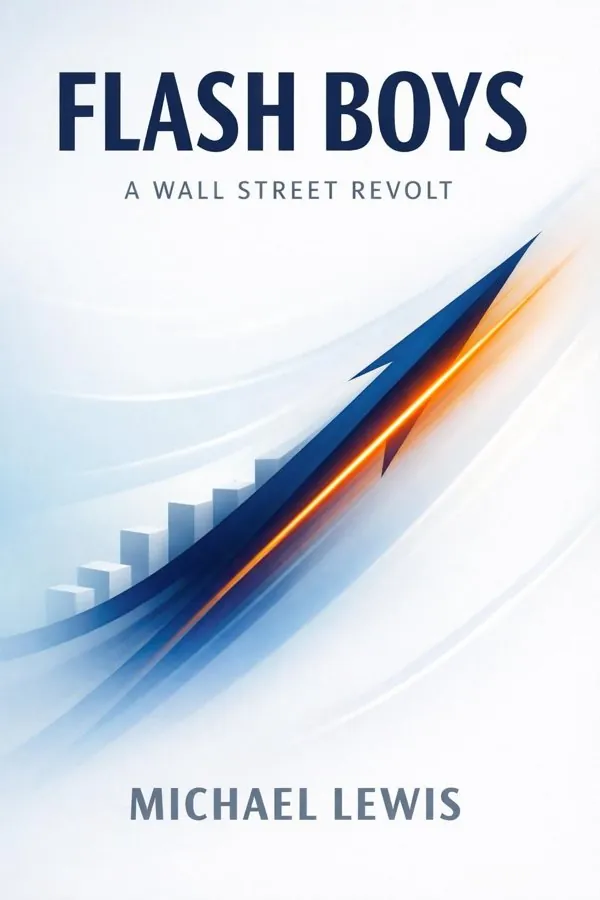
Flash Boys by Michael Lewis is a business book published in 2014 spanning 5 pages. Flash Boys by Michael Lewis is a gripping investigation into how the modern U.S. stock market stopped functioning like a simple marketplace and became a technologically engineered battleground. At the center of the story is Brad Katsuyama, a Canadian trader who begins to suspect that the market is somehow “rigged” against ordinary investors and even against large professional institutions trying to trade honestly. As he digs deeper, he discovers a hidden system shaped by high-frequency trading firms, fragmented exchanges, secretive order types, and microscopic speed advantages measured in milliseconds. What looks like a neutral market turns out to be an arena where access, infrastructure, and information asymmetry determine who wins. The book matters because it turns an abstract financial topic into a human story about fairness, trust, and power. Lewis, one of the most influential financial storytellers of his generation, combines investigative reporting with vivid character portraits to explain a complex system in plain language. More than a book about trading, Flash Boys is about how technology can quietly reshape institutions faster than regulation or public understanding can keep up—and what it takes to push back.
This FizzRead summary covers all 9 key chapters of Flash Boys in approximately 10 minutes, distilling the most important ideas, arguments, and takeaways from Michael Lewis's work. Also available as an audio summary and Key Quotes Podcast.
Flash Boys
Flash Boys by Michael Lewis is a gripping investigation into how the modern U.S. stock market stopped functioning like a simple marketplace and became a technologically engineered battleground. At the center of the story is Brad Katsuyama, a Canadian trader who begins to suspect that the market is somehow “rigged” against ordinary investors and even against large professional institutions trying to trade honestly. As he digs deeper, he discovers a hidden system shaped by high-frequency trading firms, fragmented exchanges, secretive order types, and microscopic speed advantages measured in milliseconds. What looks like a neutral market turns out to be an arena where access, infrastructure, and information asymmetry determine who wins.
The book matters because it turns an abstract financial topic into a human story about fairness, trust, and power. Lewis, one of the most influential financial storytellers of his generation, combines investigative reporting with vivid character portraits to explain a complex system in plain language. More than a book about trading, Flash Boys is about how technology can quietly reshape institutions faster than regulation or public understanding can keep up—and what it takes to push back.
Who Should Read Flash Boys?
This book is perfect for anyone interested in business and looking to gain actionable insights in a short read. Whether you're a student, professional, or lifelong learner, the key ideas from Flash Boys by Michael Lewis will help you think differently.
- ✓Readers who enjoy business and want practical takeaways
- ✓Professionals looking to apply new ideas to their work and life
- ✓Anyone who wants the core insights of Flash Boys in just 10 minutes
Want the full summary?
Get instant access to this book summary and 100K+ more with Fizz Moment.
Get Free SummaryAvailable on App Store • Free to download
Key Chapters
In modern markets, a tiny time advantage can be worth millions. One of the book’s central revelations is that high-frequency trading was built on the idea that being slightly faster than everyone else could be converted into reliable profit. Brad’s investigation deepened when he met Ronan Ryan, a telecom expert who understood the physical networks connecting exchanges. Ryan helped explain that price discrepancies and vanishing quotes were not random glitches but consequences of geography, fiber-optic cables, microwave towers, and engineered latency.
The key discovery was startling: if an order reached one exchange before another, a fast trader could detect the first signal, race ahead to the remaining venues, buy the available shares, and then sell them back at a slightly higher price. This practice, often described as latency arbitrage, did not require superior judgment about a company’s value. It required superior speed and infrastructure. In other words, market advantage had shifted from insight to engineering.
This idea extends beyond finance. In many industries, from e-commerce to digital advertising, firms increasingly compete by reducing delays that users cannot even perceive. Whoever sees demand first can shape prices, inventory, or access. Flash Boys shows how such advantages can become extractive when they are hidden and when customers do not know they are being anticipated.
The practical implication is that information is not the only edge; timing is itself a form of information. If you lead a business, this means operational speed can create real strategic power—but it also carries ethical responsibilities if customers bear unseen costs. Actionable takeaway: whenever outcomes seem systematically tilted, investigate not only who knows more, but who receives and acts on signals first.
Bad systems persist when too many participants profit from pretending nothing is wrong. Flash Boys does not portray market distortion as the work of a single villain. Instead, it shows a network of incentives that encouraged exchanges, brokers, banks, and high-frequency firms to preserve an arrangement that generated fees and trading volume. Even when participants did not explicitly call the market rigged, many benefited from conditions that made it easier for speed-driven traders to exploit incoming orders.
Exchanges that once served primarily as neutral marketplaces had become businesses competing for order flow. They designed products for their most lucrative customers, including expensive co-location services that allowed traders to place servers close to exchange computers. Brokers had incentives to route client orders to venues that paid them or offered favorable economics, not necessarily to venues that provided the best execution in a meaningful sense. Clients often received technical explanations instead of plain disclosure.
This matters because the most damaging institutional failures usually arise from misaligned incentives rather than from obvious criminality. Consider a company where sales teams are rewarded for volume instead of customer outcomes, or a platform that monetizes engagement rather than user well-being. People inside the system may sincerely believe they are behaving normally while collectively producing harmful results.
Lewis’s broader point is that fairness cannot survive if the rule-makers depend financially on the very actors they are supposed to discipline. A market does not need to be entirely fraudulent to become untrustworthy; it only needs enough incentives pointed away from the customer.
Actionable takeaway: in any organization or market, follow the incentives before you trust the stated mission. Ask who gets paid, for what behavior, and whether that behavior aligns with the interests of the people the system claims to serve.
If a system is designed, it can be redesigned. That is the hopeful counterpoint at the heart of Flash Boys. After uncovering how speed advantages were being used against ordinary market participants, Brad Katsuyama and his team did not stop at criticism. They set out to build a new exchange, IEX, designed around a radical goal in finance: fairness. Their premise was that markets are not natural phenomena like weather; they are human constructions, and their rules can either reward predation or reduce it.
IEX became famous for one seemingly strange feature: a 38-mile coil of fiber-optic cable that imposed a tiny delay, often called a “speed bump,” on incoming and outgoing orders. This delay was not meant to slow the whole market meaningfully for investors. It was meant to neutralize the ultra-fast strategies that exploited minute timing differences across exchanges. By reducing the value of racing ahead, IEX attempted to make prices more reliable and trading less vulnerable to latency arbitrage.
The practical brilliance of this solution is that it used engineering, not moral appeals alone, to change behavior. Instead of asking predatory traders to become kinder, IEX changed the environment so certain tactics would no longer pay. This is a powerful lesson for leaders, regulators, and product designers. If people exploit a loophole consistently, the answer is often better system design, not repeated requests for better ethics.
In everyday terms, this is like designing a queue so nobody can cut the line, rather than relying on everyone to behave perfectly. Actionable takeaway: when facing persistent unfairness, look for structural fixes that remove the reward for bad behavior instead of merely condemning it after the fact.
People often claim to support transparency until transparency threatens their advantage. One of the most revealing parts of Flash Boys is the intensity of the resistance faced by Brad Katsuyama and the IEX team. Their project challenged not just a few profitable firms but an entire set of assumptions about how markets should work. Once they began describing the system in plain language, they forced established players to defend complexity that had long been hidden behind jargon.
The opposition came in many forms: skepticism from industry insiders, attacks on Brad’s motives, pressure from incumbents, and public-relations efforts to discredit the idea that the market was rigged. This response was telling. If the practices under scrutiny had truly been harmless or efficiency-enhancing for everyone, there would have been less need for defensive spin. Instead, the debate itself exposed how much financial infrastructure depended on ordinary investors not understanding what happened between clicking “buy” and actually receiving shares.
This pattern appears well beyond Wall Street. Industries frequently resist reforms that make pricing, routing, ranking, or access more visible. Whether in healthcare billing, online advertising, or app-store economics, opacity can be monetized. The moment someone translates complexity into plain language, incumbents may argue that outsiders are oversimplifying. Sometimes they are. But sometimes “oversimplifying” is just another way of saying “making the hidden logic understandable.”
The lesson here is that resistance can be diagnostic. Strong pushback does not automatically prove a reform is right, but it can signal that entrenched advantages are being challenged. Actionable takeaway: when a proposed change provokes disproportionate resistance, ask what invisible benefit is being protected and whether greater transparency would help the end user make better decisions.
We often talk about technology as if it simply improves efficiency, but Flash Boys shows that every technical system embeds choices about who benefits. Fiber routes, matching engines, order types, exchange architecture, and data-feed pricing all sound like operational details. Yet these details shape market outcomes. They determine who sees what, who moves first, and who bears the hidden costs of speed-driven competition.
One reason Lewis’s book remains relevant is that it pushes readers to treat infrastructure as political and economic design, not just plumbing. A stock exchange is not only a place where buyers and sellers meet. It is a set of coded rules. If those rules allow some participants to infer demand before others and trade against it, then the technology is not neutral. It is distributing advantage.
You can apply this insight broadly. Recommendation algorithms affect which businesses are discovered. Search rankings determine visibility. Delivery platforms decide who pays for speed. Workplace software influences how labor is measured and managed. In each case, the technical layer is also a power layer. People who control architecture often shape outcomes more deeply than people who appear to make the visible decisions.
The danger is that technical complexity creates moral distance. Harm can be reframed as optimization. A hidden fee becomes a routing choice. An unequal experience becomes a latency issue. Flash Boys helps readers see how systems can be engineered to produce unfairness without ever using unfair language.
Actionable takeaway: whenever technology mediates exchange, ask what values are encoded in the design. Do not stop at what a system does; examine whom it advantages, what behaviors it rewards, and what costs it quietly shifts onto less informed users.
A market can survive volatility more easily than it can survive lost trust. Flash Boys is ultimately not just about fast trading firms or broken microstructure; it is about the erosion of confidence in the fairness of capitalism’s core machinery. Investors accept risk when they believe prices emerge from open competition. They become cynical when they suspect the game is tilted by hidden mechanisms they cannot see or challenge.
This is why the book resonated far beyond professional traders. Many readers recognized a familiar social pattern: ordinary participants are told a system is meritocratic, while insiders quietly monetize access, opacity, and superior tools. In financial markets, this dynamic is especially corrosive because markets allocate capital across the economy. If investors think those markets are rigged, participation weakens, legitimacy erodes, and public anger grows.
Trust does not require perfect equality of outcome. Skilled investors, disciplined businesses, and better ideas should still outperform. But trust does require confidence that the rules are intelligible and applied consistently. A pension fund manager may accept losing money on a trade because the market moved. What is harder to accept is losing because another participant saw the order coming and stepped in front of it by exploiting invisible speed advantages.
The broader application is straightforward: any institution that relies on participation must protect perceived fairness, not just technical legality. Schools, platforms, employers, and governments all depend on people believing the process is basically honest.
Actionable takeaway: if you lead or design systems, prioritize trust as a measurable asset. Eliminate hidden advantages where possible, explain rules plainly, and remember that users will leave long before they master a system they believe is secretly stacked against them.
Rules written for one era can become loopholes in the next. Another major theme in Flash Boys is the inability of regulation to keep pace with market innovation. The stock market changed rapidly as trading became electronic, fragmented, and hyper-fast, but the frameworks meant to ensure fairness did not evolve quickly enough to address new forms of advantage. As a result, practices that felt abusive to many participants could still exist within or around the letter of the law.
This mismatch created a dangerous ambiguity. Industry players could defend themselves by saying they were operating legally, while critics could still argue that the market had become structurally unfair. Both statements could be true. Legality is not the same as legitimacy. In many sectors, innovation moves first, profits accumulate second, and serious oversight arrives only after damage becomes visible.
Examples are easy to find outside finance. Social media platforms scaled before regulators understood their civic effects. Gig-work platforms grew before labor law adapted. AI tools are advancing faster than institutions can define acceptable use. Flash Boys belongs to this broader conversation: when technological change outruns public comprehension, early winners may write the norms to their advantage.
Lewis does not suggest regulation alone can solve everything. Regulators may lack technical understanding, move slowly, or become too close to industry. Still, the absence of effective oversight leaves fairness dependent on whistleblowers, reformers, and rare institutions willing to challenge profitable norms.
Actionable takeaway: in any fast-moving industry, do not assume “it’s allowed” means “it’s sound.” Build internal standards that exceed minimum compliance, and revisit old rules whenever new technology changes the real-world meaning of speed, access, or information.
Many broken systems remain unchallenged until someone asks a basic question that insiders have stopped asking. Flash Boys is, at one level, a story about market structure. But at another level, it is a story about curiosity, moral discomfort, and the power of outsiders who refuse to accept expert jargon as a substitute for explanation. Brad Katsuyama did not set out to become a crusader. He simply noticed something strange, kept pulling the thread, and refused to dismiss evidence that contradicted official narratives.
That mindset mattered because complex systems often train participants to normalize what they do not understand. The more specialized the field, the easier it becomes for insiders to hide behind language, credentials, and convention. Real change frequently begins when a person from an adjacent background—like Ronan Ryan with telecom knowledge, or investors willing to listen carefully—translates the system into more basic terms. Once a hidden mechanism is made legible, it becomes harder to defend.
This has clear practical value for readers. In your own work, the biggest opportunity may lie in a process everyone treats as inevitable. Ask where delays occur, who gets information first, who profits from opacity, and which assumptions are accepted because they are profitable rather than because they are true. Curiosity becomes especially powerful when paired with cross-disciplinary thinking; people from different fields often notice what specialists overlook.
Flash Boys suggests that reform does not always begin with authority. It often begins with observation plus persistence. Actionable takeaway: when something repeatedly feels off, investigate instead of rationalizing it away. Ask naive questions, seek expertise from outside the dominant circle, and follow anomalies until the structure behind them becomes clear.
All Chapters in Flash Boys
About the Author
Michael Lewis is an American bestselling author and financial journalist celebrated for making complex subjects vivid, human, and accessible. After studying art history at Princeton and economics at the London School of Economics, he worked as a bond salesman at Salomon Brothers, an experience that inspired his breakout book, Liar’s Poker. He later became one of the most influential nonfiction writers in business and economics with books such as Moneyball, The Big Short, The Blind Side, and Flash Boys. Lewis’s work typically explores the hidden logic of institutions, the incentives that drive behavior, and the unusual individuals who see through conventional wisdom. His writing blends investigative rigor with narrative storytelling, making difficult topics feel both urgent and readable.
Get This Summary in Your Preferred Format
Read or listen to the Flash Boys summary by Michael Lewis anytime, anywhere. FizzRead offers multiple formats so you can learn on your terms — all free.
Available formats: App · Audio · PDF · EPUB — All included free with FizzRead
Download Flash Boys PDF and EPUB Summary
Key Quotes from Flash Boys
“A market can look more efficient on the surface precisely when it has become harder to understand underneath.”
“In modern markets, a tiny time advantage can be worth millions.”
“Bad systems persist when too many participants profit from pretending nothing is wrong.”
“If a system is designed, it can be redesigned.”
“People often claim to support transparency until transparency threatens their advantage.”
Frequently Asked Questions about Flash Boys
Flash Boys by Michael Lewis is a business book that explores key ideas across 9 chapters. Flash Boys by Michael Lewis is a gripping investigation into how the modern U.S. stock market stopped functioning like a simple marketplace and became a technologically engineered battleground. At the center of the story is Brad Katsuyama, a Canadian trader who begins to suspect that the market is somehow “rigged” against ordinary investors and even against large professional institutions trying to trade honestly. As he digs deeper, he discovers a hidden system shaped by high-frequency trading firms, fragmented exchanges, secretive order types, and microscopic speed advantages measured in milliseconds. What looks like a neutral market turns out to be an arena where access, infrastructure, and information asymmetry determine who wins. The book matters because it turns an abstract financial topic into a human story about fairness, trust, and power. Lewis, one of the most influential financial storytellers of his generation, combines investigative reporting with vivid character portraits to explain a complex system in plain language. More than a book about trading, Flash Boys is about how technology can quietly reshape institutions faster than regulation or public understanding can keep up—and what it takes to push back.
More by Michael Lewis



You Might Also Like





Browse by Category
Ready to read Flash Boys?
Get the full summary and 100K+ more books with Fizz Moment.