
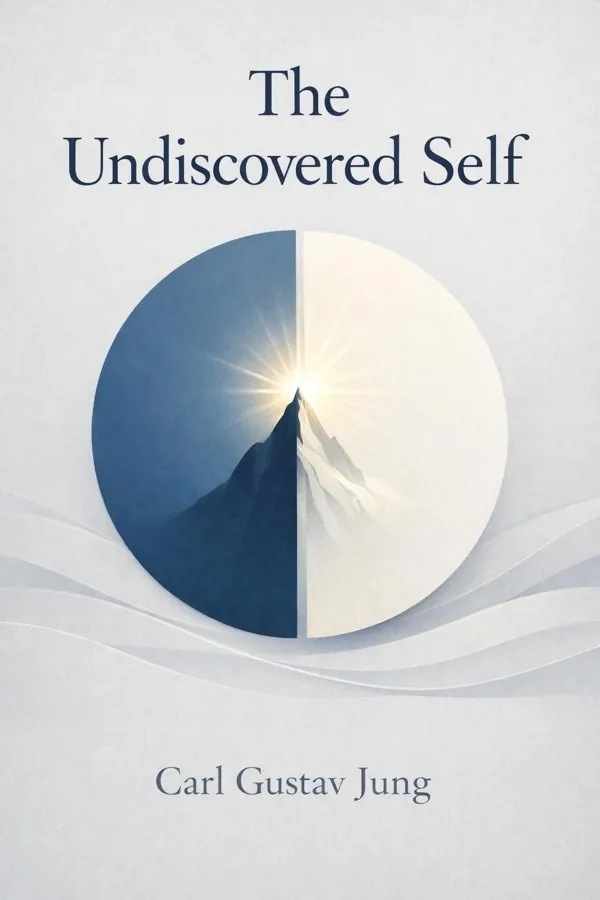
The Undiscovered Self: Summary & Key Insights
 10 min9 chaptersAudio available
What Is The Undiscovered Self About?
The Undiscovered Self by Carl Gustav Jung is a psychology book spanning 9 pages. In this profound work, Jung explores the tension between the individual and the collective, warning against the dangers of mass-mindedness and ideological conformity. He argues that self-knowledge and understanding of the unconscious are essential for maintaining individuality and freedom in modern society. Written near the end of his life, the book distills Jung’s mature reflections on psychology, spirituality, and the human condition.
This FizzRead summary covers all 9 key chapters of The Undiscovered Self in approximately 10 minutes, distilling the most important ideas, arguments, and takeaways from Carl Gustav Jung's work. Also available as an audio summary and Key Quotes Podcast.
The Undiscovered Self
In this profound work, Jung explores the tension between the individual and the collective, warning against the dangers of mass-mindedness and ideological conformity. He argues that self-knowledge and understanding of the unconscious are essential for maintaining individuality and freedom in modern society. Written near the end of his life, the book distills Jung’s mature reflections on psychology, spirituality, and the human condition.
Who Should Read The Undiscovered Self?
This book is perfect for anyone interested in psychology and looking to gain actionable insights in a short read. Whether you're a student, professional, or lifelong learner, the key ideas from The Undiscovered Self by Carl Gustav Jung will help you think differently.
- ✓Readers who enjoy psychology and want practical takeaways
- ✓Professionals looking to apply new ideas to their work and life
- ✓Anyone who wants the core insights of The Undiscovered Self in just 10 minutes
Want the full summary?
Get instant access to this book summary and 100K+ more with Fizz Moment.
Get Free SummaryAvailable on App Store • Free to download
Key Chapters
Modern society exerts an enormous pressure upon the individual. Systems of ideology, political propaganda, technological control, and economic dependency have encroached upon our freedom to think and feel for ourselves. The individual is no longer valued as a unique bearer of meaning but is absorbed into the mass. I have seen how this process deprives people of moral responsibility. When you act merely as part of a collective, you do not feel accountable; your conscience dissolves in the anonymity of the crowd. This is how atrocities become possible—ordinary men obeying commands with no awareness of their inner motives.
In earlier centuries, the individual could rely on community structures and religious frameworks that encouraged moral reflection. Today, these have lost their binding power. Mass-mindedness replaces spirituality. Ideologies offer ready-made beliefs that spare people the burden of thinking. The danger is not only political; it is psychological. When individual consciousness weakens, the unconscious forces within the psyche erupt unchecked. Collective emotions then dominate, fueling fanaticism and hatred. Only by reclaiming self-awareness can one resist being swallowed by these destructive energies.
I do not suggest isolation from society, but an inward differentiation—a recognition that each person must stand in conscious relation to the collective. The strength of a community ultimately depends on the consciousness of its individuals. The plight of modern man is that he does not know himself; he identifies with public opinions and ceases to ask, 'What do I truly think? What do I truly believe?' My purpose is to help him recover that question.
Religion once served as humanity’s main safeguard against the disintegration of meaning. It provided symbols through which individuals could relate their inner experience to the vastness of existence. But in the modern world, organized religion has declined. Dogma has lost credibility, rituals have become routine, and many dismiss faith as outdated superstition. Yet the human need for belief, for orientation toward something greater than oneself, has not vanished. Indeed, when spiritual values decay, the unconscious seeks substitutes—political ideologies, cults of science, or nationalistic fervor. These become pseudo-religions, filled with symbols of salvation and damnation, but devoid of genuine spiritual depth.
I do not advocate a return to literal belief or theological systems. Rather, I call for recognition of the psychological function religion once fulfilled. It connected the conscious mind with the unconscious, allowing symbols of wholeness—God, soul, redemption—to serve as bridges between inner and outer reality. Without such mediation, psychic energy accumulates in distorted forms. Man becomes spiritually empty, prone to mass movements and irrational outbursts. A person who is religious in the psychological sense—one who honors the mystery of the soul—develops an immunity to mass suggestion. He feels rooted in a meaning that does not depend on social approval.
The decay of faith therefore represents a psychological danger. Science may teach us how the world works, but cannot tell us why it matters. When religion ceases to counterbalance rationality, man loses his moral compass. The rediscovery of religion—not as institution, but as inner experience—is essential for restoring balance between conscious reason and unconscious depth.
+ 7 more chapters — available in the FizzRead app
All Chapters in The Undiscovered Self
About the Author
Carl Gustav Jung (1875–1961) was a Swiss psychiatrist and psychoanalyst who founded analytical psychology. His work profoundly influenced psychiatry, anthropology, literature, philosophy, and religious studies. Jung introduced key concepts such as the collective unconscious, archetypes, and individuation, shaping modern understanding of the psyche.
Get This Summary in Your Preferred Format
Read or listen to the The Undiscovered Self summary by Carl Gustav Jung anytime, anywhere. FizzRead offers multiple formats so you can learn on your terms — all free.
Available formats: App · Audio · PDF · EPUB — All included free with FizzRead
Download The Undiscovered Self PDF and EPUB Summary
Key Quotes from The Undiscovered Self
“Modern society exerts an enormous pressure upon the individual.”
“Religion once served as humanity’s main safeguard against the disintegration of meaning.”
Frequently Asked Questions about The Undiscovered Self
The Undiscovered Self by Carl Gustav Jung is a psychology book that explores key ideas across 9 chapters. In this profound work, Jung explores the tension between the individual and the collective, warning against the dangers of mass-mindedness and ideological conformity. He argues that self-knowledge and understanding of the unconscious are essential for maintaining individuality and freedom in modern society. Written near the end of his life, the book distills Jung’s mature reflections on psychology, spirituality, and the human condition.
More by Carl Gustav Jung

You Might Also Like
The Body Keeps the Score
Bessel van der Kolk
10 min
Surrounded by Idiots
Thomas Erikson
10 min
Emotional Intelligence
Daniel Goleman
10 min
Attached
Amir Levine
10 min
Why Does He Do That
Lundy Bancroft
10 min
Women Who Run with the Wolves
Clarissa Pinkola Estés
10 minBrowse by Category
Ready to read The Undiscovered Self?
Get the full summary and 100K+ more books with Fizz Moment.