
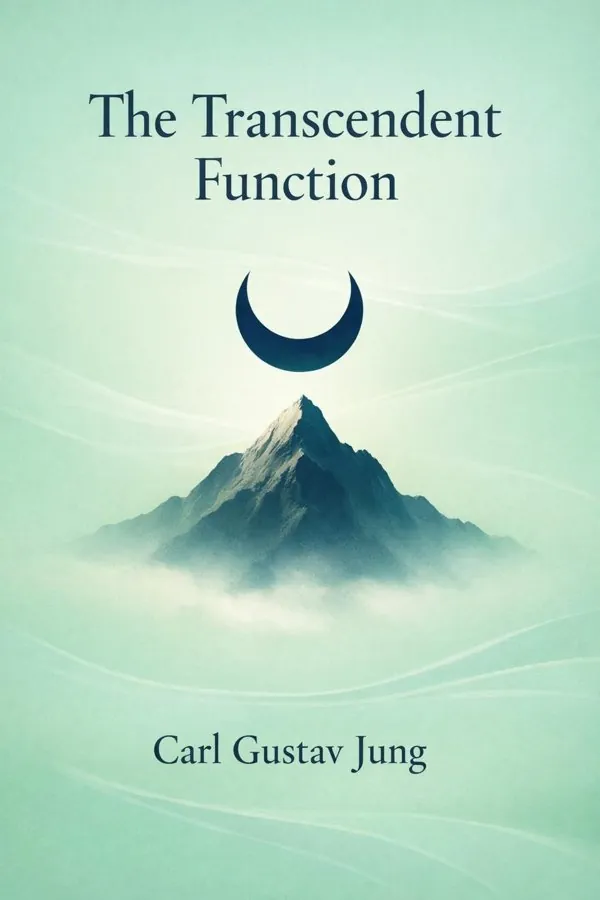
The Transcendent Function: Summary & Key Insights
 10 min4 chaptersAudio available
What Is The Transcendent Function About?
The Transcendent Function by Carl Gustav Jung is a psychology book spanning 4 pages. In this work, Carl Gustav Jung explores the 'transcendent function,' which connects the conscious and unconscious mind. Jung describes how engaging consciously with the unconscious can lead to psychological transformation and individuation. The essay is considered a key text in analytical psychology and the practical application of active imagination.
This FizzRead summary covers all 4 key chapters of The Transcendent Function in approximately 10 minutes, distilling the most important ideas, arguments, and takeaways from Carl Gustav Jung's work. Also available as an audio summary and Key Quotes Podcast.
The Transcendent Function
In this work, Carl Gustav Jung explores the 'transcendent function,' which connects the conscious and unconscious mind. Jung describes how engaging consciously with the unconscious can lead to psychological transformation and individuation. The essay is considered a key text in analytical psychology and the practical application of active imagination.
Who Should Read The Transcendent Function?
This book is perfect for anyone interested in psychology and looking to gain actionable insights in a short read. Whether you're a student, professional, or lifelong learner, the key ideas from The Transcendent Function by Carl Gustav Jung will help you think differently.
- ✓Readers who enjoy psychology and want practical takeaways
- ✓Professionals looking to apply new ideas to their work and life
- ✓Anyone who wants the core insights of The Transcendent Function in just 10 minutes
Want the full summary?
Get instant access to this book summary and 100K+ more with Fizz Moment.
Get Free SummaryAvailable on App Store • Free to download
Key Chapters
In our psychic life we are not governed by consciousness alone. The unconscious is a living system that exerts influence, guidance, and pressure upon us, mostly unnoticed. The conscious mind, with its clarity and rationality, believes itself to rule. Yet like a small island surrounded by endless sea, it is only a fragment of a far larger totality. The transcendent function arises from the dynamic tension between these systems. Consciousness represents our orientation in reality, our deliberate effort to make sense; the unconscious contains forgotten experiences, archetypal patterns, and impulses that wish to complement consciousness by revealing what it neglects.
These two systems are not stable opposites but active participants in a dialogue. When consciousness becomes rigid or denies parts of reality, the unconscious asserts itself through dreams, symptoms, moods, or creative fantasies. Each manifestation is an attempt to restore balance. In psychological work, my aim has always been to help people recognize that these eruptions are not meaningless disturbances but intentional communications from the depths of the psyche. The transcendent function depends upon such communications: it begins with the recognition that the unconscious is not merely a repository of past impressions but an autonomous creative partner.
To stimulate interaction between these systems, one must learn to listen imaginatively and without premature judgment. In analysis, I often encourage patients to record their dreams and reflect upon the symbolic images. When consciousness meets these images with respectful curiosity, the psyche begins to self-regulate. It produces compensations that widen the conscious attitude, teaching the individual not to suppress what disturbs him but to understand its message. Through this dialogue, a new standpoint gradually takes shape—the standpoint that transcends the previous one.
Conflict is not only inevitable within the psyche—it is desirable. The friction between conscious and unconscious contents generates psychic energy. This tension may feel uncomfortable, even painful, but it is the condition necessary for growth. If the tension is resolved too quickly—if we repress one side or rationalize away the conflict—development ceases. The transcendent function depends precisely on the endurance of tension until a creative synthesis can emerge.
In analysis, the individual encounters situations in which the conscious attitude proves inadequate: perhaps an instinctual impulse, a dream image, or a moral contradiction that cannot be logically reconciled. Whenever such opposites confront each other, the psyche seeks to unite them through a function beyond either pole. This function 'transcends' because it produces something new, a third perspective that was not present before.
But to allow transformation, one must not evade the conflict. The patient must hold both sides—reason and feeling, desire and duty, light and shadow—in awareness. This holding produces psychic heat; it is the crucible of transformation. The unconscious then begins to supply symbols and fantasies that point toward resolution. What emerges is not a compromise but an integration, where the individual becomes capable of embracing complexity without fragmentation. Thus, maintaining tension is the art of psychological development. It allows life itself to move within us as a dynamic, evolving force.
+ 2 more chapters — available in the FizzRead app
All Chapters in The Transcendent Function
About the Author
Carl Gustav Jung (1875–1961) was a Swiss psychiatrist and the founder of analytical psychology. He developed influential concepts such as archetypes, the collective unconscious, and individuation, profoundly shaping psychology, philosophy, art, and religion.
Get This Summary in Your Preferred Format
Read or listen to the The Transcendent Function summary by Carl Gustav Jung anytime, anywhere. FizzRead offers multiple formats so you can learn on your terms — all free.
Available formats: App · Audio · PDF · EPUB — All included free with FizzRead
Download The Transcendent Function PDF and EPUB Summary
Key Quotes from The Transcendent Function
“In our psychic life we are not governed by consciousness alone.”
“Conflict is not only inevitable within the psyche—it is desirable.”
Frequently Asked Questions about The Transcendent Function
The Transcendent Function by Carl Gustav Jung is a psychology book that explores key ideas across 4 chapters. In this work, Carl Gustav Jung explores the 'transcendent function,' which connects the conscious and unconscious mind. Jung describes how engaging consciously with the unconscious can lead to psychological transformation and individuation. The essay is considered a key text in analytical psychology and the practical application of active imagination.
More by Carl Gustav Jung
You Might Also Like
The Body Keeps the Score
Bessel van der Kolk
10 min
Surrounded by Idiots
Thomas Erikson
10 min
Emotional Intelligence
Daniel Goleman
10 min
Attached
Amir Levine
10 min
Why Does He Do That
Lundy Bancroft
10 min
Women Who Run with the Wolves
Clarissa Pinkola Estés
10 minBrowse by Category
Ready to read The Transcendent Function?
Get the full summary and 100K+ more books with Fizz Moment.