
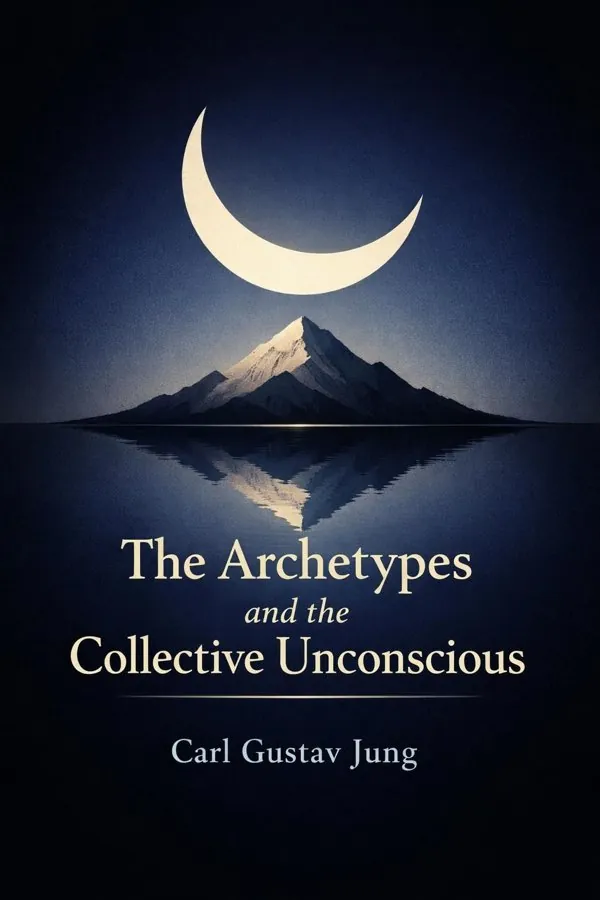
The Archetypes and the Collective Unconscious: Summary & Key Insights
 10 min9 chaptersAudio available
Key Takeaways from The Archetypes and the Collective Unconscious
Much of what moves us does not begin with us.
The most important misunderstanding to avoid is thinking of an archetype as a specific image.
Human development is guided by images long before it is guided by concepts.
What we reject in ourselves rarely disappears; it returns in disguise.
Many of our most intense relationships are partly conversations with unknown parts of ourselves.
What Is The Archetypes and the Collective Unconscious About?
The Archetypes and the Collective Unconscious by Carl Gustav Jung is a psychology book spanning 6 pages. What if the most powerful images in your dreams were not merely personal fragments, but expressions of patterns shared across all humanity? In The Archetypes and the Collective Unconscious, Carl Gustav Jung explores one of his most influential and provocative ideas: beneath the personal unconscious lies a deeper psychic layer populated by universal forms he called archetypes. These recurring patterns shape myths, religions, fantasies, symbols, and emotional life across cultures and eras. This volume matters because it offers a framework for understanding why human beings repeatedly generate similar images of the mother, the hero, the wise old man, the child, the shadow, and the trickster. Jung argues that these figures are not accidental inventions but structural features of the psyche itself. Their appearances in dreams and cultural narratives reveal how deeply the individual mind is connected to a shared psychological inheritance. As the founder of Analytical Psychology, Jung writes with clinical experience, philosophical depth, and an extraordinary command of mythology, religion, and symbolism. This book remains essential for readers interested in psychology, self-understanding, creativity, and the hidden patterns that shape both personal development and collective culture.
This FizzRead summary covers all 9 key chapters of The Archetypes and the Collective Unconscious in approximately 10 minutes, distilling the most important ideas, arguments, and takeaways from Carl Gustav Jung's work. Also available as an audio summary and Key Quotes Podcast.
The Archetypes and the Collective Unconscious
What if the most powerful images in your dreams were not merely personal fragments, but expressions of patterns shared across all humanity? In The Archetypes and the Collective Unconscious, Carl Gustav Jung explores one of his most influential and provocative ideas: beneath the personal unconscious lies a deeper psychic layer populated by universal forms he called archetypes. These recurring patterns shape myths, religions, fantasies, symbols, and emotional life across cultures and eras.
This volume matters because it offers a framework for understanding why human beings repeatedly generate similar images of the mother, the hero, the wise old man, the child, the shadow, and the trickster. Jung argues that these figures are not accidental inventions but structural features of the psyche itself. Their appearances in dreams and cultural narratives reveal how deeply the individual mind is connected to a shared psychological inheritance.
As the founder of Analytical Psychology, Jung writes with clinical experience, philosophical depth, and an extraordinary command of mythology, religion, and symbolism. This book remains essential for readers interested in psychology, self-understanding, creativity, and the hidden patterns that shape both personal development and collective culture.
Who Should Read The Archetypes and the Collective Unconscious?
This book is perfect for anyone interested in psychology and looking to gain actionable insights in a short read. Whether you're a student, professional, or lifelong learner, the key ideas from The Archetypes and the Collective Unconscious by Carl Gustav Jung will help you think differently.
- ✓Readers who enjoy psychology and want practical takeaways
- ✓Professionals looking to apply new ideas to their work and life
- ✓Anyone who wants the core insights of The Archetypes and the Collective Unconscious in just 10 minutes
Want the full summary?
Get instant access to this book summary and 100K+ more with Fizz Moment.
Get Free SummaryAvailable on App Store • Free to download
Key Chapters
Much of what moves us does not begin with us. Jung’s central claim is that the psyche contains more than personal memories, repressed feelings, and forgotten experiences. Beneath what he calls the personal unconscious lies a deeper stratum: the collective unconscious. Unlike the personal unconscious, which is formed through individual biography, the collective unconscious is inherited. It consists of universal psychic patterns common to all human beings.
Jung does not mean that people inherit ready-made ideas or detailed images. Rather, they inherit tendencies to produce certain kinds of images, emotional reactions, and symbolic forms. This helps explain why people from different cultures, times, and environments often dream similar dreams, tell parallel myths, and create comparable religious symbols. The repetition is not merely historical borrowing; it reveals a shared psychological foundation.
A modern example is the way people who have never studied mythology may still dream of descending into caves, facing monsters, meeting wise guides, or discovering miraculous children. These motifs mirror ancient narratives because the psyche spontaneously generates them under certain conditions. In psychotherapy, recognizing this deeper layer can prevent people from interpreting every dream or fantasy too narrowly. Not every inner image refers only to family history; some point to universal human struggles.
Jung���s insight also broadens our understanding of culture. Films, novels, religious rituals, and political movements often resonate because they activate collective patterns that feel instantly meaningful. We are moved not only by ideas, but by archetypal structures beneath them.
Actionable takeaway: When a dream, symbol, or recurring emotional pattern feels strangely timeless, ask not only, “What does this mean about my past?” but also, “What universal human pattern might be expressing itself through me?”
The most important misunderstanding to avoid is thinking of an archetype as a specific image. Jung insists that an archetype is not a fixed symbol like “a mother” or “a hero” in one permanent form. It is better understood as a dynamic pattern, a structural possibility within the psyche that takes shape through images, stories, and experiences. The archetype itself is invisible; what we encounter are its manifestations.
This distinction matters because archetypal images vary dramatically across cultures and individuals. The mother archetype may appear as Mary, Demeter, Mother Earth, a grandmother, a nourishing landscape, or even a dangerous devouring force. The hero may emerge as Hercules, a revolutionary, a wounded protagonist in a novel, or an ordinary person struggling to become more whole. The outer form changes, but the underlying pattern persists.
Jung compares archetypes to inherited predispositions. Just as the body develops according to biological patterns, the psyche develops according to symbolic ones. These patterns organize emotional energy and influence how we respond to major life themes such as dependence, authority, conflict, love, transformation, and death.
In practical life, this concept helps explain why certain relationships or situations carry more intensity than logic can justify. A boss may unconsciously become “the father.” A romantic partner may become “the savior” or “the ideal woman.” A child may symbolize hope and renewal beyond his or her actual personality. When archetypal projections dominate, we stop seeing reality clearly.
Understanding archetypes allows us to separate the pattern from the person. That creates psychological freedom. We can appreciate symbolic meaning without being ruled by it.
Actionable takeaway: In emotionally charged situations, ask yourself, “Am I responding to this person as they are, or to an archetypal role I have unconsciously assigned to them?”
Human development is guided by images long before it is guided by concepts. In Jung’s exploration of the mother, rebirth, and child archetypes, he shows how early psychic life is shaped by symbols of origin, protection, renewal, and future possibility. These archetypes are deeply linked because they all concern the beginnings and regeneration of life.
The mother archetype extends far beyond one’s actual mother. It includes everything experienced as containing, nourishing, sheltering, or engulfing. It may be expressed through a loving figure, a church, the earth, the sea, a homeland, or an institution that promises safety. Yet the mother archetype has both positive and negative poles. It can nurture growth, but it can also smother independence, seduce us into passivity, or trap us in dependence.
The rebirth archetype appears whenever psychic transformation becomes necessary. It is present in rites of passage, religious initiation, near-death experiences, major losses, and turning points in therapy. Rebirth does not mean becoming someone entirely new overnight; it means passing through symbolic death so that a more integrated life can emerge.
The child archetype represents potential, futurity, vulnerability, and the emergence of wholeness from weakness. Jung often treats the divine child as a paradoxical image: small yet powerful, fragile yet destined. In personal life, this image may appear when someone begins to sense an authentic self that has not yet matured but carries enormous meaning.
These archetypes are especially useful in times of transition. If you feel torn between dependence and growth, collapse and renewal, old identity and emerging possibility, Jung would say the psyche may be expressing itself through these motifs.
Actionable takeaway: During major life changes, pay attention to symbols of shelter, infancy, pregnancy, water, darkness, or new beginnings; they may reveal what in you is ending, what is protecting you, and what new life seeks to be born.
Many of our most intense relationships are partly conversations with unknown parts of ourselves. Jung’s concepts of anima and animus describe inner contrasexual figures that mediate between the ego and the deeper unconscious. In classical Jungian terms, the anima is the inner feminine figure in a man, while the animus is the inner masculine figure in a woman. Though these formulations reflect Jung’s historical context, the deeper psychological insight concerns inner otherness: the psyche contains complementary qualities that the conscious personality often underdevelops.
The anima may appear in moods, fantasies, dreams, idealized romantic projections, inspiration, and emotional depth. The animus may appear as opinions, convictions, critical inner voices, forceful ideas, and images of authority or spirit. When unconscious, these figures distort relationships. A man may project his anima onto a partner and expect her to embody mystery, salvation, emotional wisdom, or chaos. A woman may project animus qualities onto others and become possessed by rigid judgments or abstract certainty.
But these inner figures are not merely obstacles. They are bridges to psychological growth. Engaging them consciously can deepen feeling, refine thinking, increase imagination, and open access to symbolic life. In therapy, journaling, dream work, and creative practice, people often discover recurring figures who challenge one-sided identity and demand development.
Today, these ideas can be approached less literally and more functionally. The core question is: what qualities has your conscious identity excluded, and how do they return through attraction, conflict, fantasy, and inner speech? Individuation requires a dialogue with these inner opposites.
Actionable takeaway: Reflect on the traits you repeatedly seek, idealize, or fight in close relationships. They may point to undeveloped capacities within you that need integration rather than projection.
The psyche often knows more than the conscious mind can say. For Jung, symbols are not decorative extras or mere disguises for hidden wishes; they are the natural language of the unconscious. A true symbol points beyond what is already fully understood. It expresses something living, ambiguous, and transformative—something that cannot yet be reduced to a simple explanation.
This is why Jung pays so much attention to myths, religious images, alchemy, folklore, dreams, and visionary material. Across these domains, symbols arise spontaneously when human beings confront experiences too large for rational categories alone: birth, death, suffering, love, evil, sacrifice, transcendence, and psychic transformation. Symbols do not eliminate mystery; they mediate it.
A dream of crossing a bridge, entering a forest, descending into water, or meeting a wounded animal may carry psychological significance far beyond literal content. Such images condense emotional, developmental, and spiritual meanings into one living form. The same applies to collective life. Nations organize themselves around flags, founders, martyrs, sacred texts, and heroic narratives because symbolic forms unite emotion and identity more deeply than argument alone.
Jung warns, however, that symbols lose vitality when treated as dogma or when interpreted too mechanically. If we insist that every snake means one thing or every house means another, we flatten symbolic life. The task is to hold personal context and universal pattern together.
For modern readers, this idea restores seriousness to imagination. Art, ritual, dream reflection, and attentive engagement with recurring images can reveal dimensions of the self that analysis alone misses.
Actionable takeaway: Keep a record of recurring symbols in dreams, art, or daily life, and ask what emotional tension or life transition they might be expressing rather than forcing a one-size-fits-all interpretation.
Becoming yourself is not the same as expressing your preferences. Jung’s larger psychological project in this volume points toward individuation, the lifelong process of becoming more whole by confronting, differentiating, and integrating the various elements of the psyche. This process is not self-improvement in a conventional sense. It is a difficult reordering of consciousness around a deeper center.
The ego naturally wants clarity, control, and coherence. But the unconscious introduces contradiction, complexity, and symbolic material that challenge the ego’s one-sidedness. Individuation begins when a person can no longer live solely from social roles, rational plans, or inherited identities. Symptoms, depression, anxiety, dreams, creative unrest, or spiritual crisis may all signal that a deeper rebalancing is needed.
Archetypes play a major role here because they guide and disturb development. The shadow forces moral honesty. The anima or animus confronts inner imbalance. The child points toward future wholeness. Rebirth motifs accompany transformation. The self, though not always treated as a simple theme, functions as the ordering totality toward which individuation tends.
In practical life, individuation may involve reassessing career success, integrating emotional life, setting boundaries with family expectations, accepting ambivalence, or recovering neglected aspects of personality. It rarely looks dramatic from the outside, but inwardly it can feel like a profound realignment.
Jung’s contribution is to show that inner conflict is not always a defect. Often it is the psyche’s attempt to move us toward greater totality. The goal is not perfection, but conscious relationship to what we are.
Actionable takeaway: Instead of asking only how to eliminate inner conflict, ask what opposing values, needs, or potentials the conflict may be asking you to hold together in a more mature way.
Ancient stories endure because they dramatize inner realities. Jung reads myth, religion, ritual, and even dogma not only as cultural artifacts or theological claims, but as symbolic expressions of archetypal processes in the human psyche. This does not reduce religion to illusion. Rather, it shows why religious forms have psychological power: they give shape to experiences that individuals cannot easily contain on their own.
Creation stories, flood myths, sacrificial narratives, descent-and-return journeys, miraculous births, and images of apocalypse appear across civilizations because they correspond to recurring structures of psychic life. The same is true of symbols of death and resurrection, judgment, paradise, exile, and redemption. For Jung, these are not random inventions. They articulate crises of meaning, transformation, guilt, fragmentation, and renewal.
This perspective helps explain why modern people, even in secular settings, remain drawn to quasi-religious forms. Political ideologies, celebrity culture, revolutionary movements, and self-help systems often borrow the emotional intensity of myth. They create heroes, enemies, initiations, conversions, and promised salvations. When archetypal energies lose connection to reflective consciousness, they can possess groups and become dangerous.
At the personal level, Jung’s approach encourages respect for symbolic traditions without demanding literal belief. A person may find real psychological nourishment in ritual, prayer, sacred art, or mythic literature because these forms help mediate unconscious energies and life transitions.
The key is neither blind belief nor cynical dismissal, but symbolic understanding. We need forms strong enough to hold the psyche’s depths and flexible enough to remain alive.
Actionable takeaway: When a myth, ritual, or religious image strongly affects you, ask what enduring psychological need or transformation it may be giving form to in your own life.
We may think we have outgrown myth, but myth has not outgrown us. One of the most enduring lessons of Jung’s work is that archetypes continue to organize modern life even when we no longer recognize them by name. They surface in cinema, advertising, politics, branding, celebrity culture, social media identities, and therapeutic language. The costumes have changed; the psychic patterns remain.
Consider how popular stories still revolve around the chosen child, the reluctant hero, the dark double, the wise mentor, the seductive destroyer, the apocalypse, and the redemptive return. Advertising often invokes the mother through comfort and care, the hero through mastery and conquest, and rebirth through makeover culture. Political leaders are cast as saviors, fathers, rebels, or tricksters. Online communities create shadow dynamics through moral splitting, idealization, and collective outrage.
Jung helps us see why these patterns are persuasive. Archetypal images carry emotional charge because they touch deep structures of expectation and meaning. The danger arises when we remain unconscious of them. Then we confuse symbolic force with truth, charisma with wisdom, projection with perception.
For individuals, this awareness is practical. If you repeatedly chase dramatic transformations, idealize mentors, fear collapse, or become captivated by narratives of purity and enemies, archetypal material may be active. Naming it does not make life less meaningful; it makes participation more conscious.
In this sense, Jung is not only interpreting ancient symbols. He is offering a literacy for contemporary existence. To understand modern culture, we must understand the timeless images moving beneath it.
Actionable takeaway: The next time a public figure, film, brand, or movement strongly captivates you, look for the archetypal role it is playing and ask how that symbolic appeal may be shaping your judgment.
All Chapters in The Archetypes and the Collective Unconscious
About the Author
Carl Gustav Jung (1875–1961) was a Swiss psychiatrist, psychotherapist, and the founder of Analytical Psychology. Trained in medicine and early psychiatry, he first gained recognition through his work on word association and schizophrenia before becoming closely associated with Sigmund Freud. Their eventual break led Jung to develop his own far-reaching psychological system centered on the collective unconscious, archetypes, individuation, and the symbolic meaning of dreams, myths, and religious imagery. Jung’s work crossed the boundaries of clinical psychology, engaging deeply with anthropology, alchemy, comparative religion, philosophy, and literature. Though some of his ideas remain debated, his influence has been immense in psychotherapy, the humanities, and cultural thought. He is widely regarded as one of the most original and enduring psychological thinkers of the 20th century.
Get This Summary in Your Preferred Format
Read or listen to the The Archetypes and the Collective Unconscious summary by Carl Gustav Jung anytime, anywhere. FizzRead offers multiple formats so you can learn on your terms — all free.
Available formats: App · Audio · PDF · EPUB — All included free with FizzRead
Download The Archetypes and the Collective Unconscious PDF and EPUB Summary
Key Quotes from The Archetypes and the Collective Unconscious
“Much of what moves us does not begin with us.”
“The most important misunderstanding to avoid is thinking of an archetype as a specific image.”
“Human development is guided by images long before it is guided by concepts.”
“What we reject in ourselves rarely disappears; it returns in disguise.”
“Many of our most intense relationships are partly conversations with unknown parts of ourselves.”
Frequently Asked Questions about The Archetypes and the Collective Unconscious
The Archetypes and the Collective Unconscious by Carl Gustav Jung is a psychology book that explores key ideas across 9 chapters. What if the most powerful images in your dreams were not merely personal fragments, but expressions of patterns shared across all humanity? In The Archetypes and the Collective Unconscious, Carl Gustav Jung explores one of his most influential and provocative ideas: beneath the personal unconscious lies a deeper psychic layer populated by universal forms he called archetypes. These recurring patterns shape myths, religions, fantasies, symbols, and emotional life across cultures and eras. This volume matters because it offers a framework for understanding why human beings repeatedly generate similar images of the mother, the hero, the wise old man, the child, the shadow, and the trickster. Jung argues that these figures are not accidental inventions but structural features of the psyche itself. Their appearances in dreams and cultural narratives reveal how deeply the individual mind is connected to a shared psychological inheritance. As the founder of Analytical Psychology, Jung writes with clinical experience, philosophical depth, and an extraordinary command of mythology, religion, and symbolism. This book remains essential for readers interested in psychology, self-understanding, creativity, and the hidden patterns that shape both personal development and collective culture.
More by Carl Gustav Jung
You Might Also Like
The Body Keeps the Score
Bessel van der Kolk
10 min
Surrounded by Idiots
Thomas Erikson
10 min
Emotional Intelligence
Daniel Goleman
10 min
Attached
Amir Levine
10 min
Why Does He Do That
Lundy Bancroft
10 min
Women Who Run with the Wolves
Clarissa Pinkola Estés
10 minBrowse by Category
Ready to read The Archetypes and the Collective Unconscious?
Get the full summary and 100K+ more books with Fizz Moment.