
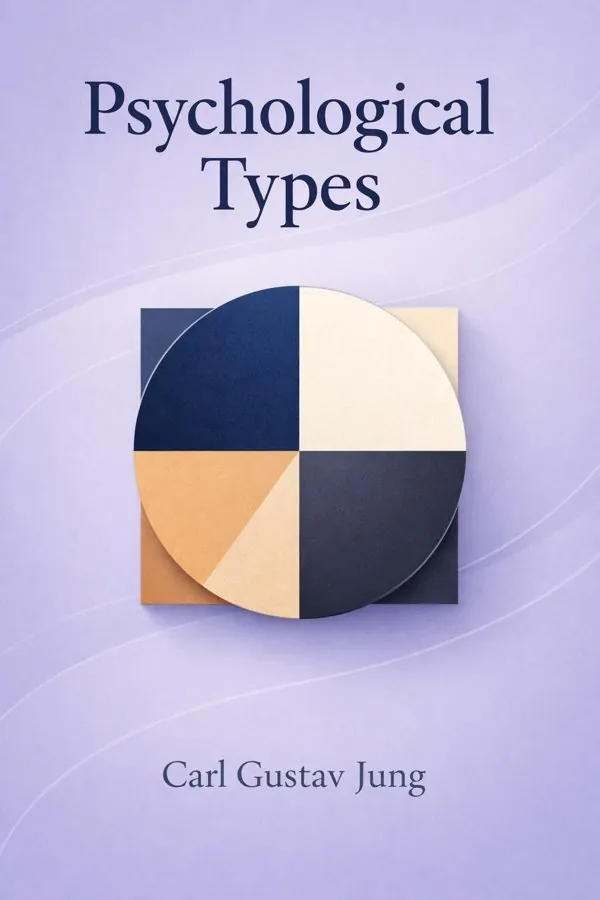
Psychological Types: Summary & Key Insights
 10 min4 chaptersAudio available
What Is Psychological Types About?
Psychological Types by Carl Gustav Jung is a psychology book spanning 4 pages. Originally published in 1921, 'Psychological Types' is one of Carl Gustav Jung’s major works. In this book, Jung introduces his theory of psychological types, which distinguishes between introversion and extraversion and identifies four primary psychological functions—thinking, feeling, sensation, and intuition. The work provides a profound analysis of individual differences in perception and behavior and has become foundational in personality psychology and typology studies.
This FizzRead summary covers all 4 key chapters of Psychological Types in approximately 10 minutes, distilling the most important ideas, arguments, and takeaways from Carl Gustav Jung's work. Also available as an audio summary and Key Quotes Podcast.
Psychological Types
Originally published in 1921, 'Psychological Types' is one of Carl Gustav Jung’s major works. In this book, Jung introduces his theory of psychological types, which distinguishes between introversion and extraversion and identifies four primary psychological functions—thinking, feeling, sensation, and intuition. The work provides a profound analysis of individual differences in perception and behavior and has become foundational in personality psychology and typology studies.
Who Should Read Psychological Types?
This book is perfect for anyone interested in psychology and looking to gain actionable insights in a short read. Whether you're a student, professional, or lifelong learner, the key ideas from Psychological Types by Carl Gustav Jung will help you think differently.
- ✓Readers who enjoy psychology and want practical takeaways
- ✓Professionals looking to apply new ideas to their work and life
- ✓Anyone who wants the core insights of Psychological Types in just 10 minutes
Want the full summary?
Get instant access to this book summary and 100K+ more with Fizz Moment.
Get Free SummaryAvailable on App Store • Free to download
Key Chapters
My analytical psychology is built upon the relationship between the conscious and the unconscious. Without understanding their structure and interaction, no psychological type can be truly grasped. Consciousness is the domain of everyday awareness—the stage of self-knowledge—while the unconscious is the unlit depths that store archetypes, emotions, and unintegrated impulses. Psychic energy flows constantly between these two realms, and its balance determines an individual’s mental stability and growth.
I have found that each person possesses a psychological center—an area of self-awareness—that floats like an island in the sea of the psyche. The power of the unconscious continuously influences consciousness, sometimes appearing through dreams, at other times through symptoms. A person’s psychological type often develops through this interplay. An overly introverted person may concentrate psychic energy inward and neglect external interaction, which can lead to detachment from reality. Conversely, a person who is excessively extroverted may scatter their energy on outward objects, losing touch with their inner dialogue.
The aim of analytical psychology is to restore humankind’s vision of the psyche as a whole. We should not treat consciousness and the unconscious as opposites but as complements. Conscious development enriches the materials of the unconscious, while unconscious content offers new inspiration to consciousness. This balance forms the foundation of what I later called individuation—the process by which psychological growth is achieved through integration.
Introversion and extroversion are the two fundamental attitudes of the human psyche. I regard them as mechanisms that direct the flow of psychic energy. When a person’s energy is primarily oriented toward the external world and objective phenomena, an extroverted attitude forms; when the energy turns inward toward thoughts, feelings, and subjective experience, an introverted tendency takes shape.
Extroverts focus their lives outward. They validate themselves through action, social connection, and objective fact, thriving on engagement and external stimuli. They seek new experiences and often measure themselves by external standards. Introverts, in contrast, direct their awareness inward. When confronted with outside stimulation, they first look within for meaning rather than reacting immediately. Their preference for reflection, solitude, and introspection does not signal indifference—it reflects that their psychic energy is concentrated in their inner world.
This difference in energy direction shapes two essential attitudes toward life. Extroverts pursue breadth—experience, pragmatism, and social exchange—while introverts seek depth—thought, meaning, and inner unity. Neither is superior, yet imbalance arises when individuals ignore their natural disposition. If an introvert forces themselves to live as an extrovert, they feel overwhelmed by external demands and lose touch with their center; if an extrovert denies their inner needs, they may experience emptiness and dependency.
True growth requires accepting one’s own psychological inclination and then finding balance with its opposite. When an introvert consciously opens to the outer world, their understanding of life deepens; when an extrovert learns to turn inward, they gain profound self-awareness. This harmony is an essential condition for individuation.
+ 2 more chapters — available in the FizzRead app
All Chapters in Psychological Types
About the Author
Carl Gustav Jung (1875–1961) was a Swiss psychiatrist and founder of analytical psychology. He is regarded as one of the most influential thinkers of the 20th century in psychology, philosophy, and religious studies. Jung developed key concepts such as the collective unconscious, archetypes, and individuation, which continue to influence psychotherapy and cultural theory today.
Get This Summary in Your Preferred Format
Read or listen to the Psychological Types summary by Carl Gustav Jung anytime, anywhere. FizzRead offers multiple formats so you can learn on your terms — all free.
Available formats: App · Audio · PDF · EPUB — All included free with FizzRead
Download Psychological Types PDF and EPUB Summary
Key Quotes from Psychological Types
“My analytical psychology is built upon the relationship between the conscious and the unconscious.”
“Introversion and extroversion are the two fundamental attitudes of the human psyche.”
Frequently Asked Questions about Psychological Types
Psychological Types by Carl Gustav Jung is a psychology book that explores key ideas across 4 chapters. Originally published in 1921, 'Psychological Types' is one of Carl Gustav Jung’s major works. In this book, Jung introduces his theory of psychological types, which distinguishes between introversion and extraversion and identifies four primary psychological functions—thinking, feeling, sensation, and intuition. The work provides a profound analysis of individual differences in perception and behavior and has become foundational in personality psychology and typology studies.
More by Carl Gustav Jung

You Might Also Like
The Body Keeps the Score
Bessel van der Kolk
10 min
Surrounded by Idiots
Thomas Erikson
10 min
Emotional Intelligence
Daniel Goleman
10 min
Attached
Amir Levine
10 min
Why Does He Do That
Lundy Bancroft
10 min
Women Who Run with the Wolves
Clarissa Pinkola Estés
10 minBrowse by Category
Ready to read Psychological Types?
Get the full summary and 100K+ more books with Fizz Moment.