
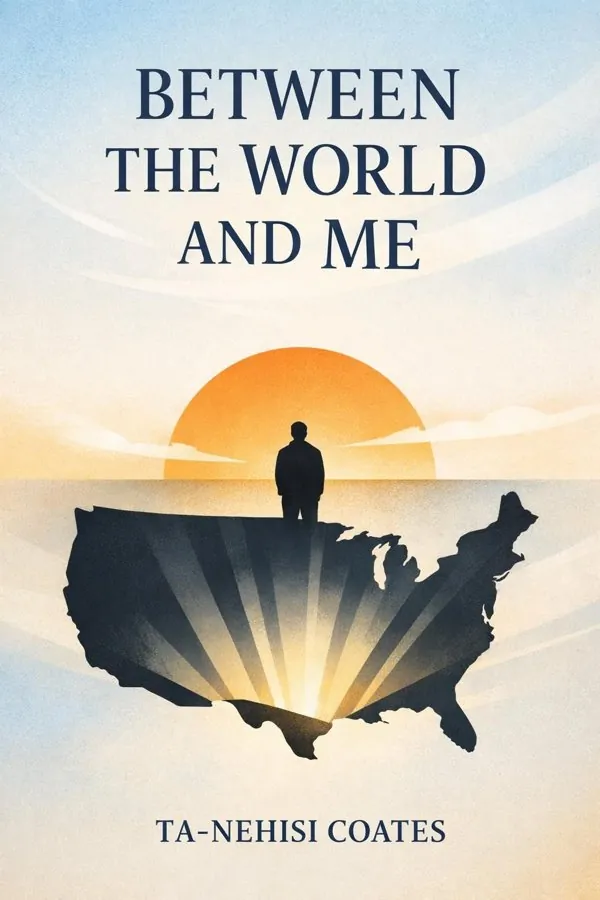
Between the World and Me: Summary & Key Insights
 10 min10 chaptersAudio available
Key Takeaways from Between the World and Me
A society reveals its deepest values by what it permits to happen to human bodies.
Children often learn their society’s truths before they know its theories.
The most transformative education often starts when we stop accepting the stories we were handed.
A nation’s past is never really past when its institutions still carry the shape of old violence.
Comfort often requires a story that hides its own cost.
What Is Between the World and Me About?
Between the World and Me by Ta-Nehisi Coates is a sociology book published in 2015 spanning 10 pages. Between the World and Me is Ta-Nehisi Coates’s searing, intimate meditation on race, history, and the fragility of the Black body in the United States. Written as a letter to his teenage son, the book blends memoir, social criticism, and philosophical reflection to confront a central American truth: racism is not just a matter of prejudice or bad intentions, but a force that has historically been enacted on Black bodies through violence, control, exclusion, and fear. Coates moves from his childhood in Baltimore to his education at Howard University, from national tragedies to personal grief, always returning to the question of how one lives honestly under such conditions. The book matters because it refuses comforting myths and instead offers moral clarity, emotional precision, and historical depth. Coates writes with the authority of a major public intellectual and journalist who has spent years examining American power, but also with the vulnerability of a father trying to prepare his son for the world as it is. The result is a modern classic that challenges readers to rethink identity, citizenship, and the American Dream.
This FizzRead summary covers all 10 key chapters of Between the World and Me in approximately 10 minutes, distilling the most important ideas, arguments, and takeaways from Ta-Nehisi Coates's work. Also available as an audio summary and Key Quotes Podcast.
Between the World and Me
Between the World and Me is Ta-Nehisi Coates’s searing, intimate meditation on race, history, and the fragility of the Black body in the United States. Written as a letter to his teenage son, the book blends memoir, social criticism, and philosophical reflection to confront a central American truth: racism is not just a matter of prejudice or bad intentions, but a force that has historically been enacted on Black bodies through violence, control, exclusion, and fear. Coates moves from his childhood in Baltimore to his education at Howard University, from national tragedies to personal grief, always returning to the question of how one lives honestly under such conditions. The book matters because it refuses comforting myths and instead offers moral clarity, emotional precision, and historical depth. Coates writes with the authority of a major public intellectual and journalist who has spent years examining American power, but also with the vulnerability of a father trying to prepare his son for the world as it is. The result is a modern classic that challenges readers to rethink identity, citizenship, and the American Dream.
Who Should Read Between the World and Me?
This book is perfect for anyone interested in sociology and looking to gain actionable insights in a short read. Whether you're a student, professional, or lifelong learner, the key ideas from Between the World and Me by Ta-Nehisi Coates will help you think differently.
- ✓Readers who enjoy sociology and want practical takeaways
- ✓Professionals looking to apply new ideas to their work and life
- ✓Anyone who wants the core insights of Between the World and Me in just 10 minutes
Want the full summary?
Get instant access to this book summary and 100K+ more with Fizz Moment.
Get Free SummaryAvailable on App Store • Free to download
Key Chapters
A society reveals its deepest values by what it permits to happen to human bodies. Coates builds his argument around this stark truth: racism is not only an abstract belief system or a collection of hateful attitudes. It is a material force that has again and again been imposed on Black bodies through slavery, policing, segregation, poverty, and the constant threat of physical harm. By focusing on the body, he strips away euphemism. He is talking about flesh, breath, bones, vulnerability, fear, and mortality. In his view, the Black body in America has never been fully protected by the promises of democracy, because the nation’s wealth and self-image were built in part through its exploitation.
This idea gives the book its moral urgency. Coates does not want his son to be lulled into thinking racism is merely a social misunderstanding that can be solved through politeness. He wants him to understand that racism has concrete consequences: where one can live, how one moves through public space, how police perceive a person, how quickly ordinary interactions can turn dangerous. Even dignity becomes physical, because to move through the world freely is to inhabit one’s body without constant surveillance.
In practical terms, this perspective changes how readers think about justice. It shifts attention from slogans to systems: school inequality, housing discrimination, incarceration, health disparities, and state violence. It asks us to examine who is protected, who is exposed, and who is expected to absorb risk.
Actionable takeaway: When evaluating any social issue, ask a simple question: whose bodies are safest, whose are most vulnerable, and what structures produce that imbalance?
Children often learn their society’s truths before they know its theories. Coates’s memories of growing up in Baltimore show how fear can become an informal education. In his neighborhood, danger was not an idea discussed in books; it was a practical reality that shaped posture, speech, timing, clothing, and awareness. He learned how to read faces, streets, and shifting moods because mistakes could carry real consequences. This education in fear came not only from the streets but from the broader conditions created by inequality, disinvestment, and a society that had abandoned certain communities while blaming them for the resulting damage.
What makes these passages powerful is that Coates refuses simplistic explanations. He does not romanticize violence, nor does he reduce it to individual moral failure. Instead, he shows how children are socialized by environments they did not choose. Parents become strict not because they enjoy control, but because they know the world may punish their children more harshly than they ever could. Fear becomes a language of care distorted by danger.
This has broad application beyond Coates’s own life. Many people inherit coping strategies from unstable environments: always scanning for threat, mistrusting institutions, or equating toughness with survival. Understanding this helps readers interpret behavior with more compassion and less judgment. It also highlights why equal opportunity cannot exist where safety itself is unevenly distributed.
For educators, parents, and leaders, the lesson is clear: behavior often reflects adaptation to conditions, not character alone. If we want different outcomes, we must change the environment, not just lecture individuals.
Actionable takeaway: Before judging how people respond to pressure, ask what fears their environment has trained them to carry.
The most transformative education often starts when we stop accepting the stories we were handed. Coates describes schooling as a place that frequently demanded obedience rather than deep understanding. He felt alienated by a version of education that celebrated national myths while avoiding the violence, theft, and exclusion that shaped the country. For him, true learning emerged elsewhere: in reading, questioning, conversations, and relentless self-instruction. This process reached a new intensity at Howard University, which he calls “The Mecca,” a place where he encountered the breadth of Black thought, culture, difference, and intellectual possibility.
This idea matters because Coates distinguishes between information and awakening. Formal education can provide facts, but genuine awareness requires intellectual independence. At Howard, he discovered that Black identity was not one story but many stories. He met people from different regions, classes, backgrounds, and ideologies. That complexity deepened his thinking and freed him from narrow definitions of self. Education, in this sense, became less about memorizing approved narratives and more about learning how to ask better questions.
Readers can apply this insight by treating education as an active practice rather than a passive credential. That might mean reading history from multiple perspectives, seeking writers outside the mainstream canon, joining discussion groups, or examining whose voices are missing from what we call common knowledge. It also means being willing to have cherished assumptions challenged.
Coates models a form of literacy that is moral as well as intellectual: the courage to look directly at reality, even when reality threatens identity or comfort. Such inquiry does not guarantee easy answers, but it does make shallow thinking harder to sustain.
Actionable takeaway: Build a personal curriculum around questions that unsettle you, not just subjects that confirm what you already believe.
A nation’s past is never really past when its institutions still carry the shape of old violence. Coates insists that racial injustice in America cannot be understood as a closed chapter. The legacy of slavery, Reconstruction’s collapse, segregation, redlining, mass incarceration, and discriminatory policy is not symbolic residue; it is embedded in neighborhoods, wealth gaps, schools, policing, and public memory. To speak of history as over is, in his view, to misunderstand how power works. Time alone does not erase structures built over centuries.
This argument challenges the comforting habit of separating then from now. Many people acknowledge slavery as evil while resisting any connection between that history and present inequality. Coates rejects that separation. If one generation is dispossessed and another accumulates advantage, the effects cascade. Wealth is inherited. Trauma is inherited. Access is inherited. So are narratives that justify these arrangements. Historical amnesia becomes a tool of innocence.
A practical example is housing. Mid-20th-century policies excluded many Black families from homeownership or confined them to neighborhoods stripped of investment. The consequences appear generations later in wealth accumulation, school funding, and community stability. This is not ancient history; it is living architecture.
The broader lesson is that justice requires historical literacy. Without it, people interpret present inequality as random or self-caused. With it, patterns become visible. Coates invites readers to replace mythic national memory with evidence-based moral memory.
Actionable takeaway: When confronting a present-day inequality, trace its historical roots before drawing conclusions about who is responsible or what fairness requires.
Comfort often requires a story that hides its own cost. One of Coates’s most enduring ideas is his critique of what he calls the Dream: a vision of suburban ease, security, innocence, and national goodness often associated with white middle-class life. This Dream appears wholesome on the surface, but Coates argues that it is sustained by forgetting. It depends on ignoring the labor, theft, exclusion, and violence that made such comfort possible. It is not merely an aspiration to a better life; it is a mythology that protects itself by denying history.
Coates’s critique is powerful because it targets not individual happiness but collective innocence. The Dream invites people to believe that success is natural, deserved, and detached from structural advantage. It turns national identity into a bedtime story. Those inside it can regard injustice as accidental, distant, or already solved. Those excluded from it are often blamed for not achieving what was never equally available.
This idea has practical relevance in everyday conversations about meritocracy, safety, schooling, neighborhoods, and patriotism. When people describe a community as “good” or “stable,” what unspoken exclusions made that possible? When they celebrate personal success, what systems cleared the path for some and obstructed it for others? Coates urges readers to interrogate not just oppression, but the narratives that make oppression invisible.
The point is not to reject hope or comfort altogether. It is to refuse comfort purchased through denial. A more honest society would seek shared flourishing without mythologizing its past or sanctifying unequal arrangements.
Actionable takeaway: Whenever a national story sounds too clean, ask what suffering, exclusion, or erasure had to be omitted to make it sound that way.
Love becomes more difficult when honesty threatens peace. One of the book’s deepest tensions lies in Coates’s role as a father. He is writing to his son out of protection, but he refuses the protective instinct that relies on false promises. He will not tell his son that America inevitably bends toward justice, that hard work guarantees safety, or that racism can be escaped through perfect conduct. Instead, he offers something sterner and, in his view, more loving: the truth as he understands it. This makes the book not only a social analysis but also a meditation on what responsible parenting looks like under unjust conditions.
Coates presents parenthood as a moral balancing act. A parent must preserve a child’s sense of wonder while preparing him for danger. Too much fear can wound; too much optimism can mislead. His solution is neither despair nor false hope, but consciousness. He wants his son to know the world clearly enough to move through it with dignity, skepticism, and self-possession.
This idea resonates beyond race. Parents everywhere confront the challenge of explaining a broken world to children without crushing their spirit. Whether the issue is discrimination, economic instability, war, or climate anxiety, the question is similar: how do you tell the truth without extinguishing possibility? Coates suggests that honesty can itself be a form of care. It treats children as future moral agents rather than passive recipients of comforting myths.
In practice, this means having age-appropriate but real conversations, encouraging critical thinking, and making room for children’s emotions rather than suppressing them. It also means modeling integrity: speaking plainly about danger while still affirming the value of beauty, community, and struggle.
Actionable takeaway: When guiding younger people, choose truthful preparation over easy reassurance, and pair hard realities with language that preserves dignity.
The categories that govern society often feel natural precisely because they were made powerful. Coates treats race not as a biological truth but as a social invention with deadly consequences. In his framing, people become “white” through historical processes of power, exclusion, and self-protection, not through timeless essence. This distinction matters because it shifts the conversation away from identity as mere culture and toward identity as structure. Race in America has been used to allocate safety, resources, innocence, and authority.
By focusing on the invention of whiteness, Coates also challenges the language of neutrality. White America is not simply a generic mainstream from which others deviate. It is a historically produced position often shielded from seeing itself as racial at all. That invisibility helps maintain power. If one group is treated as universal, its assumptions can masquerade as common sense.
Readers can apply this idea by paying attention to how institutions encode racial advantage without overtly racist language. Hiring practices, media representations, school boundaries, lending standards, and policing patterns can all reproduce inequality while appearing race-neutral. Understanding race as a system of power makes these dynamics easier to recognize.
This perspective also invites humility in personal relationships. Conversations about race are often derailed by a focus on individual intent. Coates redirects attention to what systems do, regardless of whether individuals feel benevolent. That does not eliminate personal responsibility; it deepens it. One must examine not only prejudice but participation in structures.
Actionable takeaway: In discussions about race, look beyond personal attitudes and ask how institutions distribute risk, opportunity, and legitimacy across different groups.
Sometimes distance is what allows a country to come into focus. Coates describes travel, especially to Paris, as a liberating and disorienting experience. Outside the United States, he found new ways of inhabiting his body and observing race. He does not claim that other countries are free of prejudice, but the change in context helped him see that many assumptions he had internalized were specifically American. Travel loosened the grip of inevitability. What had seemed natural at home appeared contingent abroad.
This matters because oppressive systems gain power by presenting themselves as the only possible reality. A different environment can expose those systems as historical arrangements rather than universal truths. Coates’s travel broadens his understanding not just of America but of Black identity. It reminds him that Blackness is global, varied, and not confined to the narrow scripts imposed by American racial ideology.
The practical application is not that everyone must travel internationally, though cross-cultural experience can be invaluable. The deeper point is to seek perspective beyond familiar narratives. That can happen through books, films, friendships, study, language learning, or serious engagement with other histories and societies. Exposure to different frameworks helps people recognize the assumptions hidden in their own worldview.
Travel, in Coates’s sense, is intellectual as much as geographic. It is the act of stepping outside inherited categories long enough to see them. Such perspective does not solve injustice, but it can loosen the fatalism that keeps people from imagining alternatives.
Actionable takeaway: Regularly place yourself in contexts that challenge your cultural assumptions, and use that distance to reexamine what your own society treats as normal.
Not every honest book ends with comfort; some end with responsibility. Coates closes much of his reflection by emphasizing continuity. The struggle against racial injustice did not begin with his generation, and it will not end neatly with it either. He sees himself as part of a long lineage of people trying to understand, endure, resist, and speak clearly about America’s contradictions. Legacy, in this sense, is not an inheritance of triumph but of witness. To tell the truth and pass it on is itself a form of resistance.
This idea is crucial because it offers an alternative to both naive optimism and total despair. Coates does not promise redemption, but neither does he endorse passivity. Meaning can be found in consciousness, solidarity, intellectual honesty, and the refusal to surrender one’s humanity to a false national script. To continue the struggle is not only to protest or organize, though those matter; it is also to remember, study, speak, create, and protect one another.
In practical terms, legacy asks what we hand to the next generation besides anxiety. Do we pass down silence or language? Shame or clarity? Isolation or community? For institutions, legacy means deciding whether to preserve myths or cultivate truth. For individuals, it means contributing to a moral inheritance larger than personal success.
Readers may find this especially relevant in times of backlash or fatigue. Social change is rarely linear, and setbacks can tempt people into cynicism. Coates reminds us that endurance has intellectual and ethical dimensions. To remain awake is itself a discipline.
Actionable takeaway: Think of your role in social change as intergenerational—commit to one concrete act of truth-telling, learning, or solidarity that outlasts the present moment.
All Chapters in Between the World and Me
About the Author
Ta-Nehisi Coates is an American author, journalist, essayist, and educator whose work has shaped contemporary conversations about race, democracy, and history in the United States. Born in Baltimore in 1975, he first gained major recognition for his essays and reporting, especially during his time as a national correspondent for The Atlantic. His writing is known for combining personal experience with rigorous historical analysis and a distinctive literary voice. Coates is the author of the bestselling books Between the World and Me, We Were Eight Years in Power, and The Water Dancer, and he has also written for comics, including Black Panther. Widely regarded as one of the most influential public intellectuals of his generation, Coates has received numerous honors for his contributions to literature and public discourse.
Get This Summary in Your Preferred Format
Read or listen to the Between the World and Me summary by Ta-Nehisi Coates anytime, anywhere. FizzRead offers multiple formats so you can learn on your terms — all free.
Available formats: App · Audio · PDF · EPUB — All included free with FizzRead
Download Between the World and Me PDF and EPUB Summary
Key Quotes from Between the World and Me
“A society reveals its deepest values by what it permits to happen to human bodies.”
“Children often learn their society’s truths before they know its theories.”
“The most transformative education often starts when we stop accepting the stories we were handed.”
“A nation’s past is never really past when its institutions still carry the shape of old violence.”
“Comfort often requires a story that hides its own cost.”
Frequently Asked Questions about Between the World and Me
Between the World and Me by Ta-Nehisi Coates is a sociology book that explores key ideas across 10 chapters. Between the World and Me is Ta-Nehisi Coates’s searing, intimate meditation on race, history, and the fragility of the Black body in the United States. Written as a letter to his teenage son, the book blends memoir, social criticism, and philosophical reflection to confront a central American truth: racism is not just a matter of prejudice or bad intentions, but a force that has historically been enacted on Black bodies through violence, control, exclusion, and fear. Coates moves from his childhood in Baltimore to his education at Howard University, from national tragedies to personal grief, always returning to the question of how one lives honestly under such conditions. The book matters because it refuses comforting myths and instead offers moral clarity, emotional precision, and historical depth. Coates writes with the authority of a major public intellectual and journalist who has spent years examining American power, but also with the vulnerability of a father trying to prepare his son for the world as it is. The result is a modern classic that challenges readers to rethink identity, citizenship, and the American Dream.
More by Ta-Nehisi Coates
You Might Also Like
Half the Sky
Nicholas D. Kristof, Sheryl WuDunn
10 min
Men Explain Things To Me
Rebecca Solnit
10 min
Rational Ritual
Michael Suk-Young Chwe
10 min
The New Jim Crow
Michelle Alexander
10 min
Beyond Culture
Edward T. Hall
10 min
Invisible Women: Exposing Data Bias in a World Designed for Men
Caroline Criado Perez
10 minFeatured In
Browse by Category
Ready to read Between the World and Me?
Get the full summary and 100K+ more books with Fizz Moment.