
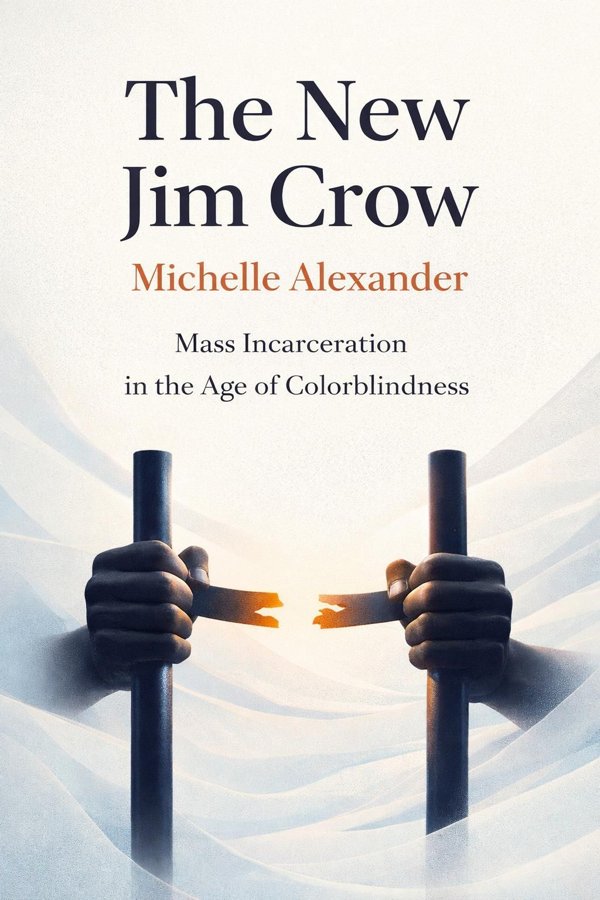
The New Jim Crow: Summary & Key Insights
 10 min9 chaptersAudio available
Key Takeaways from The New Jim Crow
A society does not need to use openly racist language to maintain racial hierarchy; it only needs institutions that reproduce it.
The front door to mass incarceration is not the courtroom or prison gate; it is the street corner.
Justice is often imagined as blind, but Alexander shows how legal discretion can produce predictable inequality.
For many people, the sentence does not end when they leave jail or prison; it becomes a lifelong status.
One of the book’s sharpest insights is that colorblind language can hide deeply racial outcomes.
What Is The New Jim Crow About?
The New Jim Crow by Michelle Alexander is a sociology book published in 2010 spanning 6 pages. What if the end of explicit segregation did not end racial caste in America, but simply redesigned it? In The New Jim Crow, Michelle Alexander argues that mass incarceration has become the latest system for managing and marginalizing Black Americans after slavery and Jim Crow. Her central claim is unsettling: the U.S. criminal justice system, often presented as neutral and colorblind, has operated in practice as a powerful mechanism of racial control. Through laws, policing strategies, prosecutorial discretion, sentencing rules, and the stigma attached to a criminal record, millions of people are pushed into a permanent second-class status. This book matters because it shifts the conversation from individual prejudice to institutional design. Alexander shows how policies such as the War on Drugs, stop-and-frisk, plea bargaining, and felony disenfranchisement combine to produce consequences that extend far beyond prison walls. The result is a caste-like system affecting employment, housing, education, voting, and family stability. Alexander writes with the authority of a civil rights lawyer and legal scholar who has worked closely on racial justice issues. Her book remains one of the most influential critiques of the American justice system, challenging readers to question comforting myths about fairness, crime, and equality.
This FizzRead summary covers all 9 key chapters of The New Jim Crow in approximately 10 minutes, distilling the most important ideas, arguments, and takeaways from Michelle Alexander's work. Also available as an audio summary and Key Quotes Podcast.
The New Jim Crow
What if the end of explicit segregation did not end racial caste in America, but simply redesigned it? In The New Jim Crow, Michelle Alexander argues that mass incarceration has become the latest system for managing and marginalizing Black Americans after slavery and Jim Crow. Her central claim is unsettling: the U.S. criminal justice system, often presented as neutral and colorblind, has operated in practice as a powerful mechanism of racial control. Through laws, policing strategies, prosecutorial discretion, sentencing rules, and the stigma attached to a criminal record, millions of people are pushed into a permanent second-class status.
This book matters because it shifts the conversation from individual prejudice to institutional design. Alexander shows how policies such as the War on Drugs, stop-and-frisk, plea bargaining, and felony disenfranchisement combine to produce consequences that extend far beyond prison walls. The result is a caste-like system affecting employment, housing, education, voting, and family stability. Alexander writes with the authority of a civil rights lawyer and legal scholar who has worked closely on racial justice issues. Her book remains one of the most influential critiques of the American justice system, challenging readers to question comforting myths about fairness, crime, and equality.
Who Should Read The New Jim Crow?
This book is perfect for anyone interested in sociology and looking to gain actionable insights in a short read. Whether you're a student, professional, or lifelong learner, the key ideas from The New Jim Crow by Michelle Alexander will help you think differently.
- ✓Readers who enjoy sociology and want practical takeaways
- ✓Professionals looking to apply new ideas to their work and life
- ✓Anyone who wants the core insights of The New Jim Crow in just 10 minutes
Want the full summary?
Get instant access to this book summary and 100K+ more with Fizz Moment.
Get Free SummaryAvailable on App Store • Free to download
Key Chapters
A society does not need to use openly racist language to maintain racial hierarchy; it only needs institutions that reproduce it. Michelle Alexander’s first major insight is that every major racial caste system in American history emerged when an older one became politically unsustainable. Slavery gave way to Jim Crow after emancipation, and when Jim Crow was dismantled through civil rights struggles, a new system of control gradually arose through crime policy and punishment.
Alexander argues that this shift did not happen by accident. During moments of social change, formal equality can coexist with new mechanisms of exclusion. In the late twentieth century, politicians increasingly framed crime, drugs, and urban disorder in coded racial terms. These narratives helped justify policies that disproportionately targeted Black communities while preserving the appearance of race neutrality. Instead of saying a group is inferior by law, the system labels people criminals and treats them as disposable.
This matters because many people assume racism exists only when it is explicit. Alexander asks readers to look at outcomes, not just language. If a legal system consistently strips one group of voting rights, jobs, housing access, and social legitimacy, then it can function like caste even without segregation signs or racial slurs.
A practical example is felony disenfranchisement. A person may serve a sentence, yet still lose political voice long afterward. Similar restrictions affect public benefits, licensing, and employment. These punishments extend social control well beyond prison.
Actionable takeaway: when evaluating claims of fairness, ask not only whether a policy is race-neutral on paper, but whether its real-world effects recreate old hierarchies under a new name.
The front door to mass incarceration is not the courtroom or prison gate; it is the street corner. Alexander emphasizes that to understand the New Jim Crow, we must begin with policing. In many poor Black and brown neighborhoods, law enforcement is experienced less as public service and more as constant surveillance. The War on Drugs dramatically expanded police power, encouraged aggressive tactics, and normalized the treatment of entire communities as suspect.
Drug crime did not rise in a way that justified such extraordinary responses, Alexander argues. In fact, drug use and drug sales occur across racial lines. Yet enforcement has been overwhelmingly concentrated in neighborhoods already marked by poverty, segregation, and limited political power. Police use stop-and-frisk, pretextual stops, sweeps, raids, and consent searches to generate arrests, often for low-level offenses.
A key point is that selective enforcement creates the statistics later used to justify even more policing. If officers repeatedly search one neighborhood, they will find more offenses there than in communities left largely unpoliced. This makes targeted communities appear more criminal, even when similar behavior exists elsewhere.
Practical examples include housing projects flooded with patrols, students growing up under routine stop-and-search practices, and drivers pulled over for minor technical violations that lead to broader searches. Over time, residents internalize the expectation that they are always under suspicion.
Actionable takeaway: when discussing crime data or public safety, examine where police resources are deployed, what tactics are used, and how unequal surveillance shapes the numbers we take for objective truth.
Justice is often imagined as blind, but Alexander shows how legal discretion can produce predictable inequality. The criminal justice system does not operate through fixed rules alone. Police choose whom to stop, prosecutors decide what charges to file, judges determine bail and sentencing within broad ranges, and defense quality varies widely depending on wealth. At every stage, discretion creates opportunities for racial disparities to deepen.
One of Alexander’s most powerful arguments is that constitutional protections have been weakened in the name of crime control. Courts have frequently allowed broad police authority, especially in drug cases. A traffic stop can become a fishing expedition. Consent searches can occur under intimidating conditions. Prosecutors can pressure defendants into plea bargains by threatening harsher penalties at trial. Since most cases never reach trial, formal rights often exist more on paper than in lived experience.
This system particularly harms poor defendants. Someone unable to afford bail may plead guilty just to go home sooner. Someone with an overworked public defender may accept a plea without fully understanding lifelong consequences. These are not exceptional cases; they are routine features of the system.
Consider two defendants charged with similar conduct. The wealthier one hires a private attorney, secures release, negotiates a better outcome, and protects future opportunities. The poorer one remains detained, loses work, accepts a plea, and leaves with a record that triggers years of exclusion.
Actionable takeaway: if you want to evaluate whether a justice system is fair, look beyond formal rights and ask who can actually exercise them, who faces pressure to surrender them, and how discretion operates in practice.
For many people, the sentence does not end when they leave jail or prison; it becomes a lifelong status. Alexander calls attention to the invisible punishment imposed by a criminal record. Once labeled a felon, a person can be denied jobs, housing, public assistance, educational opportunities, professional licenses, and the right to vote. These barriers create a social condition strikingly similar to the legally enforced second-class citizenship of earlier eras.
This is why Alexander insists that mass incarceration is not just about how many people are locked up. It is about what happens after release. Reentry is often described as a matter of personal responsibility, but the system imposes obstacles that make stable reintegration extraordinarily difficult. Employers screen out applicants with records. Landlords reject tenants. People may be excluded from jury service and civic participation. The mark of criminality follows them into every basic life domain.
The practical consequences are severe. A father returning home may want to support his family but cannot find legal work. A woman trying to rent an apartment is denied repeatedly because of her record. Someone who has served time for a drug offense may be blocked from benefits needed to survive. These conditions do not simply punish individuals; they destabilize families and whole neighborhoods.
Alexander’s point is broader than sympathy for formerly incarcerated people. A democracy that permanently stigmatizes millions creates a caste boundary between the deserving and the disposable.
Actionable takeaway: whenever you think about criminal punishment, include collateral consequences in the picture and support policies such as fair-chance hiring, housing protections, and restoration of voting rights.
One of the book’s sharpest insights is that colorblind language can hide deeply racial outcomes. After the victories of the civil rights movement, overt racism became less socially acceptable in public life. Yet Alexander argues that racial control adapted rather than disappeared. Politicians and policymakers increasingly spoke in terms of crime, drugs, welfare dependency, and law and order. These terms sounded race-neutral, but they often activated racial fear and resentment without naming race directly.
This is crucial because many people believe that if a law does not mention race, it cannot be racist. Alexander rejects that narrow view. Systems can be designed, justified, and implemented in ways that disproportionately burden a racial group while preserving plausible deniability. Colorblindness, in this context, becomes a shield against criticism. If everyone is supposedly treated the same, then unequal outcomes can be blamed on culture, choices, or morality rather than policy.
A practical example is the War on Drugs. Drug use is not exclusive to any one racial group, yet enforcement targeted Black communities with extraordinary intensity. The result was not only higher arrest rates but also a public image of Black criminality that further legitimized punitive policy.
Alexander encourages readers to question narratives that isolate social problems from historical context. Segregation, disinvestment, school inequality, and unemployment do not disappear from the story just because policy language avoids racial categories.
Actionable takeaway: when you hear a policy defended as neutral, ask what history produced it, who is most affected by it, and whether race has simply been replaced by coded language that serves the same social function.
It is tempting to think of the prison boom as the unfortunate result of rising crime, but Alexander argues that mass incarceration was built through deliberate political and institutional choices. The expansion of punishment in the United States was fueled by policy incentives, electoral strategy, media narratives, and bureaucratic momentum. In other words, this system did not just happen; it was made.
Alexander traces how the War on Drugs accelerated even when drug crime was not the nation’s most urgent threat. Federal funding rewarded local police departments for drug arrests and military-style operations. Politicians discovered that tough-on-crime rhetoric was electorally useful. Media coverage amplified fear. Prosecutors gained leverage through mandatory minimums and broad charging discretion. Courts largely deferred to law enforcement in the name of public safety. Together, these forces created a self-reinforcing machinery.
This systems view matters because it shifts attention away from individual bad actors alone. A few biased officers or harsh judges cannot explain why millions of people became entangled in punitive institutions. The incentives were structural. Police departments measured success by arrests. Prosecutors built careers on conviction rates. Communities with little political clout bore the burden.
In practical terms, this means reform cannot stop at training or better rhetoric. If funding formulas reward arrests, if plea bargaining remains coercive, and if collateral consequences remain severe, then inequality will continue under updated language.
Actionable takeaway: analyze criminal justice issues as interconnected systems of incentives, not isolated events, and support reforms that change structures such as sentencing laws, funding priorities, and post-release barriers.
When a society treats crime only as an individual moral defect, it becomes easier to ignore the conditions that shape who gets punished. Alexander does not excuse harmful behavior, but she insists that crime policy in America has often severed conduct from context. Poverty, residential segregation, underfunded schools, unemployment, trauma, and addiction are pushed aside while punishment is framed as the sole rational response.
This selective moralism is central to the New Jim Crow. Middle-class drug use may be medicalized or minimized, while similar behavior in poor Black neighborhoods is criminalized. Corporate wrongdoing can produce immense social harm but rarely carries the same stigma as street-level offenses. The line between who is seen as redeemable and who is seen as dangerous is not drawn equally.
Alexander asks readers to notice how this framing distorts public empathy. Once someone is labeled a criminal, broader social failures disappear from view. The person becomes the problem. That logic helps justify harsh policy and widespread exclusion.
A practical application of this idea is to compare investment choices. A city can fund treatment, mental health services, youth programs, housing support, and job creation, or it can devote growing resources to policing and incarceration. Those are not neutral decisions; they reflect assumptions about whose suffering deserves care and whose suffering deserves control.
Actionable takeaway: whenever crime is discussed, widen the frame to include social conditions, unequal opportunity, and the difference between accountability that restores people and punishment that permanently casts them out.
Oppressive systems endure not only through laws but through the stories people are afraid to tell. Alexander highlights how stigma keeps mass incarceration politically invisible. Because those caught in the system are labeled criminals, many Americans feel little obligation to defend them. Families may hide incarceration out of shame. People returning home often remain silent to avoid further discrimination. This silence allows the system to operate with less scrutiny.
Unlike the civil rights struggles of the mid-twentieth century, mass incarceration does not always present dramatic, easily photographed scenes of injustice. Much of its power lies in administrative routine: background checks, plea forms, parole rules, housing applications, voter restrictions. These bureaucratic practices lack the visual shock of segregated lunch counters, yet they can be equally devastating over time.
Alexander argues that stigma also fractures solidarity. Poor whites may support punitive systems that ultimately harm them too because racialized narratives encourage them to identify more with authority than with marginalized communities. Meanwhile, middle-class Americans may see incarceration as someone else’s issue.
Practical examples include job applicants screened out by automated databases, mothers hesitant to discuss a son’s imprisonment, and neighborhoods losing political power because large portions of their population are entangled in the justice system. The harm is dispersed, but cumulative.
Actionable takeaway: challenge stigma directly by treating people with records as full members of the community, listening to impacted voices, and refusing language that reduces human beings to their convictions.
Reform that only softens the edges of punishment may leave the underlying caste logic intact. In the book’s forward-looking sections, Alexander argues that meaningful change requires more than modest policy adjustments. A true movement must confront the moral and political assumptions that made mass incarceration acceptable in the first place. It must reject the idea that some populations are disposable.
Alexander calls for a broad human rights vision rooted in solidarity across race and class. She warns against reform efforts that focus only on the innocent, the nonviolent, or the exceptionally sympathetic. While those cases can mobilize attention, they may also reinforce the idea that others deserve exclusion. A deeper movement asks whether permanent civic death should exist at all, and whether punishment should be the primary response to social vulnerability.
This does not mean ignoring harm or abandoning public safety. Rather, it means redefining safety. Stable housing, good schools, addiction treatment, mental health care, and economic opportunity often do more to reduce harm than aggressive policing ever can. It also means centering people directly affected by the system in designing solutions.
Practical applications include supporting record-sealing laws, ending mandatory minimums, restoring voting rights, investing in community-based services, and building coalitions that connect racial justice to broader democratic renewal.
Actionable takeaway: do not stop at asking how to make punishment kinder; ask what kind of society would make large-scale exclusion unnecessary, and support movements that combine reform with a wider vision of justice.
All Chapters in The New Jim Crow
About the Author
Michelle Alexander is an American civil rights lawyer, legal scholar, and writer whose work focuses on racial justice, criminal law, and democratic inclusion. She has served as a law professor and held leadership roles in advocacy, including directing the Racial Justice Project at the ACLU of Northern California. Before gaining wide public recognition as an author, she worked on issues involving police practices, discrimination, and structural inequality in the legal system. Alexander is best known for The New Jim Crow, a landmark book that transformed public debate about mass incarceration by framing it as a contemporary system of racial caste. Her writing combines legal expertise with historical analysis and moral clarity, making complex institutional problems understandable to broad audiences. She remains an influential voice in conversations about civil rights, reform, and social justice.
Get This Summary in Your Preferred Format
Read or listen to the The New Jim Crow summary by Michelle Alexander anytime, anywhere. FizzRead offers multiple formats so you can learn on your terms — all free.
Available formats: App · Audio · PDF · EPUB — All included free with FizzRead
Download The New Jim Crow PDF and EPUB Summary
Key Quotes from The New Jim Crow
“A society does not need to use openly racist language to maintain racial hierarchy; it only needs institutions that reproduce it.”
“The front door to mass incarceration is not the courtroom or prison gate; it is the street corner.”
“Justice is often imagined as blind, but Alexander shows how legal discretion can produce predictable inequality.”
“For many people, the sentence does not end when they leave jail or prison; it becomes a lifelong status.”
“One of the book’s sharpest insights is that colorblind language can hide deeply racial outcomes.”
Frequently Asked Questions about The New Jim Crow
The New Jim Crow by Michelle Alexander is a sociology book that explores key ideas across 9 chapters. What if the end of explicit segregation did not end racial caste in America, but simply redesigned it? In The New Jim Crow, Michelle Alexander argues that mass incarceration has become the latest system for managing and marginalizing Black Americans after slavery and Jim Crow. Her central claim is unsettling: the U.S. criminal justice system, often presented as neutral and colorblind, has operated in practice as a powerful mechanism of racial control. Through laws, policing strategies, prosecutorial discretion, sentencing rules, and the stigma attached to a criminal record, millions of people are pushed into a permanent second-class status. This book matters because it shifts the conversation from individual prejudice to institutional design. Alexander shows how policies such as the War on Drugs, stop-and-frisk, plea bargaining, and felony disenfranchisement combine to produce consequences that extend far beyond prison walls. The result is a caste-like system affecting employment, housing, education, voting, and family stability. Alexander writes with the authority of a civil rights lawyer and legal scholar who has worked closely on racial justice issues. Her book remains one of the most influential critiques of the American justice system, challenging readers to question comforting myths about fairness, crime, and equality.
More by Michelle Alexander
You Might Also Like

Between the World and Me
Ta-Nehisi Coates
10 min
Half the Sky
Nicholas D. Kristof, Sheryl WuDunn
10 min
Men Explain Things To Me
Rebecca Solnit
10 min
Rational Ritual
Michael Suk-Young Chwe
10 min
Beyond Culture
Edward T. Hall
10 min
Invisible Women: Exposing Data Bias in a World Designed for Men
Caroline Criado Perez
10 minFeatured In
Browse by Category
Ready to read The New Jim Crow?
Get the full summary and 100K+ more books with Fizz Moment.