
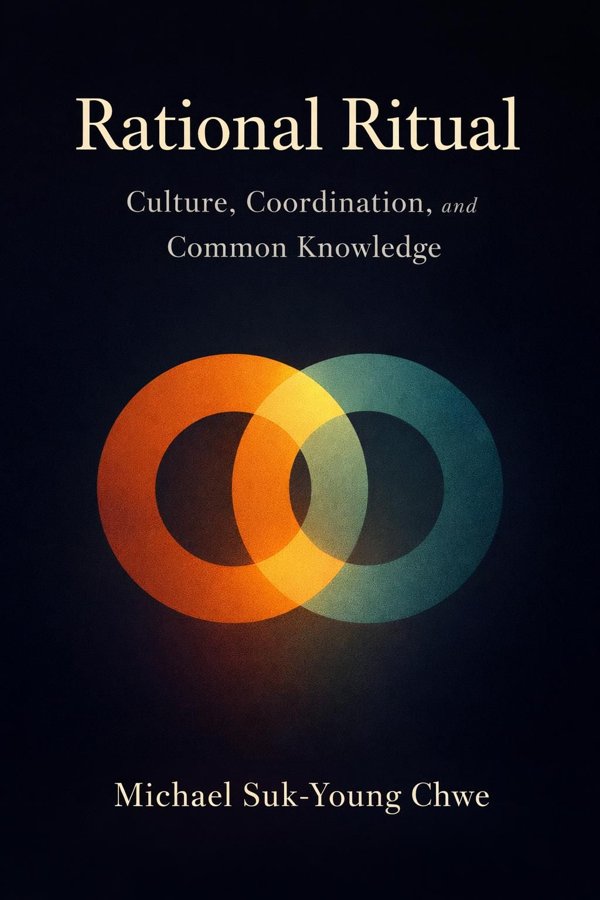
Rational Ritual: Summary & Key Insights
 10 min9 chaptersAudio available
Key Takeaways from Rational Ritual
Most social problems are not caused by ignorance alone, but by uncertainty about what other people know.
We often imagine social life as a contest of individual interests, yet many of our most important choices depend on alignment rather than rivalry.
A ritual may look ornamental from the outside, but its social function can be intensely practical.
Not all communication is equal.
Power often depends on keeping people uncertain about one another.
What Is Rational Ritual About?
Rational Ritual by Michael Suk-Young Chwe is a sociology book published in 2001 spanning 7 pages. Rational Ritual: Culture, Coordination, and Common Knowledge is a strikingly original book that explains why public ceremonies, media events, and shared cultural practices matter so much in social life. Michael Suk-Young Chwe argues that rituals are not merely symbolic leftovers from tradition or irrational displays of emotion. They are highly effective tools for creating common knowledge: not just information that many people possess, but information that everyone knows others possess as well. That difference, Chwe shows, is what makes coordinated action possible. Drawing on game theory, economics, sociology, anthropology, and political theory, Chwe offers a framework for understanding how people align behavior without direct negotiation. From festivals and political rallies to advertising and mass entertainment, public events help individuals become mutually aware of what others are seeing, thinking, and expecting. This insight helps explain everything from market behavior to protest movements and social norms. The book matters because it gives culture a rational structure without reducing it to cold calculation. Chwe, a leading political scientist and theorist of coordination, shows that ritual and reason are not opposites. In many cases, ritual is precisely what makes rational coordination possible.
This FizzRead summary covers all 9 key chapters of Rational Ritual in approximately 10 minutes, distilling the most important ideas, arguments, and takeaways from Michael Suk-Young Chwe's work. Also available as an audio summary and Key Quotes Podcast.
Rational Ritual
Rational Ritual: Culture, Coordination, and Common Knowledge is a strikingly original book that explains why public ceremonies, media events, and shared cultural practices matter so much in social life. Michael Suk-Young Chwe argues that rituals are not merely symbolic leftovers from tradition or irrational displays of emotion. They are highly effective tools for creating common knowledge: not just information that many people possess, but information that everyone knows others possess as well. That difference, Chwe shows, is what makes coordinated action possible.
Drawing on game theory, economics, sociology, anthropology, and political theory, Chwe offers a framework for understanding how people align behavior without direct negotiation. From festivals and political rallies to advertising and mass entertainment, public events help individuals become mutually aware of what others are seeing, thinking, and expecting. This insight helps explain everything from market behavior to protest movements and social norms.
The book matters because it gives culture a rational structure without reducing it to cold calculation. Chwe, a leading political scientist and theorist of coordination, shows that ritual and reason are not opposites. In many cases, ritual is precisely what makes rational coordination possible.
Who Should Read Rational Ritual?
This book is perfect for anyone interested in sociology and looking to gain actionable insights in a short read. Whether you're a student, professional, or lifelong learner, the key ideas from Rational Ritual by Michael Suk-Young Chwe will help you think differently.
- ✓Readers who enjoy sociology and want practical takeaways
- ✓Professionals looking to apply new ideas to their work and life
- ✓Anyone who wants the core insights of Rational Ritual in just 10 minutes
Want the full summary?
Get instant access to this book summary and 100K+ more with Fizz Moment.
Get Free SummaryAvailable on App Store • Free to download
Key Chapters
Most social problems are not caused by ignorance alone, but by uncertainty about what other people know. That is the powerful starting point of Rational Ritual. Chwe distinguishes between simple knowledge and common knowledge. It is one thing for you to know a fact, and for me to know it too. It is something far stronger for each of us to know that the other knows, to know that we know that, and so on. This layered mutual awareness is what game theorists call common knowledge, and it is often the hidden condition behind successful coordination.
Why does this matter? Because many decisions depend less on private belief than on expectations about others. Imagine an employee who suspects layoffs are coming. If she thinks everyone else is still calm, she may wait. But if the CEO announces the restructuring in an all-hands meeting, everyone hears it together, and everyone knows that everyone else heard it too. That shared awareness changes behavior immediately. Workers update plans, managers prepare responses, and markets react.
Common knowledge is essential in elections, social movements, product launches, school rules, emergency alerts, and cultural trends. A restaurant can quietly improve its menu, but a grand reopening event sends a different signal because it creates publicity and mutual visibility. The event is not only informative; it is coordinating.
Chwe’s point is that many institutions succeed because they generate this public, recursive awareness. Ceremonies, broadcasts, parades, and mass gatherings are socially consequential because they solve the problem of mutual uncertainty.
Actionable takeaway: When you need people to act together, do not just share information privately. Design communication so that everyone can see that everyone else received the same message.
We often imagine social life as a contest of individual interests, yet many of our most important choices depend on alignment rather than rivalry. Chwe uses game theory to shift attention from competitive situations to coordination problems, where the best outcome depends on people choosing in sync. In these cases, rationality is not about defeating others. It is about finding a shared focal point.
A classic example is deciding where to meet a friend in a city after losing phone service. The problem is not lack of intelligence or motivation. It is selecting the same option without communication. In larger social settings, the same issue appears in much higher-stakes contexts: whether citizens join a protest, whether consumers adopt a new technology, whether investors respond to signals, or whether neighbors evacuate during a crisis.
Coordination games reveal that people often need public cues, symbols, and visible commitments. These cues reduce ambiguity and make one option stand out. A national election date, a school graduation ceremony, a church bell, or a televised countdown can all function as devices that synchronize expectations. Even fashion trends and viral memes work this way. People adopt them not only because they like them, but because they believe others will recognize and adopt them too.
Chwe’s broader contribution is to show that culture often provides the focal points that economic models leave out. Rituals and shared symbols help people solve strategic uncertainty. They tell us not just what matters, but what others are likely to treat as meaningful.
Actionable takeaway: In any group effort, identify the coordination problem early and create a visible focal point, such as a public deadline, shared symbol, or common meeting place, to align expectations.
A ritual may look ornamental from the outside, but its social function can be intensely practical. Chwe argues that rituals are powerful because they create common knowledge among participants. A public ceremony does not merely express values; it makes those values visible, jointly witnessed, and therefore socially actionable. The ritual’s force lies in who sees it and who knows others have seen it.
Consider a wedding. Beyond personal emotion and symbolic beauty, the event publicly establishes a relationship. Family, friends, and community members witness vows together. That matters because the marriage is no longer just privately known by two individuals. It becomes socially recognized, and that recognition changes expectations, obligations, and future behavior. The same logic applies to inaugurations, graduations, funerals, oath-taking ceremonies, and religious observances.
Rituals often include repetition, spectacle, formal language, and a defined audience. These features are not accidental. Repetition reinforces recognition. Spectacle attracts attention. Formal language reduces ambiguity. A visible audience ensures that participants know the event was collectively witnessed. Through these mechanisms, rituals transform uncertain private states into publicly coordinated realities.
This also explains why organizations use rituals internally. Annual meetings, award ceremonies, onboarding events, and company town halls tell employees what the group values. More importantly, they make it clear that these priorities are now publicly known. A mission statement hidden in a PDF has limited force. A ritualized launch event creates alignment.
Actionable takeaway: If you want a commitment, value, or transition to have real social impact, mark it publicly with a ritual that others can witness and remember.
Not all communication is equal. A message sent privately informs, but a message broadcast publicly can coordinate. Chwe uses examples such as the Super Bowl to show that mass media can create extraordinary levels of common knowledge. A huge audience watches the same event at the same time, and crucially, viewers know that millions of others are doing the same. That shared attention has strategic value.
This helps explain why advertisers pay so much for certain broadcasts. The point is not merely reach. It is mutual visibility. A commercial shown during a massively shared event becomes a social reference point. People talk about it the next day because they assume others saw it too. The ad enters conversation, humor, imitation, and group identity. It becomes more than information; it becomes a public marker.
The same logic applies to political debates, royal weddings, award shows, major sporting events, and even viral livestreams. These are not just entertainment experiences. They are coordination platforms. Political leaders use them to signal priorities. Brands use them to launch identities. Social groups use them to synchronize interpretation.
In the digital age, this idea is even more relevant. Social media can spread information quickly, but fragmented audiences do not always produce common knowledge. A post may go viral within one niche while remaining invisible elsewhere. Chwe’s framework helps us see why broad, simultaneous, publicly recognized media moments still matter. Shared attention is scarce, and therefore valuable.
Actionable takeaway: When introducing an idea, campaign, or product that depends on social uptake, choose channels that create visible shared attention, not just high individual exposure.
Power often depends on keeping people uncertain about one another. Chwe shows that rulers, elites, and dominant institutions benefit when individuals remain isolated in their knowledge. If people each privately resent authority but believe others accept it, they may stay passive. Public rituals and visible gatherings can change that by revealing shared sentiment and creating common knowledge of potential collective action.
This insight helps explain why political regimes care so much about public assembly, censorship, and symbolic displays. Authoritarian governments stage parades and rallies to project strength, but citizens and dissidents can also use public events to demonstrate numbers, solidarity, and resolve. A protest is not only a statement to leaders. It is also a message to participants: you are not alone, and now everyone can see that.
Historical turning points often involve this shift from private grievance to public mutual awareness. Once enough people witness that others are willing to act, the strategic landscape changes. Fear declines, expectation rises, and action that once seemed impossible becomes rational. This dynamic appears in revolutions, labor strikes, civil rights marches, and campus movements.
At a smaller scale, the same pattern appears in workplaces and communities. If workers individually suspect unfair treatment, little may happen. But a public meeting, shared petition, or visible walkout creates common knowledge and can suddenly make coordination feasible.
Chwe’s contribution is to connect culture, visibility, and strategy. Ritual and publicity are not superficial additions to politics. They are part of the mechanism by which power is maintained or challenged.
Actionable takeaway: If a group is stuck in silent frustration, create safe, public ways for people to see one another’s commitment and shared concerns.
One of the boldest claims in Rational Ritual is that culture does not have to be understood as the opposite of rationality. Chwe rejects the familiar split between rational choice on one side and ritual, emotion, or symbolism on the other. He argues that many cultural practices make sense precisely because they help people solve real coordination problems. In that view, culture is not irrational residue. It is strategic infrastructure.
This does not mean every ritual is consciously designed or mathematically optimized. Rather, it means cultural forms can persist because they perform useful social functions. Repeated holidays coordinate calendars. Etiquette stabilizes expectations. Public ceremonies mark transitions in ways that reduce ambiguity. Shared stories, songs, and symbols make collective identity easier to activate. What looks purely expressive may also be deeply functional.
This perspective bridges disciplines that often speak past one another. Economists tend to focus on incentives, while anthropologists and sociologists emphasize meaning. Chwe shows that meaning and incentives are often intertwined. A flag, anthem, or graduation robe has symbolic importance, but that symbolism also helps large numbers of people coordinate around institutions and identities.
The practical value of this argument is enormous. Leaders, organizers, educators, and designers should not dismiss ceremony as fluff. Nor should they treat people as only calculators of private advantage. Human beings respond to shared symbols because those symbols help organize expectations and action.
Actionable takeaway: When evaluating a cultural practice, ask not only what it means, but what kind of coordination it enables and why that function may sustain it over time.
Chwe is especially interesting because he does not confine his argument to formal institutions or obvious rituals. His ideas also illuminate literature, drama, and shared artistic experience. Stories, performances, and cultural texts can create common reference points that help people interpret the world together. Art is not only personal expression; it can also be a coordination device.
A famous novel, a widely watched film, or a national anthem provides a shared vocabulary. People can refer to a character, scene, or phrase and assume others understand the meaning. This lowers the cost of communication and allows subtle forms of alignment. Political speeches borrow literary references to signal ideals. Movements adopt songs because they synchronize emotion and identity. Television finales, blockbuster franchises, and school reading lists shape what groups can discuss and recognize together.
This is why canon formation matters socially. When many people know the same cultural material, they gain common symbolic resources. Even disagreement becomes easier because the object of disagreement is shared. In that sense, public culture can create platforms for both solidarity and debate.
Organizations and communities can use this principle intentionally. Shared case studies, founding stories, mottos, and commemorative videos help groups coordinate interpretation. They answer not only “what happened” but “what does this mean for us together?” A team retreat that includes a common narrative can produce more alignment than a spreadsheet full of metrics.
Actionable takeaway: Build shared references into group life through stories, symbols, and repeated cultural touchpoints that people can easily recognize and invoke together.
All Chapters in Rational Ritual
About the Author
Michael Suk-Young Chwe is a political scientist and scholar known for his innovative work on game theory, social coordination, and culture. He has taught at the University of California, Los Angeles, where his research has explored how people act together under conditions of mutual awareness and strategic uncertainty. Chwe is especially notable for applying formal analytical tools to subjects often treated through sociology, anthropology, and literary studies. In Rational Ritual, he examines how rituals, ceremonies, media events, and shared symbols create common knowledge and enable collective action. His work is widely respected for bridging quantitative reasoning with cultural interpretation, showing that symbolic practices can have clear strategic functions in social and political life. He is regarded as an original thinker who connects rational choice theory with the dynamics of public culture.
Get This Summary in Your Preferred Format
Read or listen to the Rational Ritual summary by Michael Suk-Young Chwe anytime, anywhere. FizzRead offers multiple formats so you can learn on your terms — all free.
Available formats: App · Audio · PDF · EPUB — All included free with FizzRead
Download Rational Ritual PDF and EPUB Summary
Key Quotes from Rational Ritual
“Most social problems are not caused by ignorance alone, but by uncertainty about what other people know.”
“We often imagine social life as a contest of individual interests, yet many of our most important choices depend on alignment rather than rivalry.”
“A ritual may look ornamental from the outside, but its social function can be intensely practical.”
“A message sent privately informs, but a message broadcast publicly can coordinate.”
“Power often depends on keeping people uncertain about one another.”
Frequently Asked Questions about Rational Ritual
Rational Ritual by Michael Suk-Young Chwe is a sociology book that explores key ideas across 9 chapters. Rational Ritual: Culture, Coordination, and Common Knowledge is a strikingly original book that explains why public ceremonies, media events, and shared cultural practices matter so much in social life. Michael Suk-Young Chwe argues that rituals are not merely symbolic leftovers from tradition or irrational displays of emotion. They are highly effective tools for creating common knowledge: not just information that many people possess, but information that everyone knows others possess as well. That difference, Chwe shows, is what makes coordinated action possible. Drawing on game theory, economics, sociology, anthropology, and political theory, Chwe offers a framework for understanding how people align behavior without direct negotiation. From festivals and political rallies to advertising and mass entertainment, public events help individuals become mutually aware of what others are seeing, thinking, and expecting. This insight helps explain everything from market behavior to protest movements and social norms. The book matters because it gives culture a rational structure without reducing it to cold calculation. Chwe, a leading political scientist and theorist of coordination, shows that ritual and reason are not opposites. In many cases, ritual is precisely what makes rational coordination possible.
You Might Also Like
Between the World and Me
Ta-Nehisi Coates
10 min
Half the Sky
Nicholas D. Kristof, Sheryl WuDunn
10 min
Men Explain Things To Me
Rebecca Solnit
10 min
The New Jim Crow
Michelle Alexander
10 min
Beyond Culture
Edward T. Hall
10 min
Invisible Women: Exposing Data Bias in a World Designed for Men
Caroline Criado Perez
10 minFeatured In
Browse by Category
Ready to read Rational Ritual?
Get the full summary and 100K+ more books with Fizz Moment.