
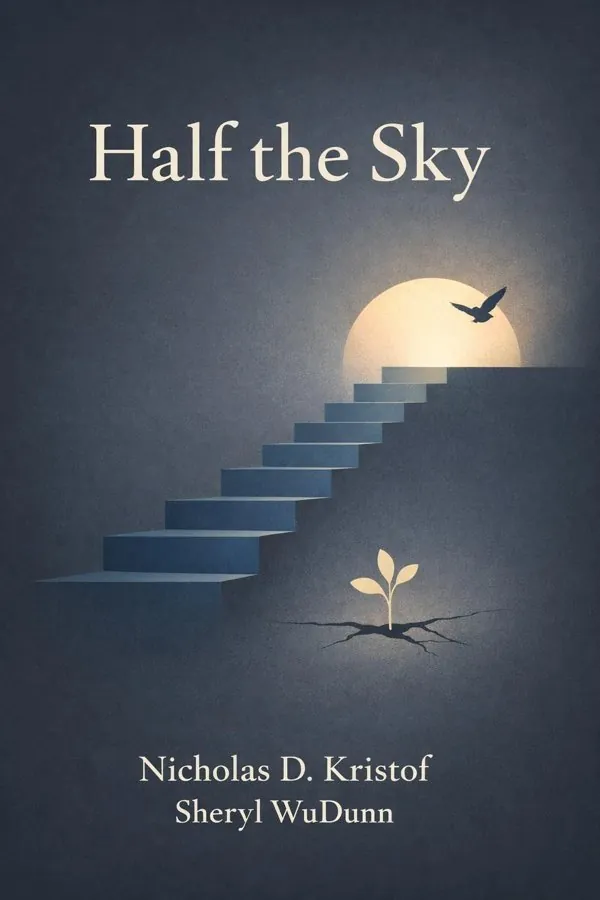
Half the Sky: Summary & Key Insights
by Nicholas D. Kristof, Sheryl WuDunn
 10 min9 chaptersAudio available
Key Takeaways from Half the Sky
One of the most transformative ideas in global development is surprisingly simple: when you invest in girls, you change the future of entire societies.
One of the most disturbing truths in Half the Sky is that slavery did not disappear; it changed form and became easier for many people to ignore.
Few injustices are as revealing as the deaths of women in pregnancy and childbirth from preventable causes.
Education does more than teach literacy; it changes what a person believes is possible.
Poverty is not just a shortage of money; it is a shortage of options.
What Is Half the Sky About?
Half the Sky by Nicholas D. Kristof, Sheryl WuDunn is a sociology book published in 2009 spanning 6 pages. Half the Sky is a powerful work of investigative journalism and moral argument that exposes one of the most pervasive injustices in the world: the systematic oppression of women and girls. In this landmark book, Nicholas D. Kristof and Sheryl WuDunn travel across Asia, Africa, and the developing world to document stories of sex trafficking, forced prostitution, maternal death, gender-based violence, and educational exclusion. Yet the book is not simply a catalog of suffering. Its deeper purpose is to show that when women gain access to education, healthcare, legal rights, and economic opportunity, entire families and communities rise with them. The result is both heartbreaking and deeply hopeful. What makes Half the Sky especially compelling is the authority of its authors. Kristof and WuDunn are Pulitzer Prize-winning journalists with decades of experience reporting on global inequality, conflict, and human rights. They combine data, policy insight, and unforgettable personal narratives to argue that gender equality is not a side issue in development, but one of the central moral and economic challenges of our time. The book matters because it turns distant statistics into human stories and then asks readers a difficult question: now that you know, what will you do?
This FizzRead summary covers all 9 key chapters of Half the Sky in approximately 10 minutes, distilling the most important ideas, arguments, and takeaways from Nicholas D. Kristof, Sheryl WuDunn's work. Also available as an audio summary and Key Quotes Podcast.
Half the Sky
Half the Sky is a powerful work of investigative journalism and moral argument that exposes one of the most pervasive injustices in the world: the systematic oppression of women and girls. In this landmark book, Nicholas D. Kristof and Sheryl WuDunn travel across Asia, Africa, and the developing world to document stories of sex trafficking, forced prostitution, maternal death, gender-based violence, and educational exclusion. Yet the book is not simply a catalog of suffering. Its deeper purpose is to show that when women gain access to education, healthcare, legal rights, and economic opportunity, entire families and communities rise with them. The result is both heartbreaking and deeply hopeful.
What makes Half the Sky especially compelling is the authority of its authors. Kristof and WuDunn are Pulitzer Prize-winning journalists with decades of experience reporting on global inequality, conflict, and human rights. They combine data, policy insight, and unforgettable personal narratives to argue that gender equality is not a side issue in development, but one of the central moral and economic challenges of our time. The book matters because it turns distant statistics into human stories and then asks readers a difficult question: now that you know, what will you do?
Who Should Read Half the Sky?
This book is perfect for anyone interested in sociology and looking to gain actionable insights in a short read. Whether you're a student, professional, or lifelong learner, the key ideas from Half the Sky by Nicholas D. Kristof, Sheryl WuDunn will help you think differently.
- ✓Readers who enjoy sociology and want practical takeaways
- ✓Professionals looking to apply new ideas to their work and life
- ✓Anyone who wants the core insights of Half the Sky in just 10 minutes
Want the full summary?
Get instant access to this book summary and 100K+ more with Fizz Moment.
Get Free SummaryAvailable on App Store • Free to download
Key Chapters
One of the most transformative ideas in global development is surprisingly simple: when you invest in girls, you change the future of entire societies. Half the Sky shows that adolescent girls are not merely a vulnerable population in need of rescue; they are among the most powerful agents of social and economic change. Educated girls marry later, have fewer and healthier children, earn more income, and are more likely to send the next generation to school. In other words, supporting girls creates a multiplier effect that benefits families, communities, and nations.
Kristof and WuDunn explain that this is not just a moral intuition but a pattern confirmed again and again across countries. A girl who stays in school is less likely to be trafficked, forced into early marriage, or trapped in extreme poverty. A woman with basic literacy and financial control often spends her income on food, healthcare, and education for her children. That means lower infant mortality, better nutrition, and stronger local economies. What may look like a small intervention—tuition support, a school uniform, a bicycle, a scholarship, sanitary supplies, or mentoring—can alter the path of a life.
The authors urge readers to see girls not as passive recipients of aid but as strategic investments in human potential. This changes how we think about charity, policy, and development spending. Instead of asking only how to relieve suffering today, we should ask how to unlock tomorrow’s capacity.
Actionable takeaway: Support organizations and policies that keep girls in school and protect their transition into adulthood, because few investments produce greater long-term returns.
One of the most disturbing truths in Half the Sky is that slavery did not disappear; it changed form and became easier for many people to ignore. The book’s reporting on sex trafficking in countries such as Cambodia reveals a brutal marketplace in which girls, often very young, are coerced, deceived, or sold into brothels and treated as disposable commodities. Kristof and WuDunn force readers to confront a painful reality: exploitation persists not only because of criminal networks, but because of corruption, indifference, poverty, and demand.
The authors make the issue concrete through the stories of individual girls whose lives are reduced to transactions. These narratives show that trafficking is not an isolated crime carried out by a few monsters. It is sustained by police who look away, legal systems that fail victims, families crushed by debt, and cultural norms that devalue female lives. Even rescue, the authors note, is not enough. Survivors need medical care, trauma support, safe housing, education, legal protection, and ways to earn a living. Without those supports, many are pushed back into exploitation.
A key contribution of the book is its insistence that trafficking should not be treated as an exotic foreign issue. It is a global human rights problem tied to migration, labor systems, weak institutions, and gender inequality. It demands a coordinated response: prevention, prosecution, survivor care, and social change.
Actionable takeaway: If you want to combat trafficking, support organizations that combine rescue with long-term rehabilitation and advocate for stronger legal accountability rather than symbolic outrage alone.
Few injustices are as revealing as the deaths of women in pregnancy and childbirth from preventable causes. Half the Sky argues that maternal mortality is not merely a medical issue; it is a measure of how little value some societies place on women’s lives. In many poor regions, women die from hemorrhage, obstructed labor, infection, or eclampsia because they lack basic prenatal care, skilled birth attendants, emergency transport, or access to simple medical interventions. These are often not rare or unavoidable tragedies. They are failures of priority.
Kristof and WuDunn show how routine and normalized this suffering has become in places where women are expected to bear risk silently. A woman may labor for days without help, or walk long distances while hemorrhaging because no clinic is nearby. Her death then leaves children motherless, households destabilized, and communities poorer. The social consequences extend far beyond the individual. Maternal health, the authors argue, is foundational public infrastructure.
The book also demonstrates that progress is possible. Training midwives, improving transportation, expanding prenatal screening, subsidizing basic obstetric care, and providing contraception can dramatically reduce deaths. These interventions are often inexpensive compared with their impact. Yet they require political will and public recognition that women’s health is not optional.
By linking maternal mortality to dignity, development, and equality, Half the Sky reframes a neglected issue as central to justice itself.
Actionable takeaway: Treat maternal health as a core development priority by supporting initiatives that expand skilled childbirth care, reproductive health services, and emergency obstetric access.
Education does more than teach literacy; it changes what a person believes is possible. In Half the Sky, education emerges as one of the most reliable tools for liberation because it expands not only knowledge but choice. A girl who can read contracts, understand health information, travel independently, and imagine a profession beyond domestic labor occupies a different social position from one who has been denied schooling. Education shifts power.
The authors show that the barriers keeping girls out of school are often ordinary and therefore overlooked: school fees, unsafe travel routes, cultural bias favoring boys, lack of toilets, menstruation stigma, child labor, and early marriage. None of these obstacles reflects a lack of ability. They reflect systems that subtly and persistently tell girls that their futures matter less. The tragedy is not just individual unrealized potential, but the cumulative loss to communities that sideline half their talent.
Kristof and WuDunn also emphasize that education protects in practical ways. Girls who remain in school are less likely to be trafficked, more likely to delay marriage, and better equipped to advocate for themselves. Educated women tend to have healthier children and stronger earning power. The classroom, in that sense, becomes a frontline defense against exploitation.
Importantly, the book rejects the idea that education alone solves everything. Schooling must be paired with safety, healthcare, and opportunity. But without education, many other interventions cannot take root.
Actionable takeaway: Support efforts that remove the practical barriers to girls’ schooling—fees, transportation, sanitation, uniforms, and community resistance—because access often depends on solving small but decisive problems.
Poverty is not just a shortage of money; it is a shortage of options. Half the Sky makes a strong case that economic empowerment is one of the most durable ways to change women’s lives because income can translate into bargaining power, mobility, safety, and self-respect. When women can earn, save, borrow, or own assets, they often gain a voice in family decisions and a greater ability to leave abusive situations or resist exploitation.
Kristof and WuDunn explore how microfinance, vocational training, entrepreneurship, and job access can help women build independent lives. A small loan may allow a woman to buy livestock, open a food stall, or start a tailoring business. These shifts can seem modest from the outside, but they matter profoundly when a woman previously had no control over resources. The ability to generate income may help her educate her children, obtain healthcare, or avoid selling a daughter into desperate arrangements.
The authors are careful, however, not to romanticize economic solutions. Microcredit is not magic, and markets can exploit as well as liberate. Some women face predatory lenders, abusive employers, or social backlash for earning outside the home. Real empowerment requires more than access to capital; it also requires legal rights, social acceptance, education, and protection from violence.
Still, the central point stands: development works better when women are treated as producers and decision-makers, not merely dependents. Economic agency strengthens every other pathway out of oppression.
Actionable takeaway: Favor programs that combine women’s income opportunities with training, legal support, and community education so that economic gains translate into genuine autonomy.
One of the boldest arguments in Half the Sky is that harmful practices should not be excused simply because they are embedded in tradition. The authors challenge a common tendency among outsiders to treat gender violence, forced marriage, honor-based abuse, or systematic exclusion as culturally sensitive issues best left untouched. Respect for cultural difference matters, but it cannot become a moral shield for cruelty.
Kristof and WuDunn show that oppressive norms are neither timeless nor universally accepted within the communities where they operate. In nearly every setting, there are local reformers—teachers, mothers, doctors, activists, religious leaders, and survivors—who are already challenging injustice. This matters because it rejects the simplistic idea that change must come from the West imposing values on others. More often, lasting transformation comes from local people gaining allies, resources, and visibility.
The book also asks readers to examine double standards. Societies often denounce foreign abuses while normalizing their own forms of sexism. Gender oppression can look different across contexts, but the underlying pattern is recognizable: women’s bodies, labor, and choices are controlled for the benefit of others. Naming that pattern is not cultural arrogance; it is moral clarity.
By confronting relativism, the authors defend a universal principle: women and girls are entitled to safety, dignity, education, and autonomy regardless of where they live.
Actionable takeaway: When evaluating harmful practices, listen to local women leading reform and support their efforts rather than hiding behind cultural relativism or assuming silence equals consent.
A striking lesson from Half the Sky is that some of the most effective solutions are not grand geopolitical plans but targeted, practical interventions. The book repeatedly shows how relatively low-cost actions—antibiotics, mosquito nets, fistula surgery, scholarships, clean birth supplies, deworming medicine, or safe shelters—can produce life-changing results. This is both encouraging and unsettling. Encouraging because progress is possible; unsettling because so much suffering continues despite the availability of solutions.
Kristof and WuDunn argue that readers often feel paralyzed by global injustice because the problems seem too vast. But the scale of the issue should not obscure the precision of many remedies. A safe house can protect trafficking survivors. A bicycle can enable school attendance. A trained birth attendant can prevent maternal death. A tiny grant can launch a business. A village education campaign can reduce child marriage. These examples remind us that effective humanitarian action often depends on understanding local needs and designing modest but smart responses.
The authors do not claim every intervention works equally well, and they acknowledge the need for accountability. Good intentions are not enough. But they strongly reject fatalism. If one intervention fails, that is a reason to improve evidence and execution, not to retreat into cynicism.
This practical spirit gives the book much of its energy. It invites readers to move from sympathy to problem-solving.
Actionable takeaway: Choose one specific issue—education, maternal health, anti-trafficking, or women’s livelihoods—and support evidence-based programs with measurable outcomes rather than vague charitable sentiment.
Statistics can inform us, but stories compel us. One reason Half the Sky had such broad impact is that it refuses to let systemic injustice remain abstract. Kristof and WuDunn use the stories of individual women and girls to make readers feel the human weight behind terms like trafficking, maternal mortality, and gender discrimination. A single survivor’s voice can expose the cruelty of an entire system more vividly than pages of data alone.
This is not merely a literary choice; it is a moral strategy. Public attention often depends on emotional connection, and many crises affecting women have historically been ignored because they happen in private spaces or distant regions. By telling stories of courage, pain, and resilience, the authors make hidden suffering visible to readers who might otherwise never engage with it. At the same time, they avoid reducing women to victims alone. Many of the book’s most memorable figures are fighters, organizers, caregivers, and entrepreneurs whose strength challenges simplistic narratives of helplessness.
The book also demonstrates the responsibility that comes with storytelling. Personal narratives must illuminate structural causes rather than become isolated tragedies. Kristof and WuDunn largely use stories to point outward—to law, custom, economics, and health systems—so that readers understand that individual suffering is socially produced.
This approach helps bridge the gap between empathy and action. Once people can picture a life, they are more likely to care about policy, funding, and reform.
Actionable takeaway: When trying to raise awareness about injustice, pair credible data with human stories that preserve dignity and connect individual experience to larger systems.
Half the Sky ultimately argues that awareness is not enough. To know about preventable suffering and do nothing is its own kind of moral failure. The authors call readers to become what might be called engaged witnesses: people who refuse indifference, educate themselves, support effective organizations, pressure institutions, and use whatever influence they have to widen the circle of concern. This is the book’s final challenge and its most demanding one.
Kristof and WuDunn resist the comforting idea that gender oppression is too complex for ordinary people to address. They acknowledge that governments, legal systems, and international agencies matter enormously, but they also insist that citizens matter. Donations can fund schools and clinics. Advocacy can shift public priorities. Consumer pressure can influence business practices. Journalism can expose abuse. Voting can shape foreign aid and human rights policy. Mentorship and local volunteering can strengthen women’s opportunities close to home.
What gives this call credibility is the authors’ emphasis on realism. They do not promise quick victories or pure solutions. Some efforts fail. Some changes are painfully slow. But the alternative—detached pessimism—serves only the status quo. Progress has always depended on people deciding that distant injustice is also their business.
The book closes not in despair but in responsibility. If oppression is human-made, then it can be human-changed.
Actionable takeaway: Turn concern into commitment by choosing one concrete form of engagement—donating, advocating, reading further, volunteering, or amplifying credible organizations—and sustain it over time.
All Chapters in Half the Sky
About the Authors
Nicholas D. Kristof and Sheryl WuDunn are Pulitzer Prize-winning journalists and bestselling authors known for their work on global inequality, human rights, and social justice. Kristof built a distinguished career at The New York Times as a foreign correspondent and columnist, reporting on war, poverty, and humanitarian crises around the world. WuDunn, who also worked at The New York Times, has combined journalism with leadership roles in business and public policy. Together, they were the first married couple to win a Pulitzer Prize for journalism. Their collaborative work is widely recognized for blending rigorous reporting with moral urgency and accessible storytelling. In Half the Sky, they draw on decades of international reporting to illuminate the systemic oppression of women and to advocate for practical, evidence-based paths toward empowerment and change.
Get This Summary in Your Preferred Format
Read or listen to the Half the Sky summary by Nicholas D. Kristof, Sheryl WuDunn anytime, anywhere. FizzRead offers multiple formats so you can learn on your terms — all free.
Available formats: App · Audio · PDF · EPUB — All included free with FizzRead
Download Half the Sky PDF and EPUB Summary
Key Quotes from Half the Sky
“One of the most transformative ideas in global development is surprisingly simple: when you invest in girls, you change the future of entire societies.”
“One of the most disturbing truths in Half the Sky is that slavery did not disappear; it changed form and became easier for many people to ignore.”
“Few injustices are as revealing as the deaths of women in pregnancy and childbirth from preventable causes.”
“Education does more than teach literacy; it changes what a person believes is possible.”
“Poverty is not just a shortage of money; it is a shortage of options.”
Frequently Asked Questions about Half the Sky
Half the Sky by Nicholas D. Kristof, Sheryl WuDunn is a sociology book that explores key ideas across 9 chapters. Half the Sky is a powerful work of investigative journalism and moral argument that exposes one of the most pervasive injustices in the world: the systematic oppression of women and girls. In this landmark book, Nicholas D. Kristof and Sheryl WuDunn travel across Asia, Africa, and the developing world to document stories of sex trafficking, forced prostitution, maternal death, gender-based violence, and educational exclusion. Yet the book is not simply a catalog of suffering. Its deeper purpose is to show that when women gain access to education, healthcare, legal rights, and economic opportunity, entire families and communities rise with them. The result is both heartbreaking and deeply hopeful. What makes Half the Sky especially compelling is the authority of its authors. Kristof and WuDunn are Pulitzer Prize-winning journalists with decades of experience reporting on global inequality, conflict, and human rights. They combine data, policy insight, and unforgettable personal narratives to argue that gender equality is not a side issue in development, but one of the central moral and economic challenges of our time. The book matters because it turns distant statistics into human stories and then asks readers a difficult question: now that you know, what will you do?
You Might Also Like
Between the World and Me
Ta-Nehisi Coates
10 min
Men Explain Things To Me
Rebecca Solnit
10 min
Rational Ritual
Michael Suk-Young Chwe
10 min
The New Jim Crow
Michelle Alexander
10 min
Beyond Culture
Edward T. Hall
10 min
Invisible Women: Exposing Data Bias in a World Designed for Men
Caroline Criado Perez
10 minFeatured In
Browse by Category
Ready to read Half the Sky?
Get the full summary and 100K+ more books with Fizz Moment.